Several people advised Nixon just to burn the Watergate tapes. Looking back after he left office, Nixon concluded that the “lesson of Watergate” is “burn the tapes.”
From the perspective of Mango Mussolini, the least bad alternative for him would be to have a bonfire on the White House lawn and burn all the Epstein files. It would be a terrible alternative for him, but it would nevertheless be the least bad alternative for him.
Right now, he’s just flailing—bleating random bullshit and throwing spaghetti at the wall.
The two news articles are from this afternoon. The Chait opinion piece is from this morning.
So, here’s my top list of things I’d like to know.
I’d like to see the whole 2003 Epstein birthday book. By the way, someone almost surely has the original. Who has it, how can we get it, whose messages does it contain, and what do the messages say? (And if, perchance, the original has been misplaced, there are bound to be copies of the book.)
There are said to be thousands of pages of investigative files. Do those thousands of pages enlighten us about who, if anyone, other than Jeffrey and Ghislaine were using the girls? And, were there blackmail materials on these other people, if there were other people? Was blackmail being paid, and, if so, by whom?
And was Trump among the customers, assuming there were any customers? (The FBI, we are told, has had a host of minions examine the files, marking references to Trump. What kind of work product did the minions produce? Just lists of references to specific documents and pages? Annotated lists? Memos? How can we get the work product, and what will we learn from it?)
In advance of knowing these things, I would like to know why, if Trump is not as guilty as homemade sin, why he is acting as if he were as guilty as homemade sin. Like a guilty thing surprised.
Jonathan Chait would like to know these things, too. He writes,
Imagine you were an elected official who discovered that an old friend had been running a sex-trafficking operation without your knowledge. You’d probably try very hard to make your innocence in the matter clear. You’d demand full transparency and answer any questions about your own involvement straightforwardly.
Donald Trump’s behavior regarding the Jeffrey Epstein case is … not that.
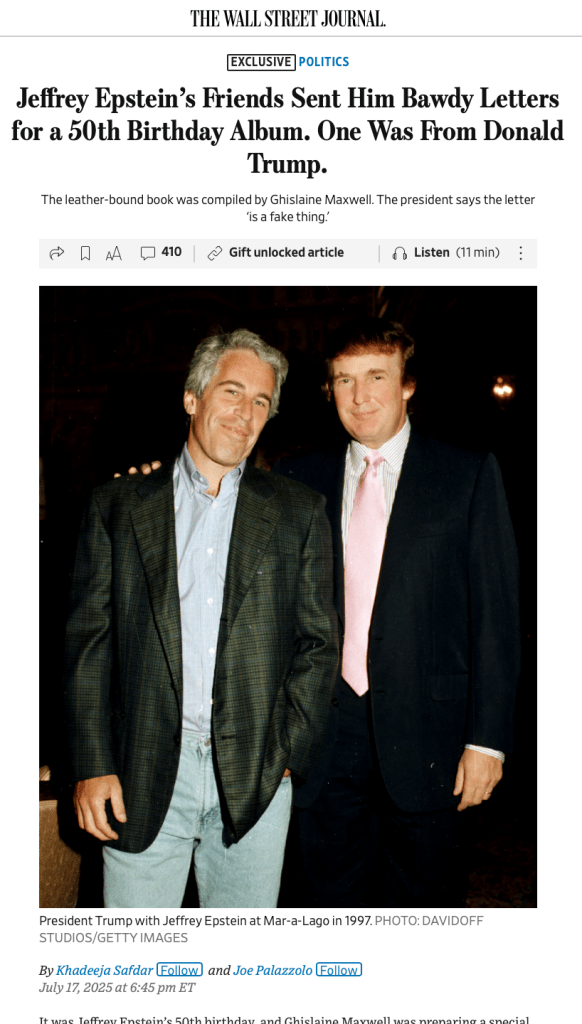
The latest cycle of frantic evasions began last week, after TheWall Street Journalreportedthat Trump had submitted a suggestive message and drawing to a scrapbook celebrating Jeffrey Epstein’s 50th birthday, in 2003. This fact alone added only incrementally to the public understanding of the two men’s friendship. Rather than brush the report off, however, Trump denied authorship. “I never wrote a picture in my life,” he told the Journal—an oddly narrow defense for a man reported to have written “may every day be another wonderful secret” to a criminal whose secret was systematically abusing girls, and one that was instantly falsified by Trump’s well-documented penchant for doodling.
On Truth Social, Trump complained that he had asked Rupert Murdoch, the Journal’s owner, to spike the story, and received an encouraging answer, only for the story to run. Under normal circumstances, a president confessing that he tried to kill an incriminating report would amount to a major scandal. But Trump has so deeply internalized his own critique of the media, according to which any organ beyond his control is “fake news,” that he believed the episode reflected badly on Murdoch’s ethics rather than his own.
Having failed to prevent the article from being published, Trump shifted into distraction mode. In a transparent attempt to offer his wavering loyalists the scent of fresh meat, Trump began to attack their standby list of enemies. On Friday, Tulsi Gabbard, the director of national intelligence, renewed charges that the Obama administration had ginned up the Russia scandal to damage Trump. None of the facts she provided supported this claim remotely. The entire sleight of hand relied on conflating the question of whether Russia had hacked into voting machines (the Obama administration said publicly and privately it hadn’t) with the very different question of whether Russia had attempted to influence voters by hacking and leaking Democratic emails (which the Obama administration, former Special Counsel Robert Mueller, and a subsequent bipartisan Senate-committee investigation all concluded it had done).
Why did Gabbard suddenly pick this moment to release and misconstrue 2016 intelligence comprising facts that the Obama administration had already acknowledged in public? Trump made the answer perfectly clear when he used a press availability with the president of the Philippines to deflect questions about Epstein into a rant about the need to arrest Obama.
“I don’t really follow that too much,” he said of the Epstein matter. “It’s sort of a witch hunt. Just a continuation of the witch hunt. The witch hunt you should be talking about is that they caught President Obama absolutely cold.” Trump has yet to specify why the “witch hunt” he’s been stewing over nonstop for nearly a decade remains fascinating, while the new “witch hunt” he just revealed to the world is too tedious to address.
In fact, Trump himself suggested that the two matters were related. He described the Epstein witch hunt as part of a continuous plot that culminated in Joe Biden stealing the 2020 presidential election. (“And by the way, it morphed into the 2020 race. And the 2020 race was rigged.”) You might think that this link would increase Trump’s curiosity about the Epstein matter, given his inexhaustible interest in vindicating his claim to have won in 2020. Not this time!
By invoking 2020, Trump managed to make the Epstein conspiracy theory sound moreworld-historically important—while attaching his protestations of innocence to claims that were hardly settled in his favor. Again, imagine you were in Trump’s position and were completely innocent of any involvement with Epstein’s crimes. You would probably not try to compare the Epstein case to the scandal in which eight of your associates were sentenced to prison, or to the other time when you tried to steal an election and then got impeached. Instead, Trump is leaning into the parallels between the Epstein case and his own long record of criminal associations and proven lies, arguing in essence that the Epstein witch hunt is as fake as the claim that Biden won the 2020 election (i.e., 100 percent real). …
Perhaps Trump is simply so habituated to lying that he has no playbook for handling a matter in which he has nothing to hide. Or maybe, as seems more plausible by the day, he is acting guilty because he is.
I was writing this post in my head when the Wall Street Journal served up this treat today at dinner time.
Donald Trump is, and has been for a long time, a bully, a liar, a con man, and a sociopath. Now he is something else as well—a doddering old fool. Whatever coherence his ramblings once had is disappearing fast. That said, one can construct something out of his disjointed utterings.
When Trump says that Thing X is a “hoax,” he means that
Thing X actually occurred or is now occurring, and that
Public knowledge about Thing X would reflect very badly on him—worse even than public knowledge that he routinely grabbed adult women by their genitalia, and bragged about this behavior.
I won’t regurgitate the whole sordid business. But it seems clear beyond peradventure of doubt that Trump is in the voluminous Epstein investigatory files, and that he is drenched in flop sweat.
To address this predicament, Trump now wants everyone to believe that Epstein was not in fact a pedophile; that he should not have been prosecuted (during Trump’s first administration) because Epstein did nothing wrong; and—by implication—that Epstein’s lover and co-conspirator, now in jail, did nothing wrong either; and that these wrongful prosecutions were the result of evil Democrats, just like the January 6 prosecutions.
To this end, Trump will cast James Comey’s daughter and career federal prosecutor, Maureen Comey, as chief villainess in the purportedly unjust prosecution of Jeffrey Epstein and Ghislaine Maxwell. That’s why he fired her yesterday.
From Team Trump’s perspective, firing Ms. Comey was a very bad idea.
As a former corporate advisor, I always told people to be careful about firing unsatisfactory employees who had dirt on you.
Firing Ms. Comey is mistake number 796. She has dirt on Trump.
Meanwhile, In Late Evening Developments
Trump says he is suing the Wall Street Journal, and all its corporate uncles, cousins, and aunts, for publishing the Epstein birthday letter.
It is widely reported that MAGA influencers—trying to play both ends against the middle—are asserting that the WSJ story about the birthday letter is fake news.
And Trump says he’s ordered the Justice Department to go to court to seek public disclosure of grand jury materials relating to Epstein.
I’m Sorry, but to Understand Anything About What’s Going On, You Need to Know a Little Something About Preliminary Injunctions
Smith sues Jones, and asks the court for a preliminary injunction, claiming that Jones is quickly, and illegally, creating “facts on the ground” that cannot easily be reversed after a final decision finally arrives. How does the court decide whether to grant the preliminary injunction? Answer: by trying to answer four specific questions:
1. Which side is more likely to win the case, on the facts and the law?
2. If there is no injunction, and if the plaintiff, Smith, ultimately wins the case, can Smith still get justice, for example, by collecting damages? Or are Jones’s current actions doing harm to Smith that is “irreparable”?
3. If Smith is going to suffer “irreparable harm,” is that harm nevertheless outweighed by the harm that Jones will suffer if the court forbids acts that may ultimately be found to be lawful?
4. Apart from Smith’s interests, and apart from Jones’s interests, what is the public interest?
Whenever a legal rule requires a court to pour a bunch of factors into a pot, stir them around, and then see what the resulting brew tastes like, the process is likely to be somewhat messy and somewhat unpredictable. That said, most lawyers understand that the first factor—we call it “likelihood of success on the merits”—tends to be dispositive.
Trump v. American Federation of Government Employees
In this case, decided a week ago, eight of the nine justices joined in a short opinion saying that the government employees union should not get a preliminary injunction, because it was unlikely, at the end of the day, to prevail on its claim that Team Trump was illegally planning to fire lots of workers. I wrote about the case last week.
McMahon v. New York
The McMahon Supreme Court ruling came a few days later, on Monday of this week. As in the American Federation case, the Court ruled for Team Trump. (The case was about whether mass firings at the Department of Education could continue, while the courts were dealing with the case on the merits.) Unlike the American Federation case, this was a 6 to 3 decision, not an 8 to 1 decision. And, unlike the American Federation case, the majority offered no explanation whatsoever about how it applied the four factor test, and about why it reached the result that it reached.
In many quarters, McMahon engendered a noisy wailing and gnashing of teeth, and a call for all law-abiding citizens to rend their garments and dress in sackcloth and ashes—because the Supreme Court has gone over to Darth Vader.
They may be right. But my view is that the catastrophists are a little premature. I shaved with Occam’s razor this morning, and Occam and I both submit that, having explained their reasoning in the union case, the majority probably acted differently in McMahon because there were not six justices who were willing to say in black and white that they thought the government would be proven right on the merits.
And, if Occam and I are speculating correctly, the assumed caution is a reason for cautious optimism. And the assumed caution would be fully justified. Certainly, as to the massive government firings, there is one hell of a lot of litigation yet to come.
Justice Sotomayor’s Dissent in McMahon (Joined by the Other Two Liberals)
I promised a friend that I would reproduce the dissent. So here it is.
I had already written this post in my mind before I read the Politico story, published about an hour ago.
Trump Has Scored a Famous Victory Over the MAGA Influencers. Or Has He?
Today, the talking heads are talking nonstop about how Trump seams to have beat the Epstein conspiracist MAGA influencers into submission—and how they’re singing a different tune from the one they sung on Friday, Saturday, Sunday, and part of Monday.
And whether or not Trump’s effort to tell his base to forget about Epstein will work or not.
The answer is that it all depends. It depends on whether the lunatic part of our American brethren and sistern will choose to believe Trump or whether they will choose to believe what they have believed about the pedophile ring coverup for the past decade. And a basement full of trafficked children in a Washington pizza restaurant that doesn’t have a basement.
That’s because the term “influencer” is inaccurate and misleading. The MAGA influencers don’t really influence. What they are good at spouting back to their listeners and viewers what their listeners and viewers want to hear.
As I would have said back when I was practicing antitrust law and relying on forensic microeconomists, the influencer competition for market share is fierce, the market is dynamic, and entry is easy. Just video yourself on your smartphone, post the video on YouTube, and start making money.
Given the market structure, given the incentives, and given the Zeitgeist, it is inevitable that some would-be influencers are going to come along spouting the theory that the pedophile ring has got to Trump and that he has gone over to the dark side.
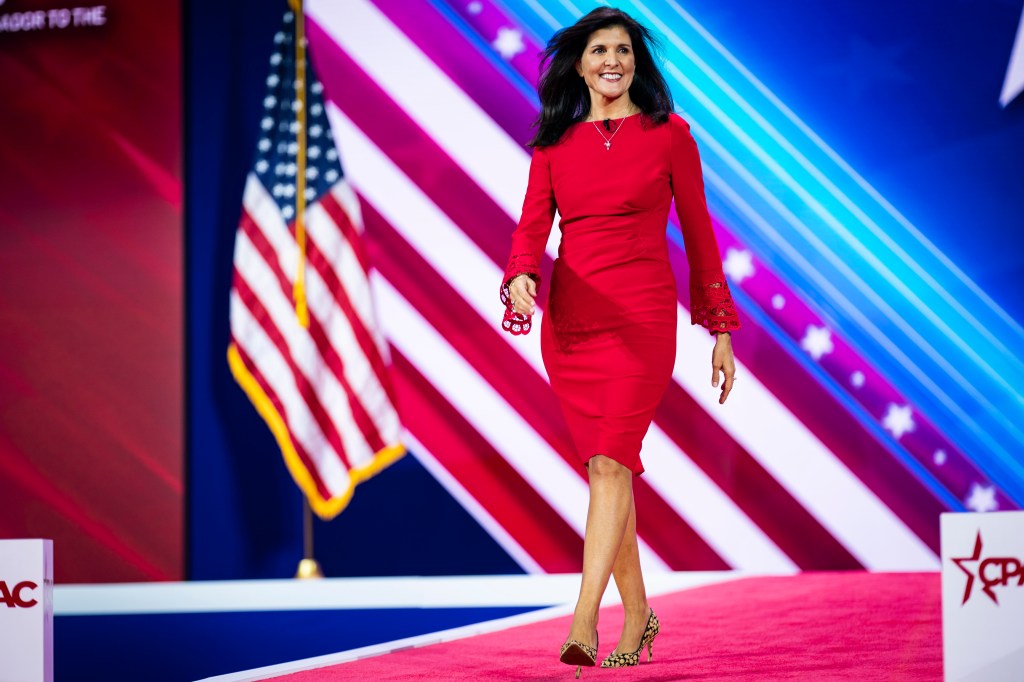
I didn’t predict—though I should have predicted—that Nikki Haley would be among the first to stride across the stage in her high heels and begin the competition to sell alternative conspiracy theories.
Others will follow. Many others.
Game on. Now it’s up to the base to see which competing conspiracy appeals to their deformed, paranoid minds.
The U.S. Justice Department normally employs about ten thousand lawyers. When you fire all the competent ones and replace them with hacks who were lucky to survive the first week of law school, this is what you get.
 Facing MAGA