
Cancel Culture
The Death and Life of Democracy
The main discussion begins at 6:45 of the video.
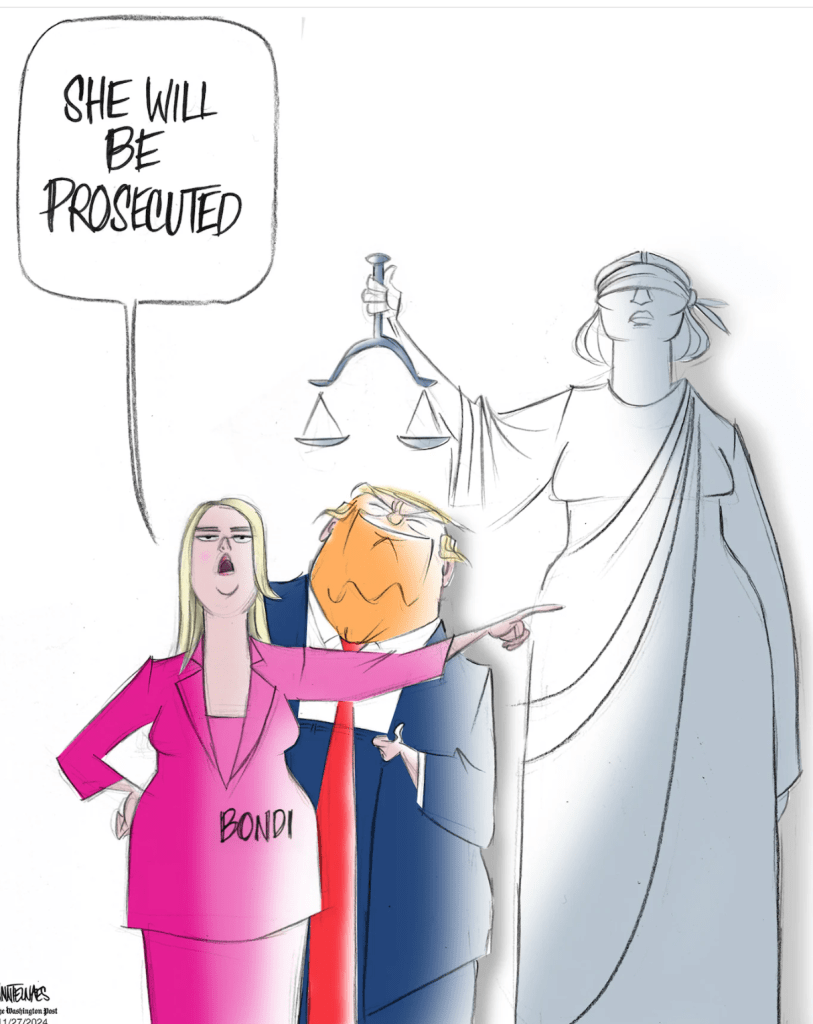
In a Country Riven by Polarization, There is Astonishing Bipartisan Consensus That Pam Bondi is a Moron
The Guardian writes,
US attorney general Pam Bondi’s pledge that the Trump administration will “absolutely target” people who use “hate speech” in the wake of the killing of conservative activist Charlie Kirk has prompted criticism of the idea from across the political spectrum, including from prominent conservatives.
Bondi said on a podcast hosted by Katie Miller, the wife of the rightwing White House deputy chief of staff Stephen Miller, that there is “free speech and then there’s hate speech, and there is no place, especially now, especially after what happened to Charlie, in our society”.
Legal experts and conservative pundits have condemned the comments because there is no “hate speech” exception in the first amendment right to speech and as such, targeting people for their charged rhetoric would be unconstitutional.
There is no unprotected category of speech in the constitution or in the case law called ‘hate speech’,” said Heidi Kitrosser, a Northwestern University law professor. “By being so vague and by talking about speech that doesn’t fit into any legal category, she is basically opening the door for taking action against anyone who engages in speech that the president or the Department of Justice or Stephen Miller doesn’t like.”
Kirk, the founder of the powerful rightwing youth activist group Turning Point and a close ally of Donald Trump, was killed on 10 September at Utah Valley University during one of his signature events in which he debated students.
The murder was part of a wave of political violence in the United States, including attempted assassinations of the US president and the assassination of Melissa Hortman, the Democratic speaker of the Minnesota House of Representatives, and her husband.
While some people on both sides of the aisle have spoken about the need for respectful dialogue, Trump and others in his administration have continued to largely blame the violence on the left and warned of a “vast domestic terror movement” prompting fears he plans a broad crackdown on his political opponents.
JD Vance guest-hosted Kirk’s podcast this week, during which the vice-president urged people to call the employers of people celebrating Kirk’s murder and said that the administration would “work to dismantle the institutions that promote violence and terrorism in our own country”.
When asked about Bondi’s comments on Tuesday, Trump told an ABC News reporter: “We’ll probably go after people like you because you treat me so unfairly. It’s hate. You have a lot of hate in your heart. Maybe they’ll come after ABC.”
Bondi also threatened to prosecute an Office Depot employee who reportedly refused to print flyers for a vigil for Kirk.
But people on the right who normally strongly support Trump have condemned Bondi’s comments and called for her ouster.
Conservative pundit Matt Walsh, who said after Kirk’s death: “We are up against demonic forces from the pit of Hell,” posted on Twitter/X of Bondi: “Get rid of her. Today. This is insane. Conservatives have fought for decades for the right to refuse service to anyone. We won that fight. Now Pam Bondi wants to roll it all back for no reason.”
Erick Erickson, a conservative commentator, also wrote on X: “Our Attorney General is apparently a moron. ‘There’s free speech and then there is hate speech.’ No ma’am. That is not the law.”
And Savanah Hernandez, a commentator with Turning Point, described those words from Bondi as “most destructive phrase that has ever been uttered … She needs to be removed as attorney general now.”
Commentators also pointed to Kirk’s own comments from 2024 concerning the idea of hate speech.
“Hate speech does not exist legally in America. There’s ugly speech. There’s gross speech. There’s evil speech,” Kirk wrote. “And ALL of it is protected by the First Amendment. Keep America free.”
Bondi’s talk of targeting people who use “hate speech” is not legal because the “first amendment creates very, very strong protections from punishment for speech that’s offensive or for speech with which people disagree. The bar for punishing speech based on content, and especially based on viewpoint, is extremely, extremely high,” Northwestern’s Kitrosser said.
Following the backlash, Bondi, who already faced calls to resign for how she handled files related to sex trafficker Jeffrey Epstein, appeared to try to walk back her comments on Tuesday.
“Freedom of speech is sacred in our country, and we will never impede upon that right,” Bondi said in a statement to Axios. “My intention was to speak about threats of violence that individuals incite against others.”
Kitrosser, however, said she remained “very concerned as to how broadly they are going to define what is an illegal threat and as to what other loopholes they may try to carve out from existing free speech case law”.
She added: “I think that we all need to remain very vigilant.”
I Join with J.D. Vance in Opposing Political Violence
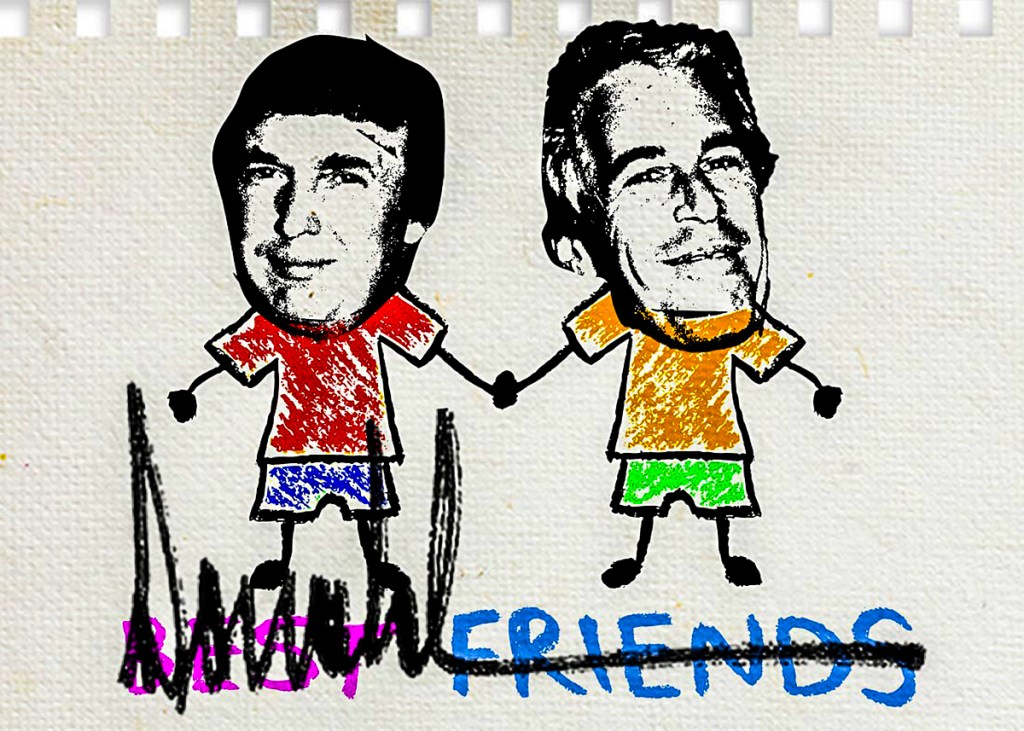
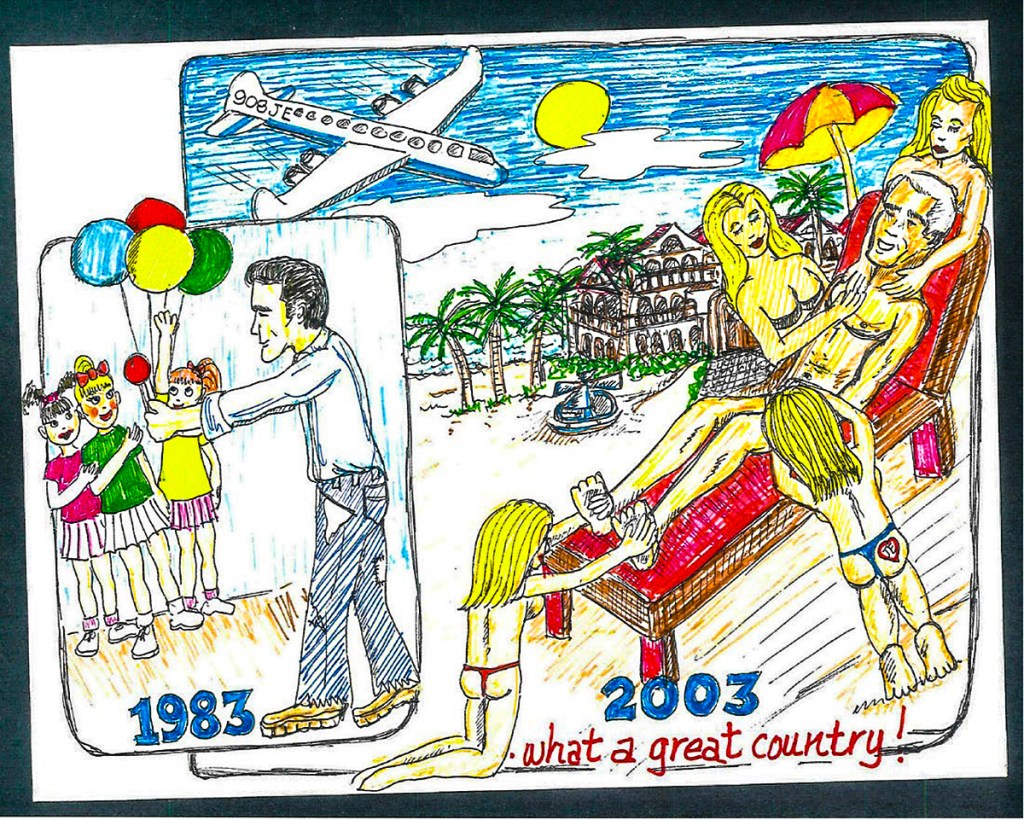
From the Epstein Birthday Book: Fully Depreciated, Sold to Donald Trump for $22,500.



It is good to learn countless skills.
Ed Luce: Trump’s “Genius is to Keep Pushing the Democrats Into a Reactive Defence of the Status Quo”
Ed Luce of the Financial Times writes,
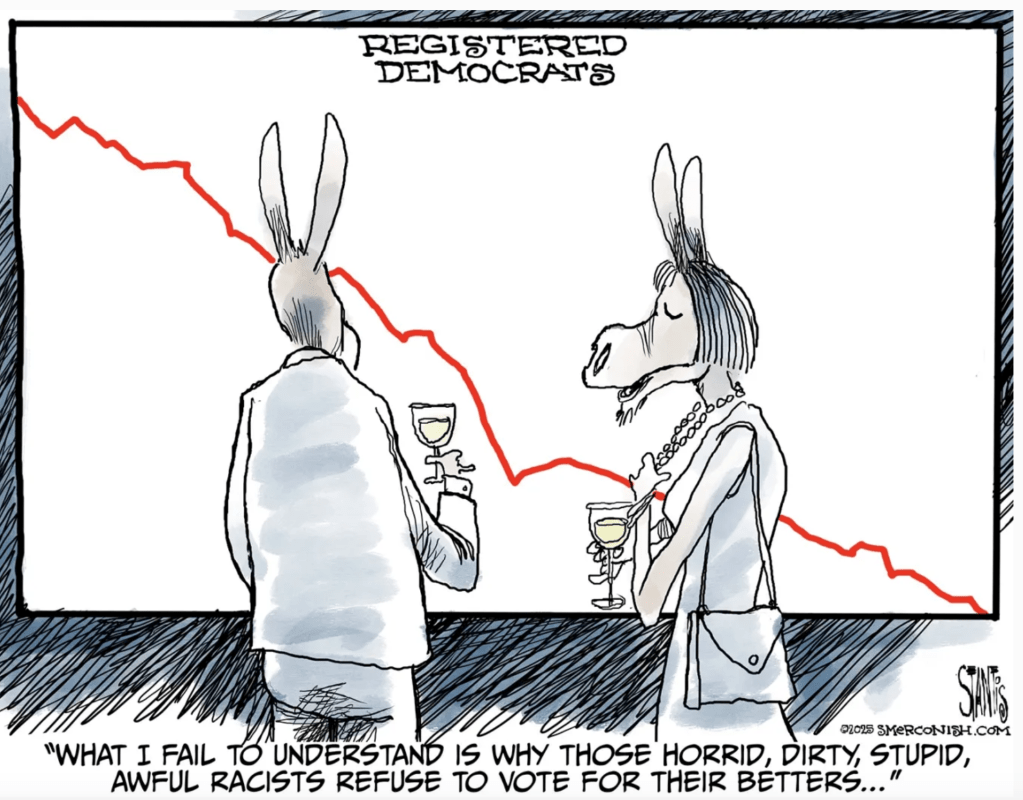
America has a conservative establishment. Its formal name is the Democratic party. Whether it be the federal government, universities, welfare or the regulatory state, Democrats fight to preserve the world as it is or was. “America is already great,” liberals cry, which is another way of saying that things were fine until Donald Trump came along. Their lodestar was Joe Biden, who personified nostalgia. Much of the party is now nostalgic for Biden. You have to be imprisoned in old ways of thinking to believe this is how US liberalism will rebound.
An invigorated US opposition would now be making hay. Trump’s team maintains a “promises kept” tally sheet. To be sure, he has in effect closed the border, demolished DEI quota culture, assaulted the deep state and launched trade wars against the rest of the world. But a big chunk of those who voted for Maga saw these moves as the means of lifting their economic prospects. The opposite is happening, which is why Trump’s numbers are in steady decline. Yet the fall in Democrats’ approval rating is even steeper. In relative terms, Trump’s political dominance has thus grown. Do not bet on a weakening economy changing that picture.
Trump’s genius is to keep pushing Democrats into reactive conservatism. That, plus the average age of the party’s leadership, makes Democrats look like permanently outraged grandparents. Trump’s assaults on pretty much every constitutional norm are indeed terrifying and outrageous. But they are remarkably inoculated against political backlash. To all intents and purposes, opposition to Trump has been reduced to a default outrage machine.
What is the solution? Democrats are a party of America’s professional elites plus various interest groups. And given that Trump won a majority of blue-collar voters, they are no longer the natural home of the working class. Any Democratic recovery would thus start by grappling with the latter’s worldview. The practical difficulty is that the party is shaped by elite professions, particularly law, government, media and academia. Such types often have a hard time concealing their distaste for those who voted for Trump. This is a poor starting point.
Democrats also face a deeper philosophical problem. Nobody knows how to reinvent 20th-century liberalism. In the US that was Franklin D Roosevelt’s 1930s New Deal, with updates over the next couple of generations. FDR built that world with “bold persistent experimentation”. His would-be heirs are stuck in a timid, persistent conservatism. They do not “welcome the hatred” of financial and business monopolists as Roosevelt did. They are the party of corporate America. No party in history could ever boast of so many expert fundraisers and humane philanthropists.
Lack of fresh ideas and cloistered demography are definitions of conservatism. If Trump did not exist, would Democrats want to reform the US administrative state? They should want to reinvent it but are now its militant defenders. A system that is so riddled with veto points that it takes years to execute simple projects and requires a PhD to navigate the tax system does not deserve to be defended. The same goes for a housing market that has priced younger voters out of the American dream and elite universities that are biased towards the children of alumni and donors. If Trump is attacking something, it must be defended to the hilt.
That Trump’s actions are destructive is no excuse. As political scientist Ruy Teixeira recently warned, Democrats are placing their chips on the “fool’s gold of midterm success”. Rather than seeking ways of reinventing a system in which America has lost faith, Democrats are betting on Trump’s defeat in next year’s congressional elections. The odds are that Republicans will lose the House of Representatives in 2026 and retain control of the Senate. Such midterm success would be a pyrrhic victory for Democrats. Biden based his 2024 re-election bid on his party’s relative success in the 2022 midterms. Look where that led.
A second piece of fool’s gold is to wait for Trumpism to die out with Trump. Even assuming that he does not launch a coup in 2028, Democrats would be unwise to think their problem will end with Trump. Familiarity with other democracies — Britain’s clueless Labour party, Germany’s moribund Social Democrats, France’s withered Socialists — shows that there is nothing unique to American populism.
The challenge for Democrats is to do what they should be doing were Trump not to exist. His superpower is to stop them from reaching that epiphany.
Explaining the Inexplicable: Some Further Observations

This follows up on the immediately preceding post.
So here’s some food for thought. Most major corporate CEOs have a corporate jet, and they have a pilot for that corporate jet. What qualities would a CEO look for in a pilot?
Would they want a person who cannot accurately acquire and process information about the weather?
Would they want to hire a pilot who does not understand the relation between his actions and the consequences of his actions?
Would they like a pilot who, when she makes a mistake, belligerently hallucinates falsehoods to explain away the facts—like some out-of-control chatbot, powered by runaway Artificial UnIntelligence?
Would the CEO want a person suffering from malignant narcissism—imagining himself to be the best pilot in the country, indeed, the best pilot who has ever lived, so capable that flying his jet through a hurricane is no cause for concern?
If the answer to these questions is no—and the answer surely is no—then why would the same corporate CEO be happy to hire a pilot for the nation who suffers from the same mental handicaps?
The Answer to My Rhetorical Question
The views of the Financial Times opinion writer are insightful, but let me add this.
We are talking about Fortune 500 CEOs, whose average compensation runs to about $17 million a year. A lot of these folks are not addicted to heroin, but they are addicted to money.
Just as a heroin-addicted paterfamilias will take the children’s milk money to spend it on a drug, so also a money-addicted person will optimize money making over considerations of common sense, not to mention considerations of empathy or morality.
Compare Joe Sixpack. Joe Sixpack didn’t go to college, but, still, he should have known enough to conclude that it was unwise to reelect Trump. When Joe Sixpack gets hurt by the tariffs and by the inflation resulting from mass deportation, he will be getting no more and no less than he deserves. I hope Joe learns from the terrible lesson he’s about to receive.
All that said, the greater responsibility falls on our country’s economic and intellectual elite.
Well and truly has it been noted that a fish rots from the head down.
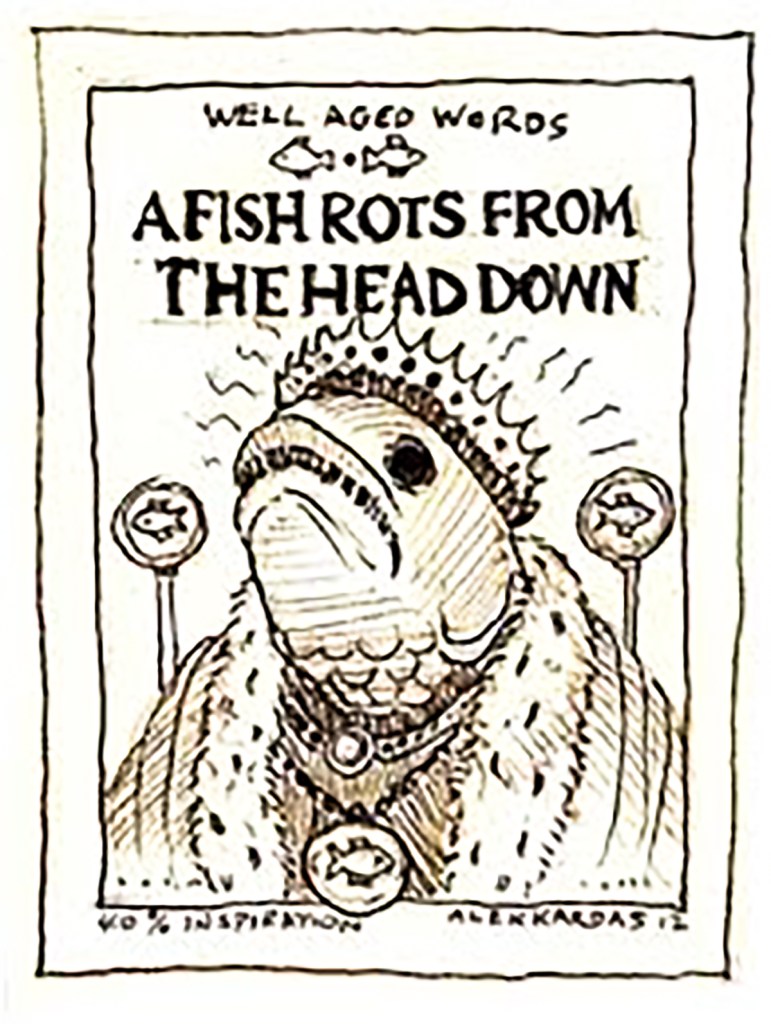
The Financial Times Explains the Inexplicable

Gillian Tett (Financial Times), The psychology of CEO loyalty to Trump: C-suites are conspicuously silent in the face of the president’s policy surprises:
A couple of weeks ago, a story emerged in Washington that was likely to make any chief executive officer shudder: according to Axios, the White House has created a secret “loyalty rating” chart ranking 553 companies and business groups on whether they display “low”, “moderate” or “strong” support for the policies enshrined in Donald Trump’s “big, beautiful” budget bill.
Initially, Trump’s team did not comment on the story, although the White House has since confirmed that the scorecard — on which groups such as Delta, Door Dash and Uber are reportedly rated highly — does exist.
But what is perhaps most notable in all this is the lack of any visible business reaction. After all, using “loyalty rankings” as a basis for policy dealings is certainly not an American norm; on the contrary, it seems to underscore that the administration has scant respect for the concept of a universal “rule of law”.
That should worry any business. So should the uncertainty about Trump’s tariff policies,deportations and regulatory upheaval. But few executives have criticised the president in public so far, even as constitutional lawyers howl. And when I recently participated in different private roundtables with executives and investors, there was little private criticism either. Fealty and silence is the new norm.
Why? If I were to put America’s C-suite on the metaphorical couch right now, I would point to at least five factors. The first — and most obvious — is fear and greed: CEOs are terrified of incurring Trump’s wrath if they oppose him, and most seem convinced they can arbitrage his policies to their own advantage, due to deregulation and/or their links with the White House. This is why “loyalty lists” matter.
A second factor is partisan politics. According to Gallup, just 1 per cent of Democrats approve of Trump’s job performance, while 93 per cent of Republicans do — equalling the biggest split since this survey started in 1979. Since business leaders skew Republican, and tend to dislike progressive politicians such as Alexandria Ocasio-Cortez, this split matters.
In addition, there are three other more subtle, and less noticed, factors at work too. One is that it seems that Trump’s “shocking” policies are starting to lose their ability to shock the C-suite quite as much as before.
Blame this, if you like, on the fact that we are now in Trump’s second term, and on a widespread embrace of the “Taco” thesis — that the US president always chickens out of his wildest threats. Moreover, business leaders have faced a series of once-unimaginable shocks in recent years, including the global financial crisis, the Covid-19 pandemic and Russia’s full-scale invasion of Ukraine. So CEO cognitive resilience has grown — and perhaps complacency has too.
A fourth factor is “animal spirits”, to cite John Maynard Keynes. Economists have always assumed that if businesses expressed public optimism, investors would feel the same. This still holds true: the fact American companies are currently beating earnings forecasts has helped to propel stocks to record highs.
However, the causality is now also working in reverse: it is hard for any corporate leader to express alarm about the outlook, or criticism of Trump, when markets seem so giddily exuberant. A form of crowd psychology is at work that few CEOs dare defy.
Last but not least, there is the issue of artificial intelligence. A host of executives and investors seem to love Trump’s policies on AI, most notably because he is deregulating it under the mantra of boosting growth — an idea that appeals to American executives increasingly scornful of what they see as Europe’s low-growth, regulation-heavy model.
However, there is another implication of the AI boom: it is enabling CEOs to talk to their investors about business uncertainty without ever needing to mention Trump’s name at all.
More bluntly, AI is the ultimate distraction device for the C-suite, since it is now absorbing so much executive headspace and public airtime that there is less space to think about other issues, such as the uglier side of Trump’s policies. It gobbles up bandwidth, literally and metaphorically.
Now, I daresay there will be readers who might disagree with this five-part explanation. Some business leaders genuinely love Trump’s policies, and think they will unleash long-term growth.
But if you think this five-part frame is even halfway accurate, then the key thing to ponder is whether anything might cause the psychology to change. If markets tumble, AI becomes less distracting or tariffs crush earnings, could there be a backlash? Or if Europe recovers, might that take the shine off Trump?
Right now, we don’t know. But what is clear is that it is a fool’s errand to think American CEOs will spark an anti-Trump rebellion anytime soon. That White House “loyalty list” has already done its job.
This is America, Where You Can Do Anything with Your Body Unless There is a Uterus in It

Alexandra Petri, writing in The Atlantic:
Florida Decided There Were Too Many Children: The state’s elimination of vaccine mandates is a courageous first step toward decluttering itself of any excess kids.
Sorry. We decided there were too many children.
You know how it goes.
Their hands are too small. Sometimes they are sticky, and no one knows why. They say they’re eating their dinner, but you can see that they are just pushing it around on their plate. They come up to you on the sidewalk and tell you their whole life story for 10 minutes, wearing face paint from a birthday party three days ago. Some afternoons they announce that they are sharks, but they are obviously not sharks. They do this over and over again.
And the state of Florida, understandably, said: Enough. This needs to stop. We have decided that there are too many children, and we can let some of them go. Or, as the state’s surgeon general put it when he eliminated all vaccine mandates yesterday: “Who am I as a government or anyone else, who am I as a man standing here now, to tell you what you should put in your body? Who am I to tell you what your child should put in [their] body? I don’t have that right.”
(That relaxed attitude about bodily autonomy comes as something of a surprise, given the state’s six-week abortion ban, but this is America, where you can do anything with your body unless there’s a uterus in it.)
Florida is the first state to take the courageous step toward decluttering itself of excess children, but under the inexpert guidance of Robert F. Kennedy Jr., other states may follow. If we lose herd immunity, we will bring back diseases that had formerly been eliminated, and some children who would otherwise have been protected will perish. But no price is too high to pay in this pointless war against decades of lifesaving science. Confusingly, this effort is being taken up at the same time that people are Very Concerned about dropping birth rates, but it makes sense when you understand that they don’t like the children we currently have. They want us to make other ones instead.
This is certainly one possible response to the epidemic of mass shootings: unleash another epidemic on our elementary schools. If I had to guess what kind of shot we would make sure schoolchildren got, I would have guessed wrong. I am always guessing wrong. I am always guessing that we want children to live.
 Facing MAGA