With clear eyes, hard facts, critical thinking, new political strategy, empathy, and a soupçon of Schadenfreude
Category: Situational Awareness
Posts about the situation we are in–the good facts, the bad facts, and the terrible facts. Facts that, if taken on board, will let us “know ourselves, know the other side” and go on to win those hundred battles.
I have been asked for a summary of how law firms responded to Trump’s threats.
There appear to be two indices.
One tracks the “AmLaw 200”—the top 200 firms, as determined by the American Lawyer. It’s found here. The 200 law firms are listed in order of their gross worldwide revenues. But, to give additional context, the rightmost column gives information on each firm’s average profit per equity partner. For example, a firm with a very large number of lawyers may rank high in gross income but lower in profit per average partner.
This first index is called the “Biglaw Spine Index,” a demonstrates the correlation between high revenue and profits and willingness to capitulate.
Another comprehensive index, prepared by Georgetown Law students, will be found here.
Meanwhile, over 800 law firms are said to have signed on to amicus briefs like this one in the lawsuit brought by WilmerHale.
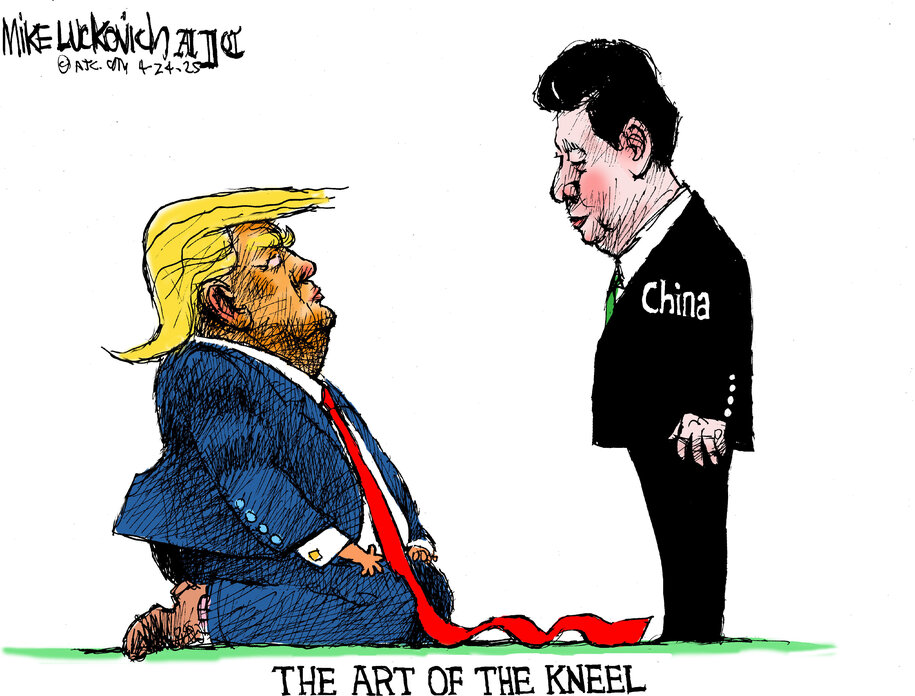
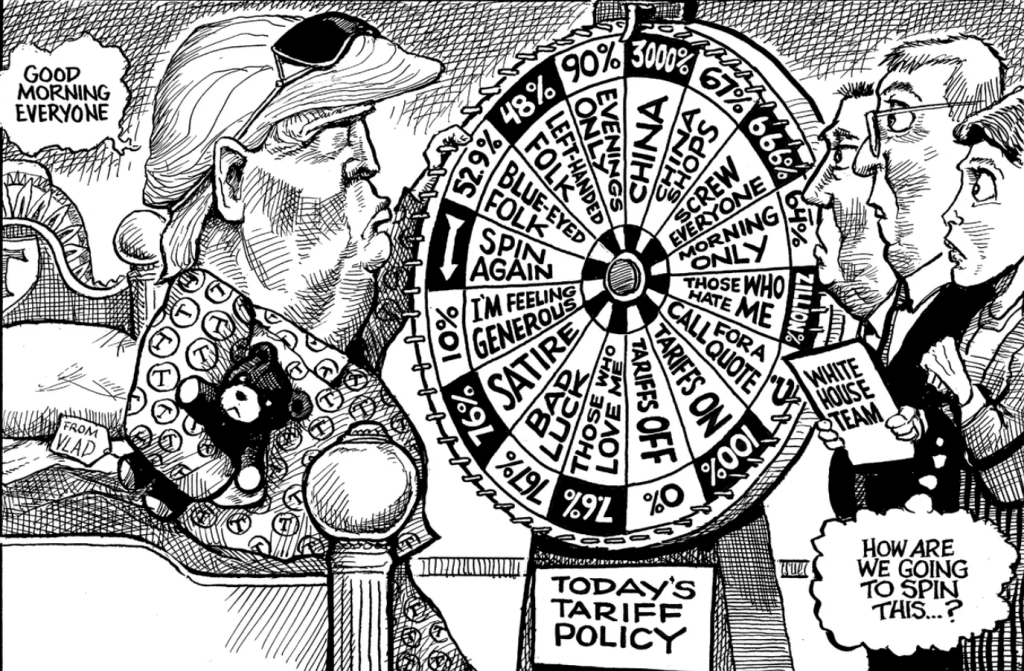
President Donald Trump said Friday that the United States could lower tariffs on China to 80 percent [instead of 145 percent] ahead of a meeting this weekend between his top aides and their counterparts from Beijing. …
The president’s apparent eagerness to get a deal reflects the mounting economic damage from the tariffs he has imposed thus far. China said its exports to the United States dropped 21 percent in April from a year before, and economists have forecast an increased likelihood of a U.S. recession. White House officials have grown alarmed by Chinese curbs on exports of rare earth minerals, used to make military drones, consumer electronics, electric cars and other important products.
When big law firms attacked by President Trump decided to make a deal with him rather than fight, many did so because their leaders feared that clients would abandon a firm caught on the administration’s bad side.
Now that logic may be getting less compelling. A major company, Microsoft, has dropped a law firm that settled with the administration in favor of one that is fighting it. …
On April 22, several attorneys at the law firm Simpson Thacher & Bartlett informed the Delaware Court of Chancery that they would no longer be representing Microsoft in a case related to the company’s 2023 acquisition of the video game giant Activision Blizzard, according to court filings.
Simpson Thacher reached a deal with the White House last month in which the firm committed to perform $125 million in free legal work for causes acceptable to the Trump administration. In a joint statement with other firms making similar agreements, Simpson Thacher said the pro bono work would be on behalf of “a wide range of underserved populations.”
On the same day that the Simpson Thacher lawyers filed paperwork withdrawing from the Microsoft case, at least three partners at the firm Jenner & Block informed the court that they would be representing Microsoft in the case. Jenner is fighting in court to permanently block a Trump administration executive order targeting its business. …
In some cases, a client may worry that a law firm that has reached a deal with the White House has a conflict of interest that prevents it from aggressively representing the client. For example, the client may be a defendant in a lawsuit brought by the federal government and worry that a settling law firm would be reluctant to stand up to the administration.
Other clients may have broader concerns. A senior partner at another firm that does not have an agreement with the White House said his firm was beginning to attract clients from firms that had settled with the administration. The partner, who was not authorized to discuss client matters publicly, said prospective clients had indicated that they had lost confidence in settling firms for not standing up to an attack on the rule of law.
Some firms challenging the administration have sought to capitalize on this frustration, suggesting that their pushback reflects a commitment to fight on behalf of their clients as well.
The window of opportunity that allowed President Trump to overwhelm his adversaries with an onslaught of executive orders dismantling core American institutions is closing.
How does a stymied autocrat deal with defeat? As the opposition gains strength, frustrating the nation’s commander in chief, how will Trump respond?
It is unthinkable to imagine him graciously acknowledging defeat, changing direction and moving on.
Will he claim victory in defeat? Will he try to provoke his adversaries into violence in order to invoke the Insurrection Act?
Trump’s unpredictability makes it impossible to answer these questions with any certainty, but as his actions in the first three months of his second term demonstrate, Trump’s choices veer to the extreme. …
If, in the face of adversity, Trump and his allies attempt to overturn democracy, what are their chances? I asked Herbert Kitschelt, a professor of international relations at Duke and the 2025 recipient of the prestigious Johan Skytte Prize in political science, that question, and he provided a nuanced reply by email: “No scientific, evidence-based investigation can currently provide a factually grounded prognosis” on “whether and how Trump and the Christian evangelical-nationalist-Southern wing of the Republican Party might break the democratic Constitution of the United States,” he wrote.
Instead, Kitschelt argued, it is possible to “outline the forces that may impinge on whether this process will take place or not.”
Kitschelt then specified the four factors working in favor of the establishment of “an authoritarian coalition in the United States”:
U.S. technological innovativeness and productivity gains — more so than in other advanced capitalist countries — have generated anxiety among many occupational groups.
The U.S. has a weak welfare state — in terms of pensions, health care, unemployment insurance, aid to families with children, public education — when compared to just about any other advanced capitalist country.
America is the most inegalitarian advanced Western country, in terms of income and wealth. That induces rich people to promote politicians who distract the economically worse off from questions of economic distribution and focus their attention on issues of political governance, culture war, racial and ethnic hierarchies and nationalist claims to global supremacy.
Unlike any other Western democracy, America has a deeply antidemocratic, intolerant, illiberal religious strand.
Kitschelt went on to describe conditions in the United States that “are adverse to the victory of an authoritarian coalition” and are, in contrast, favorable to democracy:
America’s civil society: If it awakens from its current shock and slumber, signs of which are already emerging, it is likely that it will become a powerful force to uphold democracy.
Most importantly: American capitalism, large segments of the U.S. business class, whether in finance, I.T. and A.I., U.S. manufacturers in global production chains (vehicles, aerospace, pharma, etc.) and U.S. culture industries are averse to a MAGA & Tea Party authoritarian coalition. Populism undercuts property rights and the rule of law, rendering it impossible to make rational, profit-generating, long-term business investments.
A severe economic crisis, which Kitschelt believes is probable, given current trends, would sharply undermine Republican prospects in the 2026 congressional elections, which might prompt Trump and his allies to “realize that they cannot win a free and fair election and actually might face a defeat in the midterms severe enough to precipitate the impeachment of both president and vice president.”
The question then becomes, in Kitschelt’s view:
Will evangelical-nationalist clero-fascism — with other MAGA and Tea Party currents in tow — be capable of converting America into an electoral autocracy faster than U.S. civil society and large parts of the business sector will be able to mobilize a defense of American democracy and to stiffen the spine of the U.S. judiciary to preserve American institutions?
First, if anyone has forgotten or doesn’t know, I’d like to provide a brief reminder about who George Conway is. To put this in context: YouTube serves up a lot of legal commentators. Many of them have some relevant experience and some good points to make. But, in my opinion, Conway stands out as a Very Series Person. He is a graduate of Harvard College and Yale Law School, and, for 26 years, was a litigation partner of Wachtell, Lipson, Rosen & Katz, the richest law firm in the United States. Why did he leave? It’s not clear, but my speculation is that he had as much money as he needed for the rest of his life, and wanted to be a champion for the rule of law.
Conway understands exactly what is going on. And he has the capacity to explain what’s going on.
And here’s the second random point—the question of why Legal Team Trump are acting like a bunch of menacing clowns, as detailed in the video.
They have already been smacked down by the Supreme Court. And, as sure as God made little green apples, they are headed straight for a full on, definitive, rebuke by the Court.
Actually, lots and lots of rebukes—in the immigration cases, the law firm cases, the education cases, all as discussed in the video.
So … what the hell is Legal Team Trump’s game plan? Once, rebuked, to back down and look like idiots?
Or … to tell the Supreme Court to go to hell. But if THAT’s their plan, then why not stand on “principle” now, and just tell the lower courts that they “lack jurisdiction” or are “acting illegally”? That would be a bad plan—but not merely as bad as the menacing clown show That Legal Team Trump is staging now.
There is an answer to that question. They are acting like menacing clowns because they are fifth rate minds. And, of course, because they have to please His Most High Excellency on TV every day. In now way, have they thought through where all their tomfoolery is going to lead. In no way, do they know how to deal rationally with the likely consequences of their actions.
In short, the Trump legal shit show is entirely of a piece with the shit show in pretty much all other aspects of government. See Dana Milbank (Washington Post), For the Trump administration, it’s amateur hour