
Sleet Well Tonight: An Ignoramus and a Fool is in Charge of Homeland Security
N.Y. Times, Noem Incorrectly Defines Habeas Corpus as the President’s Right to Deport People:
At a Senate hearing, Senator Maggie Hassan, Democrat of New Hampshire, asked Ms. Noem about the issue. “Secretary Noem,” she asked, “what is habeas corpus?”
“Well,” Ms. Noem said, “habeas corpus is a constitutional right that the president has to be able to remove people from this country and suspend their right to—”
“No,” Ms. Hassan interjected. “Let me stop you, ma’am. Excuse me, that’s incorrect.”
Ms. Noem’s answer, which echoed the Trump administration’s expansive view of presidential power, flipped the legal right on its head, turning a constitutional shield against unlawful detention into broad presidential authority.
The United States and China: Reflections on Prof. O’Neill’s Analysis
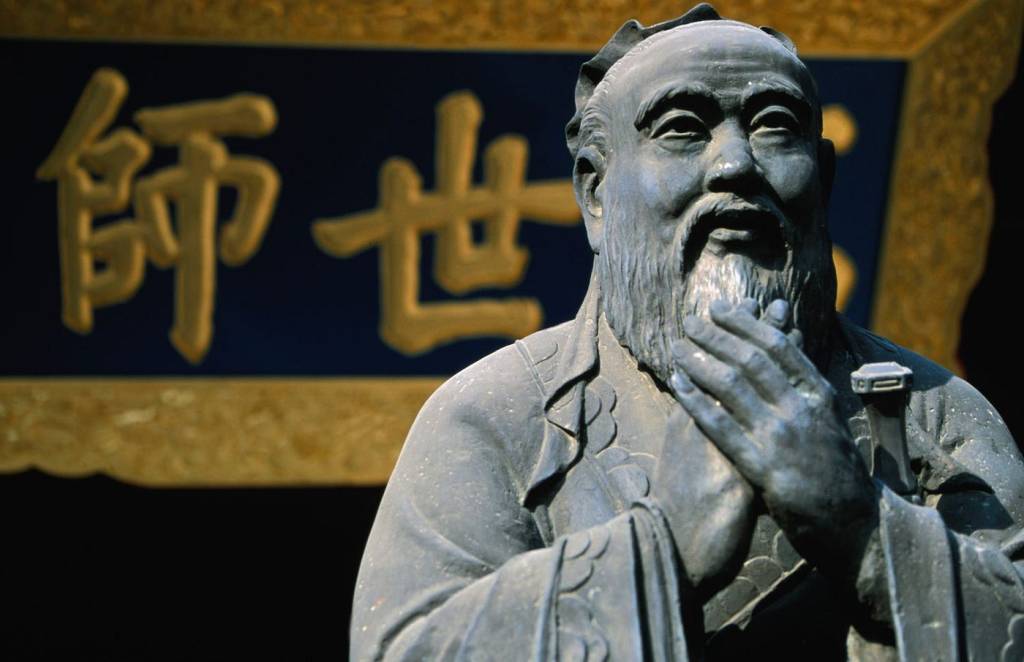
Relying on the fair use doctrine of copyright law, the immediately preceding post reproduces what, in my opinion, is an outstanding analysis of the nature of competition between China and the United States. Here are a few additional thoughts of my own.
They’re All Confucians
Throw a stone at the Politburo and you will not hit a Communist, you will instead hit a Confucian. That’s because they are all Confucians.
And what does it mean when I say that the Chinese political elite is uniformly Confucian? Mainly, it means two things. It means that the elite believes, down to the marrow of their bones, that the mass of common people—the lao bai xing—are morally and intellectually incapable of self-government.
The common people must be led. But by whom? By a moral and intellectual elite, who can guide society and government along the right path.
Confucianism became the state ideology of China in 136 BCE—the guiding framework for government, law, education, and social ethics. 2161 years later, Confucianism remains the state ideology of China.
These folks are never going to abandon Confucius and Mencius in favor of John Locke and James Madison. That’s not happening. And anyone who ever thought it was happening, or might happen, or would happen: that person does not know China.
Are You Saying, Then, That We Should Become Confucians, Too?
No, I’m not. But I am saying that our political elite and our economic elite badly needs to try to transform themselves into our intellectual and moral elite as well.
We need to be better Lockeans and Madisonians, and we need to draw our inspiration from Luke 12:48, remembering that where much is given, much is required.
And for the non-elites? They badly need to relearn how to be educated and responsible citizens of a democracy. And morally responsible folks among the elite need to do what they can to help. We could begin by restoring civics education to its rightful place in elementary and secondary schools.
Because if our political life keeps on consisting of performative nonsense, and if the American law bai xingkeep on getting their news from Russian propaganda they read on Facebook then Professor O’Neill tells us exactly where we are headed.
The United States and China: A Brilliant Analysis by a Retired CIA Executive and Current Georgia Tech Professor

Brian O’Neill (Atlanta Journal-Constitution), The China threat was always real. The American response never was: U.S. policy is reactive and performative, but China is disciplined, coordinated and strategically patient:
For decades, the United States engaged China less as it was and more as we imagined it could become. First as student, then partner and, eventually, reformer-in-waiting. We projected hopes of gradual liberalization — that exposure to global markets and Western institutions would, over time, turn China into a stakeholder in the U.S.-led order. In doing so, we cast ourselves as mentor and China as an ambitious apprentice.
It was our own geopolitical version of the Anakin Skywalker arc: We believed the student would follow the teacher’s path — until it became clear he had been blazing one of his own.
China was never waiting to be converted. It was never benign, and never blindly adversarial, either. It was a rising power studying the architecture of U.S. influence and quietly learning to apply the same tools: capital, leverage, alliances and time. The failure wasn’t that China changed. It’s that our assessment was always flawed.
We have not been outpaced by Beijing because it outmaneuvered us in some decisive moment. We’ve been falling behind for years — through bipartisan neglect, overreliance on market forces and the illusion that rhetorical consensus equaled strategic clarity.
Then-President Barack Obama bet on patient integration. President Donald Trump in his first term veered into impulsive confrontation. Neither built the foundation for enduring competition.
The Biden administration began to shift U.S. policy — reviving industrial policy through the CHIPS Act, the Inflation Reduction Act, and targeted investments in supply chains and green technology. But it was cautious, fragile and poorly explained to the public. No enduring doctrine was built around it. No political infrastructure was assembled to protect it. As a result, the effort proved vulnerable — reversible with a change of administration. And under Trump, that reversal came fast.
Trump’s impulsively imposed tariffs — framed as a necessary reckoning with China but levied broadly against 57 trading partners — became the clearest symbol of America’s collapse of strategic direction.
China was hit hard, but the real exposure was our own: a reactive, chaotic policy disconnected from any coherent plan for competing with Beijing or sustaining global leadership.
China, by contrast, achieved what we never organized: alignment between ambition and execution. It mapped where the global economy was headed, subsidized the industries that would define it and embedded itself in the infrastructure of other nations’ development. We warned about dependence. China constructed it.
While we rehearse cliches about China’s long game, Beijing continues to make the cliché true — by matching ambition with execution.
Beijing doesn’t win by being perfect. It wins by being consistent. It declares a goal, funds it, adapts along the way and recalibrates its institutions to deliver. It doesn’t always succeed. But it has internalized a lesson we’ve discarded: Long-term strength is built through continuity, coordination and patience.
China can direct capital to a strategic sector without waiting for a committee markup. It can fund five-year initiatives to dominate electric vehicle manufacturing or become indispensable in solar panel supply chains. Its leadership doesn’t worry about a change in control of the legislature halfway through an investment cycle. It mandates. It finances. It builds.
We announce initiatives, hold press events and promise resilience — while designing policies that expire with the next election.
The danger isn’t just that this administration pursues a strategy of grievance instead of a strategy of victory; it’s that we have allowed our politics to unlearn how to build at all.
Our weakness lies not in a single leader or party, but in a political culture that treats governance as performance and strategic patience as surrender. If we continue on this path, it won’t be because China outsmarted us. It will be because we dismantled the architecture of American strength ourselves — and did so without even bothering to notice.
Some will argue this is uniquely Trumpian. It’s not. The inability to turn bipartisan agreement into coherent strategy predates him. His second term hasn’t caused the collapse; it has exposed how hollow the structure already was.
When it mattered, we didn’t rebuild manufacturing. We didn’t reinforce the global structures we had built. We didn’t finalize a trade alternative to Belt and Road — China’s massive program of building ports, railways, and infrastructure across Asia, Africa and beyond. Efforts such as the Trans-Pacific Partnership never developed into a credible economic counterweight.
We didn’t redefine what global leadership should mean once the liberal order began to stall. Instead, we kept reacting — and mistaking performance for resilience.
On May 12, Trump walked backed his most extreme tariffs — not as part of a strategic recalibration, but under pressure, in exchange for a 90-day cooling-off period. The announcement, hailed as a breakthrough, masks what it really is: a negotiated timeout between two governments whose underlying strategies remain unchanged. Beijing, steady and methodical. Washington, reactive and performative.
Even if some semblance of a stable trade deal is eventually secured, the damage to America’s economic statesmanship is done. The lost trust, the stalled investment cycles, and the strategic drift of the past decade have already left scars that won’t be easily reversed.
China, too, will suffer costs. But it is structured for recovery — disciplined, coordinated, strategically patient. The United States is not. When the dust settles, Beijing will still have a plan. We will still be arguing over who to blame.
If America wants to compete, it doesn’t need another round of punitive measures. It needs a memory of how it used to build — and a political class willing to stop setting fire to the scaffolding of national strength just to prove they were here.
We don’t need to become China. But we do need to stop sabotaging ourselves.
U.S. influence isn’t lost; but it will need to be earned back. After World War II, we led the reconstruction of devastated allies through the Marshall Plan — not only to rebuild Europe, but to cement a democratic order rooted in trust and shared purpose. Today, that trust has eroded. Restoring it will require a new kind of reconstruction — not of cities, but of alliances. We must show our partners that American leadership still values cooperation over coercion and is willing to share influence, not hoard it.
Rebuilding strength also requires letting go of magical thinking. Tariffs, slogans and industrial nostalgia won’t outcompete China. Long-term leverage demands reinvestment in education, manufacturing, energy and research — protected from partisan sabotage and “short-termism.”
And we must stop pretending this is a second Cold War. China is a rival, not a monolith. We will compete — often bitterly — but on AI governance, climate stability, trade norms and crisis response, the world cannot afford economic decoupling. Managed interdependence, rooted in verifiable standards and shared risk, is the only way to prevent lasting fracture.
Finally, both political parties must stop mistaking partisan theatrics for strategy. Democrats cannot wait for a favorable electoral map in 2026 or 2028. They must begin governing through influence now — by articulating serious proposals on industrial renewal, alliance repair and global standard-setting.
Republicans, meanwhile, must accept that tariffs and televised bravado are not strategy — they are delayed tactics. They must offer a governing framework, not culture war sound bites. Congress cannot reverse course alone, but it can reassert relevance and slow the damage.
The next president won’t shape the rivalry. They’ll inherit its terms. And if we continue on this path, China won’t need to defeat us. We’ll have finished the job ourselves.
Brian O’Neill is a retired CIA executive who has served in such leadership roles as deputy director of analysis at the National Counterterrorism Center and as executive editor of the President’s Daily Brief. He now teaches national security at Georgia Tech and contributes to the journal “Just Security” and other outlets.
At This Point, He’s Just Flinging Poo at the Walls

But if Walmart doesn’t pass on the tariffs, then China loses no sales because of the tariffs. And U.S. manufacturers who compete with Chinese-made goods gain no advantage from the tariffs.
The only thing that has happened is that Walmart owners suffer an economic loss. There is no economic loss to China or its exporters. And there is no enhanced incentive to “on-shore” American manufacturing. Which was the original stated goal of the tariffs.
Trump and Big Law: The Current State of Play

The immediately preceding post gave links to sources that summarize how major law firms have reacted to Trump’s nonsense. Here, using FAQs, I give an account of the current state of play.
Among the law firms that have been targeted by Trumps, how many have sued, and how are the lawsuits going to date?
On March 6, Trump issued an executive order against Perkins Coie—“Where Innovation Meets Infrastructure”—because he was butt hurt that the firm had previously represented Hillary Clinton. Five days later, on March 11, the law firm sued. On May 2, less than two months later, the district judge issued a 100+ page order permanently enjoining Trump from carrying out his threats.
Presumably, Team Trump will appeal the decision, but that has not happened as of this writing.
Why did the district judge in the Perkins Coie case reach a final decision in record time?
Because Team Trump had no cognizable defense.
Or, as we used to say back in New York, their only argument is the so-you-caught-me defense.
What about the other law firm lawsuits?
WilmerHale filed its case on March 28, and procured a preliminary injunction—not a permanent injunction—on April 24. Team Trump can still appeal the PI ruling, if it so chooses, or it may decide to wait until the decision on a permanent injunction.
Jenner & Block also filed on March 28. Judge Howell, the judge in the Perkins Coie case, rejected Jenner’s attempt to get the case assigned to her as a “related case.” The lawsuit was then bounced to Judge Bates, who granted a temporary restraining order the same day.
Fast footwork, that.
There was a hearing on April 28 on Jenner’s request for a final ruling it its favor, but the judge has not yet issued his decision. Presumably, he is writing his opinion—with due attention to the 100+ page ruling in the Perkins Coie litigation.
Meanwhile, a temporary restraining order against Trump remains in effect.
Susman Godfrey was the last of the four, filing its complaint on April 11. A temporary restraining order was entered and remains in effect. On May 8, Judge AliKhan held a hearing on the question whether Team Trump should be enjoined permanently, but no decision has been released as of this writing. However, back on April 15 when he issued the TRO, the judge described Trump’s action against the Susman firm as a misuse of presidential authority and a “shocking abuse of power.”
This would be a clue about how the good judge is likely to rule.
Apart from the four law firms that have sued Team Trump, which other firms have been targeted by punitive executive orders?
In alphabetical order they are:
- Covington & Burling
- Elias Law Group
- Milbank
- Paul, Weiss, Rifkind Wharton & Garrison
- Skadden, Arps, Slate, Meagher & Flom
- Willkie Farr & Gallagher
Have all of these firms reached “deals” with Trump?
No. Covington and Elias have not. Milbank, Paul, Weiss, Skadden, and Willkie all have capitulated.
Have other big law firms bowed down under the mere threat of a punitive executive order?
Yes, indeed. In alphabetical order they are:
- Allan Overy Shearman Sterling
- Cadwalader, Wickersham & Taft
- Kirkland & Ellis
- Latham & Watkins
- Simpson Thacher & Bartlett
So, all together, nine big law firms have signed “deals” with Trump?
Correct.
And why are you putting quotation marks around “deals”?
Because the so-called “agreements” are not legally enforceable and do not even purport to be legally enforceable. See, for example, Just Security, No, the President Cannot Enforce the Law-Firm Deals and Yahoo News, Trump’s Law Firm Deals Are Already Falling Apart.
Are any new “deals” in the works?
I believe not.
What’s the story with Covington & Burling and the Elias Group, both of which were targeted by executive orders and neither of which has a “deal” with Team Trump?
Covington is a major law firm headquartered in Washington, D.C., has a significant lobbying operation, and recruits politically prominent individuals from both parties. Its best known current partner is Eric Holder, the former Attorney General.
As far as is publicly known—and that’s an important qualification,
- Team Trump has not taken any serious enforcement action against Covington, which continues to go about its ordinary business,
- Covington has not lost clients or lawyers,
- Covington has neither sued Team Trump nor issued any fire-breathing declarations against Trump, and
- There are no ongoing negotiations.
And why is nothing happening (as far as is publicly known)? Maybe (1) Covington, being the well-connected firm that it is, has some threat to hold over Trump’s head. Or maybe (2) Covington has done something valuable for Trump, but not told anyone about it. Or, perhaps most likely (3) with both sides knowing that Covington could walk down to the courthouse any day of the week and get an injunction, both sides decided to see how the four pending cases play out, once they reach the Supreme Court, and will then reconsider their position.
The Elias Law Group, a small, progressive firm focusing on voting rights and other public interest issues, has just told Team Trump to go to hell.
In view of all the foregoing, what are we to make of the claim by the head of Paul, Weiss that he had to capitulate because his firm faced an “existential threat”?
It’s reasonable to conclude that the head of Paul, Weiss showed poor situational awareness, exercised bad judgment, and demonstrated an attitude at odds with his duty as a legal professional.
The nine capitulating law firms have, in the aggregate, “agreed” to provide over $900 million (in value) in pro bono legal services to causes mutually agreed with Team Trump. How does that stand?
Each of the nine firms has “agreed” to provide pro bono services in identified general areas, like “promoting justice” or “opposing antisemitism.” And Trump has made some public noises about the kinds of legal services he has in mind. But, as far as is publicly known,
- None of the nine firms is currently providing pro bono services to anyone, pursuant to their Trump “deals,” and, indeed,
- There are no reports that Team Trump has asked a specific firm to take on a specific pro bono client.
Have the nine capitulating law firms suffered negative effects such as client departures, attorney resignations, and reduced recruitment of the ablest law school graduates?
In a previous post, I reported on Microsoft’s replacement of a capitulating law firm with a fighting law firm, in major ongoing litigation. More recently, the Wall Street Journal has written about how capitulating firm Cadwalader, Wickersham & Taft is in deep doo-doo. See Venerable New York Firm That Struck a Deal with Trump Is Losing Lawyers: Cadwalader avoided a punitive executive order, but the accord has left the firm in turmoil.
There have been reports of some resignations by attorneys at other capitulating firms, but, thus far, as far as is publicly known, concrete harms have been limited.
But push will shortly come to shove. To take one example: Kirkland & Ellis expects to welcome more than 500 “summer associates” (rising third-year law students) next month, at its various offices, and probably an equal number of law graduates this fall (after they have taken their bar exams).
Of those anticipated hires, how many will actually show up?
Maybe all of them, or maybe not. I don’t know. But I do know that, for those young men who descend on the K&E home office in Chicago, when the visit the men’s room they will find two kinds of hair spray and two brands of mouthwash. Their breath will smell of roses, but, otherwise, the stink will be pungent and lasting.
Finally, is the real effect of the nine capitulations something that isn’t written down on paper, namely, the cowardly law firms’ decision to stay away from clients and causes that Trump doesn’t like, both paid and pro bono?
Yes. That is a correct assessment.
Big Law Spinelessness: Scorecards That Separate the Sheep from the Goats

I have been asked for a summary of how law firms responded to Trump’s threats.
There appear to be two indices.
One tracks the “AmLaw 200”—the top 200 firms, as determined by the American Lawyer. It’s found here. The 200 law firms are listed in order of their gross worldwide revenues. But, to give additional context, the rightmost column gives information on each firm’s average profit per equity partner. For example, a firm with a very large number of lawyers may rank high in gross income but lower in profit per average partner.
This first index is called the “Biglaw Spine Index,” a demonstrates the correlation between high revenue and profits and willingness to capitulate.
Another comprehensive index, prepared by Georgetown Law students, will be found here.
Meanwhile, over 800 law firms are said to have signed on to amicus briefs like this one in the lawsuit brought by WilmerHale.
It Begins: Xi Forces Trump to Negotiate Against Himself
Washington Post, Trump suggests lowering tariffs on China ahead of talks
The Post writes,
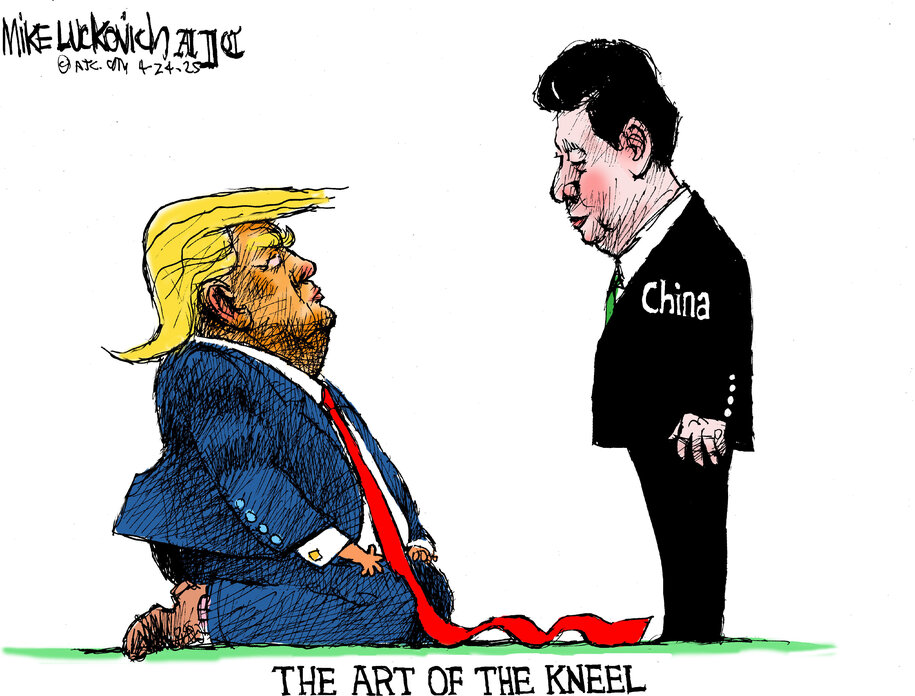
President Donald Trump said Friday that the United States could lower tariffs on China to 80 percent [instead of 145 percent] ahead of a meeting this weekend between his top aides and their counterparts from Beijing. …
The president’s apparent eagerness to get a deal reflects the mounting economic damage from the tariffs he has imposed thus far. China said its exports to the United States dropped 21 percent in April from a year before, and economists have forecast an increased likelihood of a U.S. recession. White House officials have grown alarmed by Chinese curbs on exports of rare earth minerals, used to make military drones, consumer electronics, electric cars and other important products.
Trying to Gaslight the Country. Probably Gaslighting Himself, Too.
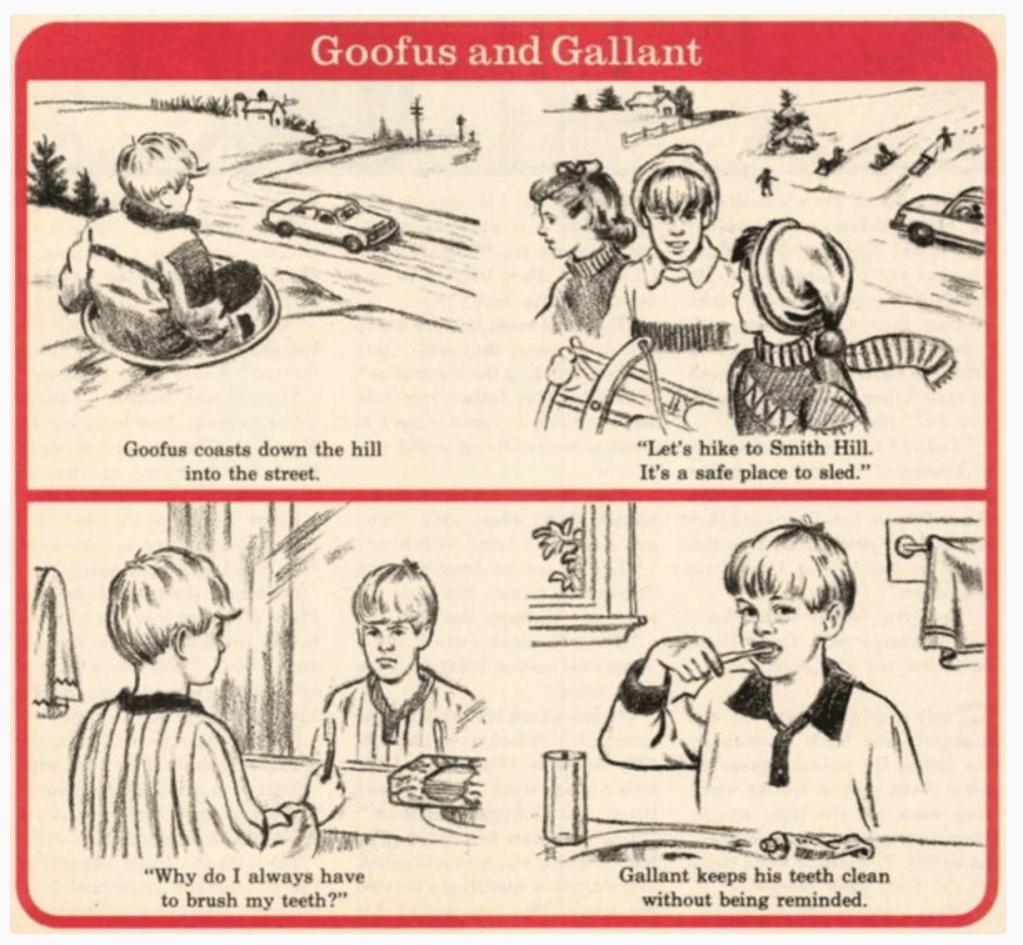
Simpson Thacher and Jenner & Block—Big Law’s Answer to Goofus and Gallant—Show the Cost of Cowardice and the Economic Value of Courage
One Swallow Does Not a Summer Make—But I Think This is the Start of a Trend
N.Y. Times, Microsoft Drops Law Firm That Made a Deal With Trump From a Case
The Times writes,
When big law firms attacked by President Trump decided to make a deal with him rather than fight, many did so because their leaders feared that clients would abandon a firm caught on the administration’s bad side.
Now that logic may be getting less compelling. A major company, Microsoft, has dropped a law firm that settled with the administration in favor of one that is fighting it. …
On April 22, several attorneys at the law firm Simpson Thacher & Bartlett informed the Delaware Court of Chancery that they would no longer be representing Microsoft in a case related to the company’s 2023 acquisition of the video game giant Activision Blizzard, according to court filings.
Simpson Thacher reached a deal with the White House last month in which the firm committed to perform $125 million in free legal work for causes acceptable to the Trump administration. In a joint statement with other firms making similar agreements, Simpson Thacher said the pro bono work would be on behalf of “a wide range of underserved populations.”
On the same day that the Simpson Thacher lawyers filed paperwork withdrawing from the Microsoft case, at least three partners at the firm Jenner & Block informed the court that they would be representing Microsoft in the case. Jenner is fighting in court to permanently block a Trump administration executive order targeting its business. …
In some cases, a client may worry that a law firm that has reached a deal with the White House has a conflict of interest that prevents it from aggressively representing the client. For example, the client may be a defendant in a lawsuit brought by the federal government and worry that a settling law firm would be reluctant to stand up to the administration.
Other clients may have broader concerns. A senior partner at another firm that does not have an agreement with the White House said his firm was beginning to attract clients from firms that had settled with the administration. The partner, who was not authorized to discuss client matters publicly, said prospective clients had indicated that they had lost confidence in settling firms for not standing up to an attack on the rule of law.
Some firms challenging the administration have sought to capitalize on this frustration, suggesting that their pushback reflects a commitment to fight on behalf of their clients as well.
 Facing MAGA