The material in these two posts should be read and considered in context: the White evangelical church is leaking like a sieve. The crew that reveled in Trump’s vileness the other day at the National Prayer Breakfast represent a declining population. There are still a lot of them, but not as many as there were a decade ago, when Trump deescalated down the golden escalator.
Southern Baptist Convention membership peaked in 2006, at 16.3 million members. By the time Russell Moore was booted out, in mid-2021, membership had declined to 13.7 million. Subsequent to Moore’s defenestration, the SBC has lost another million members.
These data are consistent with data on overall participation in White evangelical Protestant Churches. In 2006, they were 23 percent of the U.S. adult population; now, it’s 13 percent, or about one quarter of the White population in the United States.
Why are So Many Evangelicals Abandoning Ship?
A variety of reasons, but clearly some of it is because folks who actually reads the words printed in red in the New Testament and who want to follow Jesus are disgusted by what they have seen in their church.
Who is the Progressive’s Biggest Ally in Combating National Prayer Breakfast-Style Christianism?
Jesus of Nazareth.
How Will White Evangelicals Reconcile the Tension Between Their Culture War Victories Under Trump and Their Economic Losses Due to Tariffs, Inflation, Loss of Job Opportunities, Etc.?
I don’t know, of course, but it’s going to be a non-trivial threat to Trump’s remaining 70%+ approval among the White evangelical crowd.
With Trump’s Deteriorating Mental and Physical Health, Will Significant Numbers of White Evangelicals Decide They Still Want an Authoritarian Messiah, Just Not Trump as Their Authoritarian Messiah?
The National Prayer Breakfast was founded in 1953, when President Dwight Eisenhower accepted an invitation to join members of Congress to break bread together. Every president since has participated, regardless of party or religious persuasion. It offers an opportunity, according to its organizers, for political leaders to gather and pray collectively for our nation “in the spirit of love and reconciliation as Jesus of Nazareth taught 2,000 years ago.”
Donald Trump never got that memo—or, if he did, he’s found ways to ignore it.
In a rambling, 75-minute speech at the Prayer Breakfast yesterday, we saw the quintessential Trump. His comments were grievance-filled, narcissistic, conspiratorial, factually false, divisive, and insulting. He referred to his critics as “lunatics.” He engaged in projection, comparing them to “dictators” and “the gestapo.” He labeled Republican Representative Thomas Massie a “moron” because he won’t cast legislative votes the way Trump wants. Joe Biden is “Crooked Joe,” while Jacob Frey is “the horrible fake mayor” of Minneapolis. Trump praised El Salvador’s authoritarian President Nayib Bukele—Bukele has referred to himself as “the world’s coolest dictator”—for his “very strong prisons.” (The prison that Trump celebrates, Centro de Confinamiento del Terrorismo, known as CECOT, is notorious for its cruel and inhumane conditions.) Trump emphasized that Bukele—who also spoke at the National Prayer Breakfast—is “one of my favorite people.”
Trump took credit for churches “coming back stronger than ever” and for religion being “hotter than ever.” He claimed he has “done more for religion than any other president”—apparently, before the age of Trump, Christians couldn’t say “Merry Christmas” in public—and argued that his predecessors in the White House “bailed out” on religion. “I don’t know how a person of faith can vote for a Democrat. I really don’t,” he said, adding, “They cheat.”
The spirit of love and reconciliation that Jesus of Nazareth taught 2,000 years ago was not particularly evident in the words of the president. Of course, it never has been. No matter. The audience of some 3,500—the great majority of whom undoubtedly claim to be followers of Jesus—responded to Trump’s remarks with a standing ovation.
It is testimony to the marketing genius of Donald Trump that he never sold himself to Christians as one of them—pious, devoted, merciful, forgiving, irenic, biblically literate, a faithful husband and father, a man of high moral standards. Instead, he sold himself as their protector. He didn’t hide his cruelty or his belief that the ends justify the means; doing so would have been impossible for him because they are central features of his personality. So he did the opposite: He presented himself to Christians as a fierce, even ruthless, warrior on their behalf. It worked. He built a huge, loyal, fanatical following.
At the National Prayer Breakfast, Trump recounted comments made about him by Robert Jeffress, the senior pastor of the First Baptist Church in Dallas and a stalwart Trump ally for a decade.
According to Trump, the case Jeffress made on his behalf in 2016 went like this: “He may not have ever read the Bible, but he will be a much stronger messenger for us.” It was Jeffress who said at the time, “I want the meanest, toughest SOB I can find to protect this nation.”
Jerry Falwell Jr., then the president of Liberty University, put it this way in a 2018 tweet: “Conservatives & Christians need to stop electing ‘nice guys’. They might make great Christian leaders but the US needs street fighters like @realDonaldTrump at every level of government b/c the liberal fascists Dems are playing for keeps & many Repub leaders are a bunch of wimps!”
Tony Perkins, an ordained Southern Baptist minister and the president of the Family Research Council, a prominent evangelical activist group, admitted in 2018 that he and other evangelicals gave Trump a “mulligan” on his multiple affairs and hush-money payments to a porn star for a simple reason: Evangelicals “were tired of being kicked around by Barack Obama and his leftists. And I think they are finally glad that there’s somebody on the playground that is willing to punch the bully.” When asked what happened to turning the other cheek, Perkins replied, “You know, you only have two cheeks. Look, Christianity is not all about being a welcome mat which people can just stomp their feet on.”
They thrill to watch Trump savage his critics, and their devotion grows with every dehumanizing word, with every merciless act.
It is odd to see the very same evangelicals who claim the Bible is inerrant and who criticize fellow Christians about matters such as ordaining women—on the grounds that they are being unfaithful to what Paul wrote in one of his Epistles, an interpretation that many biblical scholars dispute—dismiss Jesus’s most famous sermon. For these Christians, the teachings of the son of God take a back seat to the pronouncements of the king of Mar-a-Lago.
Much of today’s evangelical world sees Trump’s viciousness not as a vice but as a virtue, so long as it is employed against those they perceive as their enemies, against those whom they resent and for whom they have a seething hatred. Unless you’ve spent time in the evangelical world, fully appreciating the level of antipathy that exists toward Democrats and progressives is difficult. The only thing that exceeds it is the loathing reserved for the Christians and conservatives who broke with Trump because their commitment to their faith, and to cherished moral truths, required them to speak out against him.
What I am describing isn’t true of all Christians, thankfully. Some have found the cumulative effect of Trump’s assault on Christian ethics too much. The Catholic Church and its American pope, Leo XIV, are speaking out prudentially but forcefully against the actions of the Trump administration. Mainline denominations, including the United Methodists, are stepping up. My friend Mark Labberton, a former president of Fuller Theological Seminary and a Presbyterian (PCUSA) pastor, traveled to Minneapolis to express solidarity with the people of that city after an ICE agent killed Renee Good. He joined many others in peaceful protests in subzero temperatures. Other pastors and theologians I respect, several of whom were formative in my journey of faith, signed a statement titled “Christ Alone: A Call to Faithful Resistance.” It nowhere mentions the president or his party, but it does take a prophetic stance “in a time of fear and capitulation in both the Church and in our civic life.”
“In this moment we specifically call on the Church and peoples across the political spectrum to recognize the clear and present danger of rising authoritarian rule to all of us, especially the most vulnerable,” the statement says. “We commit ourselves to resisting cruel or oppressive means of control and to standing in solidarity with the oppressed, the marginalized, and the silenced.”
Even among evangelicals, support for Trump is hardly universal, and many pastors I know are quite disturbed by the damage he and his administration are doing. Yet they know full well that many within their congregations voted for Trump and still align themselves with the Republican Party. These ministers are therefore hesitant to speak out not only from the pulpit but in any capacity. They want to keep their head down.
That’s understandable. The best pastors I know are instinctively wary about speaking out politically; that’s not why they got into ministry in the first place. They don’t feel that it’s their job to offer political commentary, nor do many of them feel especially equipped to do so. They also realize that many people go to church seeking a safe haven from politics. They believe, too, and with some justification, that to take a stand, even with great care, might well split a congregation.
Evangelical denominations and pastors, though, even those who are not deeply immersed in politics, are generally willing to speak out on culture-war issues that have political and sometimes legislative implications. I’ve seen this happen many times over the years.
So the reluctance to take a prophetic stance in the realm of politics and culture is less a principled unwillingness than a selective one. Ministers, like most of the rest of us, are likely to wade into controversial waters only when it’s safe—in their case, when there is overwhelming agreement within a congregation on a set of issues. They speak out when the response from those in the pews is a resounding “Amen!” rather than even a handful of voices saying, “Oh no you don’t!”
I don’t pretend these are easy matters for pastors to face. A minister of a conservative congregation might tell himself that the downside to speaking out against the sins of the authoritarian right, even judiciously and without partisan rancor, is too costly. They may fear that their ministry will be damaged, that offended parishioners will tune them out, and that they will gain nothing concrete.
But aren’t prophets esteemed precisely for their willingness to tell difficult truths to the people of God? For being steadfast in the face of fierce criticism; for denouncing social injustice and idolatry, including political idolatry, when it’s unfashionable to do so; for issuing warnings when others fall silent; and for calling people to repentance during times of moral blindness?
Non-maga evangelical pastors are going to face a set of difficult questions during the next three years: Under what conditions, if any, are you willing to speak out when a president and his administration repeatedly violate Christian ethics? Will you stay silent even when acts of cruelty, lawlessness, and injustice aren’t the exception but the norm? How much more indecency do you need to see before you act?
My colleague Jonathan Rauch, an eminently fair-minded, reasonable, and wise writer, recently explained why, after heretofore avoiding the term, he has come around to the belief that Donald Trump’s governing style qualifies as fascist.
Even if you disagree with Rauch’s conclusion, it’s still worth wrestling with his catalog of the president’s misdeeds, broken into 18 categories. And the case Rauch makes—that although America is not a fascist country, it has a fascist president—will almost certainly become stronger over time.
At some point, then, it may become nearly impossible for pastors who are not fully on board with MAGA to look away, to stall for more time, to let others do the heavy lifting, or to tell themselves that things aren’t so bad, that silence is golden. A healthy church culture, like a healthy family culture, brings things into the open. It doesn’t avoid or close off conversations.
Labberton, the Presbyterian pastor, once told me that the more highly contentious an issue is, the more likely he is to want to discuss it with his congregation in a way that is honest, open, and biblically informed. Of course, there will be a diversity of opinions. That’s not something to run from; it’s something to learn from.
“Our reality is sufficiently complex that we need to invite one another along for the journey,” Labberton said. We need to invite one another into respectful conversations. “Together we need to instigate a long journey into God’s mercy and justice.” Pastors, and the congregations they lead, have to hope that we can summon the courage to go where God’s mercy and justice lead us.
“Seldom, if ever, do I pause to answer criticism of my work and ideas,” Martin Luther King Jr. wrote. But when a group of white Alabama clergymen declared him an outside agitator whose efforts were “unwise and untimely,” he decided to respond. The result was “Letter From Birmingham Jail,” one of the most important documents in U.S. history.
This letter, like all of King’s greatest works, cannot be understood apart from his Christian faith. Faith shaped his views on ethics and human dignity. It also gave him the courage to create tension in the cause of justice. “I am grateful to God that, through the influence of the Negro church, the way of nonviolence became an integral part of our struggle,” he wrote.
The white pastors in Birmingham had a case to make. They didn’t want what they called “days of new hope” in Birmingham to be undone by “extreme measures” that would cause divisions. King, one of America’s great prophets, saw things differently. He wept over the laxity of the Church and reminded it of its high calling—not to be the master or the servant of the state, but rather its conscience.
I imagine that all of the white pastors I know think that if they had been a minister at that time—especially if they were a minister of churches that were made up of white segregationists—they would have found a way to speak up rather than be silent, would have stood with King instead of those who urged caution in the name of unity.
The question now comes again in our time: What does it mean for the Church to be the conscience of the state?
Those who enjoy reveling in their own moral superiority and the intellectual inferiority of the yokels will find much to enjoy in these two videos. If you must, brew up a nice cup of hot chocolate, or grab a frosty beer, or, better yet, pour a big glass on Jack Daniels, settle in by the fireplace, and have a fine old wallow.
That, however, was not why I wrote this post. I wrote this post to advance our understanding of what’s going on in these people’s heads. That understanding is an essential foundation if we want talk with our evangelical brethren and sistern—and if we want, in general, to begin to address the current regrettable state of our nation. Because it’s really hard to fix something that you don’t understand.
I will have some takes of my own on these matters. They will appear in a later post.
Authoritarianism and the White Evangelical Church
Pat Kahnke—not previously within my radar screen—retired as pastor of an evangelical church in St. Paul, Minnesota, in 2016. He has spent the remaining years explaining in books and podcases why people who love Jesus should not love Donald Trump.
Patriarchy, Misogyny, a Dab of Racism, and the White Evangelical Church
Russell Moore was the president of the Ethics & Religious Liberty Commission of the Southern Baptist Convention. Concerned over his ethics and his support for religious liberty, Moore’s compatriots in the SBC forced him to resign from the Commission and to exit the church in June, 2021.
As you probably know, David French is a lawyer, a New York Times columnist, and an actual Christian.
Glenn Kirschner is a retired federal prosecutor whose voice is worth listening to. In this video, he outlines four stories that illustrate his thesis that the United States Department of Justice is crashing and burning.
I believe his conclusion is sound.
If a Thing Cannot be Done, Then it Will Not be Done
One reason for all the crashing and burning is that many lawyers, especially those who have chosen government service over maximizing their earnings in the private sector, are people of honor and integrity.
A second reason—buttressing the underlying good character and ethics—is the well-founded fear that obeying illegal orders could lead to highly adverse professional consequences.
And, finally, good character aside, fear of legal discipline aside, the attorneys at the Justice Department are being ordered to do things that are impossible to do successfully. Mainly, they are being ordered to obtain criminal convictions of people who are innocent—and whose innocence is provable.
If a thing cannot be done, then it will not be done.
And a Word About All Those Redactions
If you don’t want to watch the whole thing, I recommend skipping to the very end, where Kirschner makes an interesting, and I think entirely valid, point. I’m not speaking of his views on the alleged willfulness of the Justice Department’s failing to redact many Epstein victims’ names, as required by the Epstein Transparency Act. He may well be right about that, but I don’t know enough to have an informed opinion, myself.
Rather, I am speaking about Kirschner’s claim that victims whose names were exposed to the public, and who can show how that exposure caused injury to them,
will have standing to sue the Justice Department for failing to follow the law,
and that these plaintiffs will likely get the judge to appoint a special master to second guess DOJ’s handling of the files,
who will, in turn, get to the bottom of what the hell was going on with the screwy redactions, and very probably,
will get the DOJ to cough up the rest of the damn files.
David French’s warning is timely and well taken. That said, I think we may all thank Orange Mussolini for sending a clear and timely signal about his intent with respect to the 2026 elections. We have a reasonable amount of time to litigate l’affaire Fulton County ballot seizure, establish beyond peradventure of doubt that Tulsi Gabbard is a blithering idiot—and that Trump’s delusions are in fact delusions, and take the preventative steps that David French encourages us to take.
It’s a sign of the times that Senator Thune recognized that “nationalizing elections” is unconstitutional, and that he did not cotton to the idea.
Georgia Republicans are shitting their pants about the special election in Marjorie Taylor Greene’s district.
Second Bonus News Report: Legal Karma
While some law firms caved to Trump, renowned plaintiffs’ firm Susman Godfrey stood tall, and walloped the living daylights out of Team Trump. See here.
This week brings reports that top lawyers at the Susman firm are now charging $4,000 per hour. See here.
Point of personal privilege: I was one of the late Steve Susman’s ten thousand closest friends. I’m confident Steve is looking down from heaven or the bardo at recent developments, and I know he’s still wearing that shit-eating grin.
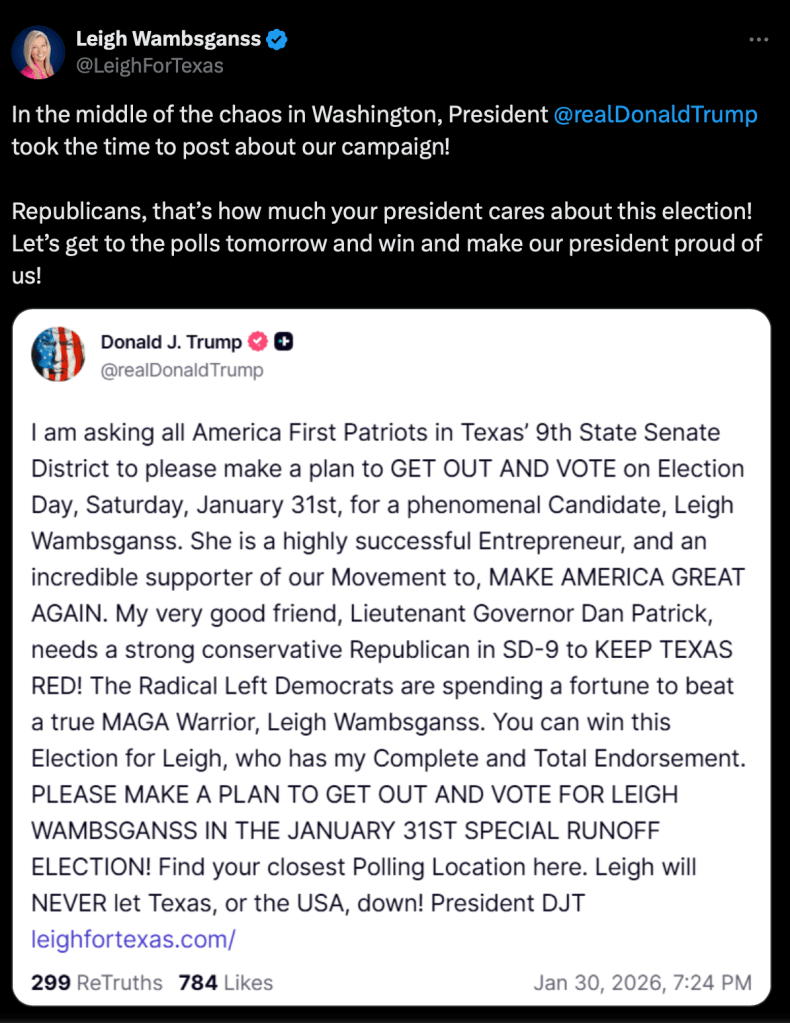
There was a special election yesterday in the Texas State Senate 9th District, located in northern part of Fort Worth and its suburbs. In 2024, Trump took the district by 17 points. Yesterday, the Democratic candidate won by 57.2 to 42.8.
Beginning with the Interstate Commerce Commission, established in 1887, Congress has created more than 25 independent agencies, chiefly to foster the development of regulatory specialization and expertise, and to provide some degree of insulation from political pressures—including the kinds of political pressures resulting from generous campaign contributions by affected interests.
Does Legal Precedent Support the Constitutionality of the Independent Regulatory Agencies?
Yes, it does. The leading case is Humphrey’s Executor v. United States, decided by the Supreme Court in 1935. The issue there was essentially identical to the current case, Trump v. Slaughter, argued before the Supreme Court in December, 2025. In each case, the President fired one of the five FTC commissioners, not “for cause,” as required by the Federal Trade Commission Act, but rather because he or she different with the President on political and policy grounds.
To amplify a little, Mr. Humphrey was a loud-mouthed, obnoxious anti-New Dealer. There was little doubt that President Roosevelt’s decision to fire him violated the FTC Act. Rather, the question was whether the statutory provision that Roosevelt violated was constitutional. The Court ruled nine to zero that yes, the pertinent FTC Act provision was in fact constitutional—and that it was OK to have independent regulatory agencies.
In the current Trump v. Slaughter case, both sides have elected to rely in general legal issues rather than whatever differences on policy may exist between Commissioner Slaughter and Orange Mussolini.
On the Face of Things, Should the Court Apply the Stare Decisis Doctrine and Reaffirm the 1935 Humphrey’s Executor Precedent?
Yes. The precedent is long standing and has enjoyed bipartisan support. There is no new or compelling reason to overturn it.
So, Does That Mean a Supreme Court Decision Favoring Trump Would be Clearly Unlawful?
Is the Court’s Likely Ruling Likely to Lead to Despotism?
No, no more than a ruling for Roosevelt back in 1935 would have led to despotism.
Is the Court’s Likely Ruling Likely, in the Current Environment, to Facilitate Kleptocracy?
Did God make little green apples? And does it rain in Indianapolis in the summertime?
A point of personal privilege here: Much of my 35 years of practice involved merger work before the Federal Trade Commission and the Antitrust Division. The staff was consistently conscientious, though they sometimes made unwise decisions, mostly because of ideological blinders. But the President was not taking bribes to dictate outcomes to the FTC or the Justice Department. And attempts by the parties or their counsel to use political influence, let alone bribery, in particular cases would have been highly counterproductive.
In my opinion, this video has more insightful observations than Carter has Little Liver Pills.
Watch it if you’re interested in understanding what is actually going on.
David French Channels Dante
And another useful source: yesterday, David French gave us a highly informative tour of the hellscape that is the MAGA mind. Along with that, he also offered thought-provoking historical precedents for our current state of affairs. David French (N.Y. Times): What MAGA Sees in the Minnesota Mirror.
And now some thoughts from me, your humble ink-stained scrivener.
The Supreme Court’s Role in 2026 as the Joker in the Deck and Potential Savior of Donald Trump—from the Perils Posed by Donald Trump
In the video above, Rick Wilson expounds on the consequences of Trump’s erratic and disastrous action regarding his key political issues, immigration and tariffs. But he doesn’t address how the Supreme Court, if it so chooses, could intervene in ways that would help to save Trump’s bacon by helping to save him from himself.
Likewise, the Court, if it so chooses, can rein in Trump’s due process violations in connection with its mass deportation project.
Apart from the fact that requiring due process will help to save the constitutional republic, it would also, once again, help to save Trump politically from himself. Essentially, for the reasons that Rick Wilson laid out in the video.
Trump’s mental problems are myriad: sociopathy, constant lying coupled with a total inability to keep his lies straight, an inability to plan, and, among others, a grievously limited political skill set.
In this witch’s brew of mental illnesses, we tend to discount the signal importance of delusional thinking. For example, Trump really thinks that he can bend the courts to his will in the same way that he has bent the Justice Department and the FBI to his will.
He should have learned his lesson in 2020, when the courts universally rejected his stolen election delusion.
But he did not learn his less, because he is delusional.
Now, once again, he is ordering his prosecutors to comply with his delusions by initiating a slew of utterly bogus criminal cases.
The consequences of the inevitable failure of that delusion will be yet another joker in the deck as we continue our hellish journey through 2026.
Of the many lessons to be drawn from the administration’s retreat in Minneapolis, the most important is that Donald Trump can be stopped.
He spent his first year acting as though the 2024 election were the last time he would ever have to give a thought to public opinion. Now the myth that Trump is invincible has been exploded.
After federal agents killed Alex Pretti, Trump-administration figures including Secretary of Homeland Security Kristi Noem and Deputy Chief of Staff Stephen Miller described the victim as a terrorist, indicating their desire to ignore or intimidate all opposition. But other Republican sources signaled their discomfort, and some called for an investigation—a routine step for a normal presidency, but a daring breach of partisan discipline in an administration that shields itself from accountability and tries to put itself above the law.
During yesterday’s White House briefing, when a reporter asked if Trump shared Miller’s belief that Pretti was a domestic terrorist, Press Secretary Karoline Leavitt replied that she hadn’t heard him use that term. Trump also sent out conciliatory messages on social media indicating that he’d had productive talks with Minnesota Governor Tim Walz and Minneapolis Mayor Jacob Frey. And he dispatched Tom Homan, the border czar and a more traditional immigration hawk, to replace Gregory Bovino, the commander at large in Minnesota. Bovino has justified his agents’ misconduct with transparent lies.
Trump’s retreat in Minneapolis is a stinging defeat for the national conservatives, the Republican Party’s most nakedly authoritarian faction. The NatCons believe American liberalism cannot be dealt with through normal political methods such as persuasion and compromise. Speakers at the National Conservatism Conference have described the American left as “the enemy within” (Senator Rick Scott of Florida) and “wokeism” as “a cancer that must be eradicated” (Rachel Bovard of the Conservative Partnership Institute). NatCons also maintain that immigration poses a mortal threat to the United States. These two strands of thought are intertwined; NatCons consider immigration a weapon employed consciously by the left to assume permanent power, via manipulating elections and creating government dependency, a conspiracy that can only be reversed through the kind of ferocious operation on display in Minneapolis.
The NatCons, whose ranks include powerful administration figures such as Vice President Vance and Miller as well as members of Congress (such as Senator Eric Schmitt of Missouri) and activists (such as Heritage Foundation President Kevin Roberts), have wielded profound influence. They have rarely, if ever, lost important struggles to steer Trump’s strategy.
For the NatCons, the mass-deportation scheme overseen by Miller is an existential priority. Vance once claimed that immigration levels “would mean we never win, meaning Republicans would never win a national election in this country ever again.” Ten days ago, Miller explained on Fox News that Democrats were resisting ICE in Minneapolis because “this mass-migration scheme is the heart of the Democratic Party’s political power.” Miller sees his crusade not merely as a matter of relieving the burden on public services or raising wages, but as a final chance to stop permanent left-wing tyranny. Thus Miller’s immediate, fervent insistence that Pretti and the other Minnesotan recently killed by federal agents, Renee Good, both deserved their fates, a line the NatCons repeated vociferously through Monday.
The NatCons have attained their sway by positioning themselves as the vanguard of Trumpism in its purist form. Other conservative factions, such as social conservatives, libertarians, and foreign-policy hawks, supported Trump reluctantly in 2016, and backed away after the January 6 attack on the Capitol, hoping Florida Governor Ron DeSantis or some other rival could displace him. The NatCons never flinched in the face of Trump’s failed autogolpe, or any other actions that made other Republicans nervous. They won the loyalty contest—which, in the second Trump administration, is the only currency of influence.
Calls for Trump to stand firmly behind Miller had a desperate yet vague tone. “Leftist protestors who shut down streets, destroy property, refuse lawful orders, and physically assault federal officers cannot be rewarded with veto power over public policy,” beseeched the Manhattan Institute activist Chris Rufo, employing the passive voice. In response to a liberal observing yesterday afternoon on X that Trump was backing down, Will Chamberlain, a national conservative affiliated with numerous right-wing organizations, replied, “This isn’t happening, and it’s very important that it does not happen.”
Nevertheless, it was happening.
The reason it happened is that, although Trump listens to the NatCons, he has no deep grounding in their theories or, for that matter, any theories. The president’s despotism is not ideological but instinctive. He cannot tolerate criticism and he deems any process that embarrasses him, including a critical news story or an election, illegitimate, even criminal.
And while he has embraced a restrictionist immigration agenda, he has vacillated between endorsing mass deportation and allowing exceptions for categories of laborers he considers necessary. As Trump told The Wall Street Journaleditorial page before the 2024 election, “I mean, there’s some human questions that get in the way of being perfect, and we have to have the heart, too.” If that has ever occurred to Miller, he has hidden it well.
Whether or not Trump’s intermittent expressions of human feeling for the immigrants his administration has abused is heartfelt, his desire to maintain his political standing most certainly is. Trump appreciates the power of imagery. It does not take a political genius to understand that, if Americans were repulsed by the sight of a Vietnamese man being executed in 1968, an American being shot in the back, facedown on a midwestern street, would not go over much better.
Trump’s capitulation would never have occurred if not for the heroic, disciplined resistance in Minneapolis. Faced with something like an occupying army that was systematicallyflouting the law, the people of Minneapolis thrust its abuse into the public eye, raising the political cost of Miller’s war until enough Republicans decided that they couldn’t bear to pay it.
Political theorists have long debated whether Trump and his movement should be described as fascist. On an intellectual level, the answer depends largely on which definition of fascismyou choose (there are several). I have generally resisted the term because the definition I prefer, and the one most Americans probably think of when they hear the term, is not mere political oppression but a form of it so extreme that opposition becomes impossible.
That may be more or less Trump’s aspiration, and possibly our destiny. But this is not a fascist country, at least not yet.

 Facing MAGA