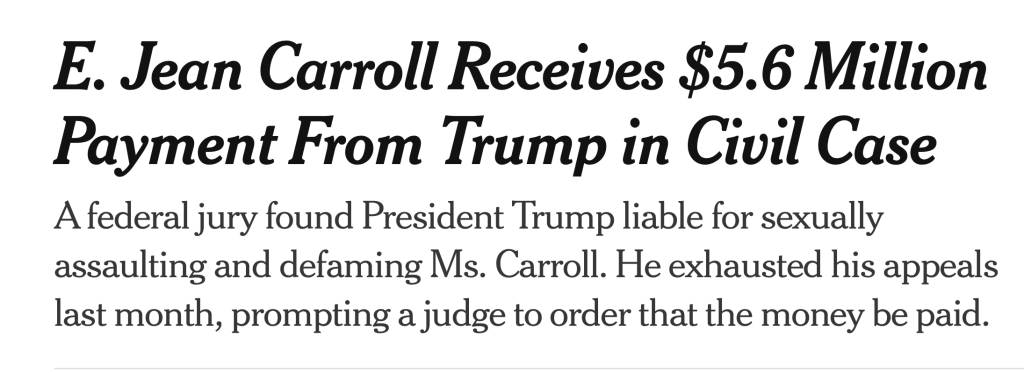
She also won $83.3 million in a later defamation case. A federal appeals court upheld that judgment in 2025, but Trump’s crack legal team is still flailing around, trying to avoid paying up.
And, you know what? If Trump defames her some more, she’s going to sue him again.
Lastly, with my apologies, a point of personal privilege. Back in the day, it was my great honor to work with Lewis Kaplan—now a senior federal judge, and the person who presided over the two E. Jean Carroll/Trump lawsuits, then a litigation partner at Paul Weiss. Together with my colleague Rick Holwell of White & Case, we achieved victory in a landmark antitrust case, Consolidated Gold Fields v. Minorco, see https://law.justia.com/cases/federal/district-courts/FSupp/698/487/2356328/
Mr. Kaplan was a gentleman and a scholar back then, and one hell of a litigator, and he remains today one hell of a federal judge.
Unlike his unworthy successors at Paul Weiss, Kaplan knows how you have to deal with someone like Mango Mussolini. Congratulations to the judge. Well done.
I would, of course, have taken a pass on the op-ed, except that it was written by Thomas Edsall, who is nobody’s fool.
The first part of Mr. Edsall’s article, in today’s New York Times, reads as follows:
Even now, according to a new survey by the left-leaning group Data for Progress, the Democratic Party has a net negative rating of minus 29 percentage points among swing voters, worse than the minus 25 for the Republican Party. Democrats seeking to restore their party’s credibility with the electorate as a whole, but especially among those crucial swing voters, might consider adding three planks — on immigration, urban disorder and transgender issues — to the 2028 Democratic platform.
Why? Because it is these three issues that serve to reinforce the perception that Democrats are willing to sacrifice the interests of the working and middle classes in favor of special interest constituencies.
I am more than a little queasy making these suggestions, but I think the Democratic Party needs to perform a kind of brutal surgery on itself.
The hard-edge character and language of what I am proposing is specifically designed to function as a public renunciation of the Democratic Party’s liabilities, its ties to special interest groups and its readiness to succumb to progressive orthodoxy.
The proposals amount, then, to an ideological exorcism.
On immigration, I would suggest — with plenty of room for amendment — the following:
Democrats will firmly enforce laws on illegal immigration, including tough border enforcement and deportation of unauthorized immigrants who commit crimes.
Unauthorized immigrants with no criminal record who have been in this country for at least five years, along with Dreamers, should be offered green cards with a path toward citizenship. More recent arrivals should be deported.
On crime:
The Democratic Party supports aggressive prosecution of those accused of violent crime, those who engage in crowdsourced “teen takeovers” of stores, as well as all forms of child abuse.
The party backs restoration of bail requirements in the case of felonies, lifetime sentences for offenders convicted of multiple violent crimes, tough enforcement of child support laws and the death penalty if supported by the voters in a state and endorsed by a jury.
Transgender and gender dysphoria:
There are two sexes: men and women.
A man can claim an identify as a woman, and the same in reverse for a woman. They have every right to do so. Their claim should be respected and they should be protected from any form of discrimination for their choice.
Their claim does not, however, alter their biological sex.
Consequently, it is legitimate in areas such as sports where a transgender person would have a competitive advantage over non-trans people to bar such participation. Similarly, a claim to a sexual identity does not give a trans woman the right to incarceration in a woman’s prison.
Finally, the debate over gender affirming surgery and hormone treatments is fraught with contradictory assertions. For now, because there are credible scientific claims of irreversible harms, such treatments for those under 18 should be barred pending further study.
There are some other planks I would add, including a strong commitment to free speech and an adamant rejection of all forms of cancel culture; an endorsement of equality of opportunity based on merit; the repudiation of socialism in favor of a free and open market accompanied by government regulation to prevent exploitation, monopolization and unfair trade practices. …
In exploring these issues with Democratic strategists, I was surprised to find significant support — with differences over language — from a variety of sources, albeit accompanied by a harsh rejection from a communications specialist for a firm headed by a major Democratic campaign strategist. …
I have posted several times about the two-pronged dilemma Trump faces in the Iran War that he started: either try to finish it off with a ground invasion of Iran, and thus royally piss off his base, by starting another endless land war in the Middle East, or supinely acquiesce to Iran’s strategic victory.
Some think the ground invasion may be inevitable, and of course they might be right. I say that supine acquiescence will probably be Trump’s final choice, because he really, really does not a land war in the Middle East; because he fears his base; and because he has a naïve faith in his ability to bullshit his way out of any problem that he creates for himself.
For completeness, I should have added that his final choice between these two alternative courses will be down the road a little bit. In the meantime, he will bluff and bluster and try to find some better third alternative. That is what’s happening right now.
He still thinks that bluster and bullshit will make whoever is in charge of Iran bend to his will. That will not happen. He is deathly afraid of a ground invasion of Iran. I actually think the Iranian leadership would welcome a ground invasion.
For several reasons, a big one being that Shi’a Islam is all about martyrdom.
The Australian Broadcast Corporation interviews Richard Pape, professor of political science at the University of Chicago and director of the Chicago Project on Security and Threats. Prof. Pape’s discussion illuminates the two—and only two—alternatives for the Iran War.
Prof. Pape is a very smart man, and he knows ten times as much as I know about international security. I believe he’s right about the two, and only two, alternatives: (1) acquiescence in Iran’s regional hegemony, control of the Strait of Hormuz, and continued nuclear program or (2) a much wider war, including a ground invasion.
However, despite his impressive credentials and wisdom, I think Pape is wrong to predict that Trump will pick Door Number 2, a massive land war. I think Trump will pick Door Number 1, acquiescence in defeat, which he will try, clumsily and unpersuasively, to disguise with his usual hallucinatory bullshit. That’s mainly because, (a) he knows his base will desert him if there is another land war in the Middle East and (b) he has a childlike faith in his ability to con the rubes.
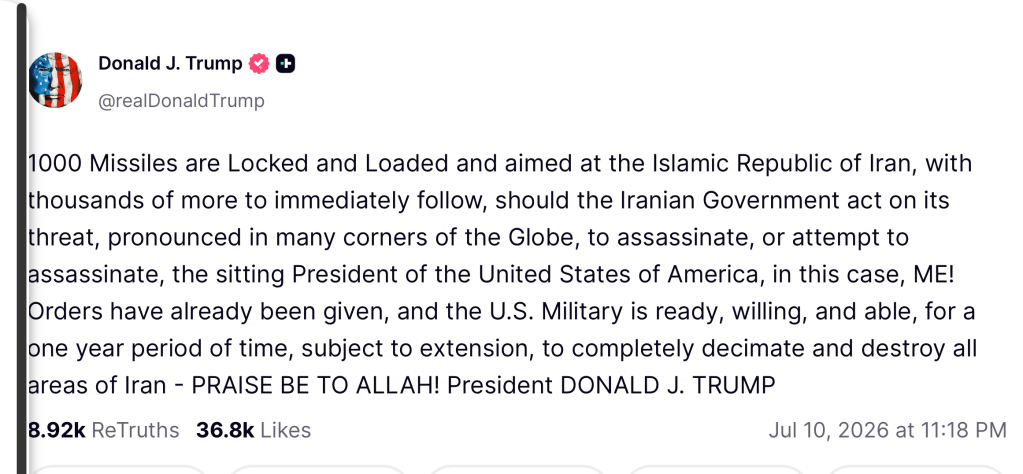
The part that isn’t bullshit is the claim that the Iranians are trying to assassinate Trump.
If you have been planning your financial affairs on the assumption that the war with the Islamic Republic of Japan will soon be over, then you are a gullible fool, and you deserve what you are going to get.
I wrote this post in order to reproduce an op-ed from the Wall Street Journal that argues—based, apparently, on European sources—that Putin may attack on of his Eastern European neighbors as a way to undermine NATO.
I think it’s an interesting question. I go further. There is, in my view, abundant evidence that Trump is a Putin tool. Consider, among many other things, the stories that the idiotic acting Director of National Intelligence is busy gutting the intelligence community.
Be all that as it may, Mr. Baker of the WSJ, writes,
Putin May See an Opportunity to Destroy NATO: Even a small incursion could doom the alliance if it lacks the political will to respond with force.
He is mired in a struggle against a country with a population and a military a fractionthe size of his own. Since the decision to launch that war has worked out so well, are we seriously being asked to believe that he would attack an alliance with an economy and military many times the size of his own?
A month ago I would have scoffed at the idea. But conversations with multiple senior European political, military and intelligence figures in the past few weeks suggest to me the possibility is real and rising.
For some Americans, including perhaps the president, the idea that Russia may take a shot at some feckless Europeans who have been notably unhelpful with America’s military preoccupations in recent months might induce a yawn of indifference or even a smirk of schadenfreude. But the risks of any Russian provocation in Europe for America’s global security are profound. Ukraine, a non-NATO member, is one thing. If we failed to respond to Russian aggression against a member of the alliance, NATO would become a dead letter.
Which is why Mr. Putin might attack. As one intelligence analyst put it to me last week: His inspiration may be Marshal Ferdinand Foch, the general who commanded French forces at the Battle of the Marne in 1914. He famously reported: “My center is yielding. My right is retreating. Situation excellent. I am attacking.”
A sudden show of unexpected force just as he appears to be reeling from his ill-advised Ukraine war could be to Mr. Putin’s advantage. Although Mr. Trump’s verbal shock treatment has jolted European NATO members into finally doing more in their own defense, they are still nowhere near ready for a defensive war. Government officials say it will be at least five years before their militaries are close to being capable of replacing U.S. capabilities in Europe.
Mr. Trump has 2½ years left in office. There is no guarantee his successor will have as skeptical an approach to NATO. If Mr. Putin chose the right targets, European leaders suspect Mr. Trump’s administration wouldn’t come to a NATO country’s aid, fatally undermining the credibility of the alliance’s collective-defense commitment—and with it, NATO’s existence—a dream outcome for Mr. Putin.
His political needs might also be suited by an attack on NATO. A former British defense official said to me last week, “After four years of failure and rising popular discontent at home, he desperately needs a military victory.” What better way to lift morale than to plant the Russian flag in some NATO field?
All this suggests we are now in a narrow window of opportunity for Russia to make a move. If Mr. Trump goes ahead with plans to cut European deployments, that window gets wider.
Sure enough, intelligence reports point to rising risks of Russian action. Last week a Polish news report said U.S. officials had warned Warsaw that Russia may attack the country. In an interview last month, a senior military figure from a NATO nation identified multiple risks, including a Russian seizure of islands in the Baltic and an incursion to “assist” the Russian minority in Estonia. None of these would amount to a full-scale invasion, but each would be enough of a provocation that if NATO failed to respond, its credibility would be in tatters.
Is Europe really worth defending with U.S. blood and treasure? Is NATO still an essential strategic interest? I’ve long sympathized with the argument that a large U.S. commitment to the European theater is an anachronism in our security posture, a throwback to 20th-century geopolitics. China is obviously the biggest threat to U.S. security and leadership; managing that relationship requires a shift of strategic resources and attention toward the Pacific. The Europeans can and should take care of their own freedom and security.
But whether we want it or not, we are in a cold-to-simmering war with an axis of resistance that runs from Beijing through Tehran to Moscow. The U.S. is still dealing with the fallout of an inconclusive war with Iran that has left us militarily depleted. As we scramble to manage potential opportunistic moves by China’s Xi Jinping in the Asia-Pacific, Mr. Putin could deal a timely and fatal blow to an already weakened trans-Atlantic alliance. That would be another hammer to the head of Western security and hegemony, and a dramatic enhancement of the power of Russia’s alliance with China and our other adversaries.
Perhaps all the talk of an imminent Russian attack is merely disinformation from European officials, trying to keep President Trump from further weakening NATO. But if you were the American president, would you want to take that risk?
Butt lick: a powerful visual metaphor which may also be a reference to Commerce Secretary Howard Lutnick, also known as Secretary Buttlick
Skanky: a slang adjective meaning extremely unpleasant, repulsive, or low in quality, usually due to being filthy, unkempt, or sleazy; can also mean morally depraved, especially with respect to sexual behavior
Throw a wobbly: British and Australian slang meaning to suddenly become extremely angry or upset, often by throwing a childish temper tantrum over something minor.
Manky: British slang for something unpleasantly dirty, grubby, or disgusting
Scorbutic: pertaining to scurvy; scorbutic conditions typically include fatigue, easy bruising, joint pain, and bleeding gums
Earworm: a piece of music that continuously plays on a loop in your mind; stuck song syndrome