Prof. Mearscheimer has been teaching international relations at the University of Chicago since 1982. He is well respected, but some of his analyses are highly controversial.
Here, Prof. Mearscheimer provides a remarkably comprehensive, granular, and detailed analysis of the United States’ current predicament in Iran. The subject lends itself to thinking in bumper sticker slogans; if that is your preferred way of thinking, then you will have no interest in this video. On the other hand, if fact-based thinking is your preference, then this video is for you.
Why Hasn’t Trump Surrendered to Iran?
I have argued that surrender is the least bad of Trump’s various bad options. I remain of that view. 100 percent. Maybe 200 percent. Watch the 57 minutes of this video and you will see why—in enormous detail.
So, why hasn’t he surrendered? And what will happen if he persists in this attitude?
First of all, let me acknowledge that far greater men than Donald John Trump have failed to understand that they were screwed, blued, and tattooed, and that their best option was to take their losses and amscray.
Second, with the June, 2026, memorandum of understanding he tried, sort of, to semi-surrender. In my view, it didn’t work (1) because elements within Iran did not want peace, even on terms that were favorable to Iran and (2) because Trump wasn’t willing to accept the full consequences of his very bad hand.
As Mearscheimer points out, Trump has specifically articulated a fear that the Iran war will cause a depression—and that he will be remembered as another Herbert Hoover.
With that thought in mind, with so few cards to play, and with his extraordinarily warped view of reality, I think there is a good chance he is going to nuke Iran.
That, I think, is what he means when he keeps blathering about “annihilation.”
Trump is the world’s worst gambler—a vital skill about which he has no clue.
Today in the New York Times, heavy hitter David Sanger, assisted by reporting from heavy hitters Jonathan Swan and Eric Schmitt, elucidate in calm and rational prose, in excruciating detail, the Iran dilemma in which Trump finds himself. From one point of view, the piece is brilliant. From another point of view, it reads like a parody of the distinguished New York Times covering a shit storm, followed by a dumpster fire.
For a long time now, it has been apparent to anyone of the meanest intelligence that, on Iran, Trump is up that famous tributary without a means of locomotion. But Trump’s intellectual acumen does not reach the level of a person of the meanest intelligence. So … he is only now realizing that he is well and truly screwed, blued, and tattooed.
A couple of observations, before we get to the estimable prose of Mr. Sanger. Firstly, it is welcome news to learn that Trump still has the mental ability to come to terms with reality, however belatedly and imperfectly. I thought he probably retained that I ability, but I was far from sure.
Secondly, if Trump wanted to walk through Door Number One and begin a program of massive war crimes amounting to genocide, he would have faced one obstacle that Sanger does not address, namely, Trump would have had to give the order and the United States military would have had to obey the order. My suspicion is that the Joint Chiefs whispered a few thoughts in Trump’s shell-like ear apropos of the duty to disobey illegal orders.
Thirdly—and you already knew this, but isn’t it fun to hold the thought in your mind?—when Trump, inevitably, cuts and runs, leaving Iran in control of the Strait and in possession of whatever nuclear assets it now how, his base is going to be well and truly pissed.
With those thoughts in mind, let’s read what David Sanger has to say:
Trump Seems Trapped by Iran War, Even as He Wields the World’s Biggest Hammer: A president who thought there were no limits to his power has discovered several, leaving him more frustrated and erratic.
President Trump often celebrates his unpredictability, declaring that it keeps allies and adversaries alike off balance.
By his telling, his willingness to bomb Iranian nuclear sites 13 months ago, and send Delta Force commandos in to snatch President Nicolás Maduro of Venezuela from his bed in early January, reflected his determination to execute military operations that would have made his predecessors blanch. He told The New York Times he was limited only by “my own morality,” as he wielded the world’s biggest hammer.
But in recent weeks, he has seemed trapped, his presidency gradually consumed by a war he cannot find his way out of.
He has discovered limits on his power that he could have scarcely imagined as he began full combat operations on Feb. 28, when he set out goals for a swift end to Iran’s nuclear program and the overthrow of the country’s government.
Five months later, those goals remain almost entirely unaccomplished. And Mr. Trump, once confident that overwhelming force would enable him to pursue in Iran what he proudly called the “Venezuela model” — a change of government to one amenable to U.S. control — is now hesitant to plunge back into major combat operations that his intelligence agencies assess are unlikely to work as well in Tehran.
He has been unable to control surging oil prices, or their effects on the stock market.The shipping that crawled to a stop in the Strait of Hormuz, then was opened for a few short weeks, is back to a trickle, with a second choke point, between the Red Sea and the Gulf of Aden, now threatened. And while the president has threatened to take Kharg Island, where Iran ships oil, or to seize its underground stores of enriched uranium, he has said publicly that he knows there is no appetite for sending in ground troops.
Those limits have left him deeply frustrated, his aides say, and have made him more erratic, even by Trumpian standards. Last week alone, Mr. Trump’s energy secretary signed a historic pact with Saudi Arabia to provide civil nuclear power to the kingdom, before the president undercut the deal less than 24 hours later, stunning the Saudis by declaring that the agreement, negotiated over 18 months, was dead unless the country joined the Abraham Accords and recognized Israel.
Aaron David Miller, a former U.S. diplomat with long experience in the Mideast, said that Mr. Trump again “alienated the Saudis, delighted Benjamin Netanyahu and gave Iran strong talking points as to why cutting deals with U.S. is a fool’s errand, bound to be betrayed.”
The next day, he declared that the “original Deal” on the $4.5 billion Gordie Howe International Bridge, a cross-border project named for the hockey star beloved on both sides of the border with Canada, was dead. He imposed 50 percent tariffs on a range of Canadian goods, in what appeared to be a blatant violation of the U.S.-Mexico-Canada Agreement that Mr. Trump negotiated in his first term and now wants to scrap.
Not surprisingly, Canada disinvited Americans from ceremonies to mark the completion of the bridge, which opens to traffic on Monday.
Mr. Trump’s rewriting of deals, out of anger or frustration, has extended to his party’s domestic priorities. Republicans had assembled chairs at the Capitol for the signing ceremony of a major housing bill — a rare bipartisan agreement celebrated by the White House — when Mr. Trump stunned them by refusing to sign it. His only priority, he said, was the SAVE America Act, his effort to change voting laws, which did not have enough Republican support.
The ceremony was canceled. The bill became law without Mr. Trump’s signature — and also without a chance for his party to get the photo opportunity of action to ease affordability for new homeowners.
Not all of Mr. Trump’s frustrations, people close to the president say, are driven by the war, now so unpopular that only 29 percent of Americans polled by The Washington Post and Ipsos approved of his handling of the conflict. But much of it is. And the angst is clear as he promises to stop Iran’s nuclear program at any cost, while his allies at home want out.
“We got to wrap it up,” Speaker Mike Johnson said last week, voicing a sentiment heard increasingly from Mr. Trump’s most enthusiastic supporters.
But the president does not have a clear way to accomplish that goal. Having entered the conflict with little strategy for victory, he now is struggling for a face-saving way to exit.
A month ago, he exuded confidence that he had found the way to declare victory. On June 17, Mr. Trump signed with a flourish — at the Palace of Versailles, where World War I officially ended in 1919 — a hastily written, 14-point cease-fire agreement.
At the time, Mr. Trump said that a new, more “reasonable” set of Iranian leaders had seen the light, and were being driven by economic interests.
“I believe they have had enough,” Mr. Trump said in an interview with The Times on June 14. He argued that he was able to get the deal because he was threatening a massive attack, prompting Iran to fold.
“We were going in for the big one, and they said, ‘Please don’t do it, we will make a deal.’ And we made a deal right after that,” he said.
It lasted only two weeks.
The Iranians who negotiated the deal appeared to have been in conflict with the Islamic Revolutionary Guard Corps, whose forces opened fire on ships that refused to use the channel of the Strait of Hormuz that Iran controls. While Mr. Trump said in the recent interview with The Times that Iranian leaders wanted billions of dollars in Iranian overseas funds unfrozen and oil shipments flowing, the Iranian Revolutionary Guard Corps seems more interested in demonstrating control.
Now Mr. Trump has three main options: military escalation, economic crackdown or declaring victory and getting out. Each has been debated in recent weeks in meetings with Vice President JD Vance; Defense Secretary Pete Hegseth; the chairman of the Joint Chiefs of Staff, Gen. Dan Caine; his son-in-law Jared Kushner; and his special envoy, Steve Witkoff.
Each option seems unpalatable, for different reasons.
On Friday, after signaling all week that he was planning a return to major combat operations in Iran, he pulled back. In briefings, according to several officials, aides cast doubt on whether a massive bombardment, one that cut off electricity and went after Iran’s resilient missile capability, would result in Iran’s return to meaningful negotiations.
And the price would be high. Mr. Trump was told that attacks of that magnitude could lead to huge civilian casualties and mass starvation among the very Iranians he once promised to protect from their own government. When he was asked in the Oval Office on Friday whether he was hesitant to blow up power plants and bridges, because that could constitute war crimes, he said, “I won’t respond to that question.”
But his real hesitation may come from the fact that the war has depleted U.S. stockpiles of missile interceptors. In April, the Center for Strategic and International Studies estimated that half the U.S. inventories of some key interceptors might have already been used. After 13 consecutive nights of attacks and counterattacks this month, those numbers, some officials say, have reached critically low levels, and were a factor in Mr. Trump’s decision in recent days to hold off on a major escalation in the war.
U.S. officials now worry that President Vladimir V. Putin of Russia and Xi Jinping of China could be factoring the shortages into calculations of their next moves, in Ukraine and Europe for Mr. Putin and perhaps against Taiwan for Mr. Xi.
Mr. Trump’s second option is to let sanctions sink in, hoping that further crackdowns on oil exports, enforced by the renewed blockade of shipments into and out of the Strait of Hormuz, will have their intended effect.
But those are slow, and Mr. Trump has been predicting economic collapse in Iran since he first pulled out of the Obama-era nuclear deal in 2018 and imposed what he called crushing controls on Iran. Eight years later, the regime lives, under a new leader who could be more dedicated to a covert nuclear program.
That strategy may yet work. But it will require a costly, continuous U.S. military presence, and the possibility of on-again, off-again exchanges of fire that risk more American lives and more attacks on Gulf allies.
The third option is to declare victory and go home. Mr. Trump seemed to be headed that way a month ago, when he said he had chosen a cease-fire and negotiations because he did not want to risk a depression that would invite comparisons to Herbert Hoover.
“He was always the one I didn’t want to be,” Mr. Trump said of the 31st president, who presided over the crash that ushered in the Great Depression. “I didn’t want to see economic catastrophe.” He later noted that if the war continued, the world would have begun to run out of oil stockpiles.
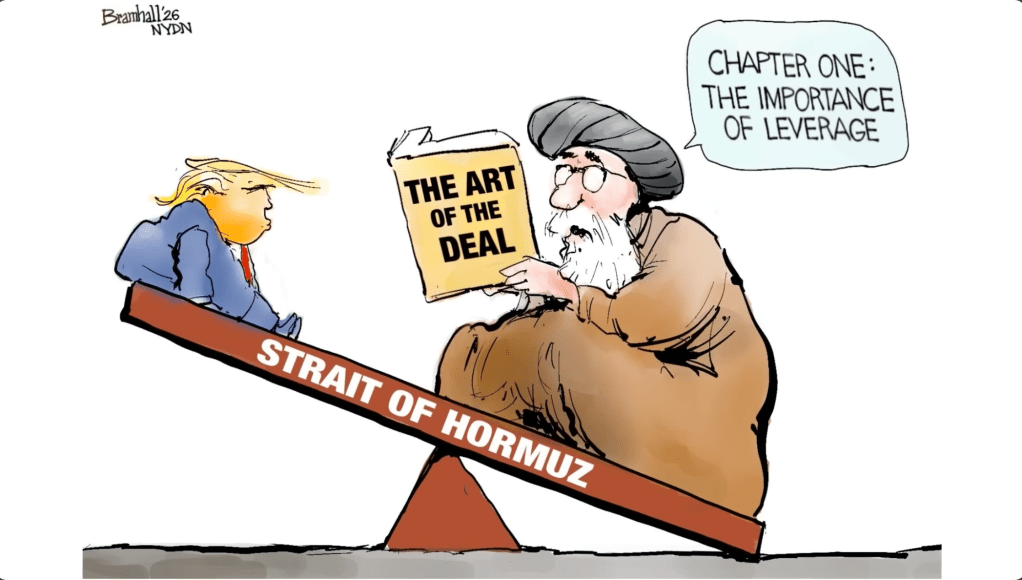
But exiting comes with costs. If Mr. Trump leaves Iran with its near-bomb grade nuclear fuel buried under rubble and with the Strait of Hormuz under de facto Iranian control, he will have failed to address the problem that triggered his attack and created a vast new one for energy markets.
It would define his legacy. And it would make clear that there are more constraints on his power than he believed in January, when he declared that his reach was limitless.
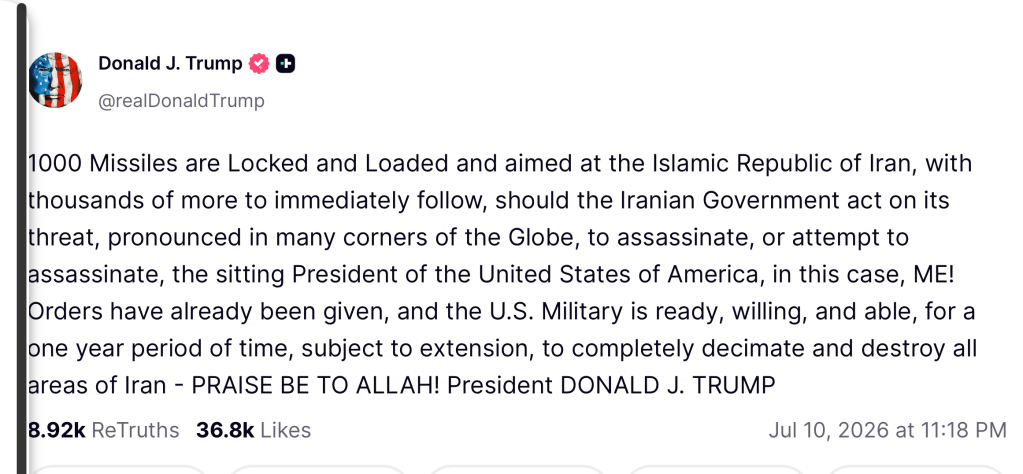
The part that isn’t bullshit is the claim that the Iranians are trying to assassinate Trump.
If you have been planning your financial affairs on the assumption that the war with the Islamic Republic of Japan will soon be over, then you are a gullible fool, and you deserve what you are going to get.
Trump has already suffered defeat at the hands of the Iranians. To try to hide that defeat from you—but most of all, to try to hide it from himself—he has fallen deeper and deeper into delusional narcissism.
When you hold a losing hand, your best option is to negotiate the least bad deal you can get, and then walk away. But in order to implement your least bad option, first you have to get past your natural reluctance to admit how bad the situation actually is.
If you are buying stock or oil futures based on the assumption that Trump and Iran are actually negotiating a deal and will soon finalize that deal, then you are a fool, and you richly deserve what’s coming to you.
Iran says it won’t negotiate any more unless and until Israel lays off Lebanon.
If Mango Mussolini tells Bibi to lay off Lebanon, and if Bibi follows those orders, then everyone’s going to say that Trump is a wimp for doing what Teheran directed him to do.
But if the war in Lebanon goes on, then a lot of people are going to blame Israel for torpedoing the deal with Iran. “Protocols of the Elders of Zion” and rampant anti-semitism, here we come again!
Toward the beginning of the video, Rick Wilson—a serious person, who is not known to make things up—gives us some new and surprising information about the terms of the Iran memorandum of understanding.
Today’s Wall Street Journal lucidly explains the situation:
Donald Trump has told US negotiators “not to rush into a deal” with Iran that would lead to the reopening of the Strait of Hormuz, saying “both sides must take their time and get it right”.
The US president’s remarks, in a post to his Truth Social platform, came a day after he suggested that an agreement was close, claiming it had “largely been negotiated”.
On Saturday afternoon, Trump said “final aspects and details” of a deal that would open the Strait of Hormuz were “currently being discussed” and would “be announced shortly”.
But his social media post on Sunday morning raised the possibility that talks would stretch beyond the weekend.
“The negotiations are proceeding in an orderly and constructive manner,” Trump wrote. He described the back-and-forth as the “exact opposite” of the two years of talks that led to the Joint Comprehensive Plan of Action, the 2015 agreement that placed restrictions on Iran’s nuclear programme and from which the president withdrew the US in his first term.
In a subsequent post he said the deal “isn’t even fully negotiated yet”.
A senior administration official later said the Iran agreement would not be signed on Sunday, but there had been “progress” made towards a deal.