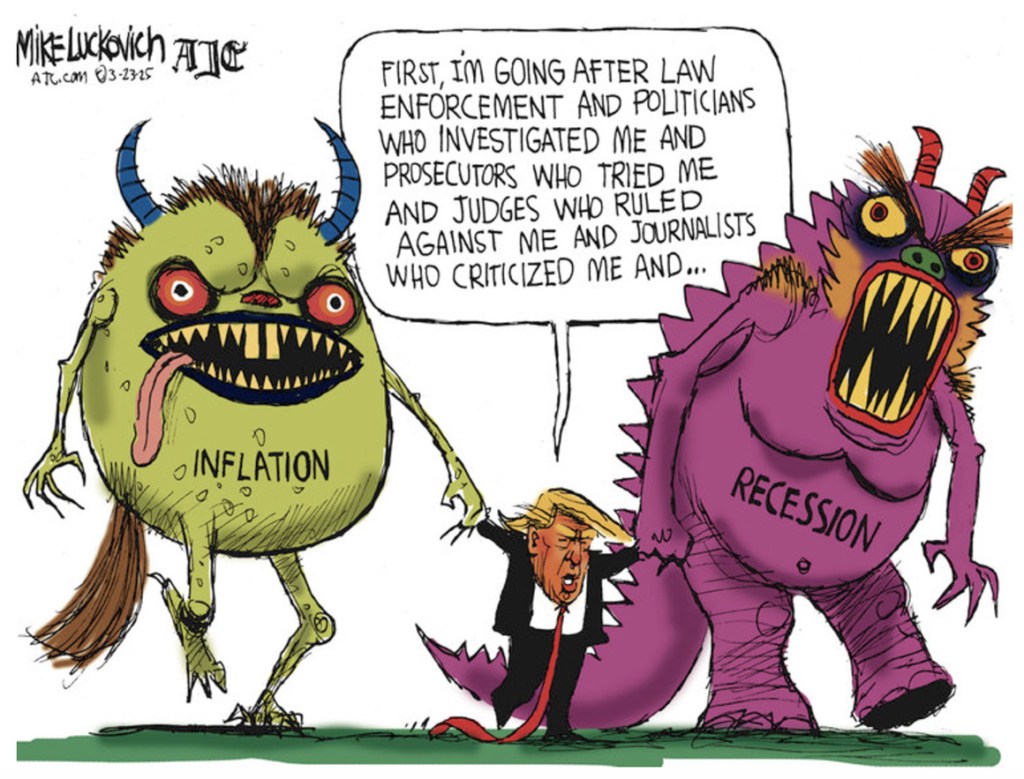
Trump Versus Big Law, Headlines Versus Reality

Michael S. Schmidt (N.Y. Times), Law Firm Bends in Face of Trump Demands: Paul, Weiss—one of three law firms targeted by President Trump as part of his retribution campaign—said it resolved the conflict by agreeing to a range of commitments.

With the United States Congress having debased and shamed itself in the face of Trump’s bullying, it’s especially important for other institutions to stand up to the nonsense. Especially the Supreme Court and the rest of the federal judiciary. Especially the colleges and universities, and particularly the elite universities. Especially the legal profession, and particularly the American Bar Association and the elite law firms. 

In recent days, Trump has targeted three of the elite law firms: Perkins CoieCovington & Burling, and Paul Weiss.

In the initial round of the Perkins Coie imbroglio, Judge Howell handed Trump his (Trump’s) ass on a silver platter

As to Covington, as far as I can tell, the matter is hanging fire.

In the case of Paul Weiss, the firm retained as its counsel a Trump-linked law firm and then, shortly thereafter, Paul Weiss’s head had a face-to-face meeting with Mango Mussolini—a meeting that is said to have resulted in a settlement agreement. The latter has been represented, at least by headline writers, as a capitulation by the targeted law firm. 

I really don’t think so.

Trump-Approved Pro Bono Work

The purported agreement is described in Mr. Schmidt’s article, cited above. One component is said to entail the firm’s contributing “$40 million in legal services to causes Mr. Trump has championed, including ‘the President’s Task Force to Combat Antisemitism, and other mutually agreed projects,” according to Schmidt’s reporting. 

Paul Weiss’s annual revenue is about $2.6 billion, and its profit per partner stands at just over $7.5 million. Even if the agreement implied that the firm would forego $40 million in revenues, that would only be a microscopic part of the firm’s annual earnings. 

Paul Weiss is currently charging $1,000 per hour for second-year associates, $1,560 per hour for senior associates, and up to $2,400 per hour for partner time. Depending on which lawyers at Paul Weiss are going to provide the Trump-approved pro bono legal services, it’s not going to take all that long to eat up $40 million. 

DEI

Schmidt also reports, “The firm, Mr. Trump said, also agreed to conduct an audit to ensure its hiring practices are merit based ‘and will not adopt, use, or pursue any DEI policies.’”

As of mid-day today, the Paul Weiss website continues to promote its “culture of inclusion” at considerable length and depth.

The Bottom Line

Interpret all of this as you will. My bottom line is that this was a face-saving retreat by Trump. 

Trump’s Authoritarian Playbook: Sadism Toward Your Own Base

Amanda Taub (N.Y. Times), Trump’s Judicial Defiance Is New to the Autocrat Playbook, Experts Say: The president’s escalating conflict with federal courts goes beyond what has happened in countries like Hungary and Turkey, where leaders spent years remaking the judiciary.

Stephen I. Vladeck (N.Y. Times), The Courts Alone Can’t Save Us

Plus: Did someone say “tariffs”?

My strong sense is that Trump’s mental illness has advanced to the stage where his situational awareness is severely, severely diminished. As so many have noted, he does indeed have an authoritarian playbook. But it’s not the playbook of a rational wannabe authoritarian. 

Perhaps through confirmation bias, this afternoon I call your attention to Amanda Taub’s essay, which draws a sharp contrast between Trump’s approach and that of the dictators presiding over Hungary and Turkey. 

Trump—and his MiniMes like Rep. Hageman of Wyoming—seem to think that their own base are a bunch of masochists.

Trump’s Right About One Thing: Only Trump Can Fix It

An authoritarian playbook based on madness and sadism toward your own supporters is a dog that won’t hunt.

Trump is right. The one person who can defeat Donald Trump—the one person who is going to defeat Donald Trump—is none other than Mango Mussolini himself. 

All Hail Mango Mussolini, savior of the Republic.

How Many Divisions Does the Chief Justice Have?

Reuters, US Chief Justice Roberts rebukes Trump’s attack on judge

N.Y. Times, Trump Administration Pushes Back Against Judge’s Orders on Deportations

A friend has written to ask, “Are we getting closer to a test [of the rule of law in the United States]?” The answer is yes. 

How are we to predict what will happen when push comes to shove?

George Conway’s face has been all over YouTube, reminding us that if and when there is a direct confrontation between the courts and the executive branch, they only coercive power the courts have is the United States Marshals Service, and that the latter is under the control of the executive.

Well, yeah. But I think there are actually two sides to this coin. 

Two Sides to the Coin: Who Will or Won’t Obey Which Orders?

Well may we ask, how do the courts enforce their orders when Trump tells his minions to violate the law?

But, by like token, when Trump tells his team to violate the law, how many of them will actually do it?

Let’s wargame this out. 

Some on the Trump team are lawyers—actual members of the bar. Lawyers who engage in contempt of court—not to mention other violations like subornation of perjury or obstruction of justice—face fines, imprisonment, and disciplinary actions up to and including disbarment. 

If you are a lawyer, there will probably come a time when a client will pressure you to violate the law or demand that you violate the law. You had bloody well not do it. It’s the wrong thing to do. But even if you don’t give a tinker’s damn about right or wrong, it’s still a really bad idea to violate the law on a client’s behalf.

Now, to push our little thought experiment to the next step: Maybe you are a member of the bar who has drunk deeply of the MAGA Kool-Aid. Maybe you think that a Trump dictatorship would be just fine and dandy. But are you SURE that the leap toward dictatorship is actually going to work? 

Because, friend, if Trump doesn’t pull off his dictatorship, then you are going to be left up that famous tributary without a means of locomotion.

If you are a lawyer, you will be subject to disbarment, and will need to find another line of work—animal husbandry, maybe?

If you are not a lawyer, you can’t be disbarred—you were never “barred” in the first place—but there are plenty of other adverse consequences that could ensue. 

In short, Conway is surely right as far as he goes: Just because the Supreme Court says “Jump,” that doesn’t mean that everyone in the land will ask “How high, sirs?”

But the same thing goes if and when Trump says “Jump—into defiance of the rule of law!” Lots of people will jump. But how many will not jump?

And Then There are the Knock-on Effects …

As Conway says, when push comes to shove, there will be a lot of folks out in the streets. But it won’t only be folks in the streets. Read the damn WSJ Editorial Board, for example: If the rule of law disappears and it becomes a jungle out there, how the hell can big business enforce its contracts—or have enough certainty to invest and thrive?

What will Trump do when every Fortune 500 CEO comes for him?

… At a Time When There is Massive Pain Throughout Society

If you’re Mango Mussolini and you want to go full authoritarian, maybe you don’t want to pick a time when government breakdowns are hurting your peeps and when trade wars are causing big pain. 

Not a Rosy Scenario—But a Damn Uncertain Scenario

No, my name is not Rosy Scenario, and of course I don’t know how all of this is going to turn out. But I do know, to a high level of confidence, that there are a whole lot of moving parts—and a lot of those moving parts may not move in Trump’s direction.

“Just Because Trump is a Product of American Rage Does not Mean he is a Solution to It”

Derek Thompson (The Atlantic), The Political Right of the Century: For the first time in decades, America has a chance to define its next political order. Trump offers fear, retribution, and scarcity. Liberals can stand for abundance.

Derek Thompson is the co-author, along with Ezra Klein, of the new book Abundance. I strongly recommend the whole article. If you don’t subscribe to The Atlantic, then you really should. 

Here are some highlights:

Donald Trump has promised a “golden age of America.” But for all his bluster about being the champion of an American century, Trump’s actual policies point to something different: not an expansive vision of the future, but a shrunken vision of the present.

Throughout the opening months of his administration, the Trump White House has consistently pointed to existing shortages to demand new sacrifices. The administration says America cannot afford its debt, and therefore we cannot afford health care for the poor. The administration says America doesn’t have a healthy economy, and therefore we have to accept economic “hardship.” The administration says America doesn’t have enough manufacturing, and so we must suffer the consequences of less trade. The administration says America doesn’t have enough housing, and so we need fewer immigrants. The administration says American scientists aren’t focused on the right research, and so we have to gut our federal science programs. Again and again, Americans are being fed the line that everything that we don’t have requires the elimination of something that we need.

The MAGA movement might try to justify its wrecking-ball style by arguing that its extreme approach is commensurate with the level of anger that voters feel about the status quo. But just because Trump is a product of American rage does not mean he is a solution to it.

In housing, for example, Americans have every right to be furious. Home construction has lagged behind our national needs for decades. Today, the median age of first-time homebuyers has surged to a record high of 38. Large declines in young homeownershiphave likely prevented many young people from dating, marrying, and starting a family. Although Trump was swept into office on a wave of economic frustration, his initial foray into economic policy has done little to help the situation. As the National Association of Home Builders pointed out in an alarmed March 7 memo, his persistent threat of tariffs on Mexico and Canada could drive up the cost of crucial materials, such as softwood lumber and drywall gypsum, which are “largely sourced from Canada and Mexico, respectively.” Meanwhile, Trump’s anti-immigrant policies foretell new labor shortages in the construction industry, where roughly 25 percent or more workers are foreign-born.

This is where Democrats should be able to stand up and show that they have a winning response to the less-is-less politics from the right. But in many places run by Democrats, the solution on offer is another variety of scarcity. Blue cities are laden with rules and litigation procedures that block new housing and transit construction. As my colleague Yoni Appelbaum has noted, in California cities where the share of progressives votes goes up by 10 points, the number of housing permits issued declines by 30 percent. Where the supply of homes is constricted, housing prices soar, and homelessness rises. As of 2023, the five states with the highest rates of homelessness were New York, Hawaii, California, Oregon, and Washington—all run by Democrats.

As the cost of living rises in blue states, tens of thousands of families are leaving them. But the left isn’t just losing people. It’s losing an argument. It has become a coalition of Kindness Is Everything signs in front yards zoned for single-family homes. Liberals say they want to save the planet from climate change, but in practice, many liberal areas have shut down zero-carbon nuclear plants and protested solar-power projects, leaving it to red states such as Texas to lead the nation in renewable-energy generation. Democrats cannot afford to become the party of language over outcomes, of ever more lawn signs and ever fewer working-class families.

If Trump’s opponents are going to win at the polls, they will need to construct a new political movement, one that aims for abundance instead of scarcity. Such a movement would combine the progressive virtue of care for the working class and a traditionally conservative celebration of national greatness, while taking a page from the libertarian obsession with eliminating harmful regulations to make the most important markets work better. It would braid a negative critique of Trump’s attack on the government with a positive vision of actual good governance in America—while providing a rigorous focus on removing the bottlenecks that stand in the way.

Abundance begins with specific goals for America’s future. Imagine much more housing where it’s most in demand. An economy powered by plentiful clean energy. A revitalized national science policy prioritizing high-risk discoveries that extend lives and improve health. And a national invention agenda that seeks to pull forward technologies in transportation, medicine, energy, and beyond that would improve people’s lives. …

I can imagine somebody opposed to the MAGA movement reading all of this and thinking: Why, at a time when Trump presents such a clear threat to the American project, is it appropriate to focus such criticism on the Democratic side?

First, to make the argument for a liberal alternative to Trumpism, Democrats have to show Americans that voting for liberals actually works. … 

Second, Americans are furious about the status quo—the youngest voters are “more jaded than ever about the state of American leadership,” according to the Harvard Political Review—and liberals need a new style of politics for the age of anti-establishment anger. The right’s answer to rage is chaos in search of an agenda. MAGA acts like a drunk toddler with a chain saw, carelessly slashing through state programs with a high risk of self-harm. But Democrats should not allow the forces of negative polarization to turn them into the party that reflexively defends the status quo at every turn, even when it means refusing to reform institutions that have lost the public’s trust. Quite the opposite: Abundance should be a movement of proud, active, and even obsessive institutional renewal.

Consider U.S. science policy, an area that is under attack from the right at this moment. As the centerpiece of U.S. biomedical funding, the National Institutes of Health has accomplished extraordinary things; you will have a hard time finding many scientific breakthroughs in the past 50 years—in heart disease, genetics, epidemiology—that were not irrigated by its funding.

But many of the same factors that have infamously plagued our housing and energy markets—paperwork, bureaucratic drift, entrenched incumbent interests—have become fixtures in American science. It is practically a cliché among researchers that the NIH privileges incremental science over the sort of high-risk, high-reward investigations that would likely uncover the most important new truths. Surveys indicate that the typical U.S. researcher spends up to 40 percent of their time preparing grant proposals and filling out paperwork rather than actually conducting science. As John Doench, the director of research and development in functional genomics at the Broad Institute, told me: “Folks need to understand how broken the system is.” …

Today, we seem to be in a rare period in American history, when the decline of one political order makes space for another. This crackup was decades in the making. It started with the Great Recession, which shattered a broad belief in free and unregulated markets. It continued throughout the 2010s, as slow economic recovery fueled public resentment of inequality, and an affordability crisis gathered steam. In 2020, the pandemic obliterated many Americans’ trust in government, or what was left of it. And from 2021 to 2024, inflation brought national attention to the interlocking crises of scarcity, supply, and unaffordability. For years, the boundaries of American politics had felt fixed, even settled. But now they are falling.

“For a political order to triumph, it must have a narrative, a story it tells about the good life,” Gerstle told me. Today’s politics are suffused with pessimism about government because “a way of living sold to us as good and achievable is no longer good, or no longer achievable.” In 2016, the rise of Bernie Sanders on the left and Donald Trump on the right revealed how many Americans had stopped believing that the life they had been promised was achievable. What both the socialist left and the populist-authoritarian right understood was that the story that had been told by the establishments of both parties, the story that had kept their movements consigned to the margins, had come to its end.

Political movements succeed when they build a vision of the future that is imbued with the virtues of the past. Franklin D. Roosevelt pitched his expansive view of government as a sentinel for American freedoms: of speech, of worship, from want, from fear. Decades later, Ronald Reagan recast government as freedom’s nemesis rather than its protector. Abundance, too, is about redefining freedom for our own time. It is about the freedom to build in an age of blocking; the freedom to move and live where you want in an age of a stuck working class; the freedom from curable diseases that come from scientific breakthroughs. Trump has defined his second term by demolition and deprivation. America can instead choose abundance.

In the Cold Light of Morning: A Government Shutdown Would Have Been the Wrong Hill to Die On

To begin with, and for what little it’s worth, I want to be recorded as deploring the instinct to try to win a difficult argument by resorting to ad hominem slurs—“He’s a coward!”—against folks who disagree with you. It’s entirely illogical. It is an extraordinarily poor way to think yourself out of a hard problem. And it gives aid and comfort to the enemy.

So please don’t do it. 

If you think Chuck Schumer’s analysis is wrong, fine, but explain why.

If you think my points are wrong, fine, but explain why. Don’t hurl ad hominem slurs. 

Now to the main points, which are five.

First, a shutdown would have given extraordinary new powers to the president. See, for example, N.Y. Times, The Democratic Divide: Would a Shutdown Have Helped or Hurt Trump?

Second, as sure as God made little green apples, Trump and his minions would have used those extraordinary powers as tools to wreck the federal government.

Third, and relatedly, the extraordinary legal powers that the law purports to confer on the president during a shutdown would have been used to give what lawyers call the “color of law” to Trump’s wrecking ball. Our side is winning in court on Trump’s abuse of power. We don’t want to give ourselves another legal hoop to jump through.

Fourth, a government shutdown would have supplied Trump and his minions with a splendid “argument” to further confuse an already confused public. “It’s not Trump who’s causing your pain,” they would scream, “it’s those damn Democrats who shut down the government.” 

With no government shutdown, ALL THE CHAOS IS ON TRUMP AND HIS ENABLERS.

Fifth, because of points one, two, three, and four, there would be little incentive for Trump and the Republicans to negotiate to get out of the shutdown. 

A shutdown is to the Trumpistas as the briar patch was to Brer Rabbit. 

After Uncle Remus, Let Us Share a Few Words from Ancient China

知己知彼,百戰不殆。

Know yourself.

Know your enemy.

Hundred battles.

No danger. 

Yesterday, I heard a talking head on the internet cite a purported academic study considering who is most likely to survive a catastrophe. Answer: it’s the person who can, most quickly, form an adequate assessment of the actual situation they are in. 

Yeah, I heard it on the internet, so it must be true. 

By the way, I gave you, above, an accurate character-by-character translation of the famous quote from Sunzi. Some people translate the whole thing to imply that you will win all one hundred battles. That’s a legitimate translation, but, personally, I suspect it’s not quite what Sunzi meant. I think he meant that you may lose some battles but that, after the war has run its full course, if you have been situationally aware, then final victory will be yours. 

Donald Trump as Brer Rabbit, the Government Shutdown as the Briar Patch

From the original Uncle Remus stories:

“Den Brer Rabbit talk mighty ‘umble.

“‘I don’t keer w’at you do wid me, Brer Fox,’ sezee, ‘so you don’t fling me in dat brier-patch. Roas’ me, Brer Fox’ sezee, ‘but don’t fling me in dat brierpatch,’ sezee.

“‘Hit’s so much trouble fer ter kindle a fier,’ sez Brer Fox, sezee, ‘dat I speck I’ll hatter hang you,’ sezee.

“‘Hang me des ez high as you please, Brer Fox,’ sez Brer Rabbit, sezee, ‘but do fer de Lord’s sake don’t fling me in dat brier- patch,’ sezee.

“‘I ain’t got no string,’ sez Brer Fox, sezee, ‘en now I speck I’ll hatter drown you,’ sezee.

“‘Drown me des ez deep ez you please, Brer Fox,’ sez Brer Rabbit, sezee, ‘but do don’t fling me in dat brier-patch,’ sezee.

“‘Dey ain’t no water nigh,’ sez Brer Fox, sezee, ‘en now I speck I’ll hatter skin you,’ sezee.

“‘Skin me, Brer Fox,’ sez Brer Rabbit, sezee, ‘snatch out my eyeballs, t’ar out my years by de roots, en cut off my legs,’ sezee, ‘but do please, Brer Fox, don’t fling me in dat brier- patch,’ sezee.

“Co’se Brer Fox wanter hurt Brer Rabbit bad ez he kin, so he cotch ‘im by de behime legs en slung ‘im right in de middle er de brier-patch. Dar wuz a considerbul flutter whar Brer Rabbit struck de bushes, en Brer Fox sorter hang ‘roun’ fer ter see w’at wuz gwineter happen. Bimeby he hear somebody call ‘im, en way up de hill he see Brer Rabbit settin’ crosslegged on a chinkapin log koamin’ de pitch outen his har wid a chip. Den Brer Fox know dat he bin swop off mighty bad. Brer Rabbit wuz bleedzed fer ter fling back some er his sass, en he holler out:

“‘Bred en bawn in a brier-patch, Brer Fox—bred en bawn in a brier-patch!’ en wid dat he skip out des ez lively ez a cricket in de embers.”

The View from 30,000 Feet: A Psychiatrist’s Analysis of our Current Psychoses

Russell Razzaque, M.D., a psychiatrist, earned his medical degree at the University of London. More on him here.

I find his psychiatric analysis of voter insecurities to be persuasive and enlightening. Take a look, and judge for yourself. 

Senator Schumer Makes His Case Against a Shutdown

N.Y. Times, Chuck Schumer: Trump and Musk Would Love a Shutdown. We Must Not Give Them One

Senator Schumer writes, 

Over the past two months, the United States has confronted a bitter truth: The federal government has been taken over by a nihilist.

President Trump has taken a blowtorch to our country and wielded chaos like a weapon. Most Republicans in Congress, meanwhile, have caved to his every whim. The Grand Old Party has devolved into a crowd of Trump sycophants and MAGA radicals who seem to want to burn everything to the ground.

Now, Republicans’ nihilism has brought us to a new brink of disaster: Unless Congress acts, the federal government will shut down Friday at midnight.

As I have said many times, there are no winners in a government shutdown. But there are certainly victims: the most vulnerable Americans, those who rely on federal programs to feed their families, get medical care and stay financially afloat. Communities that depend on government services to function will suffer.

This week Democrats offered a way out: Fund the government for another month to give appropriators more time to do their jobs. Republicans rejected this proposal.

Why? Because Mr. Trump doesn’t want the appropriators to do their job. He wants full control over government spending.

Sign up for the Opinion Today newsletter  Get expert analysis of the news and a guide to the big ideas shaping the world every weekday morning. 

He isn’t the first president to want this, but he may be the first president since Andrew Jackson to successfully cow his party into submission. That leads Democrats to a difficult decision: Either proceed with the bill before us or risk Mr. Trump throwing America into the chaos of a shutdown.

This, in my view, is no choice at all.

For sure, the Republican bill is a terrible option. It is deeply partisan. It doesn’t address this country’s needs. But even if the White House says differently, Mr. Trump and Elon Musk want a shutdown. We should not give them one. The risk of allowing the president to take even more power via a government shutdown is a much worse path.

To be clear: No one on my side of the aisle wants a government shutdown. Members who support this continuing resolution do not want that. Members who oppose it do not want that.

Members who oppose this resolution want the Republicans to take their responsibilities more seriously and to negotiate spending bills that will address the many needs of the American people.

I respect my fellow Democrats for that. Unfortunately, this Republican Party is the party of Trump.

As bad as passing the continuing resolution would be, I believe a government shutdown is far worse.

First, a shutdown would give Mr. Trump and Mr. Musk permission to destroy vital government services at a significantly faster rate than they can right now.Under a shutdown, the Trump administration would have wide-ranging authority to deem whole agencies, programs and personnel nonessential, furloughing staff members with no promise they would ever be rehired.

The decisions about what is essential would, in practice, be largely up to the executive branch, with few left at agencies to check it.

Mr. Musk has reportedly said that he wants a shutdown and may already be planning how to use one to his advantage.

Second, if we enter a shutdown, congressional Republicans could weaponize their majorities to cherry-pick which parts of government to reopen.

In a protracted shutdown, House and Senate Republicans could bring bills to the floor to reopen only their favored departments and agencies while leaving other vital services that they don’t like to languish.

Third, shutdowns mean real pain for American families.

For example, a shutdown could cause regional Veterans Affairs offices to reduce even more of their staffs, further delay benefits processing and curtail mental health services — abandoning veterans who earned, and depend on, those resources.

A shutdown could continue to slash the administrative staffs at Social Security offices — delaying applications and benefit adjustments and forcing seniors to wait even longer for their benefits.

A shutdown could further stall federal court cases and furlough critical staff members — denying victims and defendants alike their day in court, dragging out appeals and clogging the justice system for months or years.

Finally, a shutdown would be the best distraction Donald Trump could ask for from his awful agenda.

Right now, Mr. Trump owns the chaos in the government. He owns the chaos in the stock market. He owns the damage happening to our economy. The stock market is falling, and consumer confidence is plummeting.

In a shutdown, we would be busy fighting with Republicans over which agencies to reopen and which to keep closed instead of debating the damage Mr. Trump’s agenda is causing.

I believe it is my job to make the best choice for the country, to minimize the harms to the American people. Therefore, I will vote to keep the government open.

The Wall Street Journal Would Like You to Know That I Nailed it: Trump’s Screwing the Poor, He’s Screwing the Middle, and, For Good Measure, He’s Screwing the Rich, Too

Robin Hood, he ain’t.

Wall Street Journal, Consumer Angst Is Striking All Income Levels: Signs of weakness are showing up in spending on everything from basics to luxuries

The Journal identifies the “key points” as follows, after which it expatiates.

Key Points

  • Consumer spending is declining across all income levels due to concerns about tariffs, inflation and a potential recession.
  • Retailers are reporting weak demand since the start of the year as consumers become more cautious about their spending.