Trump Announces New Commissioner of Labor Statistics
With clear eyes, hard facts, critical thinking, new political strategy, empathy, and a soupçon of Schadenfreude
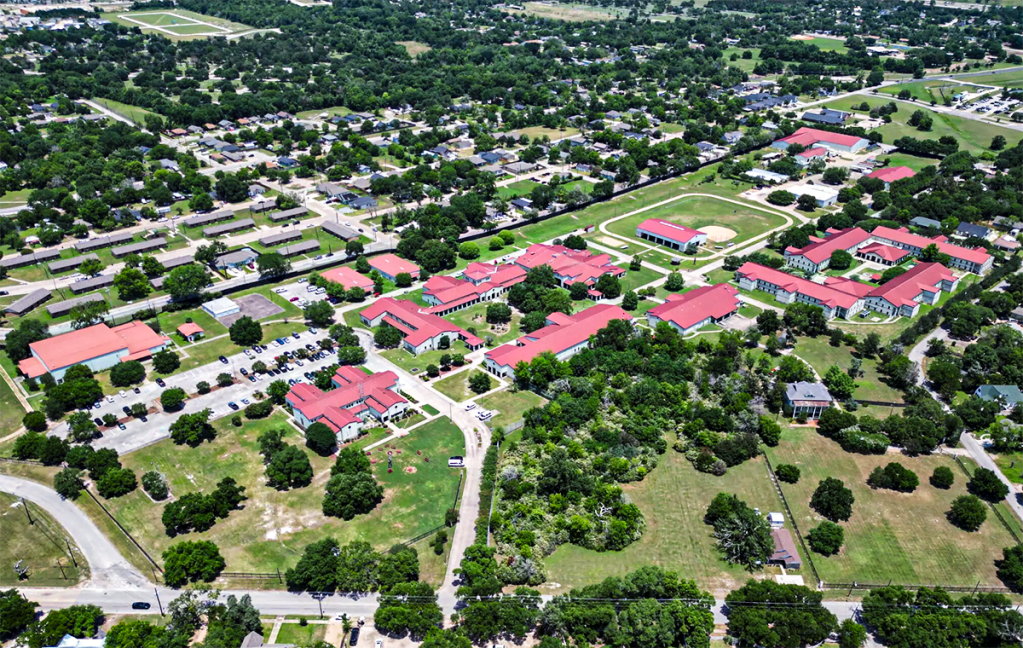
Pictured above is Ghislaine Maxwell’s new home—the federal women’s prison officially called the Federal Prison Camp, Bryan [Texas] and unofficially known as Club Fed.
On December 21, 2021, Ms. Maxwell was convicted of five counts of sex trafficking—charges that could have resulted in 65 years’ imprisonment. The prosecutors asked for 30 years. The judge gave her 20. In July, 2022, she began serving her sentence at the Federal Correction Institution, Tallahassee.
CNN writes,
Maxwell’s transfer to a minimum-security prison is relatively uncommon, as those convicted of sex offenses are almost always deemed too high of a risk to public safety. That means that those inmates are at best assigned to a low-security prison. …
The move comes a week after Maxwell met in private with Deputy Attorney General Todd Blanche at the US attorney’s office in Tallahassee. Details of that meeting have not been made public, though her lawyer has said that Maxwell “honestly answered every question that Mr. Blanche asked.”
Murphy declined to give any explanation for Maxwell’s move. The Justice Department has not responded to questions from CNN. …
A minimum-security prison camp, like in Bryan, is the least-restrictive type of facility among federal prisons, housing inmates considered to be low-risk, non-violent and unlikely to escape. Camps have very little or no fencing containing the inmates, and inside they are able to move relatively freely.
Other inmates in the camp for women include Jen Shah, who was on the TV show “Real Housewives of Salt Lake City,” and Elizabeth Holmes, formerly of the blood-testing company Theranos.
For an inmate like Maxwell to be transferred into a minimum-security prison, a top official inside of the Bureau of Prisons would need to conclude that her risk to public safety has lowered based off recommendations from prison staff or good behavior. That official, the administrator of the Designation and Sentence Computation Center, makes those determinations, according to the BOP.
The agency declined to explain the specifics of how Maxwell’s reassignment was handled.
Maxwell’s new facility, a federal prison camp, has limited perimeter fencing, a low staff-to-inmate ratio, and is “work- and program-oriented,” according to the [Bureau of Prisons] website.
Thing things about Ghislaine and her new prison home. Thing One: It’s a damn sight better for her than her old prison in Tallahassee. Thing Two: It’s a favor that Trump and his minions can take back at any time. Thing Three: The fact that Trump granted the favor—without any explanation or plausible reason, and given the ongoing Epsteingate saga—makes Trump look really, really bad.
In sum: big upside for Ghislaine, but downside for Orange Mussolini.
For those who shave with Occam’s razor, there’s only one possible explanation: Trump needs Ghislaine to zip her lips and keep ‘em zipped, because she knows things that would, at the very least, be seriously embarrassing to His Most High Excellency.
But Orange Mussolini, it must be remembered, is a man virtually without shame. He shamelessly admits to groping women by the genitalia. He shamelessly admits to barging into the dressing room at the Miss Teenage USA Pageant and taking a good look.
The mind boggles at what new shameful information might concern him now. It must be a hell of a secret.
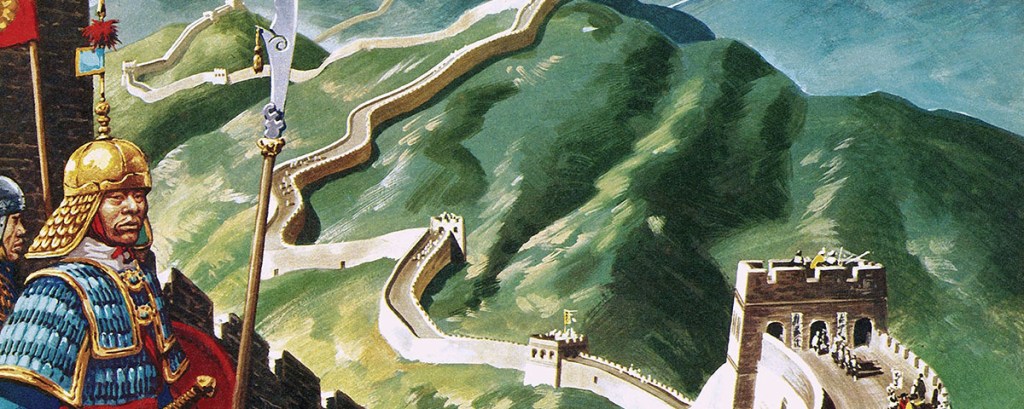
More than two millennia ago, Chinese leaders discovered that, if barbarians want to engage in mutually destructive fights among themselves, the thing for China to do is to hold their beer and let them have at it.
Today, they are delighted to see us destroy ourselves.
Ishaan Tharoor of the Post writes, a propos “China’s evolving view of President Donald Trump’s second term,”
Beijing sees Trump’s disruptive actions — his gutting of institutions of U.S. soft power, his launching of trade wars against adversaries and allies alike, his steady eroding of trust in the U.S. alliance system — as acts of self-sabotage that need no Chinese prompting. Better for now, as Gen Z would say, to let him cook.
After Trump moved to dismember the U.S. Agency for Global Media, which backed internationally oriented outlets such as Voice of America, Chinese state-made broadcasts took the place of U.S. programming on TV networks in countries as disparate as Indonesia and Nigeria. Trump, like a growing number of Republicans, viewed the media properties as suspicious fonts of “anti-American” liberalism. But Chinese propagandists exulted at the demise of these U.S.-funded news operations, which had, to varying extents, chronicled the state of pro-democracy movements around the world and provided space for dissident voices in countries where political freedoms are curtailed.
“The Chinese people are happy to see the U.S. anti-China ideological fortress breached from within,” cheered Hu Xijin, former chief editor of the Global Times, a Chinese state-run, English-language newspaper, this year on social media.
In a video circulating this month, Victor Gao, a former Chinese diplomat and vice president of the Beijing-based Center for China and Globalization, mused whether Trump may come to be remembered as an American Mikhail Gorbachev. The comparison to the late Soviet leader and famous author of glasnost and perestroika was not meant to be flattering: Gorbachev’s attempt at reforms, Gao said, precipitated the collapse of the Soviet empire and unleashed a “trauma” still being felt today.
Gao suggested that by the end of the decade, Trump’s own attempt at reforms will have “fundamentally changed” both the United States and NATO, likely for the worse. Trump would not have made America “bigger, stronger, greater,” Gao said, but rather may have “led it astray, like Gorbachev.”
The fall of the Soviet Union isn’t the only historical parallel alive in Chinese discourse about the U.S. A host of Chinese commentators see in MAGA a whiff of China’s own Cultural Revolution under Mao Zedong, which saw myriad purges and the defenestration of ranks of the intellectual classes and political elites. “Mao unleashed the Red Guards to ‘smash’ the police, prosecutors, and courts, so that loyal revolutionaries could seize control of state machinery,” Zhang Qianfan, a constitutional law professor in Beijing, recently told CNN. “Trump brought Elon Musk and six young Silicon Valley executives into the White House under the banner of eliminating corruption, waste, and inefficiency — akin to the ‘Cultural Revolution Leadership Group’ entering the party’s central leadership.” …
Various “initiatives” promulgated by Xion development, security and cultural harmony have put forward a rosy Chinese vision of global cooperation and prosperity stripped of liberal ideals around universal rights and democracy. China’s position is gaining ground thanks to the shifts in Washington. “Beijing’s assessment right now is that the United States is dismantling, fairly systematically, the sources of its strength,” Julian Gewirtz, a China scholar and former Biden administration official, said in a recent interview.
“The United States, in their view, is dismantling its alliance relationships and alienating much of the world,” Gewirtz told the Wire China. “It is dismantling aspects of the U.S. science and technology ecosystem, cutting funding to some of our great universities, and making it very unappealing, if not outright impossible, for foreign talent to come do research in those universities. And it is eliminating arms of U.S. influence around the world, from USAID to Voice of America. China’s view is that the United States is, in a sense, unilaterally disarming.”
Wall Street Journal, Justice Department Told Trump in May That His Name Is Among Many in the Epstein Files
N.Y. Times, Trump Administration Live Updates: Attorney General Alerted Trump His Name Appeared in Epstein Files
Jonathan Chait (The Atlantic), Trump’s Epstein Denials Are Ever So Slightly Unconvincing: The president is not behaving like an innocent man with nothing to hide
The two news articles are from this afternoon. The Chait opinion piece is from this morning.
So, here’s my top list of things I’d like to know.
In advance of knowing these things, I would like to know why, if Trump is not as guilty as homemade sin, why he is acting as if he were as guilty as homemade sin. Like a guilty thing surprised.
Jonathan Chait would like to know these things, too. He writes,
Imagine you were an elected official who discovered that an old friend had been running a sex-trafficking operation without your knowledge. You’d probably try very hard to make your innocence in the matter clear. You’d demand full transparency and answer any questions about your own involvement straightforwardly.
Donald Trump’s behavior regarding the Jeffrey Epstein case is … not that.
The latest cycle of frantic evasions began last week, after The Wall Street Journal reportedthat Trump had submitted a suggestive message and drawing to a scrapbook celebrating Jeffrey Epstein’s 50th birthday, in 2003. This fact alone added only incrementally to the public understanding of the two men’s friendship. Rather than brush the report off, however, Trump denied authorship. “I never wrote a picture in my life,” he told the Journal—an oddly narrow defense for a man reported to have written “may every day be another wonderful secret” to a criminal whose secret was systematically abusing girls, and one that was instantly falsified by Trump’s well-documented penchant for doodling.
On Truth Social, Trump complained that he had asked Rupert Murdoch, the Journal’s owner, to spike the story, and received an encouraging answer, only for the story to run. Under normal circumstances, a president confessing that he tried to kill an incriminating report would amount to a major scandal. But Trump has so deeply internalized his own critique of the media, according to which any organ beyond his control is “fake news,” that he believed the episode reflected badly on Murdoch’s ethics rather than his own.
Having failed to prevent the article from being published, Trump shifted into distraction mode. In a transparent attempt to offer his wavering loyalists the scent of fresh meat, Trump began to attack their standby list of enemies. On Friday, Tulsi Gabbard, the director of national intelligence, renewed charges that the Obama administration had ginned up the Russia scandal to damage Trump. None of the facts she provided supported this claim remotely. The entire sleight of hand relied on conflating the question of whether Russia had hacked into voting machines (the Obama administration said publicly and privately it hadn’t) with the very different question of whether Russia had attempted to influence voters by hacking and leaking Democratic emails (which the Obama administration, former Special Counsel Robert Mueller, and a subsequent bipartisan Senate-committee investigation all concluded it had done).
Why did Gabbard suddenly pick this moment to release and misconstrue 2016 intelligence comprising facts that the Obama administration had already acknowledged in public? Trump made the answer perfectly clear when he used a press availability with the president of the Philippines to deflect questions about Epstein into a rant about the need to arrest Obama.
“I don’t really follow that too much,” he said of the Epstein matter. “It’s sort of a witch hunt. Just a continuation of the witch hunt. The witch hunt you should be talking about is that they caught President Obama absolutely cold.” Trump has yet to specify why the “witch hunt” he’s been stewing over nonstop for nearly a decade remains fascinating, while the new “witch hunt” he just revealed to the world is too tedious to address.
In fact, Trump himself suggested that the two matters were related. He described the Epstein witch hunt as part of a continuous plot that culminated in Joe Biden stealing the 2020 presidential election. (“And by the way, it morphed into the 2020 race. And the 2020 race was rigged.”) You might think that this link would increase Trump’s curiosity about the Epstein matter, given his inexhaustible interest in vindicating his claim to have won in 2020. Not this time!
By invoking 2020, Trump managed to make the Epstein conspiracy theory sound moreworld-historically important—while attaching his protestations of innocence to claims that were hardly settled in his favor. Again, imagine you were in Trump’s position and were completely innocent of any involvement with Epstein’s crimes. You would probably not try to compare the Epstein case to the scandal in which eight of your associates were sentenced to prison, or to the other time when you tried to steal an election and then got impeached. Instead, Trump is leaning into the parallels between the Epstein case and his own long record of criminal associations and proven lies, arguing in essence that the Epstein witch hunt is as fake as the claim that Biden won the 2020 election (i.e., 100 percent real). …
Perhaps Trump is simply so habituated to lying that he has no playbook for handling a matter in which he has nothing to hide. Or maybe, as seems more plausible by the day, he is acting guilty because he is.
Says Mango Mussolini, at 9:43 This Morning
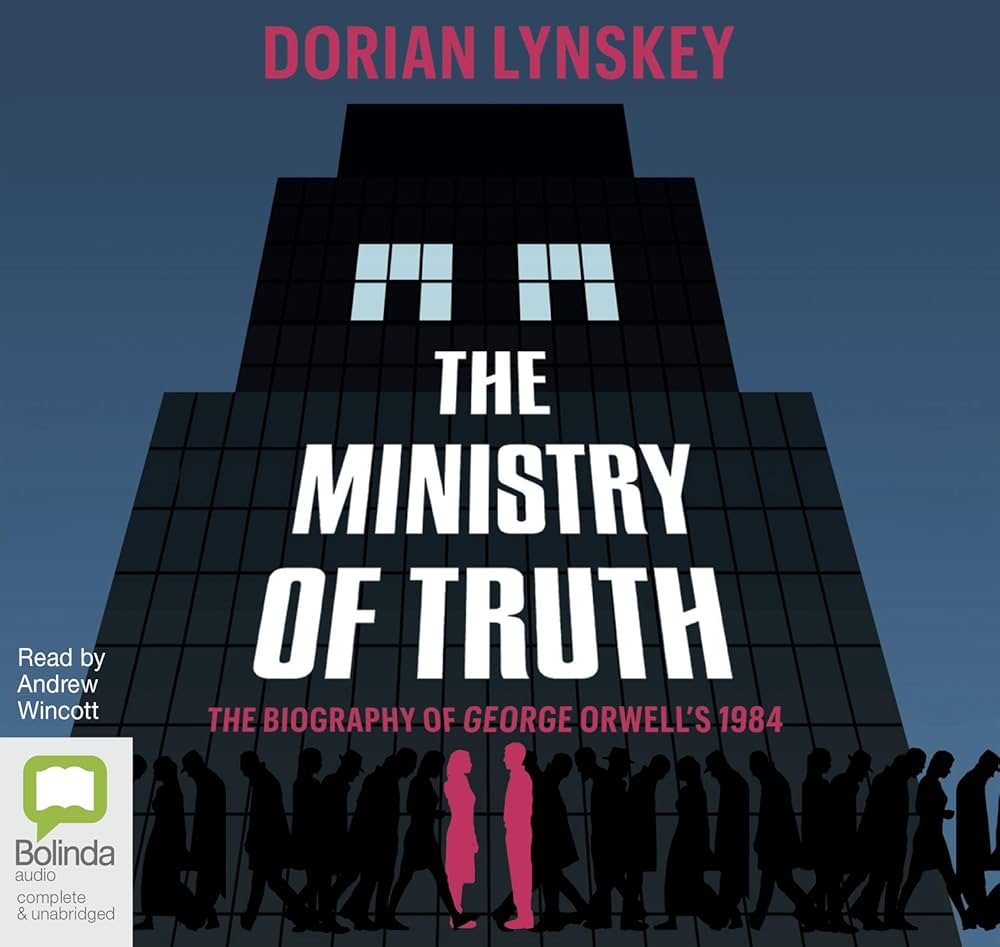
I don’t know whether people still read Orwell’s 1984. But I expect most of my readers know it. Remember what Winston Smith’s job was, at the Ministry of Truth?
This feels as if Trump is ordering the Ministry of Truth to rewrite history, and it’s not going so well.
I think the Morning Joe team did a good job of capturing the current situation. As did Philip Bump in today’s Washington Post. See Trump finds himself on the wrong side of a conspiracy theory: He has leveraged conspiracy theories for a decade—and now one lumps him in with The Elites:
One of the common misunderstandings about President Donald Trump is that he created the culture of conspiracy and surreality in which the American right is now immersed. He didn’t. He simply leveraged it.
This isn’t to say Trump hasn’t generated or amplified any conspiracy theories. He obviously has. It is simply meant to note that he emerged as a political figure a decade ago from an existing culture in which such claims were common currency. The central advantage Trump possessed in the 2016 Republican presidential primary was that he was willing to agree with false theories in a way that the established politicians against whom he was running were not. His most identifiable issue, immigration, was and is rooted in false claims about foreign powers shipping criminals to the U.S. where they are subverting traditional America. It’s conspiracies all the way down.
The conspiracies that take hold of the right centrally rely on the idea that Elites Are Up To No Good. In any objective context, Trump himself would be considered an elite, given his billions of dollars and his power, even before being elected president. But Trump sided with The People, meaning those beside him in the conspiratorial swamps. Because he stood against The Elites, a loosely bounded group that ostensibly controls America — meaning The People — Trump was granted a seemingly irrevocable dispensation from elitism.
Now, that dispensation is suddenly looking rather wobbly.
The reason? Jeffrey Epstein, the man who encapsulated so many of the characteristics that the conspiratorial right attributes to The Elites: inconceivable wealth, access to powerful politicians and celebrities, a privileged lifestyle (including a private island!) and accusations of criminal sexual deviancy involving minors. All of that was attributable to Epstein even before his 2019 death in a Manhattan jail cell — a suicide that was quickly presented by conspiracy theorists as something far more suspicious.
By the time Trump announced his presidential candidacy in mid-2015, Epstein was already a felon. The muckraking website Gawker had already published the contents of Epstein’s address book, including more than a dozen phone numbers for Trump and Mar-a-Lago, where Epstein had once been a regular. The site also published logs from Epstein’s private jet; Trump (and former president Bill Clinton) had been passengers multiple times.
But Epstein wasn’t really an issue in the 2016 election.
The salience of Epstein increased once Trump was president, and not only because it was during this period that the disgraced businessman was arrested and died. Trump’s first term in office saw the emergence of a sweeping conspiracy theory about an undercover government employee who was helping Trump conduct a secret, global campaign to uproot a cabal of pedophiles whose membership included various celebrities and (Democratic) politicians.
This was QAnon, which helped explain (as one adherent explained to me at the time) why Trump’s tumultuous, disorganized administration was actually a secret success. The pattern that Trump had leveraged since 2015 appeared again: What appeared to be, wasn’t; what was, was hidden from view.
QAnon caught on. In May 2021, PRRI found that nearly a quarter of Republicans believed in even its most extreme presentation, that “the government, media, and financial worlds in the U.S. are controlled by a group of Satan-worshipping pedophiles who run a global child sex trafficking operation.” QAnon’s adherents were a central element of the effort to overturn the 2020 election during the riot at the Capitol on Jan. 6, 2021. When Trump left power two weeks later, QAnon dissipated somewhat — though that was in part because its precepts and themes were absorbed and adopted by various right-wing actors, including Trump.
Epstein became a cudgel for the right to use against Trump’s replacement, Joe Biden. It’s much easier to espouse and amplify conspiracy theories when you don’t have the power to rebut them. Allies of Trump’s, like his son Donald Trump Jr. and then-Sen. JD Vance (R-Ohio) suggested that there was some nefarious reason that the government wasn’t sharing more information about Epstein, including a theorized set of clients or files in which various other Elites would be implicated.
The idea became so ingrained among Trump’s supporters that the existence of this material was treated as established fact and its release an inevitable element of a second Trump term. He and his allies would be asked about the material and (with a few notable exceptions) would pledge that it would be made public.
And then Trump became president.
There were other places where Trump’s return to the White House put him in a somewhat unsteady position. His advocacy for coronavirus vaccines in his first term had soured in the right-wing media universe since leaving office, for example, but that was easily remedied by tapping one of the country’s foremost anti-vaccination advocates to run the government’s health agencies. Epstein, though? Much harder to circumnavigate.
It probably didn’t help that Trump’s allies, like Attorney General Pam Bondi, weren’t interested in undercutting the right-wing narrative. Early on, she insisted that she was in possession of a client list that was being vetted. Then she — or someone at the Justice Department — attempted to put the whole thing to rest by inviting right-wing social media influencers to the White House and giving them mostly the stuff that had been published by Gawker a decade prior. The pro-Trump right wasn’t satisfied.
Last week, the Justice Department took another approach, releasing a memo flatly rejecting the idea that there was any client list to share. When a reporter attempted to ask Bondi about the memo at a Cabinet meeting, Trump interjected.
“Are you still talking about Jeffrey Epstein?” he asked. “This guy’s been talked about for years.”
Rumors swirled that senior FBI officials disagreed with the approach — officials who’d often touted conspiracy theories in their prior careers as Trump-aligned right-wing commentators. On Saturday, Trump published a lengthy message on Truth Social defending Bondi and offering a novel explanation for what had happened with the Epstein material: The “client list” conspiracy theory was itself a function of a left-wing conspiracy.
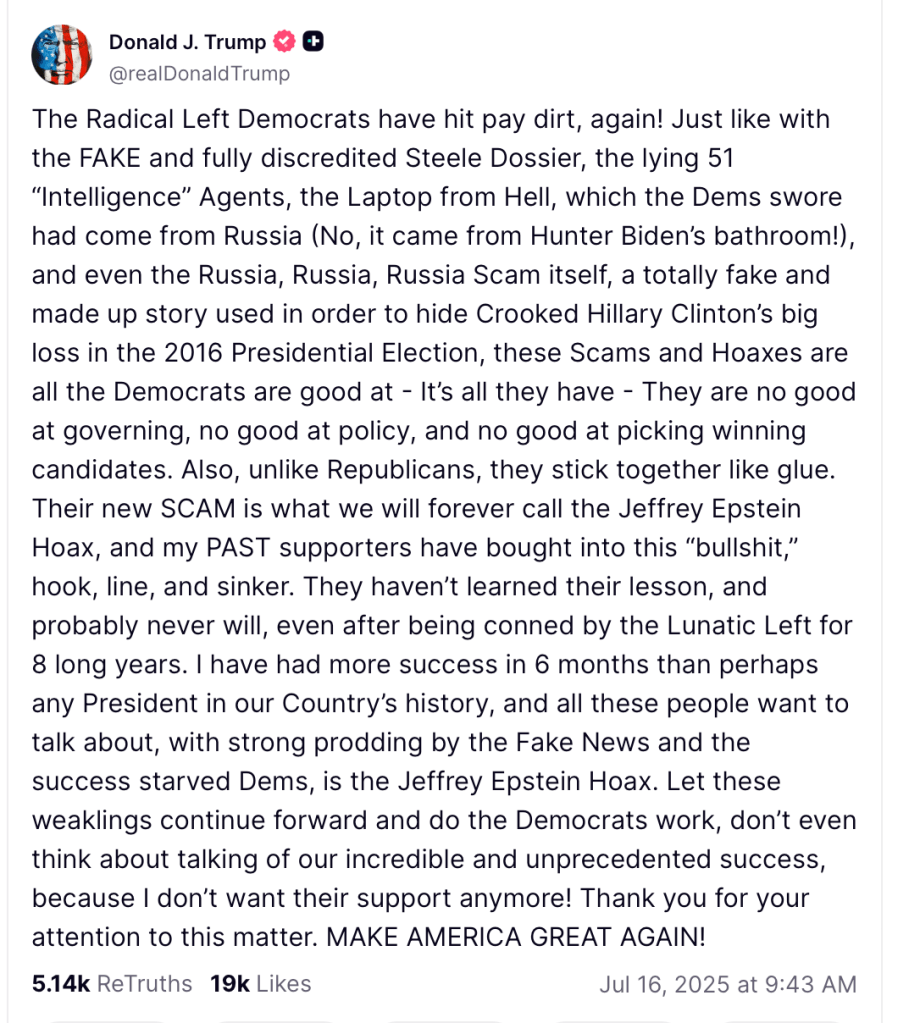
“Obama, Crooked Hillary, Comey, Brennan, and the Losers and Criminals of the Biden Administration, who conned the World with the Russia, Russia, Russia Hoax, 51 ‘Intelligence’ Agents, ‘THE LAPTOP FROM HELL,’ and more … created the Epstein Files, just like they created the FAKE Hillary Clinton/Christopher Steele Dossier,” Trump wrote, invoking various other conspiracy theories he had helped establish as canon on the right.
There are three fundamental challenges for Trump here.
The first is that he doesn’t have the control over conspiratorial thinking that he thinks he has. Again, he piggybacked existing anti-elite theorizing to reach the White House. As the vaccine debate shows, he’s never fully controlled it.
The second is that he is now president. As an expert on conspiracy theories explained to me back in 2017, the powerful have a difficult time leveraging conspiracy theories because those theories are generally tools used to rebut power (like that of The Elites). Presidents could prove a conspiracy theory true, if it were, but cannot prove one false since they are part of a system enmeshed in the theory.
The third, and most important, is that there are unanswerable questions about Trump’s relationship with Epstein. Trump was friends with Epstein. Trump and his family appear multiple times in Epstein’s address book, the only “list” that’s known to exist. Not only can the Justice Department never adequately dismiss a conspiracy theory that centers on government power; Trump is perhaps uniquely powerless to fully dismiss a conspiracy theory with which he is intertwined.
We can assume that the Epstein issue will soon fade from relevance in the national conversation, granting Trump a reprieve from the consternation of much of his base. (The replies to his post on the social media platform he owns have been broadly and unusually disparaging.) However, we can still recognize this moment for the exception that it is: Probably for the first time since he announced his candidacy in 2015, Trump has found himself on The Elites side of the divide against The People. Instead of leveraging the power of conspiratorial thinking, for at least a moment, he is seeing it being used against him.
Given how dependent his political power is on the grip with which he holds his base, even the loosening of one finger may be a weakness he can’t afford.
Imagine how much worse things would be if Pam Bondi had any sense.
I fear this post will ruin my chances of being hired by the FBI.

I was only able to download an audio file of the second podcast—by Sara Longwell and Will Sommer of the Bulwark. I recommend you give it a listen.The video may be behind a paywall, or you may be able to watch it here.
This weekend, lots of talking heads are postulating that MAGA minds are in deep distress, trying to figure out whether (1) Trump told Pam Bondi and the FBI to put the kibosh on Epsteingate because there is actually nothing to see, and Trump didn’t want to unwashed masses to realize they had been lied to, or (2) Trump told Pam Bondi and the FBI to put the kibosh on Epsteingate because Trump is as guilty as homemade sin, and he wanted to cover up his misdeeds.
Logically, there’s a third possibility too: Trump told Pam Bondi and the FBI to put the kibosh on Epsteingate because Trump realized there’s a load of blackmail material in the file, against a lot of people, and he wanted to preserve his ability to gain from those blackmail opportunities.
But, given all the facts and circumstances, I think the overwhelming probability is that Door Number Two is the right one: Trump put the kibosh on Epsteingate because Trump is guilty as sin.
Apparently, despite all the talk of splits, fissures, and cognitive dissonance within MAGA resulting from Epsteingate, most of the MAGA folks have also lept to the conclusion that there is a Trump coverup. So, not much cognitive dissonance on the assumption that this is a coverup.
Good for them.
So, what comes next? Who knows?

Contrary to the views of headline writers who did not go to law school and who suffer from chronic confirmation bias, in the recent case of Trump v. CASA, the Supreme Court opened the door to nationwide injunctions against Trump in cases where plaintiff classes have been certified according to Rule 23 of the Federal Rules of Civil Procedure.
Today, the first such injunction was granted, by a federal district judge in New Hampshire, in a case spearheaded by the American Civil Liberties Union and its allies.
The judge “ruled from the bench”—meaning that the formal text of most of his ruling isn’t available, at least currently. (The order certifying the class, however, is found here. As I predicted, Trump’s own executive order does a fine job of defining the class that is being certified.)
The ACLU’s press release reads in part,
CONCORD, N.H. — A federal court in New Hampshire today blocked President Trump’s executive order restricting birthright citizenship and certified a nationwide class that protects the citizenship rights of all children born on U.S. soil. The case is Barbara v. Donald J. Trump.
The ruling stems from a nationwide class-action lawsuit filed June 27, immediately after a Supreme Court ruling that potentially opened the door for partial enforcement of the executive order.
The American Civil Liberties Union, ACLU of New Hampshire, ACLU of Maine, ACLU of Massachusetts, Legal Defense Fund, Asian Law Caucus, and Democracy Defenders Fund brought the challenge on behalf of a proposed class of babies subject to the executive order. It seeks to protect all impacted families in the country in the wake of the Supreme Court’s recent decision in Trump v. CASA, which directed courts to consider narrowing nationwide protection that had been provided in the first round of challenges to the executive order attacking birthright citizenship.
The groups were in court today successfully arguing for a preliminary injunction and nationwide class certification. The ruling was made from the bench.
In granting the request, the court provided for a 7-day delay so that the government — which argued to the Supreme Court that a nationwide class was the appropriate way to seek nationwide protection in the birthright cases — could nevertheless try to get the First Circuit Court of Appeals to stay the relief, if it decides to pursue that option. Even with a 7-day delay, the ruling will go into effect well before July 27, when partial implementation of the unconstitutional order might otherwise have begun.
“This ruling is a huge victory and will help protect the citizenship of all children born in the United States, as the Constitution intended,” said Cody Wofsy, deputy director of the ACLU’s Immigrant’s Rights Project, who argued the case.“We are fighting to ensure President Trump doesn’t trample on the citizenship rights of one single child.”
Team Trump could wait for more decisions along the same lines by district courts around the country, in order to forum shop for the best appellate court. More likely, I think, is that they will appeal to the federal appellate court in Boston, which will quickly rule in the ACLU’s favor, so that the Supreme Court will have to address the merits of birthright citizenship very soon.
And what will happen then?
Well, maybe Justices Thomas and/or Alito and/or Gorsuch will quibble with whether a class should have been certified—or raise some other arcane, pettifogging objection to jurisdiction. Or maybe one of them will receive a revelation from the Angel Moroni that all class actions are unconstitutional.
You never can tell. But I am confident that at least five of the justices will continue to adhere to language of the Fourteenth Amendment and to reject Trump’s interpretation, just as the Supreme Court ruled back in 1898 in the Wong Kim Ark case.
And what will happen after that?
What will happen after that is that large pieces of shit will hit the fan.

