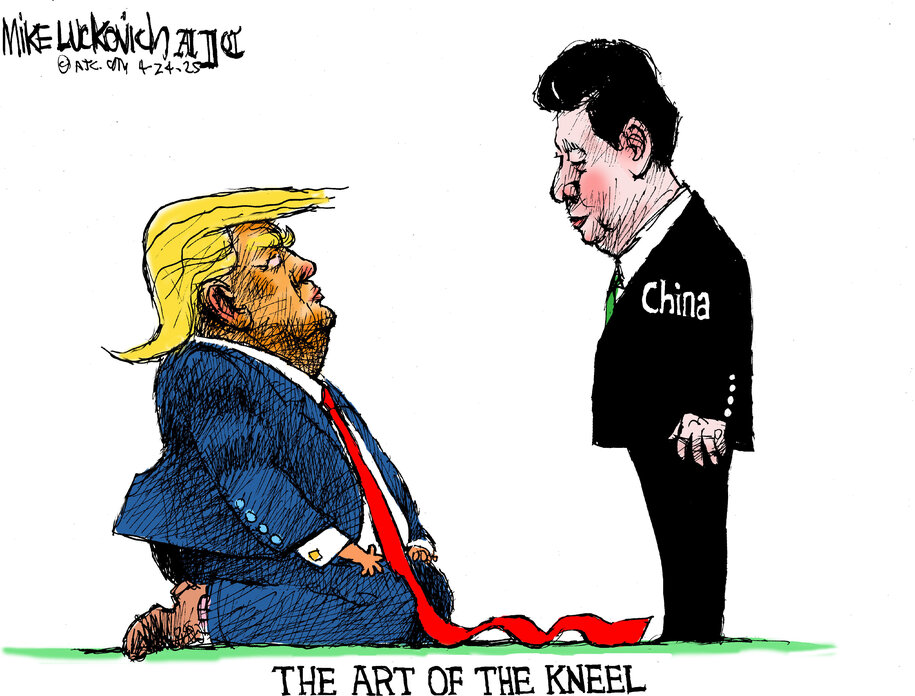

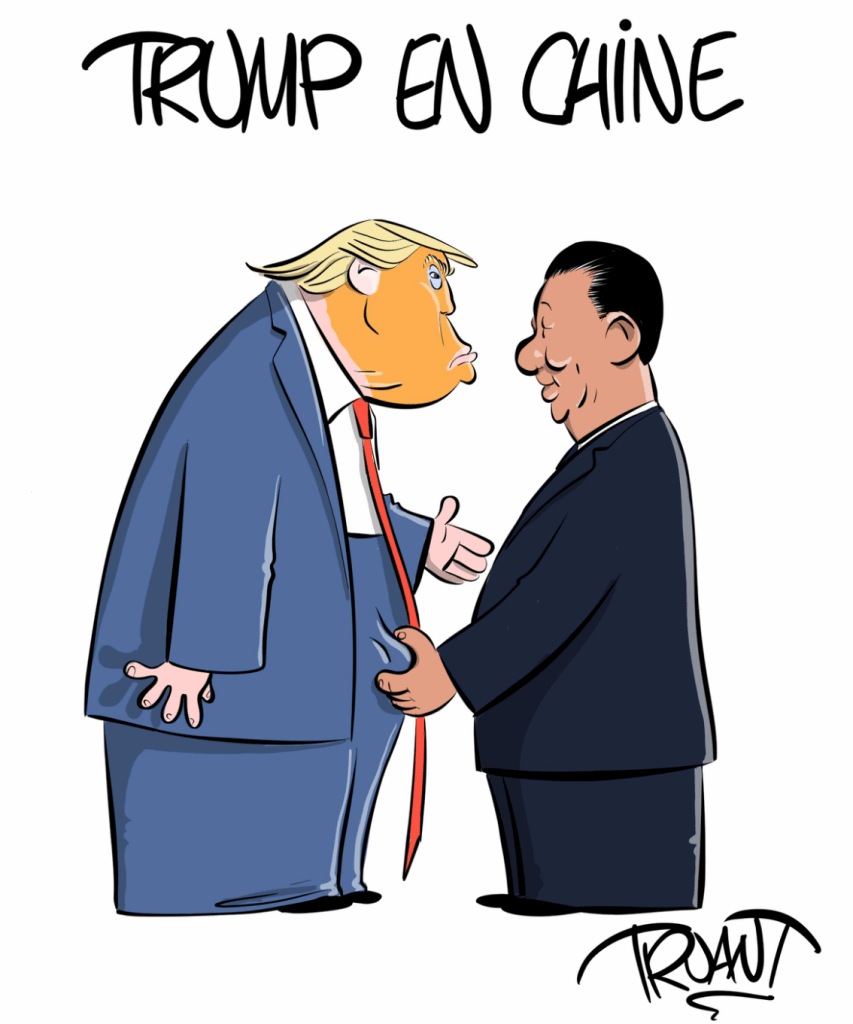
Let’s Make a Deal! The Idiot’s Guide to Backstabbing for Fun and Profit

From today’s New York Times:
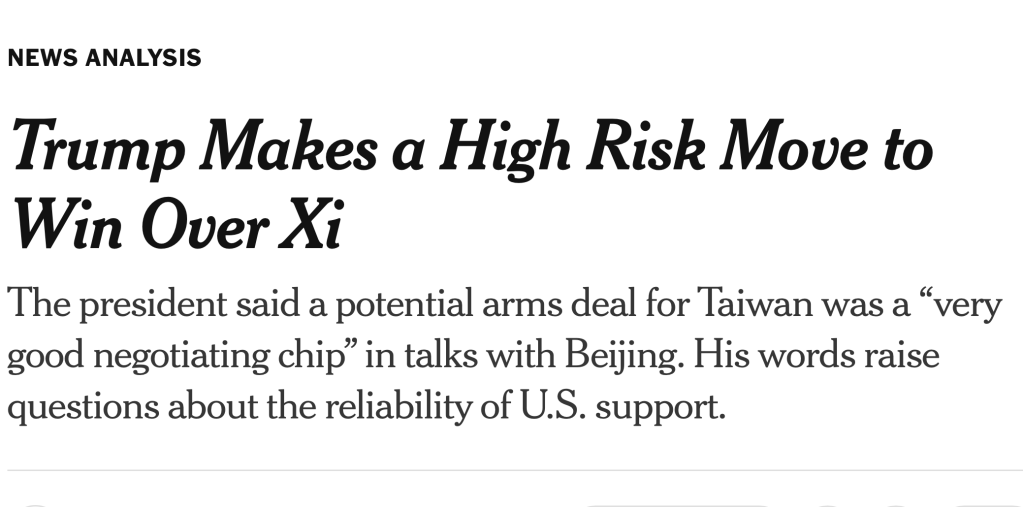
The article is here. My take, in seven points:

1. To gobble up Taiwan is Xi Jinping’s fondest desire. Xi keeps saying so, and therefore detecting the nature of Xi’s fondest desire is possible even for one of the meanest intelligence. Trump is of the meanest intelligence, and therefore he has no trouble reading Xi’s mind on this score.

2. Trump does not give a rat’s ass about Taiwan. 

3. Nor does Trump give a rat’s ass about consensus foreign policy, as set forth in the letter reproduced below.

4. To Trump’s sociopathic mind, this is the most brilliant of golden opportunities: give up something about which he does not give a rat’s ass in exchange for something, or some things, of considerable value to him. 

5. Accordingly, major league backstabbing is on the agenda. But on the road to the big time betrayal, Trump is doing to play a little footsie with the leaders of Taiwan, for two reasons: (a) because of the somewhat remote possibility that Taiwan might outbid China, or (b), failing a superior Taiwanese offer, at least as a motivation for Xi to cough up something that Trump really, really wants.

6. The Chinese know exactly what’s going on, and they’re going to know exactly how to manipulate Trump.

7. When the dust settles, Taiwan is going to be a province of the People’s Republic, and Trump is going to look even worse than he already looks. This will be a signal achi part. 

The Letter from 12 Senators

The Honorable Marco Rubio
Secretary of State
U.S. Department of State
2201 C Street NW
Washington, DC 20520

Dear Secretary Rubio,

We write to reaffirm congressional support for the 1979 Taiwan Relations Act (TRA) and our firm belief that there should be no unilateral changes to this policy nor any new declaratory policy on Taiwan, consistent with longstanding U.S. commitments including the Six Assurances President Reagan articulated.

For nearly five decades, the TRA has been the cornerstone of U.S.-Taiwan ties, enabling a strong and mutually beneficial relationship. This bipartisan law requires the United States to provide Taiwan – a critical economic and technological partner, and a thriving democracy – defense articles and services necessary to maintain the island’s self-defense capability.¹ The TRA further states that the United States would consider any attempt to determine Taiwan’s future by non-peaceful means to be “a threat to the peace and security of the Western Pacific,” and of “grave concern.”²

Our commitment to this legislation has long helped ensure peace and stability across the Taiwan Strait – which is essential to U.S. interests there and across the Indo-Pacific. Maintaining this commitment is necessary to ensure the credibility of U.S. security commitments to allies and partners in the region and beyond.

During your tenure in the U.S. Senate, you consistently demonstrated strong support for U.S.-Taiwan relations and for the TRA. In 2017, you joined a bipartisan letter to President Trump stating that the “One China policy, based on the [Taiwan Relations] Act, the Three Joint Communiques and the Six Assurances […] provides the basis for our enduring relationship with Taiwan.” You further emphasized the “bipartisan commitment that we must not waver in providing necessary support for Taiwan to defend itself in the face of China’s ongoing military aggression and the cross-Strait military imbalance.”³

These principles remain true and necessary today. In the spirit of longstanding bipartisan support for the U.S.-Taiwan relationship, we stand ready to work with your administration to further strengthen this partnership.

Sincerely,

Michael F. Bennet
United States Senator

John Curtis
United States Senator

Andy Kim
United States Senator

Thom Tillis
United States Senator

Tim Kaine
United States Senator

Christopher A. Coons
United States Senator

Jeffrey A. Merkley
United States Senator

Chris Van Hollen
United States Senator

Tammy Duckworth
United States Senator

Elissa Slotkin
United States Senator

Brian Schatz
United States Senator

Mitch McConnell
United States Senator

¹ Taiwan Relations Act, 22 U.S.C. §§ 3301–3316.[1]
² Taiwan Relations Act, 22 U.S.C. §§ 3301–3316.[1]

³ 2017 bipartisan senators’ letter to President Trump on Taiwan defense, cited in the current letter.[3][1]
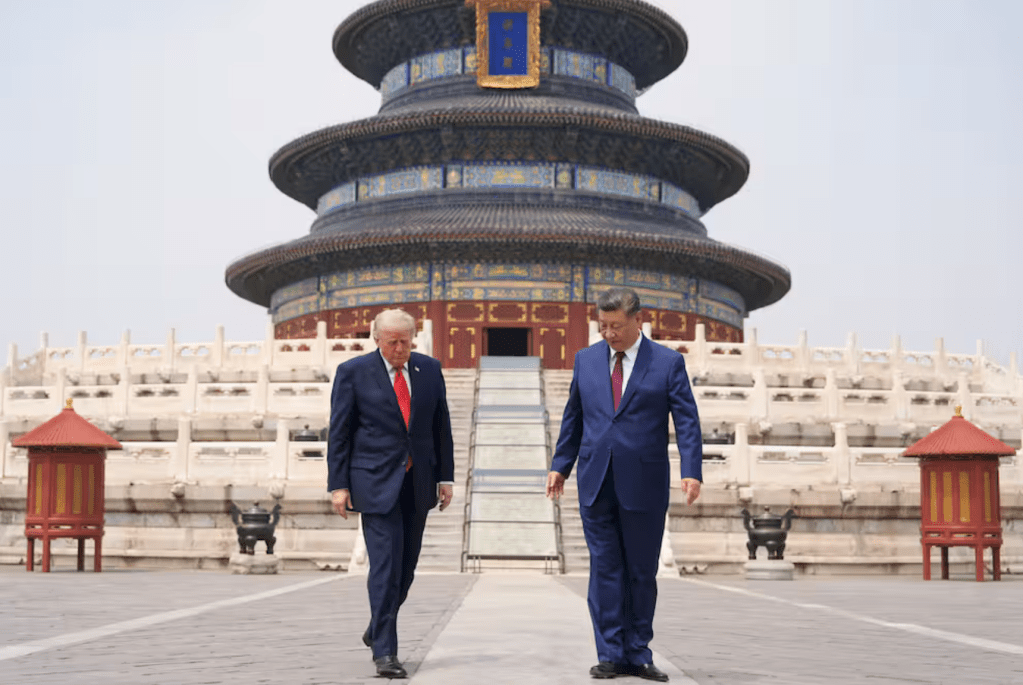
Two Emperors at the Temple of Heaven

Pictured above are Trump and Xi at the Hall of Prayer for Good Harvests, part of the Temple of Heaven complex in Beijing, dating originally from 1420 and renovated on various occasions since then. 

The Ming and Qing emperors used to pray there for—you guessed it—a good harvest.

What kind of harvest was Emperor Xi hoping for, and did he get it?

Same question for Emperor Trump.

If Emperor Trump were wise, he would have prayed not lose the Mandate of Heaven, which, in his case, is rapidly waning. But Emperor Trump is not wise, and therefore he probably prayed no such prayer.

Beijing’s ordinary residents get a lot of use out of the extensive grounds of the Temple of Heaven. Some practice tai chi. Some exercise in other ways. Some dance. Some sing Chinese opera. The old men try to outwit one another at board games.

Which of the two elderly emperors outwitted the other? I’ll let you guess.

Meanwhile, in one courtyard area, women hold up photos of their unmarried adult sons and daughters and negotiate with other women to arrange a blind date that, they hope, will lead to love, marriage, and grandchildren.

What arrangements did the two emperors negotiate? 

When and if we learn the answer, I don’t think we will like it.

Trump, China Policy, and Christopher Columbus’s Three Mistakes

N.Y. Times, DealBook Newsletter, Trump Bemoans How ‘HARD’ It Is to Strike a China Deal: Even the president appears to be doubting his strategy to win over Beijing, as relations fray between the trading partners.

Well, yeah. But the headline writer mistakenly assumes there’s a discernible goal toward which Trump has an actual strategy.

It is said that Christopher Columbus made three mistakes.

When he started out, he didn’t know where he was going.

When he got there, he didn’t know where he was.

When he came back, he didn’t know where he had been.

If you have no idea where you are going, it’s not meaningful to talk about your strategy for getting there. The ever insightful Ed Luce—who writes behind a pricey paywall—analyses the situation beautifully. 

Financial Times, Edward Luce, The great Trump riddle on China: No one knows what the US president’s desired endgame with Beijing really is:

Smart money says that Donald Trump’s upside is that you know where he stands. That may be true on his love of grift and loathing of immigrants and trade deficits. When it comes to Trump and China, however, economists should drop their caveat about “all things being equal”. 

Nothing to do with Trump’s China policy is predictable, let alone equal. Does he care about Taiwan? Let’s toss a coin. Does he want the US to decouple from China? Spin the roulette wheel. Trump’s supposed coming phone call with China’s President Xi Jinping is unlikely to lift our confusion. China is the ultimate Trump riddle. 

You can hardly blame the Chinese for being wary of talking to him. In late April, Trump told Time that Xi had called him — “and I don’t think that’s a sign of weakness on his behalf”. No call had taken place. 

Any reading by Trump of Xi’s psychology should thus be put down to an AI-style hallucination. China’s foreign ministry accused Trump of “misleading the public”, which by today’s standards was polite. But we should not mistake Xi’s avoidance of “wolf warrior” invective for submission to Trump in the tariffs war. China is not the UK. The Chinese are as confused about Trump’s endgame as everyone else. 

If Xi does finally agree to a call with Trump — the first since he was inaugurated — the duelling Washington-Beijing readouts would make for interesting reading. It is almost impossible to imagine Xi agreeing to sit down for one of Trump’s reality TV Oval Office specials. That crapshoot has had big downside impacts on Ukraine’s Volodymyr Zelenskyy and South Africa’s Cyril Ramaphosa, and proved helpful to Canada’s Mark Carney and arguably to Britain’s Keir Starmer. Xi will never agree to run that gauntlet. Nor should he. 

The China-US component of Trump’s on-again off-again trade war is in a category of its own. The rest are based on exaggerated or imaginary complaints. The EU is no likelier to concede that its value added tax is a trade barrier than Canada will admit to exporting fentanyl to the US. Both are fictions. By contrast, China’s dual-use technological ambitions pose a big geopolitical conundrum to America. How Trump addresses those — whether he scraps Joe Biden’s “small yard, high fence” restrictions on semiconductor trade with China — matters to everyone. 

Yet we have little clue how much they concern Trump. The leverage goes both ways. The US could continue to restrict China’s access to AI technology and chips. But Trump has already relaxed some of this. Nvidia’s chief executive Jensen Huang is an influential advocate with Trump of further relaxation. On the other side, China has a stranglehold on the world’s rare earth supply that is critical to a wide range of US production. Trump claims China has reneged on last month’s deal to resume its exports of rare earths to the US. In that pause, Trump reduced his 145 per cent tariff on China to 30 per cent. 

Will he ratchet tariffs up again if China does not lift its embargo? There is no way of knowing. Once upon a time Trump thought that the China-owned TikTok was a threat to US national security. Now he is keeping the social media app alive — with a possible view of a forced sale to a Trump business partner — against the wishes of Congress and the Supreme Court. As goes TikTok, so might go Trump’s China policy. 

The same confusion reigns over Taiwan. Many voices in Trump’s administration urge a hardline defence of Taiwan. Pete Hegseth, the US defence secretary, said last week: “The threat China poses [to Taiwan] is real. And it could be imminent.” But few in the US or around the world take Hegseth seriously. Trump hired him to play Pentagon chief on TV. China is widely believed to be getting ready to launch an invasion of Taiwan by 2027. Hegseth could well have been speaking the truth. But you cannot assume he is credible. Trump has thus created a real national security risk by having a secretary of defence cry wolf. 

Trump’s China uncertainty is also a tax on the global economy. France’s Emmanuel Macron spoke for many last week when he said: “We don’t want to be instructed on a daily basis what is allowed, what is not allowed, and how our life will change because of the decision of a single person.” 

That was one way of putting it. Here is another from JPMorgan’s Jamie Dimon: “China is a potential adversary . . . But what I really worry about is us.” Dimon was tactful not to name the US president. On the conundrum posed by Trump’s erraticism, China and the rest of the world are as one. 

It Begins: Xi Forces Trump to Negotiate Against Himself

Washington Post, Trump suggests lowering tariffs on China ahead of talks

The Post writes, 

President Donald Trump said Friday that the United States could lower tariffs on China to 80 percent [instead of 145 percent] ahead of a meeting this weekend between his top aides and their counterparts from Beijing. …

The president’s apparent eagerness to get a deal reflects the mounting economic damage from the tariffs he has imposed thus far. China said its exports to the United States dropped 21 percent in April from a year before, and economists have forecast an increased likelihood of a U.S. recession. White House officials have grown alarmed by Chinese curbs on exports of rare earth minerals, used to make military drones, consumer electronics, electric cars and other important products.