
With clear eyes, hard facts, critical thinking, new political strategy, empathy, and a soupçon of Schadenfreude
Here on Saturday, June 13, in the US Eastern Time Zone, the hour is past 6PM and night is drawing nigh.
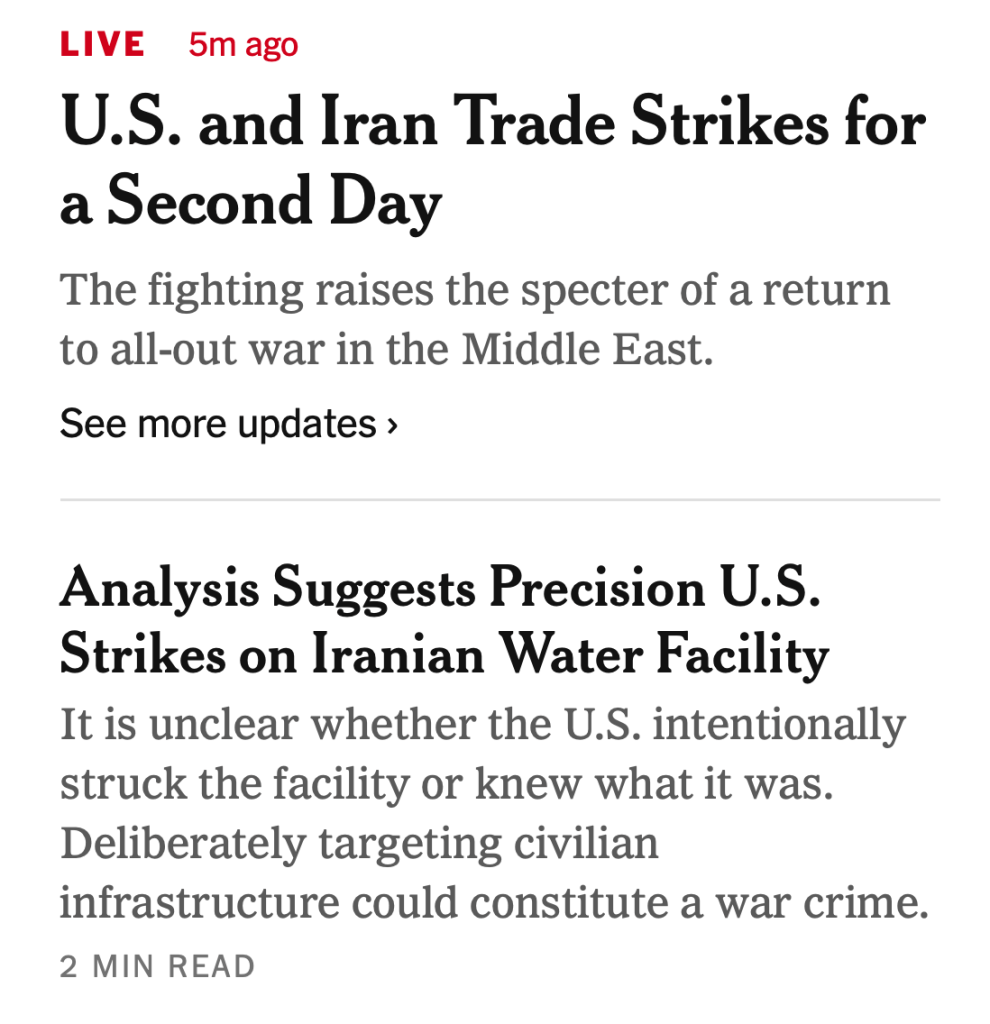
The Washington Post solemnly informs us that “U.S. and Iran to close deal within a day, Trump says, but Tehran yet to confirm: An agreement would extend the ceasefire and pave the way for a longer truce, leaders said, though a Tehran official denied that a deal will be signed Sunday.” Meanwhile, the Noo Yak Times, somewhat more fulsomely, lets us know that
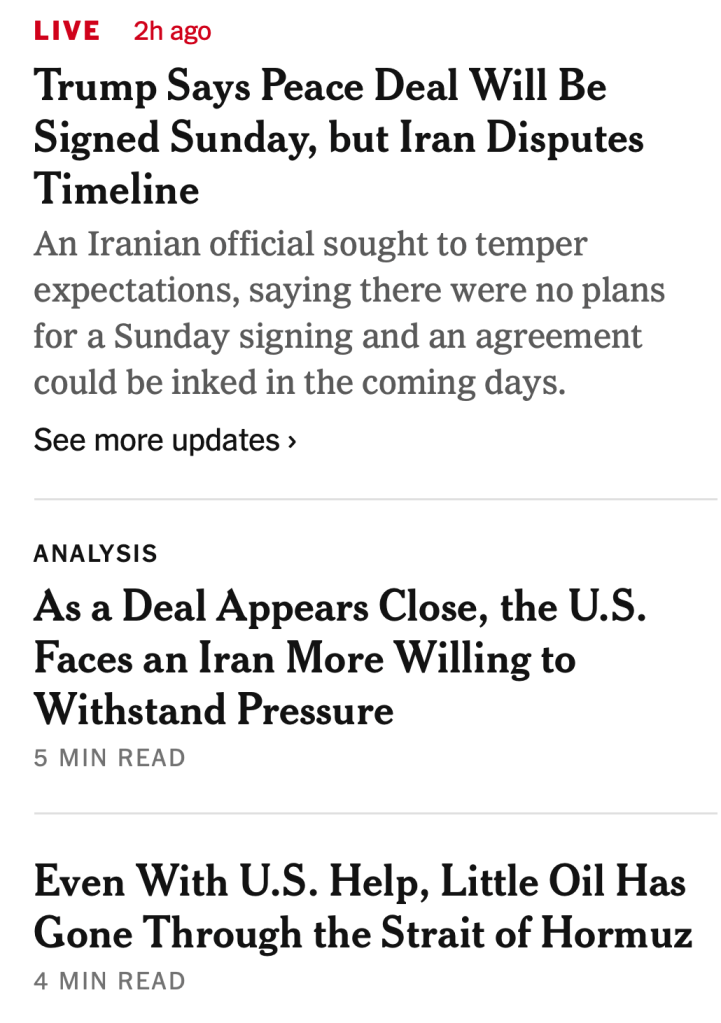
Starting with March 23 this year, this is the 38th time Trump has claimed an Iran deal is just around the corner.
We appear to be living in the age of hallucination. KPMG, one of the Big Four accounting firms, just released a major report on the impact of AI on business going forward. It provided many examples to support its conclusions. A large number of the examples were themselves AI hallucinations.
Meanwhile, K&L Gates, a top law firm, submitted a brief to a federal court in California where nine of 27 citations were wrong, including two non-existent cases hallucinated by an artificial intelligence program.
Up in Washington, at the White House, the cage fight will start in about an hour and a half. One assumes that Orange Mussolini will take time out to enjoy the human cock fight and will, temporarily, stop acting like someone whose mind has been occupied by an incompetently designed, delusional AI chat bot.
After the cage fight is all over and they’re taking away the bodies, I expect we will begin to hear more belligerent delusions about an Iran deal signing ceremony.
Will there in fact be a deal by this time next week? I very much doubt it. If you would like to bet a nice steak dinner on that, let me know.
I’m even more confident that if a deal is reached next week, it will heavily favor Iran.
If not, I expect there will soon be some dead Iranian negotiators.
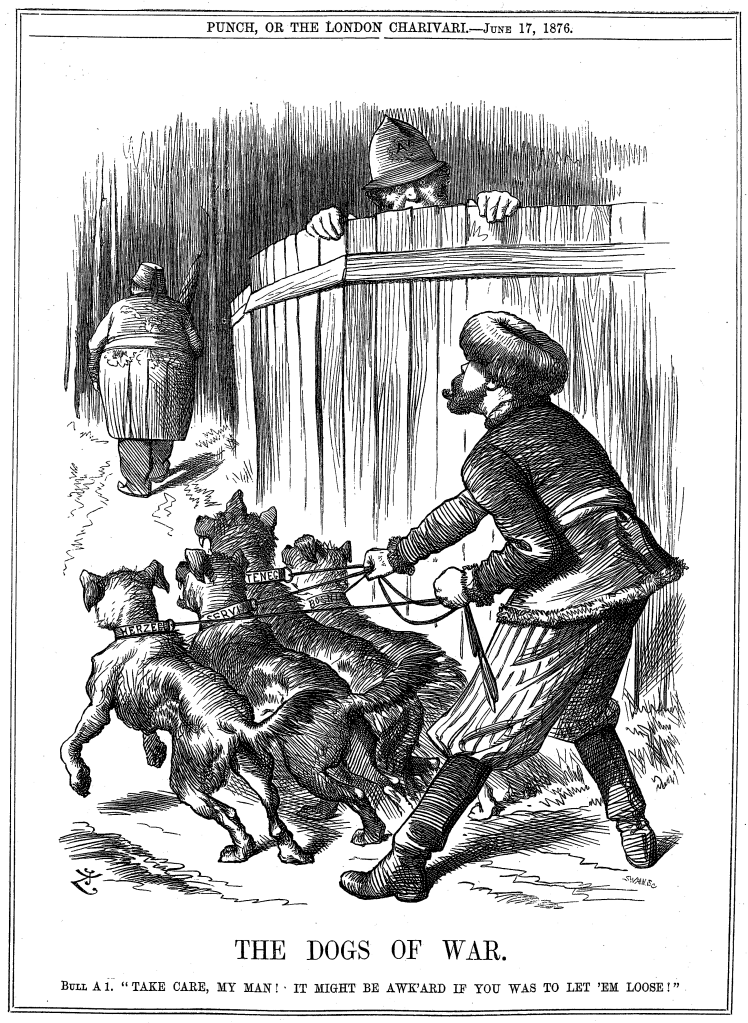
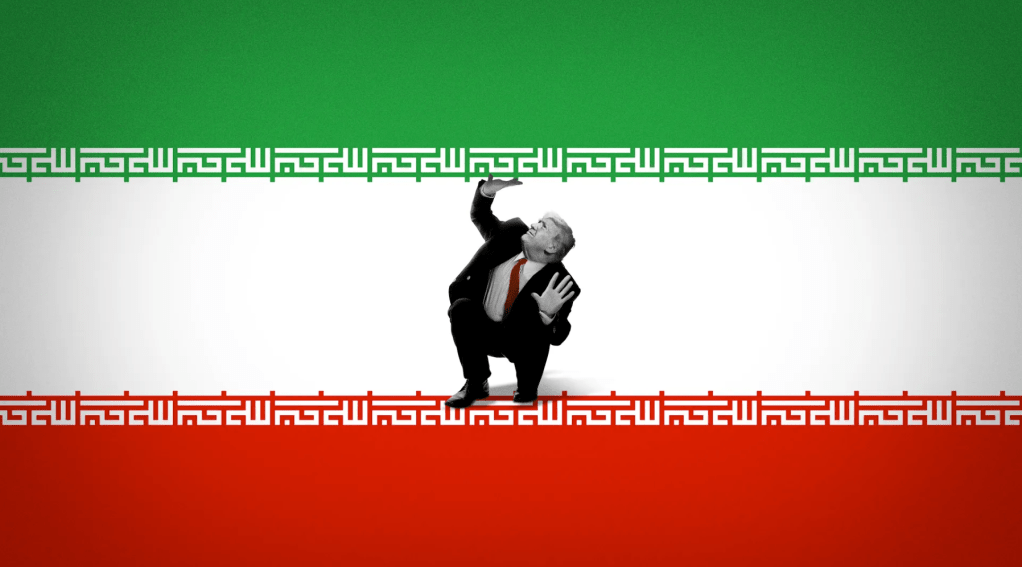
Bullying. Bluster. Delusional bullshit.
Today, he’s back to bullying. And maybe committing war crimes.
He will fail again.
Tomorrow, it will be back to delusional bullshit.
And more failure.
Four points:
One. I think he sounds a lot better in person or on video than when I just read his words on paper.
Two. I don’t know all the things he’s accused of doing or saying. I don’t know which of those things he actually did or said. He has expressed remorse; I don’t know how much of his remorse is real or feigned. He has also claimed that at least some of his youthful bad behavior was caused by PTSD arising from military action in Iraq and Afghanistan, but I don’t know how much of that is true.
I do know that when I was young I was a very great expert on which bad behavior could have been controlled and was therefore blameworthy, and which bad behavior grew out of an irresistible urge and was therefore excusable. I also know that, as I approach my 80th birthday, I have lost that expertise.
Three. Republicans apparently plan to make it a big damn deal that he has allegedly acted badly toward women.
That is rich.
Four. This November, Maine voters will decide between two people who should be disqualified for the office of senator. One should be disqualified for letting Roe v. Wade get overturned, for supporting Trump, and for bringing immiseration to Maine voters. The other is Graham Platner, who has the wrong tattoo.
To remind you:
Steven Beschloss is a journalist, writer, and adjunct professor at New York University. He is the brother of historian Michael Beschloss.
Mary Trump, the niece of Donald Trump, earned a doctorate in clinical psychology and has made a cottage industry of analyzing her uncle’s many mental disorders.
There are visionary statesmen and high-minded negotiators, pragmatic mediators and professional diplomats – and then there are meddling fools. As ceasefires implode, vast numbers of civilians die or flee, and wars Donald Trump started, fuelled or pledged to resolve rage unchecked, there’s no doubt which category he belongs to. In baseball parlance, in Ukraine, Iran-Lebanon and Israel-Palestine, Trump is “0 for 3”. He boasted he alone could cut deals and bring peace. He’s delivered neither. In striking out, he mostly makes matters worse.
The heroic age of 19th-century diplomacy, typified by Prince Metternich’s great power-balancing “concert of Europe” and Benjamin Disraeli’s Balkan “peace with honour”, is history now. But it’s not that long since Nobel-winning peacemakers such as the UN chief Kofi Annan and the Finnish diplomat Martti Ahtisaari, or the US senator George Mitchell, who brokered Northern Ireland’s Good Friday agreement, were troubleshooting intractable conflicts the world over. Where are the successors to Desmond Tutu, Andrei Sakharov or Yitzhak Rabin when you need them?
Nowadays, ceasefires fail with grim regularity. Lebanon’s latest effort flopped this week. Others, like that in Iran, are broken daily. Sudan has no ceasefire at all. And why has it become so hard to end “forever wars”? Amid record levels of global strife, a lack of respected, impartial go-betweens and bold political risk-takers is one key reason. The gulf in ability between, say, Richard Holbrooke, the US diplomat who helped settle the Bosnian war, and Trump’s amateur envoys, Steve Witkoff and Jared Kushner, is akin to that between Arsenal and a Sunday park football XI.
Factually speaking, Trump’s diplomatic record is lamentable. He promised to resolve the Ukraine war in a day. It’s now in its fifth year. He blatantly sided with Russia, told a browbeaten Ukrainian president, Volodymyr Zelenskyy, he had “no cards”, and cut weapons supplies. Yet Trump overplayed his hand while underestimating Russian president Vladimir Putin’s propensity to cheat and Ukraine’s resilience. Kremlin officials ran rings round the credulous Witkoff and Kushner during Moscow “negotiations”. To their shame, the dynamic duo has yet to visit Kyiv. Trump, having lost face, has lost interest, too. Convinced that the tide is turning, Zelenskyy is now proposing a ceasefire– which, on past form, Putin will reject.
After illegally attacking Iran in February, Trump declared a ceasefire in April with none of his main objectives met and with the strait of Hormuz largely closed to shipping. Violations occur daily, half-hearted “peace talks” via shadowy third parties lead nowhere, and the global economy splutters. Again, Trump underestimated the challenge, overestimated the power of brute military force to change political realities, followed his own (woefully bad) instincts, sidelined European allies and vainly sought a quick, easy victory. Now he faces a drawn-out conflict, a Congress in revolt and an angry public.
In Gaza, meanwhile, the world-shattering triumph Trump proclaimed last October, when a truce was agreed and Israeli hostages freed, rings distinctly hollow. His 20-point plan, pivoting on the disarming of Hamas, quickly ran into the sand. His “Board of Peace” and grandiose ideas for Gaza’s reconstruction lack credibility. The reality is continuing, unconscionable Palestinian suffering and expanding Israeli military occupation. Now Trump’s co-conspirator, prime minister Benjamin Netanyahu, is doing to southern Lebanon what he did to Gaza – creating a depopulated desert – and thereby obstructing a US-Iran deal. The two men had a furious row last week.
Trump’s serial failures reflect a bigger problem. Ceasefires and truces have come and gone in conflict zones such as Yemen, Myanmar and the Democratic Republic of the Congo in recent years without leading to lasting settlements. In Sudan, agreement to observe a humanitarian pause, let alone cease hostilities, remains elusive after more than three years of civil war. Visceral lack of trust between warring parties is a poisonous common factor. So, too, are sheer intransigence and an erroneous zero-sum belief in total victory.
The chronic inability to permanently resolve wars often stems from an absence of organised, recognised peace processes. Almost forgotten are the days when empowered UN envoys engaged with all parties, created working groups and proposed phased confidence-building measures and timelines. There was a long period when US secretaries of state, such as Henry Kissinger, Warren Christopher and John Kerry, undertook energetic shuttle diplomacy in pursuit of peace. In contrast, Marco Rubio, today’s state department incumbent – a smoothly ambitious man untroubled by principle – stands back from the fray, telling his boss he’s right when he’s wrong. Only Trump and Rubio seem surprised that Hezbollah, excluded from peace talks by their US hosts, rejected the latest Lebanon ceasefire.
The obdurate, refractory nature of modern conflict mirrors today’s world. In a global order lacking agreed rules, where major powers and non-state actors treat international law and international courts with contempt, the business of war and peace grows similarly anarchic. For unscrupulous regimes bent on maximising national advantage, no agreement is deemed unbreakable, no dishonourable breach too shameful to shrug off. Without rules, peace deals cannot ultimately be enforced.
Institutional weakness is exacerbated by the venality and banality of politicians. Soft-power tools, dialogue, logic and persuasion, moral imperatives and historical context are devalued and scorned. Overwhelming force, instant results and market-moving soundbites are prioritised. In this unpoetical wasteland, the “long term” is a foreign concept and truth and justice a lost cause. Even peace is a relative term in an era when a bellicose US president, bomber of multiple countries, can claim, in Nineteen Eighty-Four doublespeak, that he deserves a Nobel peace prize.
Endless, futile wrangling over ceasefires obscures the terrible impact of conflict on ordinary people and compelling human reasons for halting the violence. Since the Iran war began, at least 3,468 people have reportedly died inside the country, 26,500 have been injured, and millions displaced. Attention has been deflected, for example, from the still-unaccounted for Minab primary school bombing on 28 February, when US forces allegedly killed more than 100 children. If full-scale fighting resumes, there will be more atrocities, more needless suffering.
Civilian casualties continue to increase across the wider Middle East. In Lebanon, where thousands have died despite a previous (failed) ceasefire, Unicef provided a snapshot of the last week in May when, it reported, 77 children were killed or injured. Such tragedies recall the horrors of mass infant and child deaths at the height of the Gaza war. They are 77 reminders why ceasefire negotiations are not self-congratulatory political shows or social media entertainments, as Trump’s daily commentaries suggest, but urgent matters of life and death.
None of these wars will ultimately be ended by military force. It’s not about who has the biggest bombs or who gets to declare a specious victory, Mr Trump. It’s about people’s lives. As has mostly held true through history, it’s diplomacy – professional, active, skilled and well-practised diplomacy – that opens the door to peace.

