Prof. Mearscheimer has been teaching international relations at the University of Chicago since 1982. He is well respected, but some of his analyses are highly controversial.
Here, Prof. Mearscheimer provides a remarkably comprehensive, granular, and detailed analysis of the United States’ current predicament in Iran. The subject lends itself to thinking in bumper sticker slogans; if that is your preferred way of thinking, then you will have no interest in this video. On the other hand, if fact-based thinking is your preference, then this video is for you.
Why Hasn’t Trump Surrendered to Iran?
I have argued that surrender is the least bad of Trump’s various bad options. I remain of that view. 100 percent. Maybe 200 percent. Watch the 57 minutes of this video and you will see why—in enormous detail.
So, why hasn’t he surrendered? And what will happen if he persists in this attitude?
First of all, let me acknowledge that far greater men than Donald John Trump have failed to understand that they were screwed, blued, and tattooed, and that their best option was to take their losses and amscray.
Second, with the June, 2026, memorandum of understanding he tried, sort of, to semi-surrender. In my view, it didn’t work (1) because elements within Iran did not want peace, even on terms that were favorable to Iran and (2) because Trump wasn’t willing to accept the full consequences of his very bad hand.
As Mearscheimer points out, Trump has specifically articulated a fear that the Iran war will cause a depression—and that he will be remembered as another Herbert Hoover.
With that thought in mind, with so few cards to play, and with his extraordinarily warped view of reality, I think there is a good chance he is going to nuke Iran.
That, I think, is what he means when he keeps blathering about “annihilation.”
Trump is the world’s worst gambler—a vital skill about which he has no clue.
Justice Kavanaugh does not deserve having a star pinned to his chest for following the rule of law, even though following the rule of law in this instance was contrary to the immediate political interests of his fellow Republicans. Nor do the rest of the Court, including Justices Alito and Thomas deserve a medal for letting Justice Kavanaugh do what he did.
That said, in our depraved day and age, a judicial result compelled by legal precedent and logic, against the political and ideological interests of a court, seems like a Man Bites Dog story, even though it should be a Dog Bites Man headline.
Today, in “Justice Kavanaugh stands up for state constitutional law in the Missouri congressional case,” SCOTUSblog explains it all:
A crucial case decided yesterday on the Supreme Court’s emergency docket will likely mean that in the upcoming November election Republicans will win only 6 of 8 Missouri congressional seats in the new House of Representatives, rather than 7 of 8, as they were hoping for.
In this case, Hoskins v. von Glahn, Republicans wanted the Supreme Court to jump in and second-guess a state supreme court on what is essentially a matter of state constitutional law. It would have been both legally wrong and politically damaging for the court to have done so. Late yesterday, Justice Brett Kavanaugh spurned the poisoned chalice without explanation. No justice dissented, at least not publicly. (Kavanaugh in fact denied the request himself, without referring it to the whole court; he would not have acted unilaterally unless he knew a majority of the court wanted no part of this request.)
We applaud this outcome, and we offer a few quick points of elaboration.
Under both the U.S. Constitution’s Article I, section 4, and a clear congressional statute on the books, Missouri’s single-member districting lines for Congressional districts are to be determined by state law – including, of course, state constitutional law, as definitively determined by the state supreme court. The Missouri Supreme Court had already weighed in on the relevant state-law issues in Hoskins. (For the details, see Amy’s recent explainer.) There was thus no proper role for the U.S. Supremes at this point. Such is the square command of the court’s landmark ruling in the 2023 Moore v. Harper – a ruling involving congressional districting in North Carolina in which the court aligned with our amicus brief in that case (co-written with Steve Calabresi) and also built squarely on an earlier Roberts court precedent, Arizona v Independent Redistricting Commission, involving congressional districting in Arizona.
Some prominent commentators in 2023 opined that the Moore court had left the door open for U.S. Supreme Court intervention seeking to second-guess state supreme courts in a broad range of future congressional districting cases. We thought that these commentators misread Moore, and we said so back in 2023. Since then – consistent with our reading of the case, and contra the predications of these other commentators – the U.S. Supreme Court has yet to second-guess a single state supreme court state-law ruling involving congressional districting.
In Hoskins, the state supreme court was unanimous. It essentially ruled for Democrats even though a strong majority of that court had been appointed by Republican governors. This is what law looks like.
Here is another thing that law looks like: What’s sauce for a Democratic goose in Virginia is sauce for a Republican gander in Missouri. When sore-loser Democrats tried to use the Supreme Court’s emergency docket to second-guess the Virginia Supreme Court on a state-law issue in a recent congressional districting case, the Supreme Court shot down the Virginia Democrats unanimously and immediately. Yesterday, the court quite properly did the same thing on the same brisk timeline to Missouri Republicans.
The state of Missouri, via its constitution, has chosen to allow the people of the state, in certain specified situations, to weigh in directly on congressional districting before any ordinary state law changing the districting rules may go into effect. This is surely a choice Missouri is allowed to make under the 10th Amendment, the Republican Government Clause, Erie, and the Moore v. Harper line of cases. If the people of Missouri don’t like this system, they are of course free to change their state constitution. The state constitutional provisions at issue in Hoskins have a long and distinguished pedigree. The Missouri Constitution could clearly have prevented the state legislature from implementing ANY optional districting change absent two legislative votes separated by an intervening general election. Given that, the Missouri Constitution can surely take the lesser step of pausing new legislative districting rules in some situations, where opposition among the electorate is particularly intense and seemingly widespread, while allowing new legislative districting rules to take immediate effect in other, calmer and less partisan situations.
Under the so-called Purcell principle, the Supreme Court has admonished that federal courts should not upset state-law election rules and practices on the eve of an election, absent a very clear violation of federal law. …
Hooray for Justice Kavanaugh! Hooray for the court! …
But There is Someone in this Story Who Deserves Special Recognition
That would by one Denny Hoskins, the Missouri Secretary of State, who is under order to to show up in court tomorrow morning and explain why his ass should not be held in contempt of court.
I hope that Secretary Hoskins will be given the award that he so richly merits.
Like the man who once greeted Justice Felix Frankfurter “with great relish,” I look forward to the GOP midterm convention that begins today. My avid anticipation arises from Cheeto Benito’s plans to make the message ALL ABOUT TRUMP.
The Wall Street Journal has a story entitled “An $88,600 Photo With Trump: GOP Hopes to Raise Millions During Convention.” For Democrats, that would be money very well spent. Velveeta Voldemort deserves our full and unstinting support in his messaging campaign to remind EVERYONE, even those of the meanest intelligence, that HE is the one in charge—and that HE is the person responsible for their misery.
The Welland Canal allows ships to travel between Lake Erie and Lake Ontario, bypassing Niagara Falls.
A Canadian recently posted this thought: “Every ship entering the Great Lakes goes through the Welland Canal, located fully in Canada. There’s no other option. $26.3 billion of US trade depends on it. Would be a shame if tolls skyrocketed or it was transit-taxed heavily…
Sarah Longwell and John Guida, ‘Trump Voters Are Finally Starting to Sour on Him’ (N.Y. Times, Aug. 28, 2026):
Ms. Longwell is the founder and publisher of The Bulwark and host of “The Focus Group” podcast. Mr. Guida is an editor in Times Opinion.
Even longtime political professionals are still muddling through the Trump era. They are trying to make sense of what voters want, how politicians communicate and how the parties are evolving.
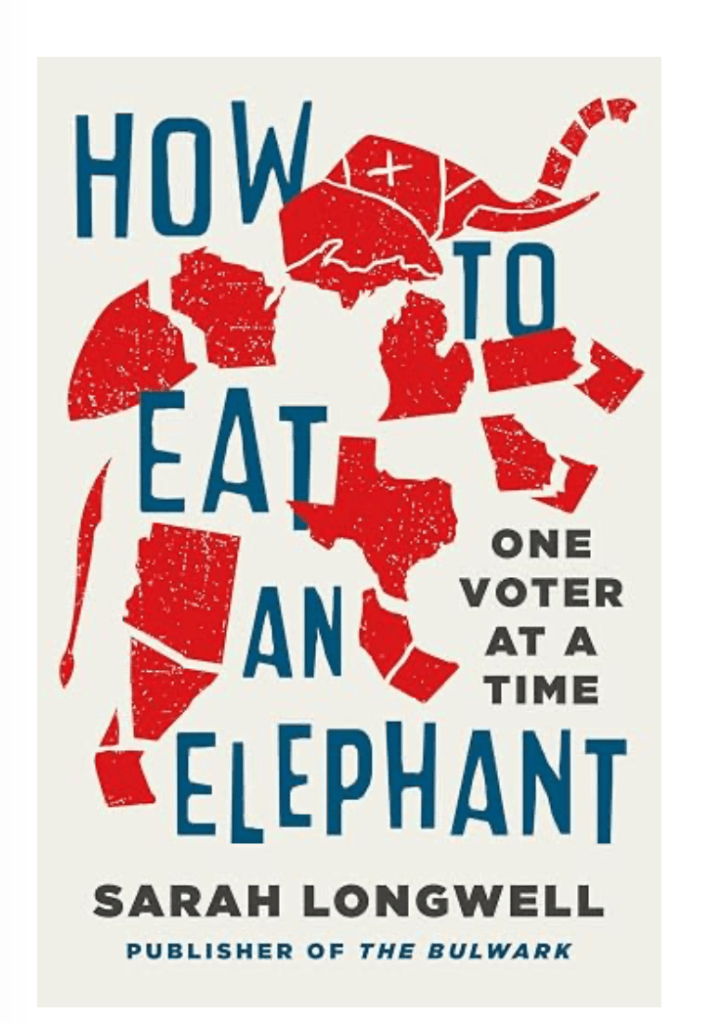
A former Republican strategist now supporting Democrats, Sarah Longwell, the founder and publisher of The Bulwark and author of the forthcoming “How to Eat an Elephant: One Voter at a Time,” has organized focus groups of voters for years to grasp their thinking and inform her knowledge of American politics. That has shaped how she approaches political communication.
She explored the state of American politics in a written conversation with John Guida, an editor in Times Opinion. It has been edited for length and clarity.
John Guida: Among Democrats, the word we hear most often is “fighter.” As in, that’s what they want in their politicians. What does that mean exactly? What form does it or should it take?
Sarah Longwell: Democratic voters want their leaders to stop acting like peacetime diplomats, recognize the Republican Party for the threat it is and mount an effective counteroffensive. They are deeply frustrated by years of their politicians saying that Trump is an existential threat to democracy, but not acting like democracy is truly at stake.
If democracy is at stake, you don’t consider nominating an unpopular 81-year-old for president. It’s one reason the Democratic establishment has lost so much trust among voters.
Guida: Do you see a connection between that quality (“fight”) and the desire for a younger generation of leaders?
Longwell: Absolutely. I’ve said that voters’ concerns over age aren’t about just age — they’re a stand-in for much larger issues. They think the old guard won’t fight because it’s too sclerotic and stuck in the past. And to a large extent, they’re right about that.
This is paired with a feeling among Democrats that the older generation of leaders simply doesn’t have a grasp on the challenges facing young people today: Artificial intelligence-driven economic disruption, data center construction, the rewiring of our brains by social media.
Guida: You have described the need for Democrats to adapt “narrative dominance” as a political communications tool. What is that, and how do you build it?
Longwell: The right achieved narrative dominance by discrediting established, fact-based media and replacing it with an always-on communications infrastructure that exists to carry a unified MAGA message. Republicans don’t tune into right-wing influencers primarily to get their “take” on the day’s news; they rely on these people to find out what’s happening in the world in the first place. It’s a self-contained information bubble.
To better compete in the attention economy, Democrats are going to need to rethink how they do communications from top to bottom — with much less reliance on mainstream media to carry their message. They have to build new communications and media platforms. This is especially true of the center-left, which is getting lapped by far-left progressives who have been much more aggressive about building new media infrastructure.
Guida: How does this apply to candidates?
Longwell: They need much more aggressive communications strategies. “Everything Everywhere All at Once” is a movie I hated, but a communications strategy I endorse. Talk like a normal human being about issues that matter to a vast majority of voters, which are generally the issues tied to material well-being: jobs, health care, education, crime.
But this works only if you have high-level communicators going into these spaces. Charismatic leaders like Jon Ossoff, Zohran Mamdani, Alexandria Ocasio-Cortez, Josh Shapiro and Pete Buttigieg are the Democrats’ strongest messengers. Notice that this has less to do with these candidates’ individual politics — some are centrists, others are progressives — and more to do with their ability to be authentic.
Guida: What role does persuasion play in today’s politics? For instance, President Trump has been criticized for his lack of effort in this regard on the Iran war and now on the trade war with Canada.
Longwell: I reject the notion that Americans are so hopelessly polarized that they are incapable of shifting perspective on a given issue. Trump proved this in his first campaign and term as president. On a host of issues, Trump persuaded Republicans to abdicate everything they once claimed they believed. They abandoned free trade, America’s role as leader of the free world, our democratic allies, the notion that character matters in politics, any whiff of fiscal responsibility and succeeded in convincing a majority of Republicans that the 2020 election was stolen.
In his second campaign he persuaded people he could magically lower grocery prices and he wouldn’t get America into any foreign wars. But since he was elected in 2024, he appears rather freed from the obligations of persuasion and is instead using the coercive levers of government to achieve his aims, with little regard for public or congressional opinion.
Guida: What issue or preoccupation has surprised you most from people in your focus groups this year?
Longwell: There are two: data centers and Jeffrey Epstein. Voters, even those we would call “low-information,” are tapped into data center construction and, for the most part, forcefully oppose it in their communities. What I hear in focus groups tracks with Gallup polling that shows that 71 percent of Americans oppose new data center construction in their areas — and Republican and Democratic groups can sound remarkably similar.
Vicki, a Texas Republican, said that “they don’t care about the land” and she thinks “they’ll make their money and leave a big mess.” Adam, a Wisconsin Democrat, said data centers are “jacking my power, dirtying my water, dirtying my air, pissing in my soil, incredibly loud, unnecessarily jacking up the price of things.”
Epstein cuts across both Republican and Democratic groups as an issue voters are tracking closely. It gets brought up unprompted all the time, because it strikes at the core of voters’ mistrust of the “establishment” — it’s a story of powerful elites conspiring to cover up despicable behavior.
Guida: Certain issues — the Reflecting Pool or the destruction of the East Wing — have broken through in ways that others — the national debt, for instance — haven’t. How do you think about how certain political issues capture voters’ imaginations and others don’t?
Longwell: It’s not that voters specifically care about the East Wing demolition or the Reflecting Pool. It’s that they think Trump is focused on these projects at the expense of the issues that matter to them — like improving the economy — and that Trump promised he would take care of as president.
Guida: Many Democrats portray Trump as a unique threat to liberal democracy. You have expressed similar views. In your focus groups, have you heard voters express these types of concerns? And if not, how do you thread the needle of “fighter” politics, rising to what you see as such a grave threat, with the politics of the material concerns you mentioned earlier? Are they in conflict?
Longwell: They are absolutely not in conflict. In fact, the best way for Democrats to win elections and discredit the authoritarian right is to focus on the politics of material concerns and make a compelling case that their policies will improve American lives.
Democrats and independents and Republicans all want to vote for candidates who they think are going to make their lives materially better. Democrats who focus relentlessly on plans for how to give Americans better access to jobs, upward economic mobility, a better education, safer streets and products that don’t have to be kept behind glass at the drugstore will have a better chance to win elections.
Guida: You are a former Republican now trying to help Democrats beat Republicans. What differences between the two parties have surprised you the most?
Longwell: Republicans are from Mars and Democrats are from Venus. Here is the biggest difference at the operative level: Republicans as a class are mercenary and entrepreneurial, more focused on building than hand-wringing. Democrats are more geared toward fairness and inclusion and tend to be overcautious in their approach.
At the voter level, Republicans approach politics from an “I am” standpoint — I am a Christian, a law-and-order person, etc. Democrats come from an “I believe” standpoint.
This creates an asymmetry between the parties. For all the talk about Democrats being ruled by identity politics, it’s actually Republicans for whom politics is most tied to identity. Which is why Trump could upend the G.O.P.’s policy framework and voters didn’t really care. For Democrats it’s more tied to policies, and the relationship to voters can be more transactional. Which is why if a Democratic politician gets out of step with the base on a policy issue, their voters will punish them for it.
Guida: What’s your sense of enthusiasm among Republican voters this year?
Longwell: I think some Trump voters are finally starting to sour on him. We always ask voters in the groups to give a letter grade on Trump’s performance in office, and recently more Republicans have been giving C’s or D’s, instead of the usual A’s. That’s because, midway through his second term, he’s still not delivering on his core promises on the economy (lower prices) and foreign policy (no new wars).
Guida: Have you seen any signs or hints about the future of the G.O.P. in the developments of the midterms this year? The consensus seems to be that the party is not going back to a Reaganite disposition. Any sense of where it is going?
Longwell: Republican voters are incredibly clear about one thing: Despite Trump’s sagging poll numbers, the overwhelming majority of Republicans have no interest in going back to the Reagan-Bush-McCain-Romney party. They view leaders who are cut from this cloth as being part of the uniparty (even if they don’t use that word), and they supported Trump because he pitched himself as a wrecking ball who would blow it all up.
Here’s Rick, a North Carolina Republican, who speaks for many of the Republicans I’ve heard from throughout the Trump era when he talks about the party: “I think it’s changed for the better,” he said. “It’s not the old, same old, same old. Because frankly, I think between the two parties, you could put them in a sack, shake them up, and dump them out. You really couldn’t tell the difference in them.”
Guida: As a matter of political practice, what’s wrong with using the word “democracy”?
Longwell: First of all, most voters don’t think a ton about democracy qua democracy. To the extent they do, the term “democracy” itself has become polarized for voters. Democratic voters tell me Republicans are a threat to democracy, and Republicans claim the inverse.
Democrats should stop talking about democracy, which is an abstract term for voters, and instead simply talk about America — which is the place where American voters practice democracy. Voters know democracy by its fruits, not its roots. Free speech, free markets, pluralism, rule of law, free and fair elections — voters care about the particular things American democracy confers, but are not necessarily animated about the concept itself.
Guida: We are more or less at the end of the primary season and heading into the fall stretch ahead of midterm Election Day. You point to the “Bush line” as a marker. What is it, and why is it important?
Longwell: George Bush’s approval rating was in the low 30s at the time of the 2008 election, setting the stage for Barack Obama and the Democrats to win the biggest popular majority since Reagan, and sweep control of the White House and Congress.
If the Democrats can drive Trump’s approval down into the 20s and keep it there, it presents a real opportunity to not just brand Trump as a failed president, but to discredit Trumpism and the MAGA movement. Right now Trump’s approval is hovering around 38 percent. Democrats need to hammer him again and again for his policy failures and explain to voters his shameless corruption until Trump is below the Bush line.
Guida: Who are swing voters?
Longwell: I think of them as six distinct species of swing voters, each motivated by a different stew of emotions. These are gleaned from my years of listening to voters in focus groups, roughly half of which have been with swing voters like these, who ultimately decide our elections:
The red-pilled, who drifted away from Democrats over concerns over Covid, “woke,” #MeToo and the like
The realigners, including Romney Republicans, who found their way to the Democrats, and loosely aligned Democrats who responded to Trump’s economic populism and anti-establishment rhetoric
The double haters, who are constantly feeling like they have to choose between the lesser of two evils
Hispanic voters, who don’t fit neatly as a bloc into any of the above categories, but have proven to be one of the swingiest demographics of recent cycles
Low-information voters, who don’t follow politics and tend to vote only in presidential elections, largely based on vibes
Young voters, who came of age during the Trump era and have never known an America that wasn’t polarized and seemingly lurching from one crisis to another
Guida: Trump has built a particular kind of Republican Party. Looking ahead, do you see anyone who could hold it together?
Longwell: Trump is going to keep the party and the public guessing for as long as possible about what he’ll do in 2028. It’s why he keeps raising the possibility of running for a third term. He’s doing this to freeze the field, and stop an heir apparent from emerging, because he can’t bear to not be at the center of our politics and our attention spans.
Of the current front-runners — JD Vance and Marco Rubio — I’ve written that Rubio is looked at by Republican voters as the more capable, serious candidate. Vance has also burned a lot of his “America First” credibility on the catastrophic war in Iran.
But I’m not convinced that either of these guys have the juice to hold together Trump’s coalition, or that voters won’t throw them overboard once they get a closer look at them. Remember Ron DeSantis 2024?
Guida: Now that the primaries are largely complete, how are you thinking about the electoral impact of progressive groups such as the Democratic Socialists of America?
Longwell: Democratic socialists need to demonstrate they can win in a competitive race versus a Republican. We haven’t seen them do this yet. While he isn’t a D.S.A. member, Abdul El-Sayed’s Senate race in Michigan will be a useful test case for the viability of this brand of politics. True, many of the party’s most gifted stars — like Zohran Mamdani and Alexandria Ocasio-Cortez — are democratic socialists, but they didn’t have to win over Republicans. The proposition is still largely untested.
On the whole, though, Democratic voters in my groups tend to reject the “more moderate versus more progressive” frame. They just want the party to be aggressive in fighting against Republicans.
Guida: We are about to enter the post-Labor Day sprint to the midterms. The outlook of many political observers at the moment is that Democrats will win a House majority. The Senate is up in the air. Do you agree with that consensus?
Longwell: I do agree. As unpopular as the Democratic Party is, there’s a real enthusiasm gap between the voters in both parties. Democrats are excited to put a check on Trump’s agenda. Republicans don’t share the same enthusiasm because they’re demoralized by Trump’s failures and high prices.
Taking the Senate requires some big upsets. Not only do Democrats have to hold Michigan and Georgia (Georgia is much easier than Michigan because of candidate quality), but they have to win three states Trump won — Ohio, Alaska and North Carolina — as well as Maine, where Susan Collins has a record of beating the odds. This is doable but by no means assured. Still, I’m cautiously optimistic that Democrats can flip it.