Today, many talking heads are talking about the events in Los Angeles as a step on the road to authoritarianism—and an attempt to distract from Team Trump’s many failures.
All true.
And yet there remains an elephant in the room for Team Blue.
As a movement, we do not yet have a coherent and politically viable answer about
How to deal with the undocumented people currently present here,
or about
What the rules and procedures for political asylum ought to be,
or about
Apart from people with legitimate asylum claims, how many—and who—should be permitted to enter the United States.
Not to have coherent and politically viable answers to these questions is political malpractice.
Support for the law firms that didn’t make deals has been growing inside the offices of corporate executives. At least 11 big companies are moving work away from law firms that settled with the administration or are giving—or intend to give—more business to firms that have been targeted but refused to strike deals, according to general counsels at those companies and other people familiar with those decisions.
Among them are technology giant Oracle, investment bank Morgan Stanley, an airline and a pharmaceutical company. Microsoft expressed reservations about working with a firm that struck a deal, and another such firm stopped representing McDonald’s in a case a few months before a scheduled trial.
In interviews, general counsels expressed concern about whether they could trust law firms that struck deals to fight for them in court and in negotiating big deals if they weren’t willing to stand up for themselves against Trump. The general counsel of a manufacturer of medical supplies said that if firms facing White House pressure “don’t have a hard line,” they don’t have any line at all. …
Not long after Latham struck a deal in April, the firm’s chair, Richard Trobman, met with Morgan Stanley’s chief legal officer, Eric Grossman, people familiar with the meeting said. Grossman heard him out about the firm’s reasoning for striking a deal and acknowledged that companies have to do what is best for themselves.
Soon after that meeting, Grossman and other Morgan Stanley lawyers communicated to law firms targeted by the White House that hadn’t signed deals that they were looking to give them new business, the people familiar with the meeting said. …
A top legal executive at another company said she called partners at Paul Weiss before it cut its deal to reassure the firm she would remain loyal, even though doing so risked millions in government contracts. She was shocked when the firm chair Brad Karp announced a deal, she said, and her company has plans to move work away from Paul Weiss.
The day after Paul Weiss struck its deal, female general counsels gathered for a conference in Washington. During a panel at the Women’s General Counsel Network event, a lawyer stood up and said her company had taken steps that morning to pull its business from Paul Weiss. The lawyer received thunderous applause.
About two weeks later, McDonald’s told a court that star Paul Weiss lawyer Loretta Lynch was withdrawing as its attorney in a high-profile lawsuit accusing the fast-food giant of discrimination against Black-owned media companies. Lynch, who had served as attorney general under former President Barack Obama, had been involved with the case for several years. It is unusual for companies to shake up representation close to trial. …
Emotions have run high inside some firms that struck deals, particularly among younger lawyers. At Skadden, Simpson, Latham and Kirkland, some associates have quit over the deals. One associate leaving Simpson wrote in his departure email, shared on LinkedIn, that he refused to “sleepwalk toward authoritarianism.” Partners, too, have left some of the firms that made deals.
At Sullivan & Cromwell, some lawyers have bristled at the role that co-chair Robert Giuffra played in facilitating a deal for Trump to drop an executive order against rival firm Paul Weiss. Giuffra, one of Trump’s personal lawyers, participated by phone in an Oval Office discussion with the Paul Weiss leader, who was there to work out a deal.
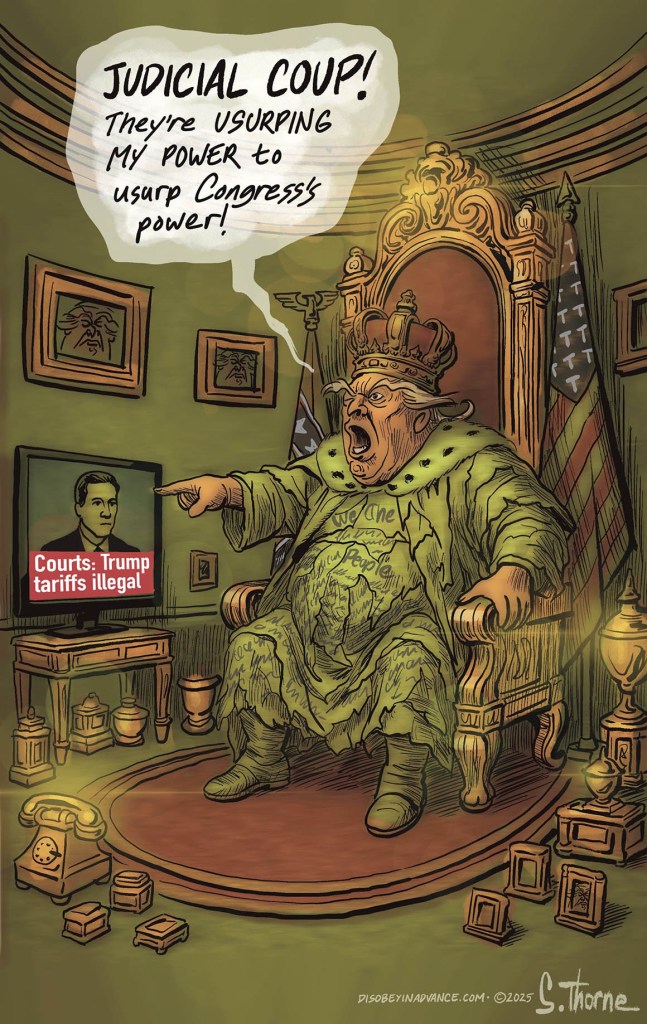
The New York Times Does a Deep Dive Into the Legal Issues Raised by Trump’s Purported Invocation of the International Economic Emergency Powers Act
This is a legally sophisticated yet understandable exposition of the legal issues. Despite the Times’ headline, the article shows how there is a large degree of bipartisan agreement among legal scholars that Trump’s tariffs are unconstitutional.
That bipartisan agreement should help the Supreme Court if and when it rules against Trump on the tariffs.
And, apart from the legal niceties, there is the fact that the tariffs are sending the economy to hell in a handbasket.
During Trump 1.0, because he thinks like a mob boss, Trump thought he was filling the federal judiciary with sycophants who would always rule his way, no matter about the facts, no matter about the law.
Federalist Society lawyers did a splendid job of conning Trump into thinking they were doing his bidding in their judicial selections.
Now, it has become apparent even to those of the meanest intelligence that most of the Federalist Society judges will not bend the knee to Trump, regardless of the facts, and regardless of the law.
Because Trump is a person of the meanest intelligence, he has now figured this out, and is busy this week throwing a hissy fit.
Specifically: where the law affords discretion to the President, it appears the Supreme Court will probably allow him to exercise that lawful discretion, even if he’s acting stupidly, in bad faith, with bad judgment, in ways that harm vast numbers of people.
BUT … BUT … BUT there is good reason to anticipate that the Supreme Court, along with the majority of the lower courts, will not endorse Trump’s actions when he or his agents
unconstitutionally refuse to spend money appropriated by Congress,
unconstitutionally dismantle federal agencies, without congressional authorization,
unconstitutionally deprive persons present in the United States of life, liberty, or property without due process of law, or
unconstitutionally use the powers they have—or claim powers they do not in fact possess—to punish people for the exercise of their civil rights, including free speech, freedom of the press, freedom of association, and freedom to petition for redress of grievances (and note that the latter freedom encompasses the freedom to file lawsuits).[1]
The Second Con
Throughout the four dreadful months of Trump 2.0, Team Trump has repeatedly—relying only on ipse dixit—asserted that it has legal powers that it does not actually have. It’s metaphysically possible that Trump has just acted without any legal advice at all. And it’s metaphysically possible that Trump has received legal advice, but decided to ignore it. That sort of thing does happen.
But I don’t think he actually acted without legal advice, or that he decided just to ignore the advice he received. It seems much more likely that he got legal advice, but that that advice was deeply flawed. If so, why? Are Trump’s legal counselors merely incompetent—or, on the other hand, are they intentionally maneuvering him into a place where the Supreme Court tells him to back down?
Take the Susman Godfrey executive order cited above. Who the hell drafted that thing? Who the hell told him it was a good idea? Who the hell told him that the courts would go along with him.
Read it. It might as well say, in all caps boldface type, at the top of the page, “THIS EXECUTIVE ORDER IS AN ATTEMPT TO PUNISH CITIZENS FOR EXERCISING THEIR CIVIL RIGHTS, AND TO DETER THEM FROM DOING SO, IN VIOLATION OF THE UNITED STATES CONSTITUTION.”
The current White House Counsel, David Warrington, is a Trump loyalist but has good credentials and has apparently never been subject to legal discipline.
Pam Bondi, the Attorney General, received her law degree from the number 98 ranked school in the country. Her lengthy Wikipedia biography reveals an astonishing number of regrettable circumstances in her legal career—notably, her exuberant embrace of the 2020 stolen election claim.
My thoughts: I don’t care that she’s the Attorney General. If you have the bad sense to ask Pam Bondi for legal advice, then you deserve what you get.
And then, of course, there is Vice President J.D. Vance—a Yale Law graduate who has come to believe Trump should just ignore Marbury v. Madison (decided in 1803, holding that “It is emphatically the province and duty of the judicial department to say what the law is”).
I don’t know whether anyone is duping Trump about the legal underpinnings of his various attempted usurpations—and, if anyone is doing so, who it is. As I implied above, maybe it’s just Trump gaslighting himself.
I do know that if any lawyer told Trump he was likely to prevail on, for example, the Susman Godfrey executive order, then that lawyer needs to be disbarred, and that right soon.
And I suspect that when the dust settles and we learn the truth, the chief culprits are going to be Bondi and Vance. And I think the evidence will show they conned Trump, intentionally misleading him about his chances with the Supreme Court–all with the goal of provoking a constitutional crisis.
[1] And then there are the tariffs. Trump purports to rely on a squinty-eyed interpretation of the International Emergency Economic Powers Act. As a matter of statutory interpretation and application, Team Trump has the legally weaker position, and his adversaries have the stronger position. But his legal case is not so ridiculous that his attorneys should be disbarred for asserting it.
Harvard has two lawsuits pending against Team Trump. The first one challenges the draconian cuts in federal research grants—said by Team Trump to be justified by the university’s purported “antisemitism,” its purported discrimination against white people, and a hodgepodge of other bellyaches, some vague and hard to pin down. I wrote about it on April 22.
The Harvard legal team elected not to ask for a temporary restraining order and preliminary injunction, but instead to demand a highly, highly expedited summary judgment process. Judge Burroughs’ order of April 28 indicates that Team Trump agreed to the schedule, leading up to oral argument on July 21—and presumably a district court decision by the end of the summer.
That means that teams of lawyers are reviewing evidence that probably runs to hundreds of thousands of pages and distilling it into legal briefs and accompanying exhibits.
In a normal case, one could expect the process to take several years. Here, it is scheduled to take only several months.
I count 17 lawyers on the Harvard legal team. It’s a little top heavy, but, that said, there are a lot of spear carriers, too. They have been getting very little sleep these past few weeks.
Been there, done that.
And a related point: wholly apart from the fact that Team Trump’s legal position eats shit, I very strongly suspect that the government’s legal team is being outmanned, outthought, and outgunned by Team Harvard.
But we shall see.
The Lawsuit about Foreign Students
As you may know, this is a separate lawsuit. On May 22, Secretary Kristi Noem—that’s the person who doesn’t know what habeas corpus means—revoked Harvard ability to have any foreign students. Harvard obviously saw that one coming a mile away. The next day, May 23, it filed a new lawsuit, asked for a temporary restraining order, and received its TRO within just a few hours.
That was just a few days ago. I assume that a preliminary injunction will soon be granted, that the First Circuit Court of Appeals will rule promptly In Harvard’s favor, and that the case will reach the Supreme Court next fall.
In the meantime, though, it’s reasonable to expect that a fair number of the 6,800 foreign students normally to be found on campus—often as teaching assistants and lab assistants—will take flight.
A Change in the Harvard Legal Team
For the second case, Harvard modified its team. Once again, Steven Lehotsky, of Lehotsky Keller Cohn LLP—revered litigator for Federalist Society causes—signed the complaint and identified a number of his partners and associates as helpers in the case. Once again, one partner each from Quinn Emanuel and King & Spalding are on the case. But Ropes & Gray is out, in the new case, replaced by a team of very heavy hitters from Jenner & Block.
As far as I can tell, Ropes & Gray is still on the first case, the one about grants. I expect their lawyers are overwhelmed with that case. Also, the head of the Ropes & Gray team has an excellent reputation, but he seems to know a lot about white collar crime, not constitutional law.
With luck, the new folks on Team Harvard from Jenner & Block will well and truly give ‘em hell.
And Finally, a Few Random Facts
There are about 320,000 living alumni of Harvard University. They tend to be richer than average. An estimated 18,000 of them are believed to have more than $30 million in wealth. Of those 18,000 very wealthy alumni, the average net worth is said to exceed $300 million.
Four top litigation partners at Paul, Weiss have walked out the, together with their associates, their paralegals, their secretaries, and their book of business. In my experience, this sort of thing happens all the time at the big firms, even without cowardly deals capitulating to a would-be tinpot dictator. I wish I were persuaded that the walkout was over the Trump deal—and that it presages severe harm to the Cowardly Nine firm—but if wishes were horses, we’d all take a ride.
And if you don’t like my hot take on the matter, then ask perplexity.ai “Does the departure of four litigation partners at Paul Weiss mean anything?” Their AI chatbot’s opinion is quite different from mine.
How Many Federal Officials Can Trump Fire?
According to statutory law, a president cannot fire, without cause, a member of the National Labor Relations Board or of the Merit Systems Protection Board. Trump did it anyway. The lower courts told him to reinstate the two individuals, pending a final decision on the merits. Over the dissent of the three liberals, the rest of the court ordered that, until the case is decided on the merits, the two fired officials can stay fired.
The legal issues are a teense complex, and if you’re interested, check out this article from SCOTUSblog.
My hot take: A majority of the Supreme Court seems to be getting ready to shitcan a century of precedent, and to destroy the independent status of heretofore independent agencies like the Federal Trade Commission.
What Else Happened to Team Trump in the Courts Last Week?
Nothing good for Trump. Harvard filed a new lawsuit against Team Trump, challenging the Administration’s refusal to allow any foreign students next year. The judge granted Harvard a preliminary injunction so fast that he barely had time to read the papers.
Another judge granted Jenner & Block’s request for a preliminary injunction against Trump. And a third judge ruled that Trump had acted illegally against the United States Institute of Peace.
A Reminder About a Fundamental Rule of Constitutional Law
At a Senate hearing, Senator Maggie Hassan, Democrat of New Hampshire, asked Ms. Noem about the issue. “Secretary Noem,” she asked, “what is habeas corpus?”
“Well,” Ms. Noem said, “habeas corpus is a constitutional right that the president has to be able to remove people from this country and suspend their right to—”
Ms. Noem’s answer, which echoed the Trump administration’s expansive view of presidential power, flipped the legal right on its head, turning a constitutional shield against unlawful detention into broad presidential authority.
Some people react to Trump-related Supreme Court decisions the way they react to baseball games. This season Team Trump was down 4 to 2 to Team Resistance, but yesterday Team Trump won, so now he’s only down 4 to 3.
If this is the way you think, then I have two pieces of advice: First, stop thinking this way, and try to figure out what’s actually going on in these court cases.
Second, if you reject my first piece of advice, then don’t count this as a Team Trump loss, because this particular game is far from over.
Hint: Only Justice Jackson disagreed with yesterday’s order. The other two liberals went along with it.
This is a clue.
Here is what the controversy appears to be about. Current law affords any President discretion—and listen up, I said “discretion”—to grant temporary protected status to immigrants who cannot safely return to their country. Recently, Team Trump exercised that discretion to pull protected status from several hundred thousand Venezuelans. Team Trump cited no evidence that conditions in Venezuela had changed for the better. Instead, their discretionary decision was based on factually unsupported bullshit about Tren de Aragua, etc., etc., etc., etc.
Now, what is a court supposed to do with this shambolic mess? Should it rule that a president lacks legal power to exercise lawful discretion if his reasoning is bullshit and arrant nonsense? Or is that approach a bridge too far in terms of constitutional separation of powers?
Yesterday, the Supreme Court decided to kick the can down the road for a mile or two. In July, the Ninth Circuit Court of Appeals is going to hear the case “on the merits” (as we shysters say). And in the meanwhile, individual Venezuelans about to be deported are entitled to a judicial hearing. So observed the Supreme Court in passing.
I’m not a mind reader, but I assume that’s why Justices Kagan and Sotomayor went along with the majority.
So this particular game isn’t over—at least not yet. But I think that the interference-with-presidential-discretion argument may, in the end, carry the day. It’s always problematic to create a legal rule that says, “You are hereby forbidden to act like an asshole and a jerk.” The courts may deem in prudent to retreat to a rule that says “You are hereby forbidden to exercise legal authority that you clearly don’t have.”
And that would mean disaster for more than a million Venezuelans, Haitians, Nicaraguans, and Cubans now residing in the United States–people whose lives may be shattered on the alter of judicial restraint.
Yesterday, May 16, the Supreme Court issued another ruling in the case of the Venezuelan people than Trump wants to deport to a gulag in El Salvador; read the opinion here. I posted about this case on April 19,April 20, and April 22.
The May 16 decision consists of (1) an eight-page unsigned (“per curiam”) opinion on behalf of the Chief Justice, the three Trump-appointed justices, and the three liberal justices, (2) a two-page concurring opinion by Justice Kavanaugh, and (3) a 14-page dissenting opinion by Justice Alito, joined by Justice Thomas.
Although the majority, per curiam opinion did not use words such as “bad faith,” “fibbing,” or “too cute for words” in describing the Justice Department’s position, it clearly implied that the government attorneys were prevaricating with the Supreme Court about the government’s plans to whisk the plaintiffs away—and then claim the Court had no jurisdiction as to individuals located in a foreign country.
The Court ordered, once again, that the Venezuelans should stay in this country pending further legal proceedings, and it remanded the case to the Fifth Circuit Court of Appeals for further consideration of how due process should work under the Alien Enemies Act, along with a variety of other considerations.
Justice Kavanaugh agreed with the majority’s analysis but would have kept the case in the Supreme Court and have the Court eschew further shilly-shallying, and just decide the damn case.
In his dissent, Justice Alito enlarged ad nauseam on the multiple ways in which the majority’s truncated, expedited procedure is in tension with the way things are normally done. As indeed they are. No shit, Sherlock. The government was lying to the courts, frog-marching the poor Venezuelans out of the country, and employing every bad faith trick in the books to use the normal, deliberative rules of the law of civil procedure in order to forestall real due process for immigrants.
Let’s look at the situation from 30,000 feet. What do we see?
First, Team Trump’s legal strategy—along will all the legal tactics that flow from that strategy—is to replace rule of law with a Ptemkin village that looks, from the outside, something like rule of law, but is not in fact rule of law.
Second, that legal strategy is doomed to failure unless a critical mass of the judiciary—and particularly a critical mass of the justices of the Supreme Court—are prepared to go along with it. (Sure, Trump could just order the police to arrest or kill all the members of the Supreme Court, and if the police obey the order, then Trump would win. But in that situation, the outcome would not be a legal Potemkin village, but rather a legal wasteland.)
Third, Team Trump seems to have thought that Justices Alito and Thomas, plus the three Trump-appointed justices would embrace the Potemkin village approach. Well, if that’s what Team Trump thought, then it appears they were right about Alito and Thomas but wrong about Kavanaugh, Gorsuch, and Barrett.
The real news here—the Man Bites Dog element—is that the three Trump-appointed justices did not bark in the night at Trump’s command.
Logical conclusion: the days are hastening on to the place where Team Trump is either going to have to back down on multiple legal fronts or it is going to have to declare, in words that are clear to the least intelligent folks among us, that the rule of law is over.
If it choose the latter option, it will be subject to vehement objections by all the Trump justices appointed in the first term–as well as a great many of the Trump Judes appointed to the courts of appeal and to the district court.
The unvarnished assault on the rule of law will come at a time when Walmart is running out of cheap goods, then Americans are being injured in multiple ways by cuts in government services, when small businesses are going out of business, and when Walmart is running out of cheap imported goods.

 Facing MAGA