I Now Present Irrefutable Proof That Trump is an Idiot

With clear eyes, hard facts, critical thinking, new political strategy, empathy, and a soupçon of Schadenfreude
Posts about the situation we are in–the good facts, the bad facts, and the terrible facts. Facts that, if taken on board, will let us “know ourselves, know the other side” and go on to win those hundred battles.
Thomas B. Edsall (N.Y. Times), How Does a Stymied Autocrat Deal With Defeat?
Mr. Edsall writes,
The window of opportunity that allowed President Trump to overwhelm his adversaries with an onslaught of executive orders dismantling core American institutions is closing.
Public opinion has turned against him, the economy is faltering, the Supreme Court has ordered him to stand down, his tariffs have backfired, and such conservative mainstays as National Reviewand The Wall Street Journal are questioning his judgment.
How does a stymied autocrat deal with defeat? As the opposition gains strength, frustrating the nation’s commander in chief, how will Trump respond?
It is unthinkable to imagine him graciously acknowledging defeat, changing direction and moving on.
Will he claim victory in defeat? Will he try to provoke his adversaries into violence in order to invoke the Insurrection Act?
Trump’s unpredictability makes it impossible to answer these questions with any certainty, but as his actions in the first three months of his second term demonstrate, Trump’s choices veer to the extreme. …
If, in the face of adversity, Trump and his allies attempt to overturn democracy, what are their chances? I asked Herbert Kitschelt, a professor of international relations at Duke and the 2025 recipient of the prestigious Johan Skytte Prize in political science, that question, and he provided a nuanced reply by email: “No scientific, evidence-based investigation can currently provide a factually grounded prognosis” on “whether and how Trump and the Christian evangelical-nationalist-Southern wing of the Republican Party might break the democratic Constitution of the United States,” he wrote.
Instead, Kitschelt argued, it is possible to “outline the forces that may impinge on whether this process will take place or not.”
Kitschelt then specified the four factors working in favor of the establishment of “an authoritarian coalition in the United States”:
U.S. technological innovativeness and productivity gains — more so than in other advanced capitalist countries — have generated anxiety among many occupational groups.
The U.S. has a weak welfare state — in terms of pensions, health care, unemployment insurance, aid to families with children, public education — when compared to just about any other advanced capitalist country.
America is the most inegalitarian advanced Western country, in terms of income and wealth. That induces rich people to promote politicians who distract the economically worse off from questions of economic distribution and focus their attention on issues of political governance, culture war, racial and ethnic hierarchies and nationalist claims to global supremacy.
Unlike any other Western democracy, America has a deeply antidemocratic, intolerant, illiberal religious strand.
Kitschelt went on to describe conditions in the United States that “are adverse to the victory of an authoritarian coalition” and are, in contrast, favorable to democracy:
America’s civil society: If it awakens from its current shock and slumber, signs of which are already emerging, it is likely that it will become a powerful force to uphold democracy.
Most importantly: American capitalism, large segments of the U.S. business class, whether in finance, I.T. and A.I., U.S. manufacturers in global production chains (vehicles, aerospace, pharma, etc.) and U.S. culture industries are averse to a MAGA & Tea Party authoritarian coalition. Populism undercuts property rights and the rule of law, rendering it impossible to make rational, profit-generating, long-term business investments.
A severe economic crisis, which Kitschelt believes is probable, given current trends, would sharply undermine Republican prospects in the 2026 congressional elections, which might prompt Trump and his allies to “realize that they cannot win a free and fair election and actually might face a defeat in the midterms severe enough to precipitate the impeachment of both president and vice president.”
The question then becomes, in Kitschelt’s view:
Will evangelical-nationalist clero-fascism — with other MAGA and Tea Party currents in tow — be capable of converting America into an electoral autocracy faster than U.S. civil society and large parts of the business sector will be able to mobilize a defense of American democracy and to stiffen the spine of the U.S. judiciary to preserve American institutions?
A couple of random points, if I may.
First, if anyone has forgotten or doesn’t know, I’d like to provide a brief reminder about who George Conway is. To put this in context: YouTube serves up a lot of legal commentators. Many of them have some relevant experience and some good points to make. But, in my opinion, Conway stands out as a Very Series Person. He is a graduate of Harvard College and Yale Law School, and, for 26 years, was a litigation partner of Wachtell, Lipson, Rosen & Katz, the richest law firm in the United States. Why did he leave? It’s not clear, but my speculation is that he had as much money as he needed for the rest of his life, and wanted to be a champion for the rule of law.
Conway understands exactly what is going on. And he has the capacity to explain what’s going on.
And here’s the second random point—the question of why Legal Team Trump are acting like a bunch of menacing clowns, as detailed in the video.
They have already been smacked down by the Supreme Court. And, as sure as God made little green apples, they are headed straight for a full on, definitive, rebuke by the Court.
Actually, lots and lots of rebukes—in the immigration cases, the law firm cases, the education cases, all as discussed in the video.
So … what the hell is Legal Team Trump’s game plan? Once, rebuked, to back down and look like idiots?
Or … to tell the Supreme Court to go to hell. But if THAT’s their plan, then why not stand on “principle” now, and just tell the lower courts that they “lack jurisdiction” or are “acting illegally”? That would be a bad plan—but not merely as bad as the menacing clown show That Legal Team Trump is staging now.
There is an answer to that question. They are acting like menacing clowns because they are fifth rate minds. And, of course, because they have to please His Most High Excellency on TV every day. In now way, have they thought through where all their tomfoolery is going to lead. In no way, do they know how to deal rationally with the likely consequences of their actions.
In short, the Trump legal shit show is entirely of a piece with the shit show in pretty much all other aspects of government. See Dana Milbank (Washington Post), For the Trump administration, it’s amateur hour
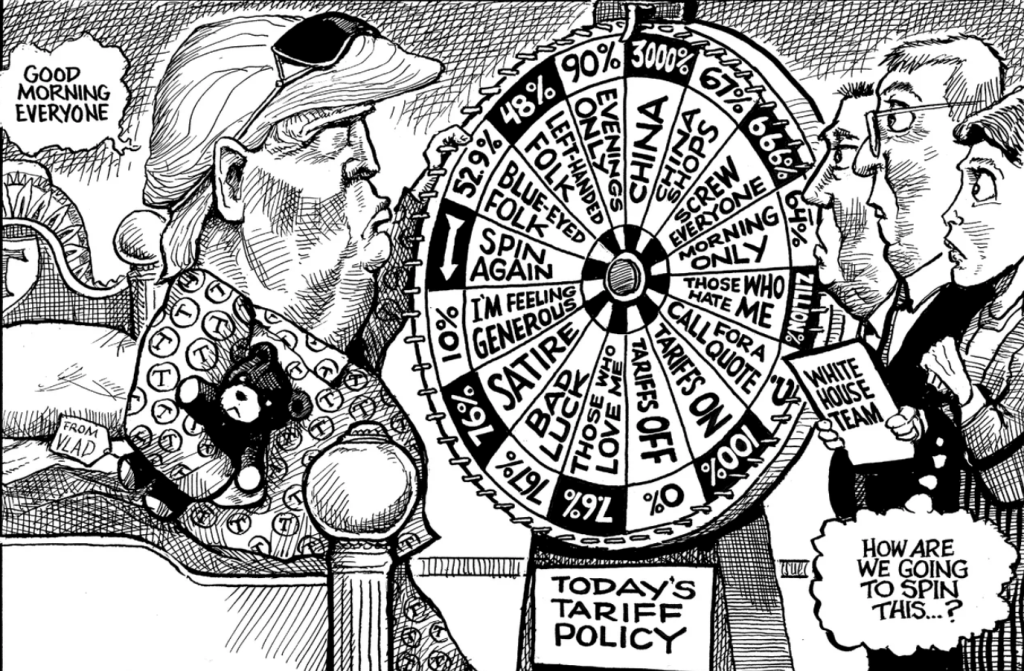
Here is what the Chinese government knows.
America is a very large country, where consumers still have enough freedom to complain loud and long when supplies run out and prices soar.
At Walmart and Target, the shelves are going to be empty in about two weeks. (You might want to schedule a shopping trip soon.)
China is a very large country, where consumers will put up with a lot of pain, because if they complain very loudly, they’ll get chucked in jail.
Hence China’s strategy:
Make His Most High Excellency negotiate against himself.
And what if he doesn’t want to negotiate against himself? And who does?
Well, in that case, just bloody well wait him out.

I made a mistake. Amidst all the chaos of the previous weekend, I thought that the Trump Administration had not responded to the Supreme Court’s midnight ruling, and to the dissent to that ruling by Justice Alito, joined by Justice Thomas.
In fact, the Solicitor General did file a brief, to which the ACLU responded.
It is common ground that, on Friday night, the ACLU sounded the alarm, got the justices out of bed, told them that the Trump Administration had put a bunch of immigrants on buses, that the buses were headed to the airport, where a plane was headed for El Salvador, and that seven of the nine justices believed the ACLU and issued the Midnight Order.
The main issue, for purposes of the weekend, was whether the ACLU was just throwing sand in the Court’s eye, or whether the Administration really was trying to pull a fast one, tying the courts up in the niceties of their own procedures while a bunch of immigrants were headed to the gulag.
Now, as I said, the Solicitor General filed a 15-page weekend brief. And what, pray tell, did the Solicitor General say about the main issue?
He said nothing whatsoever about the main issue. And that is because there was nothing he could say, without either lying through his teeth or expressing open contempt for the Supreme Court.
Ladies and gentlemen, when you are compelled to file a brief that says nothing at all about the key issue then you are indeed having a horrible, terrible, no good, very bad day.
Part of the Solicitor General’s problem was that the Fake News Media had video of the immigrants on the buses – which passed by the exit to the Abilene, Texas, airport, turned around, and delivered the prisoners back to their Texas prison!
Unlike some in the Administration, the Solicitor General has enough sense to know that “who’re you gonna believe, me or your lying eyes?” is not an argument you should make to the Supreme Court.
His Most High Excellency has addressed the issue—but only by saying that he’s very frustrated. See The Hill, Trump blasts Supreme Court while arguing trials for migrants ‘not possible’.
You never know what will happen tomorrow, or next week. But, for now, His Most High Excellency has backed off deporting people without due process.
As leaders of America’s colleges, universities, and scholarly societies, we speak with one voice against the unprecedented government overreach and political interference now endangering American higher education. We are open to constructive reform and do not oppose legitimate government oversight. However, we must oppose undue government intrusion in the lives of those who learn, live, and work on our campuses. We will always seek effective and fair financial practices, but we must reject the coercive use of public research funding.
America’s system of higher learning is as varied as the goals and dreams of the students it serves. It includes research universities and community colleges; comprehensive universities and liberal arts colleges; public institutions and private ones; freestanding and multi-site campuses. Some institutions are designed for all students, and others are dedicated to serving particular groups. Yet, American institutions of higher learning have in common the essential freedom to determine, on academic grounds, whom to admit and what is taught, how, and by whom. Our colleges and universities share a commitment to serve as centers of open inquiry where, in their pursuit of truth, faculty, students, and staff are free to exchange ideas and opinions across a full range of viewpoints without fear of retribution, censorship, or deportation.
Because of these freedoms, American institutions of higher learning are essential to American prosperity and serve as productive partners with government in promoting the common good. Colleges and universities are engines of opportunity and mobility, anchor institutions that contribute to economic and cultural vitality regionally and in our local communities. They foster creativity and innovation, provide human resources to meet the fast-changing demands of our dynamic workforce, and are themselves major employers. They nurture the scholarly pursuits that ensure America’s leadership in research, and many provide healthcare and other essential services. Most fundamentally, America’s colleges and universities prepare an educated citizenry to sustain our democracy.
The price of abridging the defining freedoms of American higher education will be paid by our students and our society. On behalf of our current and future students, and all who work at and benefit from our institutions, we call for constructive engagement that improves our institutions and serves our republic.
Signed,

Late this afternoon, Harvard filed suit against Team Trump. The complaint is here. The gist is found in paragraph 3, which reads as follows:
On April 11, 2025, citing concerns of antisemitism and ideological capture, the Government identified ten conditions Harvard must satisfy to receive federal research funding already committed to by the Governmentand relied on by Harvard, its researchers, and its affiliates (the “April 11 Letter,” attached as Exhibit A). Ex. A at 2,4. The Government dictated that Harvard “reform and restructur[e]” its governance to “reduc[e] the power” ofcertain students, faculty, and administrators. Id. at 2. It required that Harvard hire a third-party to conduct an“audit” of the viewpoints of Harvard’s student body, faculty, and staff. Id. at 3-4. Then, based on the results ofthis university-wide viewpoint audit, Harvard must “hir[e] a critical mass of new faculty” and “admit[] a critical mass of students” to achieve “viewpoint diversity” in “each department, field, or teaching unit”—to the Government’s satisfaction as determined in the Government’s sole discretion. Id. And the Government has demanded that Harvard terminate or reform its academic “programs” to the Government’s liking. Id. at 4. All told, the tradeoff put to Harvard and other universities is clear: Allow the Government to micromanageyour academic institution or jeopardize the institution’s ability to pursue medical breakthroughs, scientific discoveries, and innovative solutions.
The complaint alleges violation of the First Amendment in multiple ways, violation of the Administrative Procedures Act in multiple ways, and violation of statutory and constitutional authority.
The complaint identifies Harvard’s attorneys as individual partners of the Quinn Emanuel and King & Spalding firms—the two people who are known to have represented Harvard in discussions with Team Trump—along with four attorneys at Ropes & Gray, a distinguished old line Boston firm, and nine attorneys from four offices of Lehotsky Keller Cohn LLP, described as an elite litigation boutique firm.
The Lehotsky firm is well connected in conservative legal circles. One of the Lehotsky lawyers on the case was president of the Federalist Society at Harvard Law School.
Mr. Lehotsky, the first named partner of the firm, and the only attorney whose physical signature appears on the complaint, clerked for Justice Scalia and, at one point, directed litigation strategy for the United States Chamber of Commerce, where he was known for slaying regulatory dragons.
Chief Justice Roberts, along with Justice Gorsuch and Justice Jackson, took their undergraduate degrees from Harvard College and their law degrees from Harvard Law School. Justice Kagan came to Harvard Law by way of Princeton.
I think sounds of silence signal that the legal part of Team Trump is having a terrible, horrible, no good, very bad weekend.
Meanwhile, an insightful op-ed in the N.Y. Times speaks of a recently invented right wing legal principle—the major questions doctrine, newly discovered as a conservative cure for perceived liberal excesses—that requires “clear congressional authorization” when the bureaucrats make decisions of great “economic and political significance.” Otherwise, bye-bye liberal policy adventuresomeness.
Now, Orange Mussolini is the poster child for one who makes decisions of great economic and political significance without a ghost of a shadow of congressional authorization.
Will the courts apply their new major questions doctrine in an intellectually consistent way? Stay tuned. We’ll find out in due course. See Aaron Tang, Will This Conservative Legal Doctrine Undo Trump’s First Months in Office?
Enquiring minds want to know.
 Facing MAGA