With clear eyes, hard facts, critical thinking, new political strategy, empathy, and a soupçon of Schadenfreude
Category: Situational Awareness
Posts about the situation we are in–the good facts, the bad facts, and the terrible facts. Facts that, if taken on board, will let us “know ourselves, know the other side” and go on to win those hundred battles.
So here’s some food for thought. Most major corporate CEOs have a corporate jet, and they have a pilot for that corporate jet. What qualities would a CEO look for in a pilot?
Would they want a person who cannot accurately acquire and process information about the weather?
Would they want to hire a pilot who does not understand the relation between his actions and the consequences of his actions?
Would they like a pilot who, when she makes a mistake, belligerently hallucinates falsehoods to explain away the facts—like some out-of-control chatbot, powered by runaway Artificial UnIntelligence?
Would the CEO want a person suffering from malignant narcissism—imagining himself to be the best pilot in the country, indeed, the best pilot who has ever lived, so capable that flying his jet through a hurricane is no cause for concern?
If the answer to these questions is no—and the answer surely is no—then why would the same corporate CEO be happy to hire a pilot for the nation who suffers from the same mental handicaps?
We are talking about Fortune 500 CEOs, whose average compensation runs to about $17 million a year. A lot of these folks are not addicted to heroin, but they are addicted to money.
Just as a heroin-addicted paterfamilias will take the children’s milk money to spend it on a drug, so also a money-addicted person will optimize money making over considerations of common sense, not to mention considerations of empathy or morality.
Compare Joe Sixpack. Joe Sixpack didn’t go to college, but, still, he should have known enough to conclude that it was unwise to reelect Trump. When Joe Sixpack gets hurt by the tariffs and by the inflation resulting from mass deportation, he will be getting no more and no less than he deserves. I hope Joe learns from the terrible lesson he’s about to receive.
All that said, the greater responsibility falls on our country’s economic and intellectual elite.
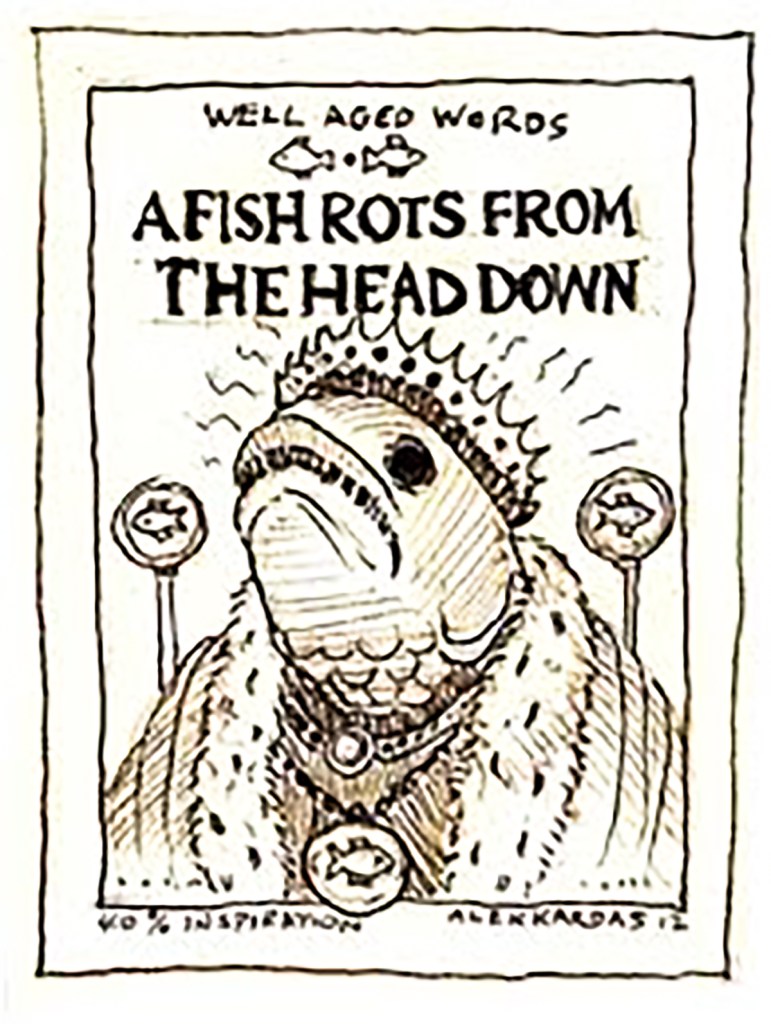
Well and truly has it been noted that a fish rots from the head down.
A couple of weeks ago, a story emerged in Washington that was likely to make any chief executive officer shudder: according to Axios, the White House has created a secret “loyalty rating” chart ranking 553 companies and business groups on whether they display “low”, “moderate” or “strong” support for the policies enshrined in Donald Trump’s “big, beautiful” budget bill.
Initially, Trump’s team did not comment on the story, although the White House has since confirmed that the scorecard — on which groups such as Delta, Door Dash and Uber are reportedly rated highly — does exist.
But what is perhaps most notable in all this is the lack of any visible business reaction. After all, using “loyalty rankings” as a basis for policy dealings is certainly not an American norm; on the contrary, it seems to underscore that the administration has scant respect for the concept of a universal “rule of law”.
That should worry any business. So should the uncertainty about Trump’s tariff policies,deportations and regulatory upheaval. But few executives have criticised the president in public so far, even as constitutional lawyers howl. And when I recently participated in different private roundtables with executives and investors, there was little private criticism either. Fealty and silence is the new norm.
Why? If I were to put America’s C-suite on the metaphorical couch right now, I would point to at least five factors. The first — and most obvious — is fear and greed: CEOs are terrified of incurring Trump’s wrath if they oppose him, and most seem convinced they can arbitrage his policies to their own advantage, due to deregulation and/or their links with the White House. This is why “loyalty lists” matter.
A second factor is partisan politics. According to Gallup, just 1 per cent of Democrats approve of Trump’s job performance, while 93 per cent of Republicans do — equalling the biggest split since this survey started in 1979. Since business leaders skew Republican, and tend to dislike progressive politicians such as Alexandria Ocasio-Cortez, this split matters.
In addition, there are three other more subtle, and less noticed, factors at work too. One is that it seems that Trump’s “shocking” policies are starting to lose their ability to shock the C-suite quite as much as before.
Blame this, if you like, on the fact that we are now in Trump’s second term, and on a widespread embrace of the “Taco” thesis — that the US president always chickens out of his wildest threats. Moreover, business leaders have faced a series of once-unimaginable shocks in recent years, including the global financial crisis, the Covid-19 pandemic and Russia’s full-scale invasion of Ukraine. So CEO cognitive resilience has grown — and perhaps complacency has too.
A fourth factor is “animal spirits”, to cite John Maynard Keynes. Economists have always assumed that if businesses expressed public optimism, investors would feel the same. This still holds true: the fact American companies are currently beating earnings forecasts has helped to propel stocks to record highs.
However, the causality is now also working in reverse: it is hard for any corporate leader to express alarm about the outlook, or criticism of Trump, when markets seem so giddily exuberant. A form of crowd psychology is at work that few CEOs dare defy.
Last but not least, there is the issue of artificial intelligence. A host of executives and investors seem to love Trump’s policies on AI, most notably because he is deregulating it under the mantra of boosting growth — an idea that appeals to American executives increasingly scornful of what they see as Europe’s low-growth, regulation-heavy model.
However, there is another implication of the AI boom: it is enabling CEOs to talk to their investors about business uncertainty without ever needing to mention Trump’s name at all.
More bluntly, AI is the ultimate distraction device for the C-suite, since it is now absorbing so much executive headspace and public airtime that there is less space to think about other issues, such as the uglier side of Trump’s policies. It gobbles up bandwidth, literally and metaphorically.
Now, I daresay there will be readers who might disagree with this five-part explanation. Some business leaders genuinely love Trump’s policies, and think they will unleash long-term growth.
But if you think this five-part frame is even halfway accurate, then the key thing to ponder is whether anything might cause the psychology to change. If markets tumble, AI becomes less distracting or tariffs crush earnings, could there be a backlash? Or if Europe recovers, might that take the shine off Trump?
Right now, we don’t know. But what is clear is that it is a fool’s errand to think American CEOs will spark an anti-Trump rebellion anytime soon. That White House “loyalty list” has already done its job.
Florida Decided There Were Too Many Children: The state’s elimination of vaccine mandates is a courageous first step toward decluttering itself of any excess kids.
Sorry. We decided there were too many children.
You know how it goes.
Their hands are too small. Sometimes they are sticky, and no one knows why. They say they’re eating their dinner, but you can see that they are just pushing it around on their plate. They come up to you on the sidewalk and tell you their whole life story for 10 minutes, wearing face paint from a birthday party three days ago. Some afternoons they announce that they are sharks, but they are obviously not sharks. They do this over and over again.
And the state of Florida, understandably, said: Enough. This needs to stop. We have decided that there are too many children, and we can let some of them go. Or, as the state’s surgeon general put it when he eliminated all vaccine mandates yesterday: “Who am I as a government or anyone else, who am I as a man standing here now, to tell you what you should put in your body? Who am I to tell you what your child should put in [their] body? I don’t have that right.”
(That relaxed attitude about bodily autonomy comes as something of a surprise, given the state’s six-week abortion ban, but this is America, where you can do anything with your body unless there’s a uterus in it.)
Florida is the first state to take the courageous step toward decluttering itself of excess children, but under the inexpert guidance of Robert F. Kennedy Jr., other states may follow. If we lose herd immunity, we will bring back diseases that had formerly been eliminated, and some children who would otherwise have been protected will perish. But no price is too high to pay in this pointless war against decades of lifesaving science. Confusingly, this effort is being taken up at the same time that people are Very Concerned about dropping birth rates, but it makes sense when you understand that they don’t like the children we currently have. They want us to make other ones instead.
This is certainly one possible response to the epidemic of mass shootings: unleash another epidemic on our elementary schools. If I had to guess what kind of shot we would make sure schoolchildren got, I would have guessed wrong. I am always guessing wrong. I am always guessing that we want children to live.
I’ll leave the fine details to the experts, but here is the gist. If Team Red—or, of course, Team Blue—finds itself with a lot of extremely safe congressional districts, the partisan redistricting may be accomplished by spreading out those partisan voters, so that the team has somewhat fewer safe seats and a larger number of seats that it’s going to win by, say, only five percent or so.
That works just fine if you can accurately predict which way the political win will be blowing, come next election. But what happens if the political wind starts blowing against you?
If, let’s say, the wind unexpectedly blows against you—let’s say by seven percent in favor of Team Blue—then your bunch of five percent wins turn into a bunch of two percent losses. And you have well and truly shot yourself in the foot.
You will recognize this situation as a corollary of the general rule that the straight edge ruler is not your best tool for short term and long term planning.
Down in Texas, Team Red—having partaken generously of Trump’s Kool-Aid—thinks that Orange Man’s popularity in the Lone Star State will continue from strength. In particular, they think the Latino community is overjoyed by the ICE arrests, and will reward Mango Mussolini in 2026 by increasing their support in congressional districts bordering on the Rio Grande.
Good luck with that.
Meanwhile, His Most High Excellency has declared today that he will order his “Justice Department” to sue California for retaliatory redistricting on the part of Team Blue.
The Very Stable Genius did not, however, articulate a coherent legal principle that would condemn Team Blue in California while, at the same time, blessing Team Red’s efforts in Texas.
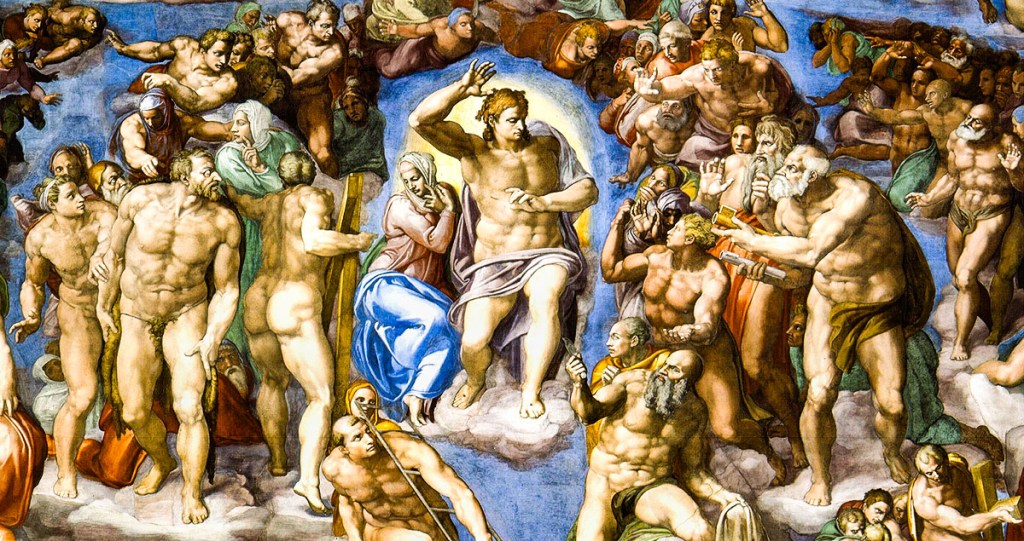
The exact quote is, “I want to try and get to heaven, if possible. I’m hearing I’m not doing well. I am really at the bottom of the totem pole. But if I can get to heaven, this [a peace deal for Ukraine] will be one of the reasons.”
Does the Archangel Michael Have Trump’s Cellphone?
The Times asks an excellent question:
This fear of perdition raised some questions. Chief among them: Who, exactly, has been informing the president that he is “not doing well” with regard to kingdom come? Did Michael the Archangel somehow get Mr. Trump’s cellphone number?
Your Chances of Getting into the Christian Heaven? Not Lookin’ Good, Donnie.
You know, Orange Man, the Gospel of Matthew is pretty damn specific about who’s a sheep and who’s a goat.
And, Donnie, you, sir, are a goat. (And that definitely doesn’t mean Greatest of All Time.)
And he shall set the sheep on his right hand, but the goats on the left.
Then shall the King say unto them on his right hand, Come, ye blessed of my Father, inherit the kingdom prepared for you from the foundation of the world. For I was an hungred, and ye gave me meat. I was thirsty, and ye gave me drink. I was a stranger, and ye took me in. Naked, and ye clothed me. I was sick, and ye visited me. I was in prison, and ye came unto me.
Then shall the righteous answer him, saying, Lord, when saw we thee an hungred, and fed thee? or thirsty, and gave thee drink? When saw we thee a stranger, and took thee in? or naked, and clothed thee? Or when saw we thee sick, or in prison, and came unto thee?
And the King shall answer and say unto them, Verily I say unto you, Inasmuch as ye have done it unto one of the least of these my brethren, ye have done it unto me.
Then shall he say also unto them on the left hand, Depart from me, ye cursed, into everlasting fire, prepared for the devil and his angels:
For I was an hungred, and ye gave me no meat. I was thirsty, and ye gave me no drink.I was a stranger, and ye took me not in; naked, and ye clothed me not; sick, and in prison, and ye visited me not.
Then shall they also answer him, saying, Lord, when saw we thee an hungred, or athirst, or a stranger, or naked, or sick, or in prison, and did not minister unto thee?
Then shall he answer them, saying, Verily I say unto you, Inasmuch as ye did it not to one of the least of these, ye did it not to me.
And these shall go away into everlasting punishment, but the righteous into life eternal.
And, Guess What, Donnie, You’re Also Going to Secular Hell for Megalomaniacs
And what, pray tell, is secular hell for megalomaniacs? I will answer my own rhetorical question. Secular hell for megalomaniacs is a fixed, enduring, well known and well established historical reputation for evil, vaingloriousness, inability to assess the relevant facts of a situation, inability to predict the consequences of your actions, refusal to recognize and accept good counsel, always valuing loyalty over competence, not recognizing the truth when it bites your own butt, and a love of performative cruelty.
Donnie, you and I are both 79 years old. We both graduated from an Ivy League university in 1968. AI tells us that deaths per year for 1968 Ivy League grads begin to reach their peak in our late 70s and early 80s.
Some, based on observation of your physical condition, your behavior, and your beginning to muse—in your own illiterate way—about the afterlife, ask, “Is Trump dying?”
Well, guess what, Donnie? Yeah, you’re dying. Maybe not next week. Maybe not next year. But you’re well on the way to your final reward.
And know this.
In future decades, in future centuries, for ages and ages to come, world without end, your name will be a byword.
It will be a byword for megalomania.
It will be a byword for wilful, pigheaded ignorance.
It will be a byword for joyous performative cruelty.
You will be a poster child for the President of the United States who possessed not a single character trait that made him worthy of his high office.
Clearly, he wants the Peace Prize so much that Putin can twist him around his middle finger.
Some thoughts that come to mind:
Maybe the Heritage Foundation, joined with the Southern Baptist Convention, could name him the International Prince of Peace.
Or the Council on Foreign Relations could award him the Annual Prize for Creative Diplomatic Strategy—commenting that Obama never won this prize, which clearly proves Trump is twice the man Obama is.
Or perhaps the best idea of all: Harvard could give him an honorary Ph.D in Foreign PolicyThinkology.
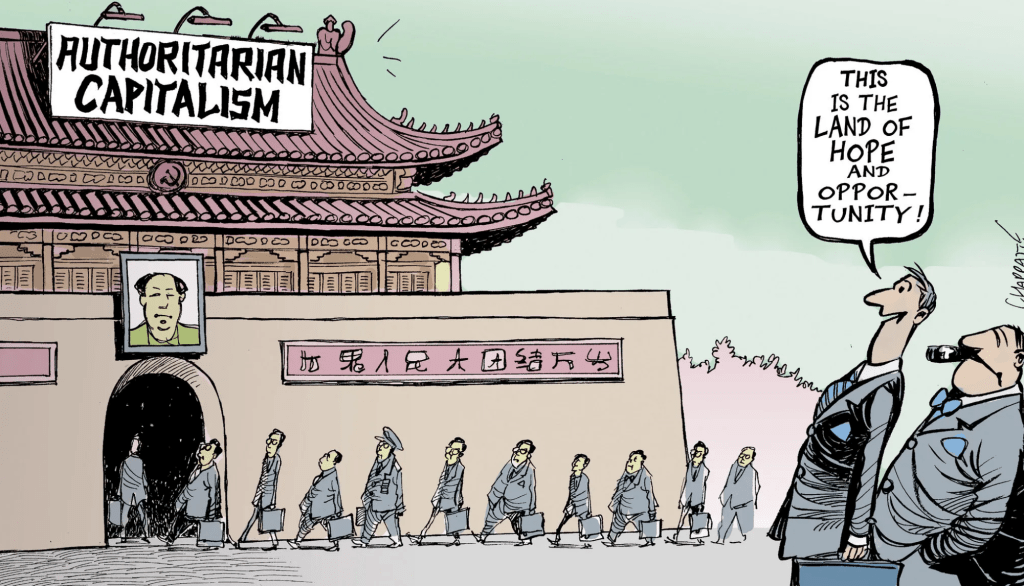
This isn’t socialism, in which the state owns the means of production. It is more like state capitalism, a hybrid between socialism and capitalism in which the state guides the decisions of nominally private enterprises.
China calls its hybrid “socialism with Chinese characteristics.” The U.S. hasn’t gone as far as China or even milder practitioners of state capitalism such as Russia, Brazil and, at times, France. So call this variant “state capitalism with American characteristics.” It is still a sea change from the free market ethos the U.S. once embodied.
How we learned to love state capitalism
We wouldn’t be dabbling with state capitalism if not for the public’s and both parties’ belief that free-market capitalism wasn’t working. That system encouraged profit-maximizing CEOs to move production abroad. The result was a shrunken manufacturing workforce, dependence on China for vital products such as critical minerals, and underinvestment in the industries of the future such as clean energy and semiconductors.
The federal government has often waded into the corporate world. It commandeered production during World War II and, under the Defense Production Act, emergencies such as the Covid-19 pandemic. It bailed out banks and car companies during the 2007-09 financial crisis. Those, however, were temporary expedients.
Former President Joe Biden went further, seeking to shape the actual structure of industry. His Inflation Reduction Act authorized $400 billion in clean-energy loans. The Chips and Science Act earmarked $39 billion in subsidies for domestic semiconductor manufacturing. Of that, $8.5 billion went to Intel, giving Trump leverage to demand the removal of its CEO over past ties to China. (Intel so far has refused.)
Biden officials had mulled a sovereign-wealth fund to finance strategically important but commercially risky projects such as in critical minerals, which China dominates. Last month, Trump’s Department of Defense said it would take a 15% stake in MP Materials, a miner of critical minerals.
Many in the West admire China for its ability to turbocharge growth through massive feats of infrastructure building, scientific advance and promotion of favored industries. American efforts are often bogged down amid the checks, balances and compromises of pluralistic democracy.
In his forthcoming book, “Breakneck: China’s Quest to Engineer the Future,” author Dan Wang writes: “China is an engineering state, building big at breakneck speed, in contrast to the United States’ lawyerly society, blocking everything it can, good and bad.”
To admirers, Trump’s appeal is his willingness to bulldoze those lawyerly obstacles. He has imposed tariffs on an array of countries and sectors, seizing authority that is supposed to belong to Congress. He extracted $1.5 trillion in investment pledges from Japan, the European Union and South Korea that he claims he will personally direct, though no legal mechanism for doing so appears to exist. (Those pledges are already in dispute.)
Trouble with state capitalism
There are reasons state capitalism never caught on before. The state can’t allocate capital more efficiently than private markets. Distortions, waste and cronyism typically follow. Russia, Brazil and France have grown much more slowly than the U.S.
Chinese state capitalism isn’t the success story it seems. Barry Naughton of the University of California, San Diego has documented how China’s rapid growth since 1979 has come from market sources, not the state. As Chinese leader Xi Jinping has reimposed state control, growth has slowed. China is awash with savings, but the state wastes much of it. From steel to vehicles, excess capacity leads to plummeting prices and profits.
State capitalism is an all-of-society affair in China, directed from Beijing via millions of cadres in local governments and company boardrooms. In the U.S., it consists largely of Oval Office announcements lacking any policy or institutional framework. “The core characteristic of China’s state capitalism is discipline, and Trump is the complete opposite of that,” Wang said in an interview.
Means of control
State capitalism is a means of political, not just economic, control. Xi ruthlessly deploys economic levers to crush any challenge to party primacy. In 2020, Alibaba co-founder Jack Ma, arguably the country’s most famous business leader, criticized Chinese regulators for stifling financial innovation. Retaliation was swift. Regulators canceled the initial public offering of Ma’s financial company, Ant Group, and eventually fined it $2.8 billion for anticompetitive behavior. Ma briefly disappeared from public view.
Trump has similarly deployed executive orders and regulatory powers against media companies, banks, law firms and other companies he believes oppose him, while rewarding executives who align themselves with his priorities.
In Trump’s first term, CEOs routinely spoke out when they disagreed with his policies such as on immigration and trade. Now, they shower him with donations and praise, or are mostly silent.
Trump is also seeking political control over agencies that have long operated at arm’s length from the White House, such as the Bureau of Labor Statistics and the Federal Reserve. That, too, has echoes of China where the bureaucracy is fully subordinate to the ruling party.
Trump has long admired the control Xi exercises over his country, but there are, in theory, limits to how far he can emulate him.
American democracy constrains the state through an independent judiciary, free speech, due process and the diffusion of power among multiple levels and branches of government. How far state capitalism ultimately displaces free-market capitalism in the U.S. depends on how well those checks and balances hold up.
Hot Take by Me: Does Silence Necessarily Mean Capitulation?
I was struck by Mr. Ip’s observation that CEOs now keep silent about things they would have publicly protested in earlier years. I’m sure that’s right. But here’s another truth: CEOs also bloody well know how to scheme and collude in private.
I join with those who say the legal case against Trump’s power grab under the purported authority of the International Emergency Economic Powers Act of 1977 is overwhelming. That case, moreover, ought to appeal both to the Supreme Court’s progressives as well as to the other six justices, who achieved their high station through the good offices of the Federalist Society.
Notably, the litigation challenging Trump’s tariff power grab is being financed by Mr. Federalist Society himself, Leonard Leo, along the Cato Institute, the Charles Koch Foundation, and many others of their ilk.
In this context today, the Wall Street Journal waxed sardonic. I’ll share the Journal’s words, followed by a final hot take by my good self.
The Journal’s Editorial Board writes,
Mr. Trump justified his “reciprocal” tariffs by invoking the 1977 International Emergency Economic Powers Act to declare emergencies over fentanyl and the trade deficit. A lower court blocked the tariffs in May (V.O.S. Selections v. Trump) as an illegal exercise of presidential power, and Mr. Trump is appealing.
The Federal Circuit put a stay on the lower- court ruling so it could hear the President’s appeal. Oral arguments before the full Federal Circuit late last month didn’t go well for the government, which may explain the Justice Department letter, which echoes a tirade by Mr. Trump against the judges.
“If a Radical Left Court ruled against us at this late date, in an attempt to bring down or disturb the largest amount of money, wealth creation and influence the U.S.A. has ever seen, it would be impossible to ever recover, or pay back, these massive sums of money and honor,” Mr. Trump wrote Friday on Truth Social. “It would be 1929 all over again, a GREAT DEPRESSION!”
Wow. Ending a tax increase means depression. Who knew? Mr. Trump also seems to think any judge who rules against him is a radical leftist. But the 11 judges who heard the appeal include Republican and Democratic appointees. Messrs. Sauer and Shumate parrot Mr. Trump’s doomsday prophesies in their letter.
“The President believes that our country would not be able to pay back the trillions of dollars that other countries have already committed to pay, which could lead to financial ruin,” the lawyers write. We doubt the President believes that, but in any case it isn’t true.
It is true that foreign countries have pledged to increase investment in the U.S. in return for avoiding even higher tariffs than Mr. Trump has imposed. But these are nonbinding commitments, and the government wouldn’t have to pay anything back to countries if the tariffs are blocked. It would have to compensate U.S. businesses that paid the illegal tariffs—and with interest.
Obtaining a refund could be a bureaucratic mess and take years. But putting an end to this tax increase would also be a relief to thousands of businesses. The U.S. Chamber of Commerce recently estimated that the Trump tariffs will cost the average small business importer $856,000 a year. Consumers notably won’t be able to seek refunds for tariff costs passed on to them.
The letter to the Federal Circuit judges illustrates the Trump style: try to intimidate by exaggerating the impact of a decision he doesn’t like and suggest he’ll blame the judges. We trust the judges won’t fall for it. If they do rule against the President and he appeals, we hope the Supreme Court quickly takes the case.
A Final Hot Take: Perhaps You Have Heard the Old Proverb, “Give a Fool Enough Rope and He’ll Hang Himself”
Along with Leonard Leo and his many close friends, thirteen states are suing to get a judicial finding that Trump is making a lawless power grab on tariffs: Arizona, California, Colorado, Connecticut, Delaware, Illinois, Maine, Minnesota, Nevada, New Mexico, New York, Oregon, and Vermont.
Ironically, a victory by these assorted plaintiffs would not only save the country from a lot of economic grief, it would also save Trump’s bacon by depriving him of the rope he needs to keep on hanging himself.
My hot take: If I were on the Supreme Court, I’d consider voting for Team Trump on this one, just to spite him.



 Facing MAGA