Jonathan Chait used to write for New York magazine and how he’s with The Atlantic. In my opinion, he’s often very good. I think his piece from yesterday afternoon is outstanding. Like the chicken who crossed to the middle of the street, he truly lays it on the line:
All Donald Trump had to do was start telling people the economy was good now. Take over in the middle of an economic expansion and then, without changing the underlying trend line, convince the country that you created prosperity. That’s what he did when he won his first term, and it is what Democrats expected and feared he would do this time.
But Trump couldn’t do the easy and obvious thing, apparently because he did not view his first term as a success. He considered it a failure, and blamed the failure on the coterie of aides, bureaucrats, and congressional allies who talked him out of his instincts, or ignored them. The second term has been Full Trump, as even his most delusional or abusive whims are translated immediately into policy without regard to democratic norms, the law, the Constitution, public opinion, or the hand-wringing of his party.
That is why Trump’s second term poses a far more dire threat to the republic than his first did. But it is also why his second term is at risk of catastrophic failure. Nothing illustrates this more clearly than Trump’s insistence on sabotaging the U.S. economy by imposing massive tariffs.
This afternoon, in an event the administration hyped as “Liberation Day,” Trump unveiled his long-teased plan to impose reciprocal trade restrictions on every country that puts up barriers to American exports. Although at least some economists would defend some kinds of tariff policies—such as those targeted at egregious trade-violating countries, or those designed to protect a handful of strategic industries—Trump has careened into an across-the-board version that will do little but raise prices and invite reprisal against American exports. As an indication of the mad-king dynamic at play, the new plan imposes a 20 percent tariff on the European Union, partly in retaliation against the bloc’s value-added tax system—even though the VAT applies equally to imports and domestic goods and is therefore not a trade barrier at all. U.S. stocks, which have fallen for weeks in anticipation of the tariffs, plunged even more sharply after Trump’s announcement.
Trump would not be the first president to encounter economic turbulence. But he might become the first one to kill off a healthy economy through an almost universally foreseeable unforced error. The best explanation for why Trump is intent on imposing tariffs is that he genuinely believes they are a source of free money supplied by residents of foreign countries, and nobody can tell him otherwise. (Tariffs are taxes on imports, which economists agree are paid mostly by domestic consumers in the form of higher prices.)
He has compounded the unavoidable damage to business confidence of any large tariff scheme by floating his intention for months while waffling over the details, paralyzing business investment. Even taken on its own terms, a successful version of Trump’s plan would require wrenching dislocations in the global economy. The United States would need to create new industries to replace the imports it is walling off, and this investment would require businesses to believe not only that Trump won’t reverse himself but also that the tariffs he imposes are likely to stay in place after January 20, 2029.
If businesses don’t believe that Trump will stick with his tariffs, the investment required to spur a domestic industrial revival won’t materialize. But if they do believe him, the markets will crash, because Trump’s tariff scheme will, by the estimation of the economists that investors listen to, produce substantially lower growth.
Probably the likeliest outcome is an in-between muddling through, with slower growth and higher inflation. Even Trump’s gestures toward sweeping tariffs have already made the economy wobble and lifted inflationary expectations. At this point, getting back to the steady growth and cooling inflation Trump inherited will require a great deal of luck.
Why didn’t anyone around Trump talk him out of this mistake? Because the second Trump administration has dedicated itself to filtering out the kinds of advisers who thwarted some of his most authoritarian first-term instincts, as well as his most economically dangerous ones. The current version of the national Republican Party, by contrast, is dedicated to the proposition recently articulated by one of Elon Musk’s baseball caps: Trump was right about everything.
In this atmosphere, questioning Trump’s instincts is seen as a form of disloyalty, and Trump has made painfully evident what awaits the disloyal. As The Washington Postreports, “Business leaders have been reluctant to publicly express concerns, say people familiar with discussions between the White House and leading companies, lest they lose their seats at the table or become a target for the president’s attacks.” Asked recently about the prospect of tariffs, House Speaker Mike Johnson revealingly said, “Look, you have to trust the president’s instincts on the economy”—a phrase containing the same kind of double meaning (have to) as Don Corleone’s offer he can’t refuse.
This dynamic allows Trump to do whatever he wants, no doubt to his delight. But the political consequences for his administration and his party could be ruinous. Public-opinion polling on Trump’s economic management, which has always been the floor that has held him up in the face of widespread public dislike for his character, has tumbled. This has happened without Americans feeling the full effects of his trade war. Once they start experiencing widespread higher prices and slower growth, the bottom could fall out.
A Fox News host recently lectured the audience that it should accept sacrifice for Trump’s tariffs just as the country would sacrifice to win a war. Hard-core Trump fanatics may subscribe to this reasoning, but the crucial bloc of persuadable voters who approved of Trump because they saw him as a business genius are unlikely to follow along. They don’t see a trade war as necessary. Two decades ago, public opinion was roughly balancedbetween seeing foreign trade as a threat and an opportunity. Today, more than four-fifths of Americans see foreign trade as an opportunity, against a mere 14 percent who see it, like Trump does, as a threat.
As the political scientists Steven Levitsky and Lucan Way point out, “Authoritarian leaders do the most damage when they enjoy broad public support.” Dictators such as Vladimir Putin and Hugo Chávez have shown that power grabs are easier to pull off when the public is behind your agenda. Trump’s support, however, is already teetering. The more unpopular he becomes, the less his allies and his targets believe he will keep his boot on the opposition’s neck forever, and the less likely they will be to comply with his demands.
The Republican Party’s descent into an authoritarian personality cult poses a mortal threat to American democracy. But it is also the thing that might save it.
The Financial Times interviewed 35 people who actually know what the hell they’re talking about, and summarized their views. (Most of them spoke anonymously.) I quoted extensively from the FT’s reporting in the immediately preceding post. I would like to add a few points.
First, while it’s clearly correct to view Trump’s actions against the law firms as thuggish extortion, it is, nevertheless, an odd form of extortion.
It’s as if Joe Bonanno didn’t want money or anything of much economic value—he just wanted you to go out in public and kiss his ring, and then he would leave you alone.
Second, as long as some firms are resisting—and they are—and as long as the courts are standing firm, Trump’s extortion stands on legally shaky ground. That implies several things, including (i) if Trump’s demands become impossible to meet, Paul Weiss can always do a 180, and (ii) if and when it becomes too hot to be seen kissing Trump’s right, Paul Weiss can also do a 180. Not saying they will. Not saying when they will. I’m saying it’s a distinct possibility.
A propos the question of which side of history you want to choose: Trump and Musk humiliated themselves in the Wisconsin state Supreme Court election; Republican margins drastically diminished in two red districts in Florida; and Trump is about to cause a recession with his tariffs.
Third, for some people, the love of big money is akin to heroin addiction or gambling addiction. For those folks, if forced to choose between keeping their big money and acting dishonorably or giving up some of their money in order to do the right thing, it’s not really a choice.
For others—as the FT article makes clear—it’s now a choice between making a lot of money while choosing the wrong side of history, versus making somewhat less money but saving your soul.
Some people will actually want to save their souls. Others will choose the right side when it becomes highly unpopular to pick the wrong side. As is just about to happen.
The Financial Times spoke with a large number of knowledgeable folks, and has produced the most insightful reporting that I have seen on l’affaire Paul Weiss. The FT writes,
In the mid-1980s, Arthur Liman was almost certainly the most acclaimed corporate lawyer in America.
As a star dealmaker at Paul, Weiss, Rifkind, Wharton & Garrison, Liman negotiated on behalf of corporate raiders such as Ron Perelman and defended “junk bond king” Michael Milken in federal court.
But he also won a reputation as a dedicated part-time public servant. Liman led high-profile investigations into the Attica prison riot in the 1970s and of President Ronald Reagan’s Iran-Contra scandal in the 1980s.
Rising through the ranks at that time was Brad Karp, a Harvard law graduate who joined Paul Weiss in 1985. A quarter-century later, Karp would take the helm of the firm, which has since grown to 1,200 lawyers strong. He explicitly moulded it in Liman’s image: a decisive presence across corporate law practices, with lawyers who carry an ethos of public service, seriousness and sobriety.
Yet within a few days last month, that carefully constructed edifice was challenged at its core.
President Donald Trump issued an executive order that in effect banned Paul Weiss from appearing in federal courts and cases over claims that its work on progressive causes undermined the judicial system and that its pro-diversity hiring policies were illegal. The edict threatened the survival of Paul Weiss, Karp claimed.
Paul Weiss is not the only firm to have been targeted by the Trump administration, and judges have since frozen critical parts of similar orders against Jenner & Block, WilmerHale and Perkins Coie for being illegal.
But rather than litigate, Karp cut a deal with Trump that cancelled the executive order in exchange for concessions including $40mn worth of pro bono legal services on issues important to the president.
The deal Karp signed sent shockwaves through the American legal establishment because it highlights the growing identity crisis among many of the larger law firms — especially those with a strong connection to Wall Street.
The Financial Times spoke to 35 corporate lawyers and legal insiders for this story, although many requested anonymity due to concerns about retaliation from the president and his associates.
Within Paul Weiss, some lawyers in the litigation department — once its key strength — were disturbed to see a powerful institution swiftly cede the high ground, especially one that had the firepower within its own ranks to fight, say people with direct knowledge of the matter. But many of the lawyers in its ascendant mergers and acquisitions and private equity groups were relieved. Ultimately, there was unanimity among the senior management to settle.
Over the past two decades, dealmaking has become a much more important part of the business models of many of the larger firms, buoyed in part by the explosive growth of the private equity industry and hedge funds. This shift has brought with it a coterie of star lawyers and pay packages that mirror those of their Wall Street clients.
The threats from the Trump administration are playing into this culture clash between the litigation business — where some lawyers would take it as a point of pride to be seen standing up to the government — and the deals lawyers, who tend to be more focused on the short-term flow of transactions and whose incentives are to keep out of the government’s crosshairs.
The dilemma that Paul Weiss faced is now being felt in other parts of the industry as Trump broadens his assault on the sector. While some such as Perkins Coie, Jenner & Block and WilmerHale have resisted, others have not; Skadden Arps, an arch-rival to Paul Weiss for many of its corporate clients, reached a deal with Trump to offer $100mn worth of pro bono services to avoid being hit by an executive order.
On Tuesday, Willkie Farr & Gallagher reached a similar agreement to the one Skadden struck, becoming the third major firm to forge a deal with the White House.
The industry is divided over how to respond. While a large number of small and medium-sized firms are willing to support Perkins Coie in its legal effort to fight sanctions imposed by the Trump administration, the Financial Times revealed at the weekend that not one of the 20 top law firms in the US — most of which have large dealmaking businesses — has so far given their “unconditional support” to the effort.
Although Paul Weiss was the first elite law firm to buckle to Trump’s demands, several leaders from rival firms told the Financial Times privately that they would cut similar deals if targeted with an executive order.
Karp told his colleagues that there was “no right answer” to the administration’s threats. “It is very easy for commentators to judge our actions from the sidelines,” he wrote in an email. “But no one in the wider world can appreciate how stressful it is to confront an executive order like this until one is directed at you.” …
For Karp, who has chaired Paul Weiss since 2008, the attack has represented a brutal personal reversal. An outspoken Wall Street supporter of the Democratic party, he had helped raise millions of dollars for Kamala Harris. Had she won, Karp was in the running to be US attorney-general, the highest ranking lawyer in America, according to multiple Democratic party operatives and donors.
His decision to cut a deal with the man he had worked tirelessly to keep out of office does not represent an ideological shift, according to people briefed on the matter. In Karp’s mind, the livelihoods of his thousands of employees were at stake.
One person close to Karp says the decision was excruciatingly painful for the 65-year-old: “He wasn’t just thinking about his own interests, he did it for the thousands of people who work there: the secretaries, the associates, the young partners who would have their financial lives adversely affected if the deal did not go through.”
Shortly after Trump targeted Perkins Coie and Covington, Karp contacted the heads of several law firms to try to organise support for them. The response was almost non-existent, and also failed to materialise when the White House issued an executive order against Paul Weiss.
“Disappointingly, far from support, we learned that certain other firms were seeking to exploit our vulnerabilities by aggressively soliciting our clients and recruiting our attorneys,” he wrote in the email to employees of the firm after he reached a deal with Trump.
Once Karp realised there was no united front to fight the executive order, the pressure grew to find an alternative solution. Some clients warned the firm’s partners that unless the matter was resolved swiftly, they would move their business elsewhere. Rumours swirled that competitors were circling Paul Weiss’s top talent, ready to pounce whenever the opportunity arose.
Under mounting pressure, Karp travelled to Washington in mid-March to meet Trump to plead for clemency. During the meeting at the Oval Office, in a move that was not expected by Karp, the president patched in on speaker Robert Giuffra, the co-chair of rival firm Sullivan & Cromwell and a Trump donor, to help hammer out a truce.
Karp swallowed his pride and agreed to the terms imposed by Trump. People close to Karp said that Paul Weiss did not actually make any big concession but agreed that the symbolism of what went down at the White House, while demeaning, was ultimately pragmatic.
“We’ve used Paul Weiss forever and . . . we would have had to seek new counsel if they didn’t settle,” says a person working at a company that regularly hires Paul Weiss and has ties with the federal government. “Brad did the right thing, although we realise it must have been humiliating for him and the legal industry . . . the problem isn’t Brad but it’s Trump.”
Yet Paul Weiss’s need to strike a deal with the administration in the first place is in part a symptom of how the law firm has morphed in recent decades into a mainstay of Wall Street, with salaries and culture to match.
Paul Weiss is one of a handful of firms that has created a thriving free-agent market for lawyers. Partners a decade ago would make perhaps $3mn or $4mn a year and would enjoy lifetime employment and generous pensions.
With the growth of private equity firms, hard-knuckled hedge funds and a regular churn of multibillion-dollar corporate acquisitions, a small set of lawyers now command eight-figure pay packages and have no reluctance about jumping firms for the highest bidder. Karp played the poaching game as aggressively as anyone.
Since Karp took over, Paul Weiss has evolved into a transactional powerhouse attracting top-tier corporate lawyers from rivals, such as the star dealmaker Scott Barshay, who joined from Cravath, Swaine & Moore to propel Paul Weiss’s M&A business.
But today’s lavishly paid top talent are less likely to display allegiance. “Karp saw a clear and present [danger] that star partners there would defect to other peer firms and take very lucrative business with them,” says John Coffee, a professor at Columbia Law School. “M&A stars are unique and carry the keys to Fort Knox with them.” People close to Barshay say he had no intention to leave regardless of the decision.
One lawyer who has gone up against Paul Weiss put it more bluntly: “There’s too much fucking money. When a Big Law partnership is $2mn a year, people can have some principles because the fall isn’t so bad.” The calculation changes entirely, the person says, “when they are making $20mn a year”. …
Under Karp’s leadership, the firm has often been a ruthless advocate for the powerful. Its biggest clients include Apollo Global Management and Goldman Sachs, while it has also represented members of the Sackler family, who founded Purdue Pharma, the pharmaceutical behemoth that has been accused by prosecutors of stoking the US opioid crisis.
Indeed, one of the considerations for the firm was its stable of private equity clients, many of whom are Republicans. As one partner puts it, if the firm only acted for clients whose ethics they agreed with then they would have no clients.
Some in the industry see Paul Weiss’s concession to Trump as a compromise of its values.
The firm’s history is steeped in contributions to dismantling segregation, defending reproductive and LGBT+ rights, and challenging the death penalty, and it maintains an image of strong social consciousness.
Given all that, many of the lawyers and people working in adjacent industries who spoke to the FT say it would have been the best-placed firm to set an example by taking the fight to Trump.
“As lawyers, we need to be really stepping up and doing just the opposite of what the administration wants,” says Jessie Weber, managing partner at Brown Goldstein & Levy, a mid-sized firm with a big civil rights practice. “But certainly, it will take the whole legal community stepping into that role, and that’s what I hope to see.”
During Trump’s first term, leaders at Paul Weiss stood up to the administration. Karp himself co-wrote an op-ed in 2018 accusing the government of violating the law.
Around that time, a team of Paul Weiss lawyers volunteered to provide counsel travellers from countries affected by the administration’s Muslim ban, says Erin Elmouji, a partner at Mancuso Brightman who previously worked at Paul Weiss.
“Standing up for the underprivileged and the voiceless is something Paul Weiss has committed to over and over again over the years,” she says. Reaching a deal with the White House “has made it a lot harder for other firms and organisations to stand up and fight [governmental over-reach], which is essential to preserve the independence of the legal system”.
Some critics of Karp’s deal say that in the long term, the cost of settling will outweigh the short-term benefits.
Reaching an agreement with Trump raises the question of whether Paul Weiss can independently advocate for the positions of its clients, Elmouji says, and ultimately makes the law firm vulnerable to further demands from the administration.
“Would you really hire Paul Weiss to go to war against the government?” says one lawyer at a rival firm. “Would you hire Karp to go up against the DoJ [Department of Justice] right now, when he just folded when his own interests were at stake?”
A litigator who has close ties with many colleagues at Paul Weiss rejects this as half of the firm’s business involves interacting regularly with federal and state regulatory agencies. “Under the Trump administration, when he says you’re an enemy, he’s going to make sure that everyone is retributive and vengeful towards you, and anything Paul Weiss wanted by way of relief from these regulators they would not get. It would have destroyed them even if they were purely a litigation firm.” …
There is little sign of pressure letting up. The Equal Employment Opportunity Commission has sent letters to 20 large law firms, most of which were large corporate firms similar to Paul Weiss, asking them to describe their diversity, equity and inclusion policies.
Lawyers at many of those firms say they are sympathetic to Karp’s decision and admit their firms could soon similarly bow to Trump in an effort to preserve their businesses.
“Most firm leaders would do exactly what Brad did,” says a chair from one of the country’s top law firms. “We — and I talk to everyone — are all incredibly grateful because it allows the industry, it gives us a blueprint, to resolve things in a constructive way.”
“No one is willing to go on the record because everyone’s concerned. I don’t want to pop my head up because you don’t know how it’s going to get smacked. But that’s very different from saying we don’t support what was done.”
Another corporate adviser is more blunt: “It was a mafia-like shakedown . . . There was no choice. Do you have a choice whether to pay the mob?”
Perkins Coie, WilmerHale and Jenner & Block will test whether signing a deal with Trump is the right thing to do.
The temporary victory in court of the three firms “may give Paul Weiss a reason to reconsider its approach”, says Ryan Goodman, professor at the New York University School of Law. “That will be even more likely if their reputation emerges stronger for having put up this fight.”
As for Paul Weiss, even if its business model remains intact, there is still the risk it has irreparably sacrificed its singular moral authority among elite law firms. …
Today’s message from the President of Princeton University:
Dear Princeton community:
Princeton University yesterday and today received notifications from government agencies including the Department of Energy, NASA, and the Defense Department suspending several dozen Princeton research grants. The full rationale for this action is not yet clear, but I want to be clear about the principles that will guide our response.
Princeton University will comply with the law. We are committed to fighting antisemitism and all forms of discrimination, and we will cooperate with the government in combating antisemitism. Princeton will also vigorously defend academic freedom and the due process rights of this University.
We have begun reaching out to affected faculty, academic researchers, and grants managers. My colleagues or I will continue to be in touch as information becomes available. Anyone with specific questions should contact grantsquestions@princeton.edu.
Thank you for your resilience and commitment to our shared mission during this challenging time.
Chris Eisgruber
Princeton’s alumni number over 100,000. Their career choices and incomes are diverse, but, on the average, they are considerably more affluent than other college graduates.
143 colleges and universities have endowments exceeding $1 billion. Among those 143, Princeton ranks number 5.
In view of Princeton’s great wealth, many alumni have found other objects for our charity. Now is the time to reconsider, and to do what must be done.
To: Management Committee, Dewey Cheatem & Howe LLP
From: Alphonse Thaddeus Vanderbilt-Morgan, Chair, Corporate Department
John Maximus Rambo, Chair, Litigation Department
re: possible participation by Dewey Cheatem as amicus in the Perkins Coie case
Question Presented
The Management Committee has asked for our joint advice on the question whether our firm should join with others as an amicus curiae in support of plaintiff in Perkins Coie v. United States Department of Justice.
Answer to Question Presented
After consulting with our colleagues and with each other, we concur in advising the Management Committee that the firm should not, at the moment, join in the amicus curiae brief.
We see the current situation as evolving rapidly. Our firm should establish a task force to monitor the situation, carefully assess alternatives, and be prepared to move when the time comes.
Analysis
In formulating our response to the Management Committee’s inquiry, we have placed most emphasis on the following eight factors (which we have not tried to rank order in importance.
1. Inevitable Litigation Victories by Perkins Coie (#66), Jenner & Block (#51), and WilmerHale (#31). (Throughout this memo, numbers in parentheses are a firm’s rank order in profits per partner.)
Constitutional case law establishes beyond peradventure of doubt that the government may not deprive a person or organization of a benefit in retaliation for that person or organization’s exercise of its constitutional rights. Moreover, the legal filings by the three law firm plaintiffs demonstrate clearly that they, and potentially their clients and other affiliates, were denied due process of law by President Trump’s unilateral and unsupported decision that they were guilty of some fault.
Each of the three firms has, with lightning speed, asked for and received a temporary restraining order. There is absolutely no reason to expect a more favorable outcome for the Administration as the cases move through the courts.
In our judgment, the case for the Trump Administration is indefensible—so bad, in fact, that do not know what Justice Department attorneys may argue on behalf of the Administration without jeopardizing their own standing at the bar.
Of particular note, people or agencies charged with unconstitutional retaliation generally try to confuse the issue by offering some pretext for their behavior. Here, however, whoever was preparing documentation in support of the Administrations executive orders against the three firms seems to have gone out of their way to create a written record that conclusively demonstrates the unconstitutionality of the orders.
2. Futility of an Amicus Brief by Other Firms. The three plaintiff law firms are very well represented: Perkins by Williams & Connolly (#89), Jenner by Cooley LLP (#23), and WilmerHale by the prestigious conservative boutique firm Clement & Murphy. Peer firms like ours have no additional legal insight to bring to bear on the situation, nor would a firm such as ours have some useful insight into the facts that might help a court to decide any of these three cases.
Our best judgment is that possible amicus briefs by other law firms, not presently involved in the lawsuits, would have zero likelihood of influencing the ultimate outcome of any of the cases.
3. Symbolic Support for the Plaintiff Law Firms and for the Rule of Law. We agree with those who have emphasized the need for joint action to support the rule of law. But we believe this is best done by the legal profession collectively, acting through the American Bar Association and other bar groups such as the New York City Bar Association. The ABA, the NYCBA, and many others have forcefully condemned the Administration’s challenges to the rule of law.
Our able young partner Mahmoud Sadiq serves on the NYCBA’s Board of Directors, and our senior partner Ophelia Orotund sits in the ABA House of Delegates. Both have supported resolutions condemning threats to the rule of law. We encourage them to continue along that path.
In short, our firm’s public position on the rule of law should already be clear to all concerned.
4. Potential Downsides of Going Out of Our Way to “Poke” President Trump. A small number of our clients, including two large and important clients, have been in touch with members of the firm to express concern if we “stick our heads up.”
Within the partnership, two senior deal makers, Ainsley Smart and Alexander Hurlbutt, have expressed particular concern. Our sense is that Ms. Smart and Mr. Hurlbutt would be reluctant to move elsewhere, but you never can tell for sure. Among our partners, the strongest opponent of anti-Trump action is the head of our Washington Office, Jayson Opponlander, who hopes to steal business from WilmerHale and from Covington & Burling, which Trump has targeted and which may be in negotiation with him.
By contrast with our Corporate Department, the instinct of many of our litigation partners is to stand up for the rule of law.
Finally, those involved in recruiting and retaining our associate work force advise that just standing pat probably will not affect us much, one way or another, in the current situation. But that could change as events evolve.
5. Piggybacking Off of Current Litigation by Perkins etc. Unless we join as an amicus againstPresident Trump, we do not see any big risk that our firm might become a target of his ire. But if that should happen, the relevant case law on which we will rely in defense us is already being created in the three pending cases.
6. Planning for a Hypothetical Trump Executive Order Against Dewey Cheatum. In our judgment, points one through five suffice to support our conclusion that the firm should not join an amicus brief at this time. That said, in our judgment, it is vital for the firm to begin to plan what do in the event of possible executive order against us. We believe a task force should be formed to, among other things,
monitor developments in the three firms’ lawsuits versus the Administration,
monitor client reactions to the split among the major law firms, and
closely watch the effect on associate recruitment—will Scadden (#12) and Paul Weiss (#21) keep on getting the pick of the litter? Or will their brands suffer from a reputation for cowardice and weakness, leading to difficulty in recruiting associates?
Pending the monitoring of future developments, we have no definitive recommendation at the moment as to how the firm should respond to a hypothetical executive order against us.
7. Special Attention for DEI. We have a strong DEI program. Its purpose—and, we believe, its effect—is not to discriminate against anyone, including heterosexual white males. Its purpose is to make sure that the best and the brightest feel comfortable at our firm, regardless of gender, sexual orientation, religion, or ethnicity. We want the best people we can get, and we want their best efforts.
If necessary, we can and will defend the legality of our program in court.
While we do not recommend modifying our DEI program at this time, we nevertheless think the proposed new task force should take soundings to determine whether any of our partners, associates, or other employees feels like a victim of discrimination. If so, the firm should look into the matter and determine whether any action is required.
8. The View from 30,000 Feet. Finally, our proposed task force should monitor not only developments like associate recruitment and client sentiment but also the big picture.
From where we sit today, it looks as if President Trump and his advisers have initiated an aggressive authoritarian project. That project’s goals and techniques appear similar to Victor Orbán’s—except that President Trump seems to be trying to accomplish in ten weeks what Orbán did in ten years. Moreover, Orbán took care to promote the economic interests of his supporters while Trump seems to want to harm everyone.
In short, on the available evidence, President Trump literally does not know what he is doing.
Implication: over the long run, firms that appear supportive of President Trump, or that appear subservient to him, are likely to suffer a significant reputational loss, and conversely.
Accordingly, our firm must be ready to take appropriate action at the appropriate time.
None of the top 20 law firms in the US have so far offered their “unconditional support” to an effort by Perkins Coie to fight sanctions imposed by the Trump administration.
Organisers of an amicus brief in support of Perkins Coie’s lawsuit are struggling to convince America’s most powerful law firms to sign up amid concerns they will face retaliation by the Trump administration, according to emails seen by the Financial Times.
Eric Green, a well-known mediator, has been circulating a draft of the brief and tallying daily numbers of those law firms willing to add their names to the document. The brief is being prepared by the Los Angeles firm Munger, Tolles & Olson.
According to an email sent on Saturday afternoon by Green’s firm, Resolutions LLC, which was seen by the FT, 173 of 248 law firms that have responded to the survey are offering “unconditional support”.
However, among the top 100 law firms by revenue, as ranked by The American Lawyer magazine, only three have offered “unconditional support” with none coming from the top 20.
The brief is supposed to be submitted to the court in the next few days in conjunction with the formal court papers Perkins Coie files to challenge the executive order against the firm, with Munger, Tolles & Olson trying to rally law firms behind the effort before that deadline.
Eight firms in the top 100 have offered their support with conditions, including that their closest peers also sign the brief, according to one person involved in the process. As such, nearly all of the full-throated support so far for the amicus brief originates from small and medium-sized firms.
“So the numbers are great, but not from the largest firms,” wrote Green in the email, which said the responses of law firms would remain anonymous in the current feedback phase.
According to Trump’s executive order, Perkins Coie would be banned from federal government work and have any security clearances revoked. A federal judge in Washington has issued a temporary injunction to halt the implementation of the order while Perkins Coie pursues its appeal in court.
Since the Perkins Coie order, the Trump administration has imposed sanctions on several top law firms tied to the Democratic party or who have hired investigators who previously targeted President Donald Trump.
Law firms have been struggling with the question of whether to publicly confront Trump’s campaign against the legal community or seek a détente in order to avoid the business disruptions that the executive orders could bring.
After facing a similar executive order, Paul, Weiss cut a deal with Trump to cancel the sanctions in exchange for $40mn of pro bono legal services dedicated in part to causes Trump supports. Another large firm, Skadden, said it would offer $100mn to support similar legal services to avoid facing its own order.
Two other firms, WilmerHale and Jenner & Block, have vowed court fights to contest their sanctions and had their own orders temporarily blocked in federal court on Friday.
Perkins Coie and Eric Green, the mediator, did not immediately respond to requests for comment.
The three-page draft brief seen by the FT sets out legal arguments that challenge the constitutionality of the executive orders.
It concludes: “Like every lawyer, the members of the amicus law firms have sworn an oath to uphold the constitution . . . that oath obligates all of us, no matter our political views, to be faithful custodians of our Nation’s commitment to the rule of law . . . we therefore feel a special responsibility to stand up now to the unprecedented threat posed by the Executive Order.”
Comments: Despite the headline, the article mostly addresses this question: “Does the Trump administration plan to ignore or defy future court orders that it disagrees with—perhaps even an order from the Supreme Court?”
The author marshals arguments for the view that, at the end of the day, Trump will obey the courts, because he will understand and abide by his own self-interest.
The author might be right. I strongly suggest you read the piece.
I agree that, if Trump tells the Supreme Court just to pound sand, that will end the decades-long project to remake the courts into a powerful force for economic and social conservatism, all in the name of “federalism,” the Constitution, “originalism,” and “textualism.”
All hail James Madison!
But what the author does not say is that ending that decades-long Federalist Society project makes no nevermind if you plan a permanent rightwing dictatorship based on the exercise of ruthless force.
If you see our future as continuing a contest between two parties, then the Federalist Society project is important. If you see our future as fascist dictatorship, then the Federalist Society project is worth no more than a bucket of warm spit.
And let me add this: Trump is a doofus, and he has willfully surrounded himself with a coterie of doofi.
To me, the evidence strongly indicates that some of the doofuses are trying maneuver Orange Mussolini into a position where he will think he has not choice but to defy the Supreme Court.



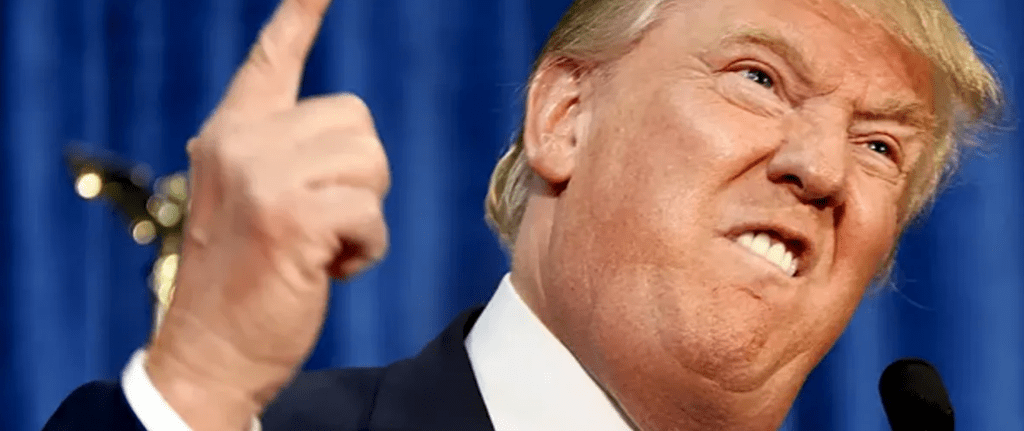
 Facing MAGA