Defunding Science: Another Chapter in America’s National Suicide

The Economist, Trump’s attack on science is growing fiercer and more indiscriminate: It started as a crackdown on DEI. Now all types of research are being cancelled:

Scientists in America are used to being the best. The country is home to the world’s foremost universities, hosts the lion’s share of scientific Nobel laureates and has long been among the top producers of influential research papers. Generous funding helps keep the system running. Counting both taxpayer and industrial dollars, America spends more on research than any other country. The federal government doles out around $120bn a year, $50bn or so of which goes towards tens of thousands of grants and contracts for higher-education institutions, with the rest going to public research bodies.

Now, however, many of America’s top scientific minds are troubled. In the space of a few months the Trump administration has upended well-established ways of funding and conducting research. Actions with the stated goal of cutting costs and stamping out diversity, equity and inclusion (dei) initiatives are taking a toll on scientific endeavour. And such actions are broadening. On May 15th it emerged that the administration had cancelled grants made to Harvard University for research on everything from Arctic geochemistry to quantum physics, following a similar move against Columbia. The consequences of these cuts for America’s scientific prowess could be profound.

Under the current system, which was established soon after the second world war, researchers apply to receive federal funding from grant-making agencies, namely the National Institutes of Health (NIH) and the National Science Foundation (NSF) as well as the Departments of Defence (DOD) and Energy (DOE). Once a proposal has been assessed by a panel of peers and approved by the agency, the agreed money is paid out for a set period.

This setup is facing tremendous upheaval. Since Mr Trump’s return to the White House, somewhere in the region of $8bn has been cancelled or withdrawn from scientists or their institutions, equivalent to nearly 16% of the yearly federal grant budget for higher education. A further $12.2bn was rescinded but has since been reinstated by courts. The NIH and the NSF have cancelled more than 3,000 already-approved grants, according to Grant Watch, a tracking website run by academics (see chart 1); an unknown number have been scrapped by the doe, the dod and others. Most cancellations have hit research that Mr Trump and his team do not like, including work that appears associated with dei and research on climate change, misinformation, covid-19 and vaccines. Other terminations have targeted work conducted at elite universities.

Much more is under threat. The president hopes to slash the NIH budget by 38%, or almost $18bn; cut the NSF budget by $4.7bn, more than 50%; and scrap nearly half of NASA’s Science Mission Directorate. All told, the proposed cuts to federal research agencies come to nearly $40bn. Many have already gone under the knife. In March the Department for Health and Human Services (HHS), which includes the NIH, announced it would scrap 20,000 jobs, or 25% of its workforce. According to news reports, about 1,300 jobs, or more than 10%, have been lost at the National Oceanic and Atmospheric Administration (NOAA), which carries out environmental and climate research. Staff cuts were reportedly also due to start at the NSF, but have been temporarily blocked by courts. To save more money, the NIH, the NSF, the DOE and the DOD have launched restrictive caps on so-called indirect grant costs, which help fund facilities and administration at universities. (These limits have also been partly blocked by courts.)

The administration says it has a plan. Mr Trump entered office on a mission to cut government waste, a problem from which the scientific establishment is not immune. On May 19th Michael Kratsios, his scientific adviser, stood up in front of the National Academies of Sciences and defended the administration’s vision. It wants to improve science by making it better and more efficient, he said—to “get more bang for America’s research bucks”. To do so, funding must better match the nation’s priorities, and researchers should be freed from groupthink, empowered to challenge each other more freely without fear of convention and dogma.

Shaking things up

He is right that science has a number of stubborn problems that can hardly be solved by a business-as-usual approach. Scientific papers are less disruptive and innovative than they used to be, and more money has not always translated into speedier progress. In the pharmaceutical sciences, new drug approvals have plateaued in recent years despite ever larger budgets. Researchers also spend much too long writing grant proposals and completing similar administrative tasks, which keeps them away from their laboratories.

Some of Mr Trump’s proposals are, in fact, overdue. Many NASA watchers, for example, would agree with his plan to find commercial alternatives for the Space Launch System, a giant rocket being built to take people to the Moon and beyond but which is years behind schedule and billions of dollars over budget.

It would be hard, if not impossible, to improve the science funding system without some disruption. The problem, however, is that the administration’s cuts are broader and deeper than they first appear, and its methods more chaotic. Take the focus on dei, which the administration bemoans as a dangerous left-wing ideology. The agencies are targeting it because of an executive order banning them from supporting such work. But dei is notoriously ill-defined. Programmes that are being cancelled are not just inclusive education schemes, but also projects that focus on the health of at-risk groups.

Though it is mostly unclear why specific projects have been cancelled, Grant Watch keeps track of words that could have landed researchers in trouble. “Latinx”, for example, is a term for Hispanic people flagged as a telltale sign of DEI by Ted Cruz, a Republican senator. The NIH has cancelled a project on anal-cancer risk factors, the abstract of which uses the word Latinx. Another cancelled project concerns oral and throat cancer, for which gay men are at higher risk. Its abstract uses the phrase “sexual and gender minority”. There are many such examples.

Other cuts may do more damage. Some NIH-funded research on vaccines has been cancelled, as have $11bn-worth of special funds from the Centres for Disease Control and Prevention (CDC) for pandemic-related research. In March Ralph Baric, an epidemiologist at the University of North Carolina at Chapel Hill who helped test the Moderna mrna vaccine for covid-19, had several vaccine grants terminated. One project aimed to develop broad-spectrum vaccines for the same family of viruses that sars-cov-2 comes from; scientists fear other strains might cross from animals to humans. Both the CDC and NIH justified such cuts by saying that the covid-19 pandemic is over. But this is short-sighted, argues Dr Baric, given the number of worrying viruses. “We’re in for multiple pandemics” in the future, he says. “I guess we’ll have to buy the drugs from the Chinese.”

Even for scientists who have not been affected by cuts, other changes have made conducting research more challenging. For example, the NIH and NSF have both delayed funding new grants. Jeremy Berg, a biophysicist at the University of Pittsburgh who is tracking the delay in grant approvals, wrote in his May report that the NIH has released about $2.9bn less funding since the start of the year, relative to 2023 and 2024. According to media reports, the NSF has stopped approving grants entirely until further notice.

At the NIH itself, the largest biomedical research centre in the country, lab supplies have become more difficult to procure. Department credit cards have been cut back and the administrative staff who would normally place orders and pay invoices have been fired. Scientists report shortages of reagents, lab animals and basic equipment like gloves. All these factors are destabilising for researchers—labs need a steady, predictable flow of cash and other resources to continue functioning.

If next year’s cuts to federal agencies are approved, more pain could be coming (see chart 2). The nsf’s budget cuts, for instance, will hit climate and clean energy research. And, according to leaked documents, the research arm of noaa would most probably cease to exist entirely. That would almost certainly mean defunding the Geophysical Fluid Dynamics Laboratory at Princeton University, “one of the best labs in the world for modelling the atmosphere”, says Adam Sobel, a professor at Columbia University’s Lamont-Doherty Earth Observatory. nasa’s Earth-observation satellites would likewise take a beating, potentially damaging the agency’s ability to keep track of wildfires, sea-level rises, surface-temperature trends and the health of Earth’s poles. Those effects would be felt by ordinary people both in America and abroad.

And as Mr Trump increasingly wields grant terminations as bludgeons against institutions he dislikes, even projects that his own administration might otherwise have found worthy of support are being cancelled. Take his feud with Columbia. His administration has accused the institution of inaction against antisemitism on campus after Hamas’s attack on October 7th 2023 and Israel’s subsequent war in Gaza. On March 10th the nih announced on X that it had terminated more than 400 grants to Columbia on orders from the administration, as a bargaining chip to get the university to take action. Some $400m of funding has been withheld, despite Columbia having laid out what it is doing to deal with the administration’s concerns. Those grants include fundamental research on Alzheimer’s disease, schizophrenia and HIV—topics that a spokesperson confirmed to The Economist represent priority areas for the NIH.

Columbia is not alone. The administration is withholding $2.7bn from Harvard University, which has responded with a lawsuit. Within hours of Harvard refusing the administration’s demands, scientists at some of the university’s world-leading labs received stop-work orders. The administration has since said that Harvard will be awarded no more federal grants. Letters from the nih, the nsf, the dod and the doesent to Harvard around May 12th seem to cancel existing grants as well.

While it is too soon to say exactly how many grants are involved, 188 newly terminated nsf grants from Harvard appeared in the Grant Watch database on May 15th, touching all scientific disciplines. A leaked internal communication from Harvard Medical School, the highest-ranked in the country, says that nearly all its federal grants have been cancelled. Cornell University says it too has received 75 stop-work orders for dod-sponsored research on new materials, superconductors, robotics and satellites. The administration has also frozen over $1.7bn destined for Brown, Northwestern and Princeton universities and the University of Pennsylvania.

As these efforts intensify, scientists are hoping that Congress and the courts will step in to limit the damage. Swingeing as the budget plan is, the administration’s proposals are routinely modified by Congress. During Mr Trump’s first term, similar proposals to squeeze scientific agencies were dismissed by Congress and he might meet opposition again.

Susan Collins, the Republican chairwoman of the Senate appropriations committee, which is responsible for modifying the president’s budget, has expressed concern that Mr Trump’s cuts will hurt America’s competitiveness in biotech and yield ground to China. Katie Britt, a Trump loyalist and senator for Alabama, has spoken to Robert F. Kennedy junior, the health secretary, about the the need for research to continue. (The University of Alabama at Birmingham is among the top recipients of NIH money.) When on May 14th Mr Kennedy appeared before lawmakers to defend the restructuring of the HHS, Bill Cassidy, the Republican chairman of the Senate health committee, asked him to reassure Americans that the reforms “will make their lives easier, not harder”.

Courts will have their say as well. On May 5th 13 universities sued the administration over the NSF’s new indirect-cost cap, and the American Association of University Professors has likewise sued Mr Trump over his treatment of Harvard and Columbia. Harvard’s suit is ongoing. Dr Baric is one researcher who has had his grant terminations reversed in this manner. His state of North Carolina, alongside 22 other states and the District of Columbia, sued the HHS over the revoked CDC funding for vaccine research. On May 16th the court ruled that the federal government had overstepped and not followed due process, and ordered the HHS to reinstate the funding.

Reversing more cuts will take time, however. And the uncertainty and chaos in the short term could have lasting effects. A country where approved grants can be terminated before work is finished and appealing against decisions is difficult becomes a less attractive place to do science. Some researchers may consider moving abroad. American science has long seen itself as the world’s best; today it faces its gravest moment ever. 
Legal Developments: A Fistful of Hot Takes

Walking Out the Door at Paul, Weiss

Four top litigation partners at Paul, Weiss have walked out the, together with their associates, their paralegals, their secretaries, and their book of business. In my experience, this sort of thing happens all the time at the big firms, even without cowardly deals capitulating to a would-be tinpot dictator. I wish I were persuaded that the walkout was over the Trump deal—and that it presages severe harm to the Cowardly Nine firm—but if wishes were horses, we’d all take a ride.

And if you don’t like my hot take on the matter, then ask perplexity.ai “Does the departure of four litigation partners at Paul Weiss mean anything?” Their AI chatbot’s opinion is quite different from mine.

How Many Federal Officials Can Trump Fire?

According to statutory law, a president cannot fire, without cause, a member of the National Labor Relations Board or of the Merit Systems Protection Board. Trump did it anyway. The lower courts told him to reinstate the two individuals, pending a final decision on the merits. Over the dissent of the three liberals, the rest of the court ordered that, until the case is decided on the merits, the two fired officials can stay fired. 

The legal issues are a teense complex, and if you’re interested, check out this article from SCOTUSblog.

My hot take: A majority of the Supreme Court seems to be getting ready to shitcan a century of precedent, and to destroy the independent status of heretofore independent agencies like the Federal Trade Commission. 

What Else Happened to Team Trump in the Courts Last Week?

Nothing good for Trump. Harvard filed a new lawsuit against Team Trump, challenging the Administration’s refusal to allow any foreign students next year. The judge granted Harvard a preliminary injunction so fast that he barely had time to read the papers.

Another judge granted Jenner & Block’s request for a preliminary injunction against Trump. And a third judge ruled that Trump had acted illegally against the United States Institute of Peace. 

A Reminder About a Fundamental Rule of Constitutional Law

Finally, Prof. Mitchell Berman of the University of Pennsylvania reminds us that No, Trump can’t force his agenda on U.S. entities. They have rights: The government cannot withhold benefits because it doesn’t like how people exercise their rights.

At This Point, He’s Just Flinging Poo at the Walls

But if Walmart doesn’t pass on the tariffs, then China loses no sales because of the tariffs. And U.S. manufacturers who compete with Chinese-made goods gain no advantage from the tariffs.

The only thing that has happened is that Walmart owners suffer an economic loss. There is no economic loss to China or its exporters. And there is no enhanced incentive to “on-shore” American manufacturing. Which was the original stated goal of the tariffs.

Of Habeas Corpus, Venezuelan Deportees, Class Action Procedures, Appellate Jurisdiction, Cutesy-Poo Bad Faith Maneuvers by the Justice Department, and Hound Dogs That Are Not Barking in the Night

Yesterday, May 16, the Supreme Court issued another ruling in the case of the Venezuelan people than Trump wants to deport to a gulag in El Salvador; read the opinion here. I posted about this case on April 19,April 20, and April 22.

The May 16 decision consists of (1) an eight-page unsigned (“per curiam”) opinion on behalf of the Chief Justice, the three Trump-appointed justices, and the three liberal justices, (2) a two-page concurring opinion by Justice Kavanaugh, and (3) a 14-page dissenting opinion by Justice Alito, joined by Justice Thomas. 

Although the majority, per curiam opinion did not use words such as “bad faith,” “fibbing,” or “too cute for words” in describing the Justice Department’s position, it clearly implied that the government attorneys were prevaricating with the Supreme Court about the government’s plans to whisk the plaintiffs away—and then claim the Court had no jurisdiction as to individuals located in a foreign country. 

The Court ordered, once again, that the Venezuelans should stay in this country pending further legal proceedings, and it remanded the case to the Fifth Circuit Court of Appeals for further consideration of how due process should work under the Alien Enemies Act, along with a variety of other considerations.

Justice Kavanaugh agreed with the majority’s analysis but would have kept the case in the Supreme Court and have the Court eschew further shilly-shallying, and just decide the damn case. 

In his dissent, Justice Alito enlarged ad nauseam on the multiple ways in which the majority’s truncated, expedited procedure is in tension with the way things are normally done. As indeed they are. No shit, Sherlock. The government was lying to the courts, frog-marching the poor Venezuelans out of the country, and employing every bad faith trick in the books to use the normal, deliberative rules of the law of civil procedure in order to forestall real due process for immigrants.

Let’s look at the situation from 30,000 feet. What do we see?

First, Team Trump’s legal strategy—along will all the legal tactics that flow from that strategy—is to replace rule of law with a Ptemkin village that looks, from the outside, something like rule of law, but is not in fact rule of law. 

Second, that legal strategy is doomed to failure unless a critical mass of the judiciary—and particularly a critical mass of the justices of the Supreme Court—are prepared to go along with it. (Sure, Trump could just order the police to arrest or kill all the members of the Supreme Court, and if the police obey the order, then Trump would win. But in that situation, the outcome would not be a legal Potemkin village, but rather a legal wasteland.)

Third, Team Trump seems to have thought that Justices Alito and Thomas, plus the three Trump-appointed justices would embrace the Potemkin village approach. Well, if that’s what Team Trump thought, then it appears they were right about Alito and Thomas but wrong about Kavanaugh, Gorsuch, and Barrett. 

The real news here—the Man Bites Dog element—is that the three Trump-appointed justices did not bark in the night at Trump’s command.

Logical conclusion: the days are hastening on to the place where Team Trump is either going to have to back down on multiple legal fronts or it is going to have to declare, in words that are clear to the least intelligent folks among us, that the rule of law is over. 

If it choose the latter option, it will be subject to vehement objections by all the Trump justices appointed in the first term–as well as a great many of the Trump Judes appointed to the courts of appeal and to the district court.

The unvarnished assault on the rule of law will come at a time when Walmart is running out of cheap goods, then Americans are being injured in multiple ways by cuts in government services, when small businesses are going out of business, and when Walmart is running out of cheap imported goods.

Trump and Big Law: The Current State of Play

The immediately preceding post gave links to sources that summarize how major law firms have reacted to Trump’s nonsense. Here, using FAQs, I give an account of the current state of play.

Among the law firms that have been targeted by Trumps, how many have sued, and how are the lawsuits going to date?

On March 6, Trump issued an executive order against Perkins Coie—“Where Innovation Meets Infrastructure”—because he was butt hurt that the firm had previously represented Hillary Clinton. Five days later, on March 11, the law firm sued. On May 2, less than two months later, the district judge issued a 100+ page order permanently enjoining Trump from carrying out his threats. 

Presumably, Team Trump will appeal the decision, but that has not happened as of this writing.

Why did the district judge in the Perkins Coie case reach a final decision in record time?

Because Team Trump had no cognizable defense. 

Or, as we used to say back in New York, their only argument is the so-you-caught-me defense.

What about the other law firm lawsuits?

WilmerHale filed its case on March 28, and procured a preliminary injunction—not a permanent injunction—on April 24. Team Trump can still appeal the PI ruling, if it so chooses, or it may decide to wait until the decision on a permanent injunction. 

Jenner & Block also filed on March 28. Judge Howell, the judge in the Perkins Coie case, rejected Jenner’s attempt to get the case assigned to her as a “related case.” The lawsuit was then bounced to Judge Bates, who granted a temporary restraining order the same day.

Fast footwork, that. 

There was a hearing on April 28 on Jenner’s request for a final ruling it its favor, but the judge has not yet issued his decision. Presumably, he is writing his opinion—with due attention to the 100+ page ruling in the Perkins Coie litigation. 

Meanwhile, a temporary restraining order against Trump remains in effect. 

Susman Godfrey was the last of the four, filing its complaint on April 11. A temporary restraining order was entered and remains in effect. On May 8, Judge AliKhan held a hearing on the question whether Team Trump should be enjoined permanently, but no decision has been released as of this writing. However, back on April 15 when he issued the TRO, the judge described Trump’s action against the Susman firm as a misuse of presidential authority and a “shocking abuse of power.”

This would be a clue about how the good judge is likely to rule.

Apart from the four law firms that have sued Team Trump, which other firms have been targeted by punitive executive orders?

In alphabetical order they are:

  • Covington & Burling
  • Elias Law Group
  • Milbank
  • Paul, Weiss, Rifkind Wharton & Garrison
  • Skadden, Arps, Slate, Meagher & Flom
  • Willkie Farr & Gallagher
Have all of these firms reached “deals” with Trump?

No. Covington and Elias have not. Milbank, Paul, Weiss, Skadden, and Willkie all have capitulated.

Have other big law firms bowed down under the mere threat of a punitive executive order?

Yes, indeed. In alphabetical order they are:

  • Allan Overy Shearman Sterling
  • Cadwalader, Wickersham & Taft
  • Kirkland & Ellis
  • Latham & Watkins
  • Simpson Thacher & Bartlett

So, all together, nine big law firms have signed “deals” with Trump?

Correct.

And why are you putting quotation marks around “deals”?

Because the so-called “agreements” are not legally enforceable and do not even purport to be legally enforceable. See, for example, Just Security, No, the President Cannot Enforce the Law-Firm Deals and Yahoo News, Trump’s Law Firm Deals Are Already Falling Apart.

Are any new “deals” in the works?

I believe not.

What’s the story with Covington & Burling and the Elias Group, both of which were targeted by executive orders and neither of which has a “deal” with Team Trump?

Covington is a major law firm headquartered in Washington, D.C., has a significant lobbying operation, and recruits politically prominent individuals from both parties. Its best known current partner is Eric Holder, the former Attorney General. 

As far as is publicly known—and that’s an important qualification,

  • Team Trump has not taken any serious enforcement action against Covington, which continues to go about its ordinary business, 
  • Covington has not lost clients or lawyers,
  • Covington has neither sued Team Trump nor issued any fire-breathing declarations against Trump, and
  • There are no ongoing negotiations.

And why is nothing happening (as far as is publicly known)? Maybe (1) Covington, being the well-connected firm that it is, has some threat to hold over Trump’s head. Or maybe (2) Covington has done something valuable for Trump, but not told anyone about it. Or, perhaps most likely (3) with both sides knowing that Covington could walk down to the courthouse any day of the week and get an injunction, both sides decided to see how the four pending cases play out, once they reach the Supreme Court, and will then reconsider their position.

The Elias Law Group, a small, progressive firm focusing on voting rights and other public interest issues, has just told Team Trump to go to hell.

In view of all the foregoing, what are we to make of the claim by the head of Paul, Weiss that he had to capitulate because his firm faced an “existential threat”?

It’s reasonable to conclude that the head of Paul, Weiss showed poor situational awareness, exercised bad judgment, and demonstrated an attitude at odds with his duty as a legal professional.

The nine capitulating law firms have, in the aggregate, “agreed” to provide over $900 million (in value) in pro bono legal services to causes mutually agreed with Team Trump. How does that stand?

Each of the nine firms has “agreed” to provide pro bono services in identified general areas, like “promoting justice” or “opposing antisemitism.” And Trump has made some public noises about the kinds of legal services he has in mind. But, as far as is publicly known,

  • None of the nine firms is currently providing pro bono services to anyone, pursuant to their Trump “deals,” and, indeed,
  • There are no reports that Team Trump has asked a specific firm to take on a specific pro bono client.

Have the nine capitulating law firms suffered negative effects such as client departures, attorney resignations, and reduced recruitment of the ablest law school graduates?

In a previous post, I reported on Microsoft’s replacement of a capitulating law firm with a fighting law firm, in major ongoing litigation. More recently, the Wall Street Journal has written about how capitulating firm Cadwalader, Wickersham & Taft is in deep doo-doo. See Venerable New York Firm That Struck a Deal with Trump Is Losing Lawyers: Cadwalader avoided a punitive executive order, but the accord has left the firm in turmoil.

There have been reports of some resignations by attorneys at other capitulating firms, but, thus far, as far as is publicly known, concrete harms have been limited.

But push will shortly come to shove. To take one example: Kirkland & Ellis expects to welcome more than 500 “summer associates” (rising third-year law students) next month, at its various offices, and probably an equal number of law graduates this fall (after they have taken their bar exams).

Of those anticipated hires, how many will actually show up? 

Maybe all of them, or maybe not. I don’t know. But I do know that, for those young men who descend on the K&E home office in Chicago, when the visit the men’s room they will find two kinds of hair spray and two brands of mouthwash. Their breath will smell of roses, but, otherwise, the stink will be pungent and lasting.

Finally, is the real effect of the nine capitulations something that isn’t written down on paper, namely, the cowardly law firms’ decision to stay away from clients and causes that Trump doesn’t like, both paid and pro bono?

Yes. That is a correct assessment.

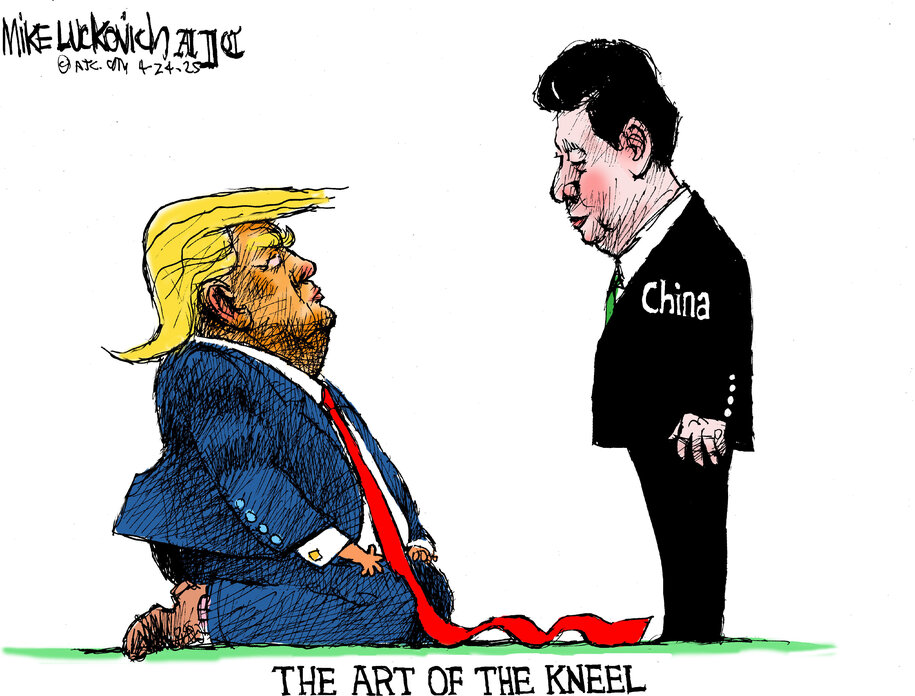
It Begins: Xi Forces Trump to Negotiate Against Himself

Washington Post, Trump suggests lowering tariffs on China ahead of talks

The Post writes, 

President Donald Trump said Friday that the United States could lower tariffs on China to 80 percent [instead of 145 percent] ahead of a meeting this weekend between his top aides and their counterparts from Beijing. …

The president’s apparent eagerness to get a deal reflects the mounting economic damage from the tariffs he has imposed thus far. China said its exports to the United States dropped 21 percent in April from a year before, and economists have forecast an increased likelihood of a U.S. recession. White House officials have grown alarmed by Chinese curbs on exports of rare earth minerals, used to make military drones, consumer electronics, electric cars and other important products.

Try to Remember

The Constitution has this to say about the presidential oath of office:

Before he enter on the Execution of his Office, he shall take the following Oath or Affirmation: – “I do solemnly swear (or affirm) that I will faithfully execute the office of President of the United States, and will to the best of my ability, preserve, protect and defend the Constitution of the United States.”

The Constitution has this to say about the role of the courts:

The Judicial Power of the United States, shall be vested in one supreme Court, and in such inferior Courts as the Congress may from time to time ordain and establish. The Judges, both of the supreme and inferior Courts, shall hold their Offices during good Behavior … The Judicial Power shall extend to all Cases, in Law and Equity, arising under this Constitution [or] the Laws of the United States …