IMHO, George Will and Ross Douthat have some pretty good things to say this morning. Will sees a crisis caused by “a president’s fragile ego, as usual.” Douthat has two alternative explanations: “malignant narcissism flavored with insane Nobel Peace Prize-related self-pity” or “how Trump always negotiates.” There’s much truth in both op-eds, and you would probably do well to read them.
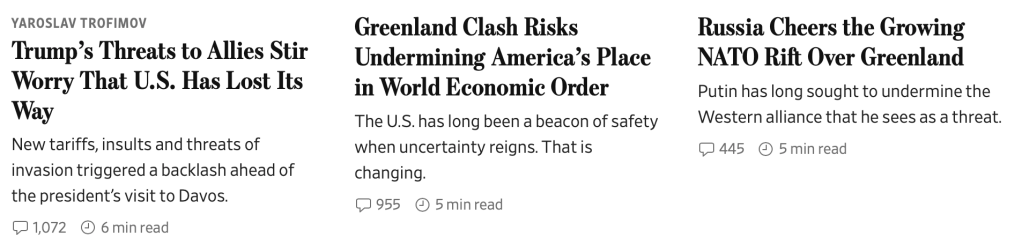
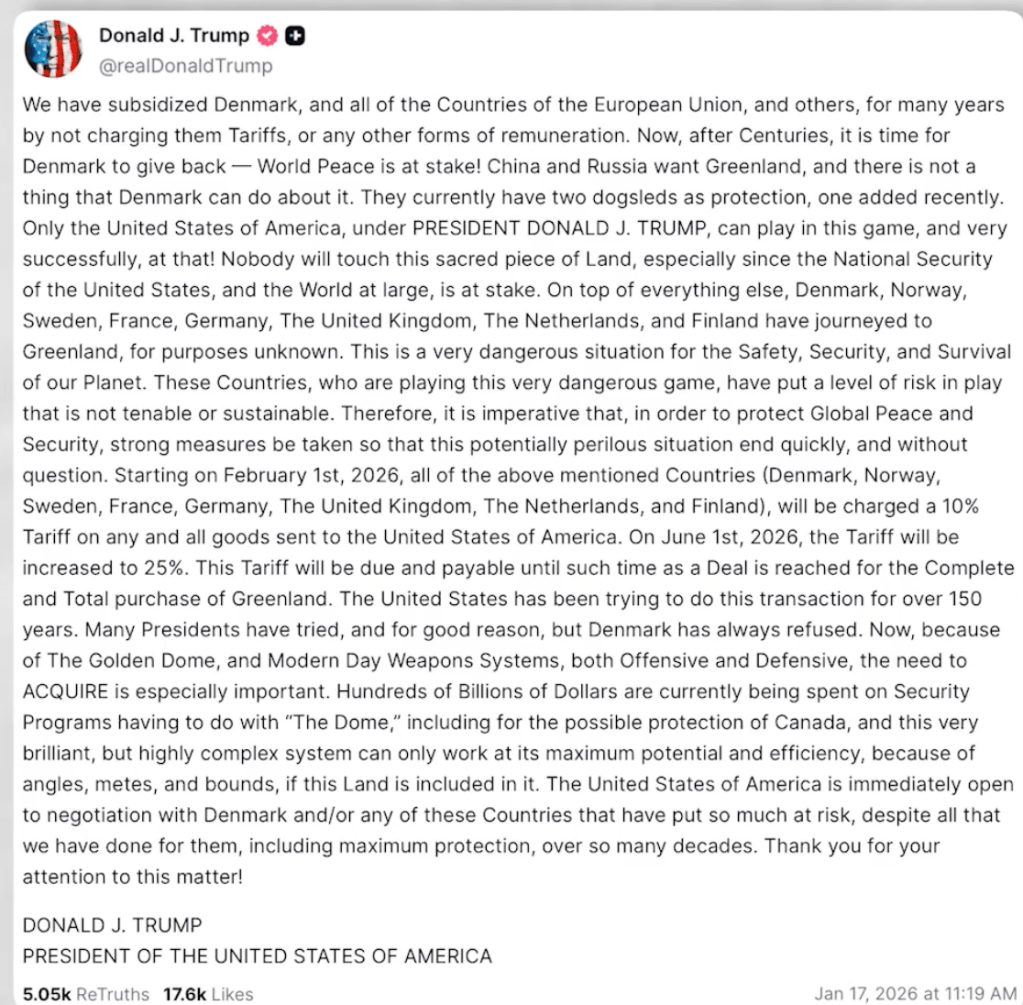
You would also do well to take a look at the online front page of the Wall Street Journal—a good source for the business/financial elites’ view of the world. Part of it is reproduced above.
The elites are worried. The thing they value most—maybe the only thing they value at all—is their money. Trump’s behavior is increasingly threatening their core values.
I’m posting right now because I have my own take on the Mad King’s current thought processes. It’s set forth in the next paragraph, which is all speculation—but reasonable speculation based on known facts, analyzed logically.
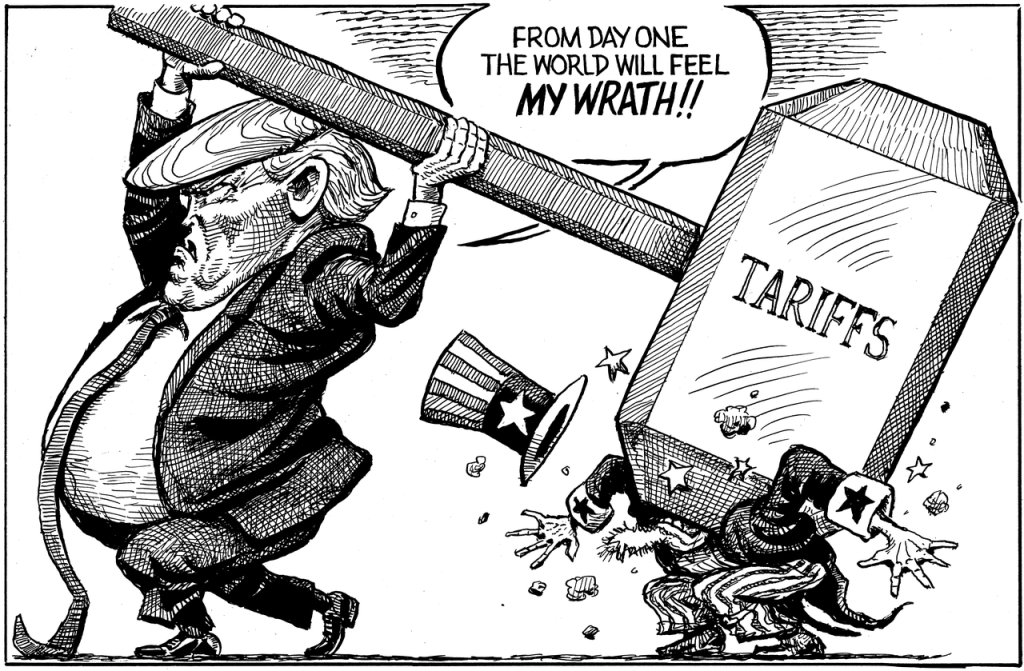
Trump has been told—probably by the Solicitor General, the unfortunately named Mr. Sauer—that he is going to lose the tariff case in the Supreme Court. Bigly. Faced with that grave forthcoming affront to his fee-fees, Orange Mussolini has devised an insane Hail Mary pass: use tariffs to force Europe to give him Greenland, thereby “demonstrating” to the Supreme Court the great “value” of his favorite play-pretty, his usurped power to bully other countries with tariffs and threats of tariffs.
Historical sensibility tells us it is the barbarians who storm the gates. In today’s America, it is the other way round. Inside the citadel, the hordes are incinerating America’s traditions of law, civility and restraint. The civic-minded cry in the wilderness. Measured by the old era’s conventions, US President Donald Trump’s bonfire is only a quarter of the way through. Like so much else — the US Institute of Peace, the Kennedy Center, the Versailles-style White House ballroom, other people’s Nobel Prizes — Trump is rebranding the US as his own. As America prepares to commemorate its 250th anniversary, the republic is flirting with its own funeral.
Exaggeration? Since Trump descended that escalator in 2015, loyalists have diagnosed critics as suffering from “Trump derangement syndrome”. In line with the president’s core trait, they project their own condition on to others. With Trump, accusation is confession. He calls his opponents corrupt, unpatriotic, dishonest and much cruder things besides. Trump’s apologists — a more numerous crowd than true believers — work round the clock to sane-wash his policies into something coherent. Alas, Trump’s caprice makes it impossible for his explainers to keep pace.
One day Trump is a restrainer paring back America’s role in the world. The next, he is a true nationalist asserting his country’s domain over all he surveys. Tomorrow, he could revert to libertarianism. Today he is a pragmatic statist taking bites out of the shiniest bits of the private sector. Some make heroic attempts to depict Trump as a 21st-century reincarnation of Ronald Reagan. They get an A for effort. Like the fable of the naked emperor, he is imagined in all sorts of finery. More’s the pity that he is not playing along.
Fate will decide what becomes of Trump. He could get to the point where he loses his grip over the 2028 succession. He could just as equally bury America’s constitutional order and claim a third term into his mid-eighties. Those who discount the latter should recall that Trump serially exceeds the worst forecasts of what he will do. The move-along-nothing-to-see-here crowd have never had it so bad. The only thing that stopped Trump from staging an auto-coup in 2020 was a display of rectitude from his formerly quiescent vice-president, Mike Pence. JD Vance, the current vice-president, was picked to prevent such insubordination from recurring.
The other improbable hero of 2020 was Bill Barr, the attorney-general who was an ultra-loyalist up to the point that Trump asked him to seize voting machines and investigate voter fraud. Barr resigned. Pam Bondi, Barr’s successor, can be relied on to carry out any such instruction. Sceptics of Bondi’s limits should consult the Jeffrey Epstein files. Congress passed a law last month mandating Bondi to release them, which she has largely ignored. The law apparently is dispensable when it clashes with the wishes of America’s greatest leader. Whatever fate decrees for Trump, his Greek chorus are lashed to his mast. There is no easy path back from unquestioning obedience to the whims of one man.
How should rational planners — American and foreign alike — respond to whatever Trump throws at them? They have little chance of success unless they see him for what he is. No ideological code can fully capture his actions. Calling him a fascist may offer emotional release but his autocratic impulses stem more from vanity and insecurity than a coherent belief system. Trumpism is whatever he chooses it to be even as he contradicts himself. The key thus lies in Trump’s psychology, which has never been a mystery. His character is hidden in plain sight.
For those belatedly ready to see today’s abyss for what it is, here once again is Trump’s worldview. Life is a battle in which one person wins and the other loses. Everyone else, including his henchmen and America’s allies, is the other person. A zero-sum world permits no room for sentiment or friends. Opponents earn respect. Loyalty is for fools. Rivals might win or lose, depending on their hand. China has been the biggest winner of Trump’s second term so far — and has earned his respect. Venezuela’s Nicolás Maduro is an obvious loser. Greenland, and quite possibly Nato, could be next.
The lesson for America’s friends is clear. Flattering Trump will earn his contempt. The world should study the fate of Canada’s Mark Carney. Alone among allies so far, the Canadian prime minister is responding to the reality of America’s deranged turn. Standing up to Trump offers no guarantee of success. Submission, on the other hand, is certain to fail.
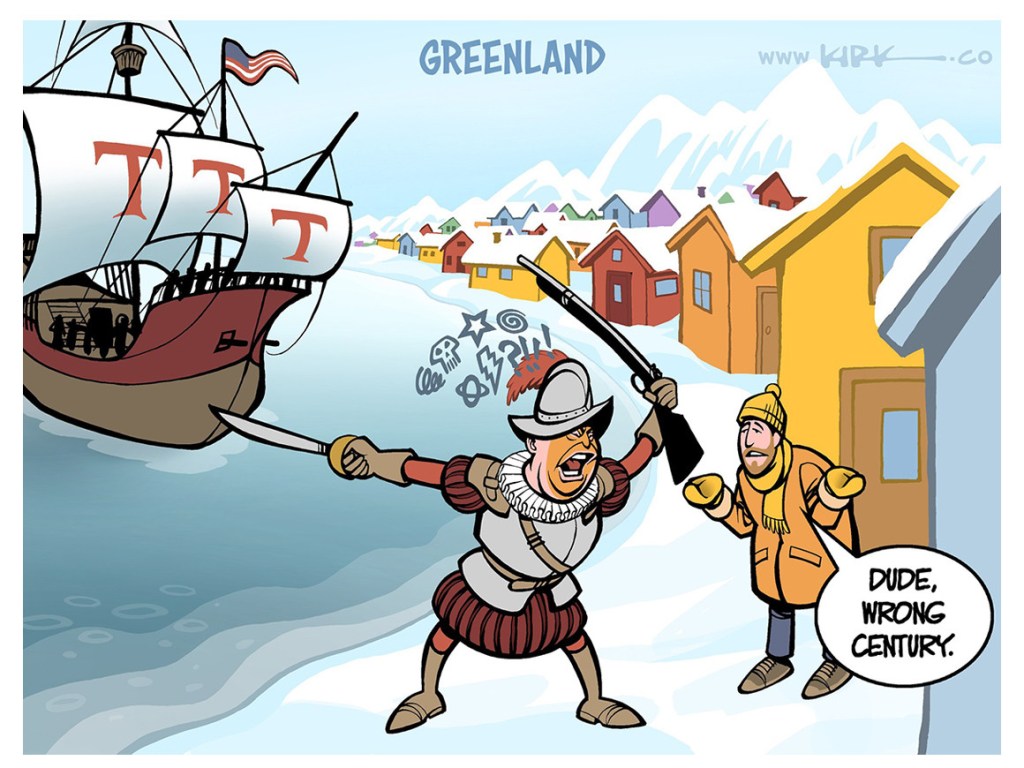
I thought the heavy hitters on Morning Joe today were hitting pretty heavily about Trump’s bully boy tactics to try to steal Greenland.
A military invasion might conceivably generate some adverse congressional response. Alternatively, Orange Mussolini can try emasculating NATO by withholding essential military parts, intelligence cooperation, etc. But, first, he will apparently try economic aggression and threats of aggression.
As a Daily Kos article (relying heavily on Le Monde) informs us, there are a host of way in which European countries, individually and collectively, can stick it to the United States.
A glance at the Wall Street Journal this afternoon shows that Big Finance is pissed, bigly. As of the 3PM hour, World Time, the Dow is down 800 points.
Isn’t it inspiring to see Daily Kos and the Wall Street Journal singing from the same hymnal?
One way to read the occupation of Minnesota is as a flex — a demonstration of the government’s power and authority. That, perhaps, is how Miller and Kristi Noem see the situation. I smell, on the other hand, a stench of desperation, an attempt to do with force what they can’t accomplish through ordinary politics. Faced with an angry public but committed to a rigid agenda of nativist brutality, the president and his coterie of ideologues are playing the only move they seem to have: wanton violence and threats of further escalation. They thinkthis will break their opposition.
But looking at the ironclad resolve of ordinary Minnesotans to protect their homes and defend their neighbors, I think the administration is more likely to break ontheir opposition and learn, as the British did in Boston, that Americans are quite jealous of their liberties.
On November 5, the Court heard oral argument in Trump v. V.O.S. Selections (litigation sponsored by a libertarian foundation) and other cases challenging Trump’s attempted usurpation of tariff setting powers in purported reliance on the International Economic Emergency Powers Act. The decision should come soon. (There was a rumor that it would come yesterday, but that did not happen.
How to Predict the Outcome of a Case
For best results, you want to ask two big questions—one ruthlessly objective and the other relentlessly subjective.
Your first big question is, Which side should win the case? Gather the fact and take a rigorously objective view of them, study applicable legal principles, and ask how an intelligent, diligent, and utterly fair-minded court would apply the relevant principles to the relevant facts.
Your second big question is, Which side does the court want to win the case? Consider the judge’s (or judges’) political ideology, legal ideology, prior rulings, class interests, friends, and anything and everything else you know about the court’s leanings.
Obviously, if the party that should win the case is also the party that the court wants to win the case, then it’s easy to predict that that party is probably going to win the case.
What Factors Apply Here?
Here is how I see it.
1. This is a case of statutory interpretation. Pretty much all the traditional canons of statutory interpretation point toward the conclusion that Trump does not have the statutory power he claims to have.
2. Taking a textualist and originalist view of the matter, one reaches the same conclusion.
3. Prudential considerations go the same way: the tariffs are harming almost all segments of the economy.
4. Because the tariffs are creating broad economic harm, they are hurting Republicans politically, and will probably play an important role in the 2026 elections.
5. Trump will scream like a stuck pig when he loses the tariff cases, but, even if he doesn’t know it, a negative decision would tend to save him from his own misjudgment.
6. Liberals don’t like tariffs, and would applaud a decision against Trump.
6. Conservatives don’t like tariffs, and would applaud a decision against Trump.
Conclusion
A decision against Trump on the tariffs would be thoroughly unsurprising.
A decision the other way would mean that something very, very odd had happened.
This follows up on the immediately preceding post. Some comments below.
1. What one key thing explains the rise of Trump? It’s a great question. I’ve been asking it for a decade, and so, very probably, have you.
In my opinion, this onion has a whole lot of layers, but if you’re looking to identify the essence of the matter, I think MacWilliams—he’s a political scientist at the University of Massachusetts—has as good an insight as any: (a) Always and everywhere, there are a goodly number of people with authoritarian tendencies. (b) Trump found a way to trigger these folks’ natural inclination toward authoritarianism. (c) The triggering process was greatly facilitated by the rise of the internet and of social media.
2. Some more layers to the onion, you said? Yes, I did say that. Here are some of them:
Point: with the rise of social media, a whole lot of our fellow citizens have detected a permission structure to joyfully embrace their inner asshole. One of these ways, but only one, is saying hello to the Nazi side of their personality.
Point: although I don’t believe either Goldberg or MacWilliams mentions racism by name, I think a large part of Trump’s attractiveness is the fact that he is both a stone cold racist and a wealthy celebrity. It gratifies his unwashed followers that a person of such wealth and celebrity will openly share their racism.
Point: I strongly suspect that, when a definitive history of our era is available, we’ll find it wasn’t just underlying racism, it wasn’t just the malign ability of one man to appear charismatic, and it wasn’t just the rise of social media as such. I think we’re going to find there was a whole lot of conscious, clever, compensated manipulation of social media by intelligent people in the pay of some of our economic overlords.
3. Always look on the bright side of life. Trump is not Machiavelli. His fundamental problem is that he believes a lot of his own bullshit—not all of it, but a whole lot of it, and a lot of it that is relevant to pursuing his fascist agenda. In consequence, he is forever misunderstanding key facts about the politico-economic environment. He lacks, moreover, the ability to gather, evaluate, and apply important information. He regularly fails to predict how key actors will respond to his lies, his bluster, his threats, and his bullshit. And when people do not respond as he might wish, his severely limited skill set handicaps him in reacting to an unfavorable situation. He cannot, for example, construct a rational argument or distinguish between a plausible lie and an implausible lie.
4. A lot of people think that things have changed in the past month. Are they right? Yes, I certainly think so. Michelle Goldberg identifies some key factors, and I agree with her.
Trump dimly perceives (a) that L’Affaire Epstein is a serious challenge to his continued popularity among the one third of the country who are his core supporters, and (b) that his standing with his own people is further threatened by the economic chaos caused by his policies on tariffs and immigration.
In response, Trump is trying both to appease and to distract the worst of his own supporters with military aggression, domestic and foreign. Because if the worst of the worst desert him, who will he have left?
5. What is the best advice for decent progressives? When your adversary is screwing himself, hold his beer, and let him get on with it.
We must oppose fascist aggression. And we must be mindful that Trump’s gross incompetence is helping him to dig his own political grave.
For the last decade there’s been a debate, among people who don’t like Donald Trump, about whether he’s a fascist.
The argument that he isn’t often hinges on two things. First, when Trump first came to power, he lacked a street-fighting force like Benito Mussolini’s Blackshirts, even if he was able to muster a violent rabble on Jan. 6. “Trump didn’t proceed to unleash an army of paramilitary supporters in an American Kristallnacht or take dramatic action to remake the American state in his image,” wrote the leftists Daniel Bessner and Ben Burgis in “Did It Happen Here?,” a 2024 anthology examining the fascism question.
Second, Trump didn’t pursue campaigns of imperial expansion, which some scholars view as intrinsic to fascism. “For all of Trump’s hostility towards countries he perceives as enemies of the U.S., notably Iran, there is no indication that he sought a war with any foreign power, still less that he has been consumed by a desire for foreign conquest and the creation of an American empire,” wrote Richard J. Evans in his 2021 essay “Why Trump Isn’t a Fascist.”
It’s striking how much the arguments that Trump is nota fascist have suffered in just the first few days of this year, in which we’ve plunged to new depths of national madness.
Now that America has plucked the dictator Nicolás Maduro from power in Venezuela and announced that it would help itself to the country’s oil, other nations are adjusting to a reality in which we’re more predator than ally. European countries are contemplating stepping up their military presence in Greenland to protect it from the United States. An Economist headline proclaims, “Canada’s Armed Forces Are Planning for Threats From America.”
In the Midwest, Trump’s paramilitary forces killed a citizen in Minneapolis and now appear to be using her death to threaten other activists, barking at one observer, “You did not learn from what just happened?” Videos from the city show gun-toting men in masks and camouflage descending on people to demand proof of citizenship, pelting crowded streets with tear gas and sometimes attacking those who film them. Meanwhile, a new ICE recruiting ad declares, “We’ll Have Our Home Again,” which just happens to be part of the refrain of a white nationalist anthem.
Both ICE’s occupation of Minneapolis and Trump’s threatened seizure of Greenland are part of the same story: An increasingly unpopular regime is rapidly radicalizing and testing how far it can go down the road toward autocracy. If anyone had predicted back in 2024 precisely what Trump’s return to the White House was going to look like, I suspect they’d have been accused of suffering from Trump Derangement Syndrome. But the shrillest of Resistance libs have always understood Trump better than those who make a show of their dispassion. As the heterodox writer Leighton Woodhouse put it on X, “The hysterical pussy hats were right.”
Of course they were. From the moment he descended his golden escalator, Trump’s message, the emotional core of his movement, has been textbook fascism. In his 2004 book “The Anatomy of Fascism,” the eminent historian Robert O. Paxton described the “mobilizing passions” that form fascism’s foundation. Among them are a “sense of overwhelming crisis” that renders traditional solutions obsolete; a belief that one’s own group has been victimized, justifying almost any action in redress; “dread of the group’s decline under the corrosive effects of individualistic liberalism, class conflict and alien influences”; and the need for a strong male leader with instincts more powerful than mere “abstract and universal reason.”
The premonitions of our current regime in Paxton’s work don’t stop there. Fascism, in his telling, is marked by its contradictory attitude toward modernity: a hatred of atomized urban life combined with a fetish for technology. Fascist movements “exploited the protests of the victims of rapid industrialization and globalization,” he wrote, though in power, they doubled down on industrial concentration. And, of course, fascists “need a demonized enemy against which to mobilize followers.”
If Trump didn’t always act on his most fascistic predilections in his first term, it was because he was restrained by the establishment types around him. Mark Esper, Trump’s former defense secretary, said that Trump repeatedly broached the idea of bombing Mexico. In 2019, Trump canceled a meeting with Prime Minister Mette Frederiksen of Denmark after she refused to entertain the idea of selling him Greenland. His taste for violence against his political enemies has never been secret, and was made clearest on Jan. 6, the event that led a once-doubtful Paxton to conclude that the word “fascist” applied to Trump.
None of this means that America is destined to become a fully fascist country. For now, we are trapped in the space between the liberal democracy most Americans grew up in and the dark, belligerent authoritarian state that our government seeks to impose. The important thing isn’t really the name we give to this political development, but our ability to see what’s happening clearly and make sense of its likely trajectory.
On the last page of “The Anatomy of Fascism,” Paxton offers a warning. “We know from tracing its path that fascism does not require a spectacular ‘march’ on some capital to take root,” he writes. “Seemingly anodyne decisions to tolerate lawless treatment of national ‘enemies’ is enough.”


 Facing MAGA