I normally watch the beginning of the Morning Joe show. The quality of the analysis various considerably, in my opinion. This morning’s analysis of the Iran War state of play was, I think, particularly complete and insightful. Among the insights, in my words:
The big CIA leak reported this morning demonstrates how many cards Iran holds and how few Trump holds
Another big leak, reported by The Economist, shows how Russia would be prepared to help Iran if Trump sends in ground troops
As to the alleged “ceasefire,” Trump continues to spout delusional nonsense
Trump is desperate
All of Trump’s options are really bad, but his least bad option is essentially to replicate the nuclear deal that Obama made, declare victory, and go on to some other shit show
As and when Trump finally takes his least bad option, he will leave Iran much stronger than it was before the war
Trump started the Iran war to make him look stronger before his summit with Xi Jinping (currently scheduled for next week); now he looks much weaker than before, and Chinese officials are mocking him
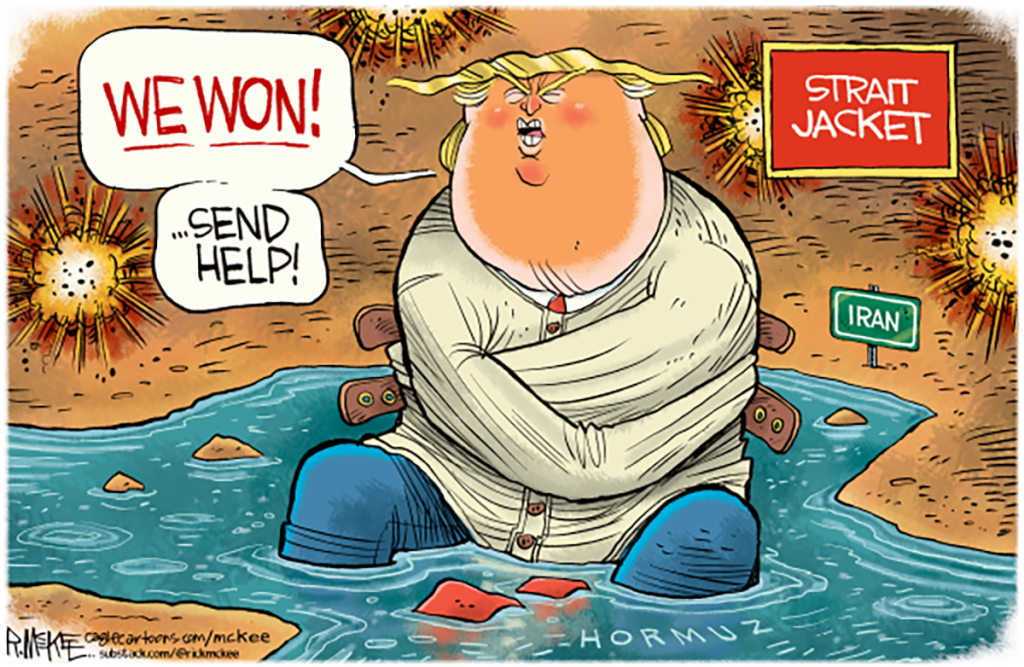
With the mutual Hormuz blocades, Iran is trying to inflict pain on the US while waiting for the US to capitulate, while Trump is trying to inflict pain on Iran while waiting for Iran to capitulate.
Iran’s pain tolerance is much higher than Trump’s, and he would be delighted to surrender if Iran would let him do so on terms that he could then proclaim as a victory. But, as a general matter, Iran wants no part of such a deal. More particularly, a sham surrender by Iran would require them to give Trump a better deal on nuclear weapons than Barack Obama got. And that is not happening.
I don’t know whether Trump will ever do what he has to do, to get out of this mess. But if and when he ever does it, it will be far too late to save his political bacon. Because, if the Strait of Hormuz opened tomorrow, it would take a long time for the newly reflowing oil to reach its destination.
“It looked like a good thing: but wait till I tell you.”
That’s the opening of the classic O. Henry short story “The Ransom of Red Chief.”
The tale, written in 1907, is the ultimate parable about the perils of trying to seize and control a hellion so devious, so maniacal, so awful that the captors become the captives.
The story is about two small-time crooks who think they can make some easy money by kidnapping a 10-year-old boy, the son of an affluent landowner in a sleepy Alabama town.
They underestimate badly. When they go to abduct the red-haired, freckle-faced boy, he is throwing rocks at a kitten and hurls a brick at one of his kidnappers.
“Red Chief, the terror of the plains,” as the boy calls himself, runs his captors ragged. He relishes tormenting the men and doesn’t want to go home. In the end, they have to drop their demand for a $2,000 ransom, pay the boy’s father $250 to take the demonic child off their hands and run for the hills.
President Trump went along with Bibi Netanyahu’s Panglossian case for slamming Iran. It looked like a good thing: but wait till I tell you.
After nearly two months of tangling with the demonic Iranian leadership and its allies, Trump looks desperate to run for the hills. He constantly says he has defeated the mullahs and “obliterated” their military power, and yet Iran refuses to be subdued.
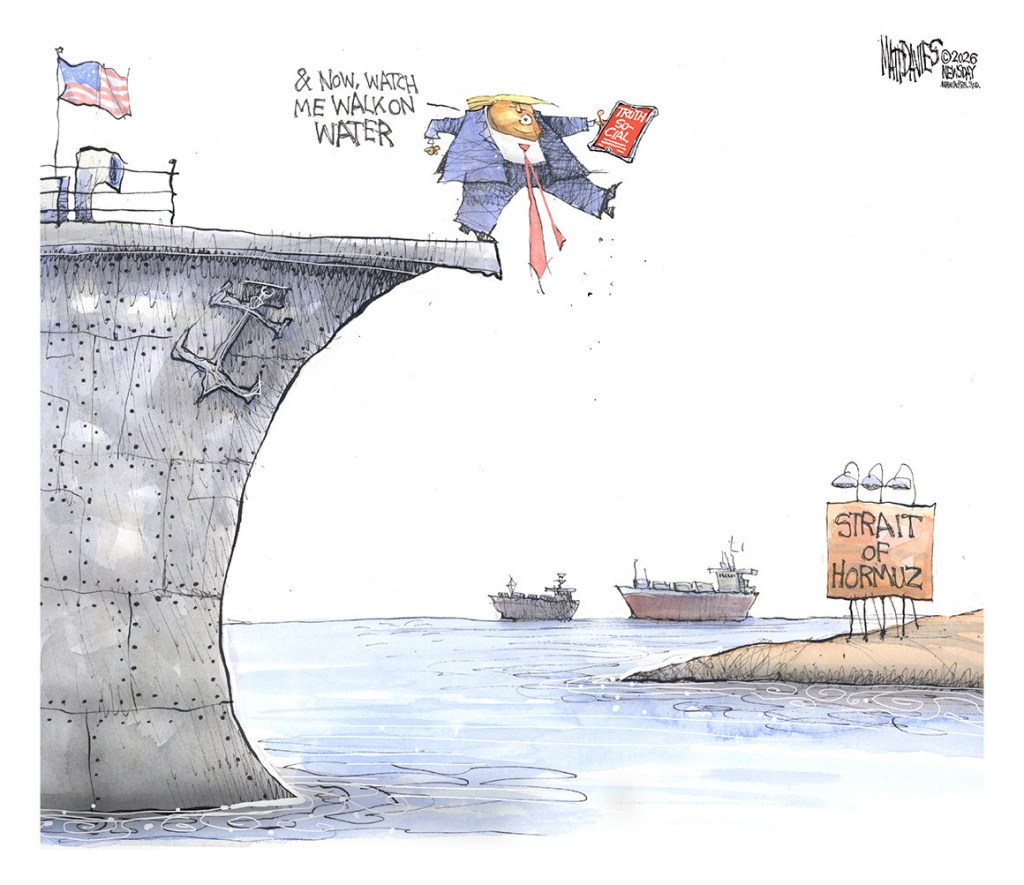
Trump says there’s a new regime that’s easier to deal with, but actually it’s the same regime but worse — run by hardened, fanatical generals. Iran has not turned over its enriched uranium, and negotiations are touch-and-go. The Strait of Hormuz, which Trump keeps insisting is open, is closed. Trump is blockading the Iranian blockade.
“Iran has proven to be far more resilient and resourceful than he was prepared for,” Richard Haass, a foreign policy adviser for President George W. Bush, wrote in his newsletter, “Home & Away.” “Almost all the administration’s assumptions have been proven wrong.”
Aside from the weakening of Iran’s conventional military capability, Haass said, “virtually every other metric shows the United States, the region and the world to be worse off.”
The Iranians are tormenting Trump — even as they out-troll the master troller, viciously mocking the president as a “L.O.S.E.R.” and Bibi puppet who wants to distract from the Epstein files.
One viral Iranian rap addressing Trump calls the conflict “a trap you couldn’t see. Welcome to the graveyard of your vanity.”
Conceding that Iran is winning the meme war, the “Daily Show” correspondent Ronny Chieng keened about Trump, “What’s the point of electing a cyberbully if he sucks at cyberbullying?”
Now that Iran has flexed power in the strait, Trump has to bargain with it to get back to where things were before.
He is pinioned in a weird nook and cranny of the planet that seems almost medieval, sitting next to a backward, villainous theocracy. And yet ships carrying over 20 percent of the world’s oil must traverse the narrow passage to get to the Arabian Sea.
Trump, who grew overconfident after his adventurism in Venezuela, is being driven to distraction.
He got so rattled when the two American airmen were shot down, Josh Dawsey and Annie Linskey reported in The Wall Street Journal, that he “screamed at aides for hours.” Last month, Trump talked about the danger of becoming another Jimmy Carter, spiraling amid the hostages and a failed rescue with eight helicopters lost.
One of my first big stories as a reporter was covering those hostage families for a year and then going to West Point to see the hostages come home in 1981. So I had a front-row seat to the Iranians’ jujitsu tactics, using 52 Americans in our embassy to gain leverage over Carter’s presidency, reputation and re-election.
Trump tried to scare the Iranians with a profane post on Easter and a wild threat to destroy their civilization. But Iran is not Afghanistan or Iraq. The Iranian mullahs and generals are the terrors of the strait.
Trump has forsaken the one good Middle East policy he had: avoiding the mirage of quick wins while getting sucked once more into “blood and sand,” as he dismissively called it during his first term.
When he was running in 2016, Trump deemed the invasion of Iraq “a big, fat mistake” that destabilized the Middle East and cost too much, in money and lives.
But, seduced by the detestable Bibi, he got suckered into the blood and sand. Unlike W., who had the good grace to trump up a case for war, Trump let Bibi lead him by the nose into this one, blowing off Congress, our allies and many furious MAGA acolytes.
Maggie Haberman and Jonathan Swan reveal in their forthcoming book, “Regime Change: Inside the Imperial Presidency of Donald Trump,” that the president brushed aside Gen. Dan Caine’s warnings that a war with Iran would drastically deplete our weapons stockpiles and jeopardize the traffic in the Strait of Hormuz.
As The Times reported Thursday, the United States has burned through half — around 1,100 — of its long-range stealth cruise missiles built for a war with China.
The president with the attention span of a gnat posted on Truth Social that “I have all the Time in the World, but Iran doesn’t — The clock is ticking!” But he is the one who has lost control of the timeline, and himself.
As a developer, Trump said, he employed “truthful hyperbole.” But now, in frantic Truth Social posts, in calls with reporters and in interviews, he employs hyperbolic wishful thinking. His staff is resigned to a midterm electoral disaster brought on by higher gas prices and a lack of focus on the economy.
And he keeps returning to his gargantuan ballroom. According to a Washington Post analysis, “Trump has invoked the ballroom on about a third of the days this year.” It’s a pleasant mental escape, now that he has tied himself into a Gordian knot with Iran.
Heather Cox Richardson offers a wide variety of indications that Trump is, as they used to say in China, rapidly losing the Mandate of Heaven.
I think her presentation will very much repay the viewing. Among her topics are one or two that I actually know something about. Chief among these is antitrust, where her discussion begins about 4 ½ minutes into the video.
IMHO, Dr. Richardson’s nostalgia for the pre-Reagainism/Neoliberalism is slightly too enthusiastic. It’s true, as she says, that by the 1960s there was precedent for considering the legitimate interests of many corporate “stakeholders”—shareholders, customers, suppliers, vendors, and workers—when evaluating mergers under the Clayton Act. But any legal rule that instructs a judge to throw a lot of disparate factors into a pot, stir them around, and see what emerges, tends to produce results that are hard to predict, that may be especially susceptible to the judge’s political bias, and that may lack intellectual consistency.
Richardson goes on to express optimism about a new antitrust institute being formed at Columbia Law School by the brilliant but controversial Lina Khan, former Chair of the Federal Trade Commission, to rethink the foundations of antitrust law. I wish them well. And I am glad to hear that “there are some smart lawyers at Columbia Law,” or words to that effect.
Some content on this page was disabled on May 25, 2026 as a result of a DMCA takedown notice from Dow Jones & Company, Inc.. You can learn more about the DMCA here:
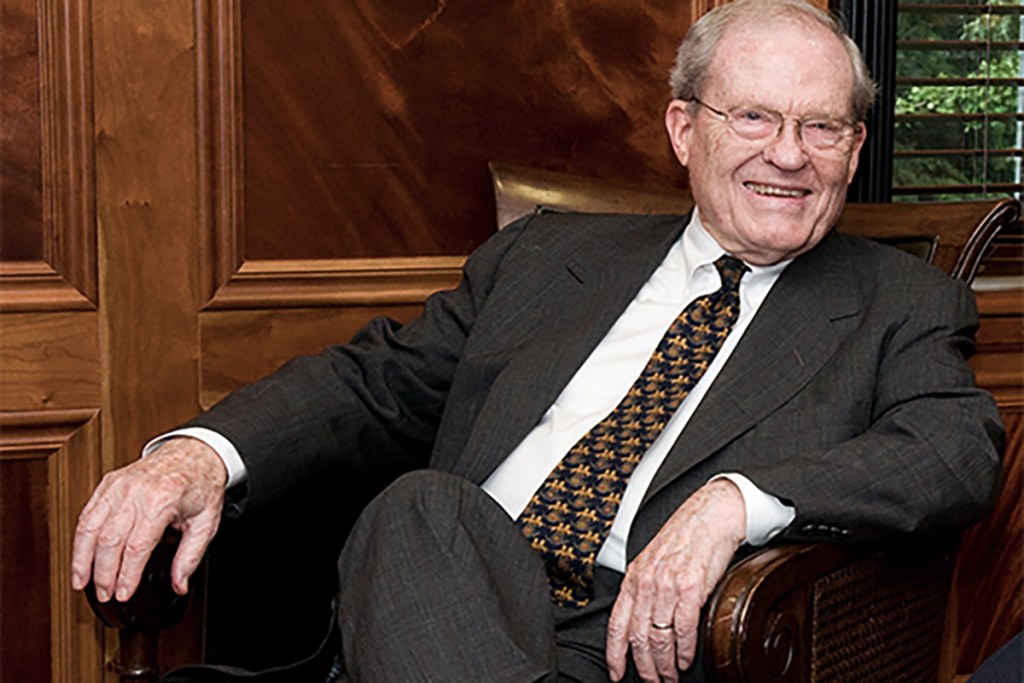
Jim Laney, 98, is a former president of Emory University, a former ambassador to South Korea, and a person I am honored to call my friend. Reproduced below is an article discussing Dr. Laney’s views on the current relationship between South Korea and the United States. The piece is by S. Nathan Park, an international business litigator, expert on international relations, and a contributor to Foreign Affairs, The Atlantic, and many other publications.
U.S.-South Korea Relations Are at BreakingPoint
The Iran war has confirmed how little Washington cares for its ally’s welfare.
ByS. Nathan Park, a Washington-based attorney and nonresident fellow of the Quincy Institute for Responsible Statecraft.
Few U.S. experts are as respected in South Korea as James Laney, former U.S. ambassador to the country. Laney first went to Korea in 1947 as an army intelligence officer and returned in 1959 as a Methodist missionary. Two of his three daughters were born in the country, which was recovering from the devastating Korean War. After serving as president of Emory University for 16years, Laney served as the U.S. ambassador in Seoul from 1993 to 1997, playing an important role in diffusing the North Koreannuclear crisis in 1994.
Yonsei University, one of South Korea’s most prestigious universities, has a James Laney chair professorship as well as a James Laney lecture series, which features the most prominent minds in U.S.- Korea relations.
So it was no small news when the 98-year-old former ambassador offered a blunt assessment of the current state of the SouthKorea-U.S. alliance on March 5, as he received the 2026 Building Bridges Award from the Pacific Century Institute (where I am a board member). In an event usually filled with fluffy grace notes, Laney’s prerecorded remarks offered a cold-eyed analysis that left the audience—which included former South Korean President Moon Jae-in—stunned:
“The [United States] has unilaterally turned the bridge [of the U.S.-Korea alliance] into a drawbridge, with controls only on theUnited States side. Even when the bridge is down, the gates, that is, tariffs, are controlled by Washington, and the entire edifice operates at the whim of a United States president.
“It grieves me to say it. Boy, I never thought I would have to say it. But I think Korea must begin to project its future on its ownterms. Of course, it will do so wisely and prudently, but its interests are no longer congruent with those of the White House.
“What this means for troop command, independent nuclear capability and relations with China will require political skill anddeftness of extraordinary range. … [U.S. President Donald] Trump has made it abundantly clear that the [United States] is solely concerned with its own interest. Anything else is for the gullible.”
Laney verbalized what many Korea analysts have been thinking but were too afraid to say: the U.S.-South Korea alliance is close to rupturing, and Washington is at fault. Thanks to the Trump administration’s actions, Seoul must reconsider the fundamentalbuilding blocks of the alliance, including U.S. troop presence in South Korea, a nuclear umbrella instead of its own nucleararmament, and participation in U.S. deterrence of China.
One may disagree with Laney’s prescription, but his diagnosis is unassailable: Trump has shown no regard toward the value of thealliance. Trump’s 25 percent tariff against South Korea’s exports is a flagrant violation of the 2007 U.S.-Korea Free TradeAgreement, as well as the 2025 negotiation between the two countries to set tariffs at 15 percent. The latter agreement was coupled with South Korea’s pledge to invest up to $350 billion in U.S. industries, but the Trump administration could not even gracefully accept the financial boon.
In September 2025, U.S. immigration authorities conducted a thuggish raid on a Hyundai factory that was under construction in Georgia. The South Korean public watched in shock as hundreds of South Korean engineers, most of whom had valid employment visas, were shackled in chains on live television. Even Chosun Ilbo, South Korea’s leading conservative daily paper with a staunch pro-U.S. stance, wrote in an editorial that the raid was “unacceptable between allies” and “raised fundamental questions as to what the United States means by ‘alliance.’”
Trump’s reckless war may be the straw that breaks the camel’s back, pushing the U.S.-South Korea alliance to the point of no return. Laney prepared his remarks before Trump began the attack on Iran, but his warning proved unusually prescient.
The Iran war has imposed significant costs on South Korea. More than 70 percent of South Korea’s crude oil imports pass through the Strait of Hormuz, which is now blockaded. So dire is the petroleum shortage in South Korea that the government has limitedthe operation of government-owned vehicles and is weighing restriction on driving—a drastic measure unseen since the 1997 Asian financial crisis.
Petroleum by-products are also affected. With no crude oil to process, South Korea’s refineries have been shutting down one by one, leading to a critical shortage of naphtha—the raw ingredient for all plastic products, including paint and plastic bags. The same is happening with helium, a by-product of liquefied natural gas and an essential material for semiconductor manufacturing.South Korea’s stock market had been flying high thanks to its world-leading semiconductor companies, but the possibility of losing up to 90 percent of its helium imports from Qatar has sent its market tumbling.
But the intangible costs of the war may be even harder. For the first time in its existence as an independent nation, South Korea is genuinely doubting whether the United States can in fact make good on its security guarantee. The Iran war was the moment whenthe U.S. military was supposed to show its might on a real-life battlefield. But since the rubber met the road, the United States has been reduced to watching helplessly as Iran blockades the Strait of Hormuz and Iranian missiles hit the glittering skyscrapers of Dubai and oil refineries in Saudi Arabia.
To be sure, South Korea has a much stronger self-defense capability than the United Arab Emirates or Saudi Arabia. (The UAE, infact, uses South Korea’s M-SAM Cheongung-II missile defense system.) But it only takes a short mental jump for South Koreans to imagine a potential conflict between China and Taiwan, and Chinese missiles raining down on the high-rises in Seoul because of the U.S. military presence in South Korea.
One move in particular made the Trump administration seem pathetic to South Koreans. Because of his inability to prevail over Iran, Trump had to resort to redeploying the United States’s Terminal High Altitude Area Defense (THAAD) missile defense system from South Korea to the Middle East, while begging South Korea to send its navy to the Persian Gulf. The redeployment of THAAD is particularly galling for South Koreans; in 2017, after allowing the United States to deploy THAAD on South Korean territorydespite China’s objections, Seoul suffered boycotts and trade restrictions imposed by Beijing. These wreaked havoc on large SouthKorean companies that were operating in China, such as Lotte, while the United States (then under the first Trump administration) stood pat and did nothing.
What good is the U.S. security guarantee against China when the United States cannot even handle a middle power such as Iran? What was the point of suffering through China’s economic retaliation to deploy THAAD in the name of upholding the U.S.-South Korea alliance when the United States makes a mockery of that suffering by unilaterally pulling THAAD to a different corner of theworld? What good is a guarantor that asks you to spend your resources to cover the liability it created?
For many South Koreans, the logical move seems to be what Laney counsels: take full control of the South Korean military (over which the United States currently has joint wartime operational control,) develop nuclear weapons, and seek better relations withChina while downgrading the U.S. alliance to a transactional relationship.
From a U.S. perspective, there is no good time for weakened alliance, but this moment could not be worse. In a world where Chinais the top geopolitical rival of the United States, South Korea may well be the U.S.’s most indispensable ally. Camp Humphreys in Pyeongtaek, South Korea, is the largest overseas U.S. military base, and the closest one to mainland China.
In nearly all future-oriented technology industries where China is poised to overtake the United States—including semiconductors, electric vehicle batteries, nuclear power, and advanced shipbuilding—South Korea holds technology and capacity that the United States simply does not have. For too long, Washington has arrogantly assumed that Seoul could not afford to walk away from thealliance. It should have been asking if the United States could afford not to have South Korea as an ally.
Rupture in the U.S.-South Korea alliance is not a foregone conclusion. But to forestall this unwanted future, Washington must begin a full reverse from its current path of economic sanctions over allies and military adventurism that disrupts the global supply chain. The full reverse must come from all component parts of the U.S. government. Congress must exercise its oversight, and the judiciary must continue declaring Trump’s unilateral tariffs and undemocratic power grabs illegal.
The same is true for U.S. foreign-policy experts. It is a failure of the Korea expert community in Washington that a 98-year-oldformer ambassador is virtually the only one with the courage to speak up about the damage Trump is causing to the alliance, while the leading think tanks are cowed into silence. If nothing is done to stop Trump, Laney’s dire predictions will become grim reality.