Oil Market Running on Empty. No Plan. No Concept of a Plan. Just Hallucination and Bullshit. 

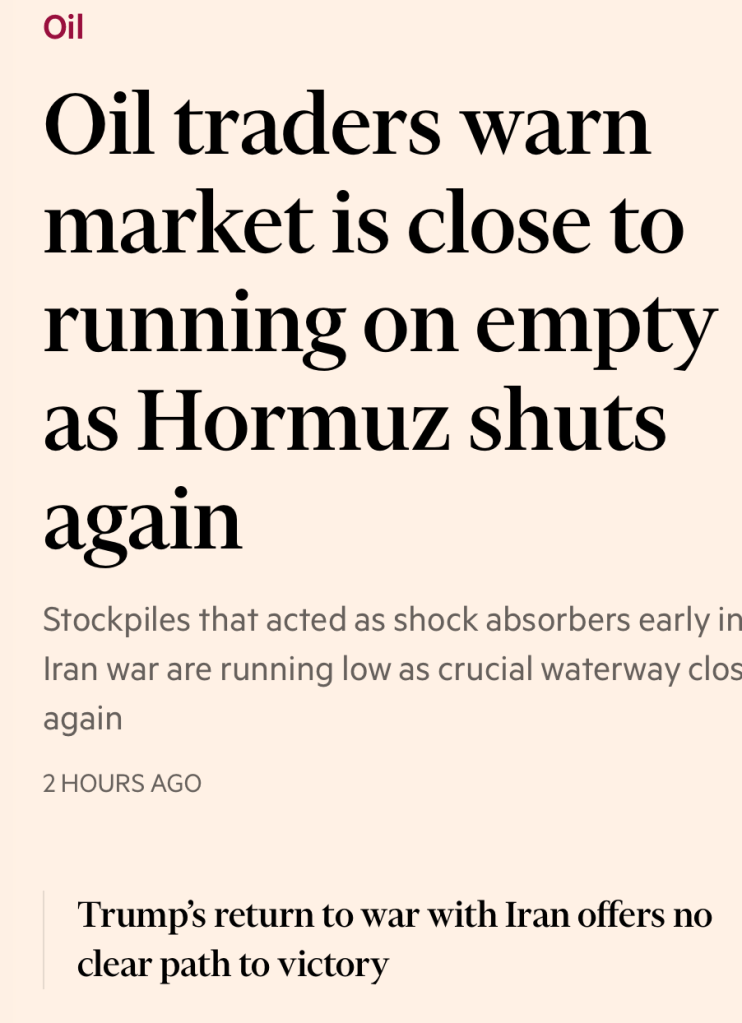
From this evening’s Financial Times:
Peter Baker on how Trump, utterly misunderstanding Iran, has screwed himself to a fare-thee-well:

In Iran, Trump Has Found an Opponent He Cannot Easily Dominate

The president is accustomed to forcing other countries to bend to his will. But he is struggling to come up with a strategy to extract Iranian concessions as the cease-fire he brokered collapses.

Published July 14, 2026 Updated July 15, 2026, 4:14 p.m. ET

On the 136th day of his war against Iran, President Trump came up with a new plan. He would impose tolls on ships traversing the Strait of Hormuz in exchange for protecting them from Iranian forces.

But that was then. On Day 137, he had another new plan. No tolls after all.

Mr. Trump’s 180-degree reversal this week in the face of protests from his Arab allies who were not so excited about paying tolls reflected how adrift he seems to be in prosecuting his war against Iran. What was supposed to be a clean four-to-six-week operation is now in its messy 20th week. Improvisation and impulse are not working.

A president who has made flexing his power on the world stage a hallmark of his second term has found in Iran an opponent that so far will not bend to his will and a geopolitical conflict that cannot be won through nasty social media posts or tariff threats. The memorandum of understanding that he brokered with Tehran last month to halt the fighting turns out to have been a memorandum of misunderstanding, and Mr. Trump now seems to have neither a clear military nor diplomatic strategy.

“He’s encountered a country that is not willing to play by his set of rules, which is you bend and kiss the ring and tell him how great he is and try to get whatever concession he’s willing to give,” said Vali Nasr, a professor at the Johns Hopkins University School of Advanced International Studies who has advised presidents and secretaries of state on the Middle East.

Mr. Trump’s no-end-in-sight venture in the Middle East has become a fresh lesson in why the region has been a sinkhole for presidential ambition for generations. The instruments of power that help advance U.S. interests elsewhere around the globe do not necessarily work there, as many of Mr. Trump’s predecessors have discovered.

It has been especially frustrating for Mr. Trump, who has reveled in getting his way since returning to office last year and even boasted that he might be the most powerful man in world history. But while he has successfully pressured NATO allies into increasing military spending, extracted concessions from trading partners and essentially took over Venezuela with a one-night surgical commando raid, it is not clear that he can get his way in the Persian desert.

“Trump’s forceful approach to the world in his second term has benefited from some luck and the occasional willingness of other states to facilitate an off-ramp,” said Suzanne Maloney, vice president and director of foreign policy at the Brookings Institution. “Nothing in the past 47 years should have led him to believe that Tehran would follow that route.”

John Hannah, a former national security adviser to Vice President Dick Cheney and now a senior fellow at the Jewish Institute for National Security of America, in the past has supported the limited use of military force to stop Iran from building a nuclear weapon. But he said that by going for “a massive decapitation strike,” Mr. Trump had clearly underestimated the theocratic power structure that took power in the 1979 Iranian revolution and overestimated American capacity to topple it.

“In retrospect, this was clearly a war based on fatally flawed assumptions,” Mr. Hannah said, “none more damaging than the president’s apparent conviction that Iran’s revolutionary regime was a flimsy house of cards ready to collapse in a hail of American airstrikes and bellicose Truth Social posts.”

“Compounding the error,” he added, “there was no rigorous national security apparatus around the president prepared to speak truth to power and subject his wrongheaded assumptions to systematic questioning based on the knowledge and experience of real foreign policy, defense and intelligence professionals.”

The cease-fire that has now collapsed amid nightly strikes was not even a particularly far-reaching agreement. It was meant to be a stopgap to quiet the guns for 60 days so that the two sides could negotiate the truly thorny disputes, particularly the future of Iran’s nuclear program. If a temporary deal cannot last, it is hard to see how the two sides can get to a permanent accord requiring painful compromises.

Mr. Trump seems uncertain how to proceed. He has turned back to the use of military force and ordered the resumption of a naval blockade in the Strait of Hormuz. He has threatened to take “a nice, big fat shot” at Pickaxe Mountain, a fortified site near one of Iran’s main nuclear facilities. He vowed to “knock out all their power plants” and “knock out all their bridges unless they get to the table and negotiate.”

But for all the saber rattling, he has given little indication that he is willing to resume the sort of full-fledged bombardment that marked the beginning of the war, given popular opinion against escalated conflict.

At the same time, he has suggested there will be further negotiations but has not articulated how talks that failed before could succeed now. In fact, he has expressed deep skepticism that they could, although of course that might simply be a way of lowering expectations. Instead, Mr. Trump seems to think that he can outlast the Iranians because their economy is in dire shape while the Iranians seem to think that they can outlast him because of the politics of gas prices heading into midterm elections at home.

“Trump’s in a box, and he’s facing a brutal and tenacious adversary whose objectives — maintaining leverage over the strait and a newfound desire for hegemony over the Gulf —now hold him hostage,” said Aaron David Miller, a former Middle East peace negotiator who served presidents of both parties and is now a senior fellow at the Carnegie Endowment for International Peace.

“Iran consumed and tarnished the legacy of one president,” he added, referring to Jimmy Carter and the 1979-81 hostage crisis. “And the way it appears now, with time on Iran’s side, not on Trump’s, it could very well tarnish or ruin the legacy of another.”

Other foreign policy experts rejected the analogy and cautioned against overstating the impact of the Iran war on Mr. Trump’s presidency.

“I don’t think Iran has destroyed Trump’s agenda, which is a broad one,” said Elliott Abrams, a national security official in multiple Republican administrations, including Mr. Trump’s first term. “As long as Americans are not dying, Iran will be a secondary issue for most Americans.”

Other foreign policy challenges like Ukraine, Cuba and China “don’t depend on Iran,” he added, so everyone should “keep Iran in perspective.”

Mr. Abrams noted that Democrats appear increasingly at odds with each other over Israel and the Palestinians, a divide that has played a major factor in some congressional primaries this season. “It’s the Democrats who are in danger of having a Middle East issue, namely Israel, swallow up their agenda,” he said.

The abrupt flip-flop on tolls underscored how much Mr. Trump is ad libbing these days. In announcing that he would charge 20 percent on cargo to protect shipping in the Strait of Hormuz on Monday, he contradicted his own administration’s position that tolls were an unacceptable violation of international law.

His decision to cancel them on Tuesday after calls from anxious Gulf Arab leaders made clear that he had not bothered to consult his allies before announcing the new tolls or disregarded their concerns. He covered for the shift with a face-saving if barely plausible explanation that the Gulf leaders had promised “trade and investment deals” instead.

What investments he did not say, nor were there further details to suggest any concrete commitments. “They’re going to be making massive investments into the U.S., and I like that much better,” Mr. Trump told reporters. “I don’t like the concept of a fee,” he said a day after calling it a simple “matter of fairness.”

It was hardly the only contradiction of recent days. When Mr. Trump sealed the cease-fire agreement last month, he praised Iranian negotiators. “We’re dealing with people that I think are very rational people,” he said then. “They were nice to deal with. They were strong people, smart people.”

By last week, he had changed his mind. “They’re scum,” he complained. “They’re sick people. They’re led by sick people.” Asked what had changed in just three weeks, Mr. Trump said, “I got to know them.” Which of course begged the question of why he did not know who he was dealing with in the first place.

“I don’t think he has a strategy on Iran,” said Abbas Milani, director of Iranian studies at Stanford University and a research fellow at the conservative Hoover Institution. “That’s the key problem. He approaches these things instinctively and he approaches them with two contradictory goals. On the one hand, he keeps saying, ‘We want to make a deal with you guys and make Iran a thriving economy.’ And on the other hand, he says, ‘I’m going to obliterate your civilization.’”

Mr. Milani said he agreed with Mr. Trump that Iran actually does want a peace agreement, and in fact he believes it is “desperate for a deal” because its economy is in free-fall. But he faulted the president for sending negotiators who are not steeped in the region and do not grasp its intricate history and details.

“I don’t think he ever really understood the nature of this regime,” Mr. Milani said of Mr. Trump. “He still doesn’t understand it. It’s not like any other. It always does the unexpected and will go to any limit to keep itself in power.”
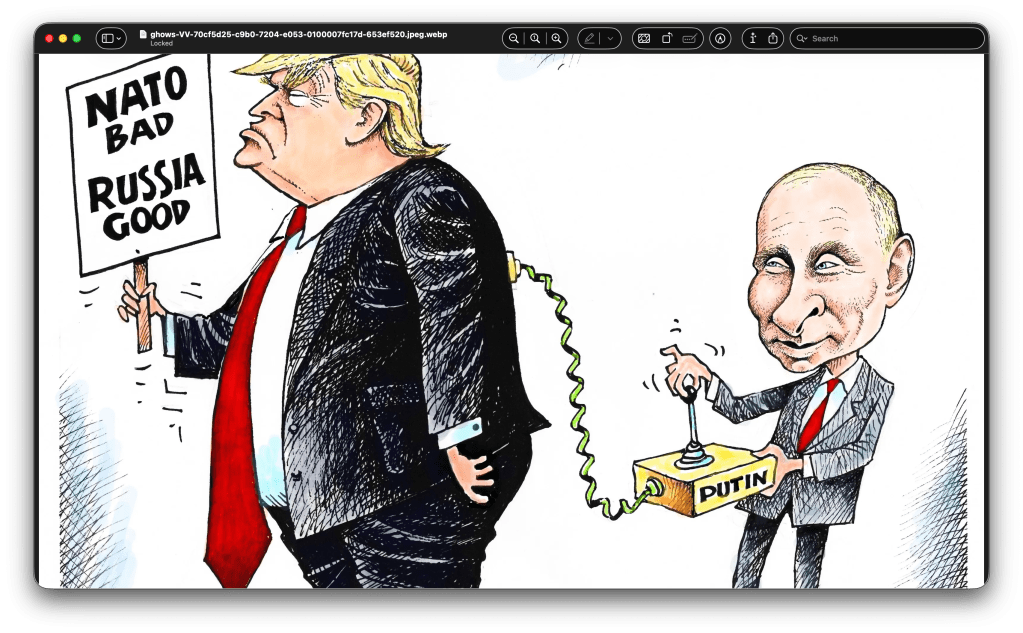
Is Trump Conspiring with Putin to Destroy NATO?

I wrote this post in order to reproduce an op-ed from the Wall Street Journal that argues—based, apparently, on European sources—that Putin may attack on of his Eastern European neighbors as a way to undermine NATO. 

I think it’s an interesting question. I go further. There is, in my view, abundant evidence that Trump is a Putin tool. Consider, among many other things, the stories that the idiotic acting Director of National Intelligence is busy gutting the intelligence community. 

Be all that as it may, Mr. Baker of the WSJ, writes,

Putin May See an Opportunity to Destroy NATO: Even a small incursion could doom the alliance if it lacks the political will to respond with force.

He is mired in a struggle against a country with a population and a military a fractionthe size of his own. Since the decision to launch that war has worked out so well, are we seriously being asked to believe that he would attack an alliance with an economy and military many times the size of his own?

A month ago I would have scoffed at the idea. But conversations with multiple senior European political, military and intelligence figures in the past few weeks suggest to me the possibility is real and rising. 

For some Americans, including perhaps the president, the idea that Russia may take a shot at some feckless Europeans who have been notably unhelpful with America’s military preoccupations in recent months might induce a yawn of indifference or even a smirk of schadenfreude. But the risks of any Russian provocation in Europe for America’s global security are profound. Ukraine, a non-NATO member, is one thing. If we failed to respond to Russian aggression against a member of the alliance, NATO would become a dead letter. 

Which is why Mr. Putin might attack. As one intelligence analyst put it to me last week: His inspiration may be Marshal Ferdinand Foch, the general who commanded French forces at the Battle of the Marne in 1914. He famously reported: “My center is yielding. My right is retreating. Situation excellent. I am attacking.”

A sudden show of unexpected force just as he appears to be reeling from his ill-advised Ukraine war could be to Mr. Putin’s advantage. Although Mr. Trump’s verbal shock treatment has jolted European NATO members into finally doing more in their own defense, they are still nowhere near ready for a defensive war. Government officials say it will be at least five years before their militaries are close to being capable of replacing U.S. capabilities in Europe.

Mr. Trump has 2½ years left in office. There is no guarantee his successor will have as skeptical an approach to NATO. If Mr. Putin chose the right targets, European leaders suspect Mr. Trump’s administration wouldn’t come to a NATO country’s aid, fatally undermining the credibility of the alliance’s collective-defense commitment—and with it, NATO’s existence—a dream outcome for Mr. Putin. 

His political needs might also be suited by an attack on NATO. A former British defense official said to me last week, “After four years of failure and rising popular discontent at home, he desperately needs a military victory.” What better way to lift morale than to plant the Russian flag in some NATO field?

All this suggests we are now in a narrow window of opportunity for Russia to make a move. If Mr. Trump goes ahead with plans to cut European deployments, that window gets wider. 

Sure enough, intelligence reports point to rising risks of Russian action. Last week a Polish news report said U.S. officials had warned Warsaw that Russia may attack the country. In an interview last month, a senior military figure from a NATO nation identified multiple risks, including a Russian seizure of islands in the Baltic and an incursion to “assist” the Russian minority in Estonia. None of these would amount to a full-scale invasion, but each would be enough of a provocation that if NATO failed to respond, its credibility would be in tatters.

Is Europe really worth defending with U.S. blood and treasure? Is NATO still an essential strategic interest? I’ve long sympathized with the argument that a large U.S. commitment to the European theater is an anachronism in our security posture, a throwback to 20th-century geopolitics. China is obviously the biggest threat to U.S. security and leadership; managing that relationship requires a shift of strategic resources and attention toward the Pacific. The Europeans can and should take care of their own freedom and security. 

But whether we want it or not, we are in a cold-to-simmering war with an axis of resistance that runs from Beijing through Tehran to Moscow. The U.S. is still dealing with the fallout of an inconclusive war with Iran that has left us militarily depleted. As we scramble to manage potential opportunistic moves by China’s Xi Jinping in the Asia-Pacific, Mr. Putin could deal a timely and fatal blow to an already weakened trans-Atlantic alliance. That would be another hammer to the head of Western security and hegemony, and a dramatic enhancement of the power of Russia’s alliance with China and our other adversaries.

Perhaps all the talk of an imminent Russian attack is merely disinformation from European officials, trying to keep President Trump from further weakening NATO. But if you were the American president, would you want to take that risk?

Deal or No Deal? Hallucination or No Hallucination?

Here on Saturday, June 13, in the US Eastern Time Zone, the hour is past 6PM and night is drawing nigh. 

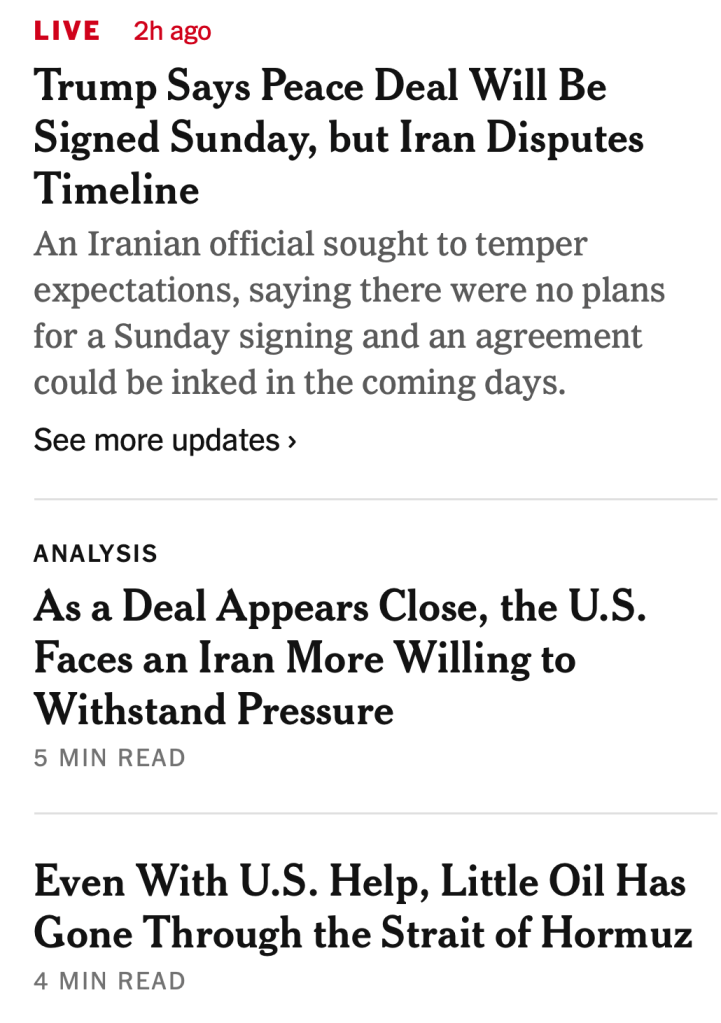
The Washington Post solemnly informs us that  “U.S. and Iran to close deal within a day, Trump says, but Tehran yet to confirm: An agreement would extend the ceasefire and pave the way for a longer truce, leaders said, though a Tehran official denied that a deal will be signed Sunday.” Meanwhile, the Noo Yak Times, somewhat more fulsomely, lets us know that 

Starting with March 23 this year, this is the 38th time Trump has claimed an Iran deal is just around the corner. 

We appear to be living in the age of hallucination. KPMG, one of the Big Four accounting firms, just released a major report on the impact of AI on business going forward. It provided many examples to support its conclusions. A large number of the examples were themselves AI hallucinations.

Meanwhile, K&L Gates, a top law firm, submitted a brief to a federal court in California where nine of 27 citations were wrong, including two non-existent cases hallucinated by an artificial intelligence program.

Up in Washington, at the White House, the cage fight will start in about an hour and a half. One assumes that Orange Mussolini will take time out to enjoy the human cock fight and will, temporarily, stop acting like someone whose mind has been occupied by an incompetently designed, delusional AI chat bot. 

After the cage fight is all over and they’re taking away the bodies, I expect we will begin to hear more belligerent delusions about an Iran deal signing ceremony. 

Will there in fact be a deal by this time next week? I very much doubt it. If you would like to bet a nice steak dinner on that, let me know. 

I’m even more confident that if a deal is reached next week, it will heavily favor Iran.

If not, I expect there will soon be some dead Iranian negotiators. 

Narcissistic Collapse

To remind you:

Steven Beschloss is a journalist, writer, and adjunct professor at New York University. He is the brother of historian Michael Beschloss.

Mary Trump, the niece of Donald Trump, earned a doctorate in clinical psychology and has made a cottage industry of analyzing her uncle’s many mental disorders. 

War and Peace: A Comprehensive Summation from Today’s Guardian. It is Not a Pretty Picture. 

Trump’s failure to maintain ceasefires is part of the new world disorder – and ordinary people pay the price | Simon Tisdall

There are visionary statesmen and high-minded negotiators, pragmatic mediators and professional diplomats – and then there are meddling fools. As ceasefires implode, vast numbers of civilians die or flee, and wars Donald Trump started, fuelled or pledged to resolve rage unchecked, there’s no doubt which category he belongs to. In baseball parlance, in Ukraine, Iran-Lebanon and Israel-Palestine, Trump is “0 for 3”. He boasted he alone could cut deals and bring peace. He’s delivered neither. In striking out, he mostly makes matters worse.

The heroic age of 19th-century diplomacy, typified by Prince Metternich’s great power-balancing “concert of Europe” and Benjamin Disraeli’s Balkan “peace with honour”, is history now. But it’s not that long since Nobel-winning peacemakers such as the UN chief Kofi Annan and the Finnish diplomat Martti Ahtisaari, or the US senator George Mitchell, who brokered Northern Ireland’s Good Friday agreement, were troubleshooting intractable conflicts the world over. Where are the successors to Desmond Tutu, Andrei Sakharov or Yitzhak Rabin when you need them?

Nowadays, ceasefires fail with grim regularity. Lebanon’s latest effort flopped this week. Others, like that in Iran, are broken daily. Sudan has no ceasefire at all. And why has it become so hard to end “forever wars”? Amid record levels of global strife, a lack of respected, impartial go-betweens and bold political risk-takers is one key reason. The gulf in ability between, say, Richard Holbrooke, the US diplomat who helped settle the Bosnian war, and Trump’s amateur envoys, Steve Witkoff and Jared Kushner, is akin to that between Arsenal and a Sunday park football XI.

Factually speaking, Trump’s diplomatic record is lamentable. He promised to resolve the Ukraine war in a day. It’s now in its fifth year. He blatantly sided with Russia, told a browbeaten Ukrainian president, Volodymyr Zelenskyy, he had “no cards”, and cut weapons supplies. Yet Trump overplayed his hand while underestimating Russian president Vladimir Putin’s propensity to cheat and Ukraine’s resilience. Kremlin officials ran rings round the credulous Witkoff and Kushner during Moscow “negotiations”. To their shame, the dynamic duo has yet to visit Kyiv. Trump, having lost face, has lost interest, too. Convinced that the tide is turning, Zelenskyy is now proposing a ceasefire– which, on past form, Putin will reject.

After illegally attacking Iran in February, Trump declared a ceasefire in April with none of his main objectives met and with the strait of Hormuz largely closed to shipping. Violations occur daily, half-hearted “peace talks” via shadowy third parties lead nowhere, and the global economy splutters. Again, Trump underestimated the challenge, overestimated the power of brute military force to change political realities, followed his own (woefully bad) instincts, sidelined European allies and vainly sought a quick, easy victory. Now he faces a drawn-out conflict, a Congress in revolt and an angry public.

In Gaza, meanwhile, the world-shattering triumph Trump proclaimed last October, when a truce was agreed and Israeli hostages freed, rings distinctly hollow. His 20-point plan, pivoting on the disarming of Hamas, quickly ran into the sand. His “Board of Peace” and grandiose ideas for Gaza’s reconstruction lack credibility. The reality is continuing, unconscionable Palestinian suffering and expanding Israeli military occupation. Now Trump’s co-conspirator, prime minister Benjamin Netanyahu, is doing to southern Lebanon what he did to Gaza – creating a depopulated desert – and thereby obstructing a US-Iran deal. The two men had a furious row last week.

Trump’s serial failures reflect a bigger problem. Ceasefires and truces have come and gone in conflict zones such as Yemen, Myanmar and the Democratic Republic of the Congo in recent years without leading to lasting settlements. In Sudan, agreement to observe a humanitarian pause, let alone cease hostilities, remains elusive after more than three years of civil war. Visceral lack of trust between warring parties is a poisonous common factor. So, too, are sheer intransigence and an erroneous zero-sum belief in total victory.

The chronic inability to permanently resolve wars often stems from an absence of organised, recognised peace processes. Almost forgotten are the days when empowered UN envoys engaged with all parties, created working groups and proposed phased confidence-building measures and timelines. There was a long period when US secretaries of state, such as Henry Kissinger, Warren Christopher and John Kerry, undertook energetic shuttle diplomacy in pursuit of peace. In contrast, Marco Rubio, today’s state department incumbent – a smoothly ambitious man untroubled by principle – stands back from the fray, telling his boss he’s right when he’s wrong. Only Trump and Rubio seem surprised that Hezbollah, excluded from peace talks by their US hosts, rejected the latest Lebanon ceasefire.

The obdurate, refractory nature of modern conflict mirrors today’s world. In a global order lacking agreed rules, where major powers and non-state actors treat international law and international courts with contempt, the business of war and peace grows similarly anarchic. For unscrupulous regimes bent on maximising national advantage, no agreement is deemed unbreakable, no dishonourable breach too shameful to shrug off. Without rules, peace deals cannot ultimately be enforced.

Institutional weakness is exacerbated by the venality and banality of politicians. Soft-power tools, dialogue, logic and persuasion, moral imperatives and historical context are devalued and scorned. Overwhelming force, instant results and market-moving soundbites are prioritised. In this unpoetical wasteland, the “long term” is a foreign concept and truth and justice a lost cause. Even peace is a relative term in an era when a bellicose US president, bomber of multiple countries, can claim, in Nineteen Eighty-Four doublespeak, that he deserves a Nobel peace prize.

Endless, futile wrangling over ceasefires obscures the terrible impact of conflict on ordinary people and compelling human reasons for halting the violence. Since the Iran war began, at least 3,468 people have reportedly died inside the country, 26,500 have been injured, and millions displaced. Attention has been deflected, for example, from the still-unaccounted for Minab primary school bombing on 28 February, when US forces allegedly killed more than 100 children. If full-scale fighting resumes, there will be more atrocities, more needless suffering.

Civilian casualties continue to increase across the wider Middle East. In Lebanon, where thousands have died despite a previous (failed) ceasefire, Unicef provided a snapshot of the last week in May when, it reported, 77 children were killed or injured. Such tragedies recall the horrors of mass infant and child deaths at the height of the Gaza war. They are 77 reminders why ceasefire negotiations are not self-congratulatory political shows or social media entertainments, as Trump’s daily commentaries suggest, but urgent matters of life and death.

None of these wars will ultimately be ended by military force. It’s not about who has the biggest bombs or who gets to declare a specious victory, Mr Trump. It’s about people’s lives. As has mostly held true through history, it’s diplomacy – professional, active, skilled and well-practised diplomacy – that opens the door to peace.

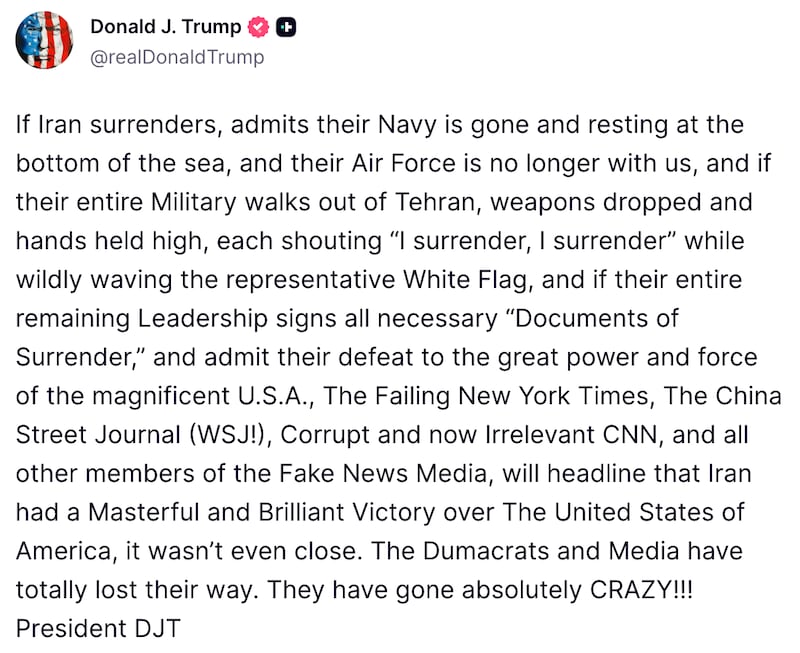
He Posted this on May 18. Then He Posted the Same Thing Again on May 26. Then He Posted it Again Last Night. 

Trump has already suffered defeat at the hands of the Iranians. To try to hide that defeat from you—but most of all, to try to hide it from himself—he has fallen deeper and deeper into delusional narcissism. 

When you hold a losing hand, your best option is to negotiate the least bad deal you can get, and then walk away. But in order to implement your least bad option, first you have to get past your natural reluctance to admit how bad the situation actually is. 

If you are buying stock or oil futures based on the assumption that Trump and Iran are actually negotiating a deal and will soon finalize that deal, then you are a fool, and you richly deserve what’s coming to you. 

Here’s a Howdy Do

Iran says it won’t negotiate any more unless and until Israel lays off Lebanon.

If Mango Mussolini tells Bibi to lay off Lebanon, and if Bibi follows those orders, then everyone’s going to say that Trump is a wimp for doing what Teheran directed him to do.

But if the war in Lebanon goes on, then a lot of people are going to blame Israel for torpedoing the deal with Iran. “Protocols of the Elders of Zion” and rampant anti-semitism, here we come again!

Not Looking Good for the Lyin’ King

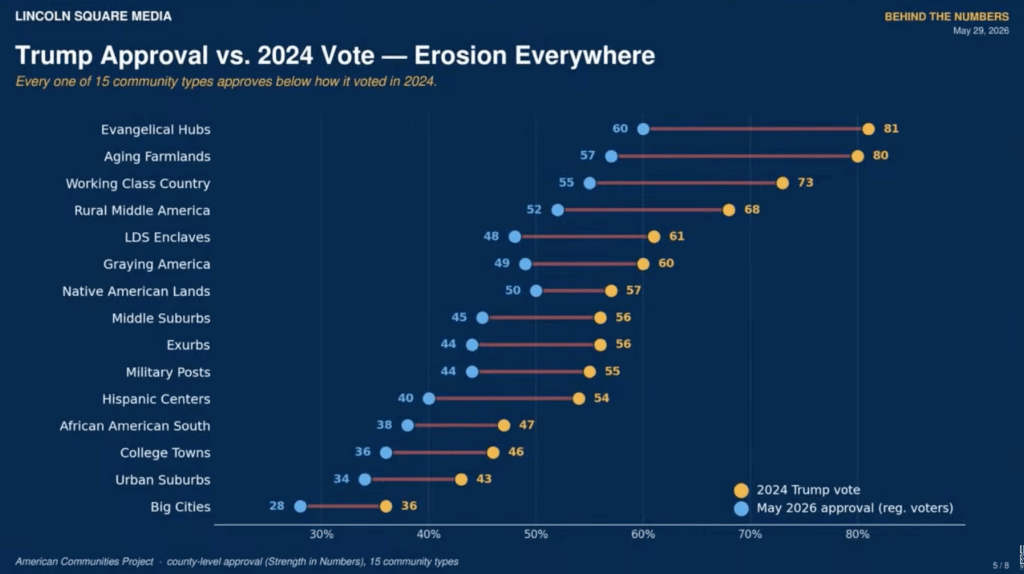
The biggest losses seem to be with the core of the base—the four groups listed at the top of the graph. 

And the odds are strongly in favor of It getting worse for the Tangerine Toddler. Today brings news that negotiations with Iran are off and the war is back on. And you know what that means for gas prices and for the US economy, generally.