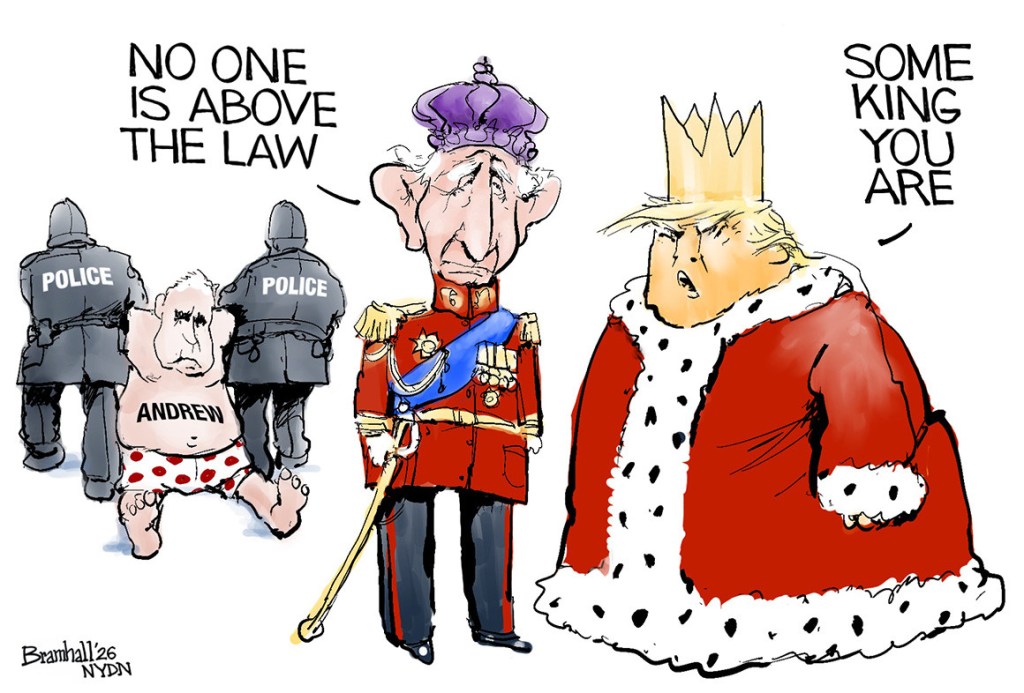
Some King You Are!

With clear eyes, hard facts, critical thinking, new political strategy, empathy, and a soupçon of Schadenfreude
Some legal scholars say—and they’re right—that for ages to come Friday’s Supreme Court decision in Learning Resources v. Trump will be hailed as a landmark ruling on the limits of presidential power. Students of constitutional law will read it alongside Youngstown Sheet & Tube Co. v. Sawyer, a 1952 case establishing that a President cannot seize private property without congressional authorization.
Fun fact: Both yesterday’s decision and the 1952 decision were 6 to 3 rulings.
The legal, economic, and political issues impacted by yesterday’s decision are, at one and the same time, both simple and complex. Like so many aspects of law and political economy, a full understanding requires thinking in different ways at the same time.
In this post, I am going to deal with the simple part of the matter: the Court’s holding—i.e., what the six members of the majority agreed on.
Chief Justice Roberts wrote the opinion for the majority, consisting of himself and Justices Barrett, Gorsuch, Kagan, Sotomayor, and Barrett. The Chief Justice’s opinion is 21 pages long, but only Roberts, Barrett, and Gorsuch agreed with all 21 pages. All six agreed with the Court’s bottom line decision set forth at page 21, and all six agree with what the Chief Justice wrote at pages 1 through 7 and at pages 14-20. However, only Justices Roberts, Barrett, and Gorsuch agreed with pages 7-14 and with the part that begins on page 20.
In addition to this 21-page opinion of the Chief Justice, there are five other concurring or dissenting opinions. The whole enchilada amounts to 170 pages.
But, of course, what really counts are the 13 pages of prose on which the 6-justice majority could come together.
This was not a contract case or a tort case or even a constitutional law case. It was instead a case of statutory interpretation—albeit a statute that required interpretation with the words of the Constitution in mind.
That statute in question was the IEEPA, the International Emergency Economic Powers Act, passed in 1977 to replace the old Trading with the Enemy Act, which was thought to have granted excessive power to the government.
Going in, there were two main issues.
First, had Trump correctly determined the existence of some economic emergency justifying the invocation of the IEEPA? (And relatedly, even if he might have screwed up the emergency determination, was that determination nevertheless, as he claimed, unreviewable by the courts?)
Second, assuming for the sake of the discussion that the emergency finding was OK, did the IEEPA give the President the unrestrained power to impose any old tariff, at any old amount, for as long as he wanted, even though tariffs were no mentioned in the words of the statute and even though the Constitution says that Congress has exclusive power to impose tariffs?
As to the first of these two questions, the Court punted. Chief Justice Roberts wrote, “We claim no special competence in matters of economics or foreign affairs.” That sentence, by the way, appeared in the part of the 21-page opinion that the three liberals did not endorse.
Clearly, there was no majority in favor of ruling on the existence of the purported emergency, let alone a majority for rebuking Trump on that point.
The key ruling concerned the second question—whether, if a valid emergency exists, the kitbag of Presidential remedies does or does not include tariffs.
Bottom line: six members of the Court ruled that the answer is no, the power to impose tariffs may not properly be inferred from language that does not mention tariffs, given the Constitution’s reservation of the tariff power to Congress, not the President.
As I said before, the six-member majority agreed on some 13 pages of Chief Justice Roberts’ opinion, and those 13 pages state the holding of the Court. The rest of the 170-page package is largely devoted to intense theological naval contemplation regarding the “major questions doctrine.”
The “major questions doctrine,” dating from about the year 2000, is a novel principle of statutory interpretation, beloved of business-oriented right wingers, intended to do battle against the administrative state.
The gist is that questions of major political or economic significance may not be delegated to an administrative agency except with clear and explicit congressional authorization. If you’re interested, Wikipedia has a good article.
As we have seen, in the Friday tariff case, the six right-leaning justices split down the middle. The pro-Trump-tariffs faction had to explain how their position could be reconciled with their beloved major questions doctrine, and that, in turn, required pages and pages of tortured prose. Meanwhile, the anti-Trump-tariffs faction of right wingers wanted to get the three liberals to admit that the major questions doctrine was really a good thing after all.
No such luck. The three liberals were having none of it. Ordinary statutory interpretation—without any special newly invented right wing canon of statutory exegesis—was fully sufficient to conclude that Trump was acting unlawfully.
And THAT, as we have seen, was, at the end of the day, exactly the 6 to 3 holding of the Supreme Court.
The extra 150 pages were, in my opinion, largely a waste of ink and paper.
Six members of the Supreme Court have crossed the Rubicon, ruling clearly and unambiguously that our toddler-in-chief has to give up his favorite box of matches.
I watched this lengthy, but very insightful, dialogue between two focus group experts. The time was well spent. Consider taking the trouble to watch yourself, if you want to understand the current state of opinion among the masses of our fellow Americans.
First of all, if you want to employ advocacy in the real world—not just in environments where you feel comfortable, but also in situations where advocacy might actually achieve something—then you need to identify your target and to be clear about what you want he, she, or them to do.
Now, it would be nice if everyone on Team Red would recognize the error of their ways, and come join Team Blue. But that is not going to happen. A more realistic objective would be to help them realize that things are going badly for Team Red—and there’s no real point in their voting in the next election or two. If lots of Team Red stay home, then we win—which, by the way, is exactly what has been happening in recent special elections.
Second, while honesty is essential, candor is likely to be counterproductive. To illustrate: the next time you’re dining with a MAGA acquaintance, you probably don’t want to say something candid such as, “I know that I am your moral and intellectual superior, but I’ll deign to talk with you if you will listen politely.”
A better course would be to argue along the lines, “Well, if you believe X, let’s talk about the implications of that belief.”
Third, if your objective is to get your MAGA acquaintance just to stay home on election day, then a good way of accomplishing that objective may to join he, she, or them in reasoning rationally and honestly from the false premises that he, she, or they entertain. To wit: your MAGA dinner companion may have voted for Trump three times because he or she believes that, while Trump is an asshole, he is an asshole who is working for the MAGA community and against the people whom the MAGA community hates.
Your objective is not to convince your MAGA acquaintance that he or she ought not to hate people—or that she or he ought not to hate the particular kinds of people that he or she hates.
No, your objective is to convince him or her that Trump is an asshole all right, but he is the kind of asshole who actually despises the people who voted for him three times—and that Orange Mussolini has absolutely no intention of prioritizing the core economic interests of his core supporters, namely, white people without a college education.
In other words, MAGA folks, yes, he’s an asshole, but he is most emphatically NOT YOUR asshole.
The biggest and most important thing I learned as a professional advocate for several decades is that it is so much easier—so much easier—to sell an argument if that argument is based on actual facts, as distinguished from delusional bullshit.
Notice how Jon Ossoff uses actual facts to construct his argument, and then to tie it all together with a pink ribbon using the concept of “the Epstein class.”
A deeply considered dive into the nature of our elites.

Back in the day, the state of New York used to show prospective jurors a film about Crown v. Zenger, a 1735 trial in which a New York jury refused to convict John Peter Zenger for “seditious libel” because he published criticism of the Royal governor.
I hope they are still showing it.

Two days ago, a federal judge in Fulton County ordered that Team Trump “shall file, no later than the close of business on Tuesday, February 10, 2026, the search warrant affidavit [about the alleged voter fraud in 2020] subject to the redaction of the names of non-governmental witnesses.”
United States District Judge J.P. Boulee signed the order. A former partner at Jones Day, where he worked in that firm’s Corporate Criminal Investigations practice group, Judge Boulee was elevated to the federal bench by Donald Trump.
Louisiana state House of Representatives District 60 is a rural area south of Baton Rouge. In 2024, 56 percent of its voters cast their franchise for Trump, while 43 percent voted for the Democratic ticket.
In yesterday’s special election, the Democratic candidate won 62 percent to 38 percent.
In other words, there was a 37 percent shift in favor of the Democrats between November, 2024, and February, 2026.

