There are reports that Skadden Arps is about to do a deal with Trump along the lines of the Paul Weiss capitulation. I am feeling nauseous. But all is far from lost.
Jenner & Block is a large, Chicago-based firm with a number of offices. It is among the top 100 American firms in profit per partner. It heavily emphasizes litigation, including a serious amount of pro bono work—much of it for organizations Trump does not like.
When the firm got in Trump’s cross hairs, it responded, in words or substance, “Fuck You Very Much.”
The firm’s statement of today reads,
Today, Jenner & Block filed a lawsuit to stop an unconstitutional executive order that has already been declared unlawful by a federal court. We expect to prevail quickly.For more than 100 years, Jenner has stood firm and tirelessly advocated for our clients against all adversaries, including against unlawful government action. We once again go to court to do just that. To do otherwise would mean compromising our ability to zealously advocate for all of our clients and capitulating to unconstitutional government coercion, which is simply not in our DNA.
Jenner & Block’s complaint, filed on its behalf by Cooley LLP, is 64 pages long and alleges 13 constitutional violations.
WilmerHale is the union of the old DC-based Wilmer Cutler & Pickering and the old Boston-based Hale and Dorr. It has 1000+ lawyers, and is particularly prominent in litigation. It was recently ranked as number 31 among American law firms.
To represent the firm, WilmerHale retained renowed conservative attorney Paul Clement, of whom Wikipedia notes,
Mr. Clement’s complaint on behalf of WilmerHale runs to 57 pages, describes in great detail the eleven constitutional violations of his client’s rights, and is a masterpiece.
Also worthy of praise is the brief in support of a temporary restraining order by Williams and Connolly, on behalf of Perkins Coie. Follow the links and read ‘em both.
Bar organizations’ statement in support of the rule of law
CHICAGO, March 26, 2025 — We the undersigned bar organizations stand together with and in support of the American Bar Association to defend the rule of law and reject efforts to undermine the courts and the legal profession.
In particular, as outlined by the ABA:
We endorse the sentiments expressed by the chief justice of the U.S. Supreme Court in his 2024 Year End Report on the Federal Judiciary, “[w]ithin the past year we have also seen the need for state and federal bar associations to come to the defense of a federal district judge whose decisions in a high-profile case prompted an elected official to call for her impeachment. Attempts to intimidate judges for their rulings in cases are inappropriate and should be vigorously opposed.”
We support the right of people to advance their interests in courts of law when they have been wronged. We reject the notion that the U.S. government can punish lawyers and law firms who represent certain clients or punish judges who rule certain ways. We cannot accept government actions that seek to twist the scales of justice in this manner.
We reject efforts to undermine the courts and the profession. We will not stay silent in the face of efforts to remake the legal profession into something that rewards those who agree with the government and punishes those who do not. Words and actions matter. And the intimidating words and actions we have heard and seen must end. They are designed to cow our country’s judges, our country’s courts and our legal profession.
There are clear choices facing our profession. We can choose to remain silent and allow these acts to continue or we can stand for the rule of law and the values we hold dear. We call upon the entire profession, including lawyers in private practice from Main Street to Wall Street, as well as those in corporations and who serve in elected positions, to speak out against intimidation.
If lawyers do not speak, who will speak for our judges? Who will protect our bedrock of justice? If we do not speak now, when will we speak? Now is the time. That is why we stand together with the ABA in support of the rule of law.
American Bar Association Alameda County (California) Bar Association Alexandria (Virginia) Bar Association Allegheny County Bar Association (Pennsylvania) American Immigration Lawyers Association Appellate Lawyers Association Arab American Bar Association of Illinois Association of Professional Responsibility Lawyers Bar Association of Erie County (New York) Bar Association of Metropolitan St. Louis Bar Association of San Francisco Berks County (Pennsylvania) Bar Association Boston Bar Association Boulder County (Colorado) Bar Association Chicago Bar Association Chicago Council of Lawyers Cleveland Metropolitan Bar Association Columbus (Ohio) Bar Association Connecticut Bar Association Contra Costa (California) County Bar Association Detroit Bar Association and Foundation Erie County (Pennsylvania) Bar Association First Judicial District Bar Association (Colorado) Hawaii Women Lawyers Hennepin County (Minnesota) Bar Association Hispanic National Bar Association Hudson County (New Jersey) Bar Association Illinois State Bar Association International Society of Barristers Kansas Bar Association Kansas City Metropolitan Bar Association Kansas City Metropolitan Bar Foundation Lawyers Club of San Diego Long Beach (California) Bar Association Los Angeles County Bar Association Louisville Bar Association Maine State Bar Association Maricopa County Bar Association Massachusetts Bar Association Massachusetts LGBTQ Bar Association Middlesex County (New Jersey) Bar Association Milwaukee Bar Association Minnesota State Bar Association Monroe County (New York) Bar Association Muslim Bar Association of Chicago Nassau County (New York) Bar Association National Arab American Bar Association National Arab American Bar Association – Michigan Chapter National Asian Pacific American Bar Association National Association of Women Lawyers National Conference of Bar Presidents National Filipino American Lawyers Association National LGBTQ+ Bar Association National Native American Bar Association New Jersey Women Lawyers Association New Mexico Black Lawyers Association New York City Bar Association New York County Lawyers Association North County (California) Bar Association Board of Governors of the Oregon State Bar Palestinian American Bar Association Passaic County (New Jersey) Bar Association Philadelphia Bar Association Queens County (New York) Bar Association Ramsey County (Minnesota) Bar Association San Diego County Bar Association San Fernando Valley (California) Bar Association Santa Clara County Bar Association (California) South Asian Bar Association of North America State Bar of New Mexico Virgin Islands Bar Association Board of Governors of the Washington State Bar Association Women’s Bar Association of the State of New York Worcester County (Massachusetts) Bar Association
Democrats have been lost in the wilderness since Donald Trump’s victory, but if Tuesday’s special election shocker in Pennsylvania is any harbinger, the MAGA Republican ascendancy is perishable. In Lancaster County, which went for Mr. Trump last year by 16 points, Democrats flipped a state Senate seat that the GOP had occupied for decades. …
[N]ationalizing relatively sleepy local races can be politically effective, and Democrats hope to do the same thing next week in Wisconsin’s state Supreme Court election, and in two special elections for open U.S. House seats in Florida.
Voter turnout in such races can be considerably smaller than in November, so the results aren’t always predictive. …
Still, Republicans might want to take this surprise loss in MAGA country as a warning. Mr. Trump’s tariff threats are whipsawing financial markets and the broader economy. The Conference Board said Tuesday that its survey of consumer confidence showed a drop in March, for the fourth consecutive month. Even voters who like the GOP’s policy agenda could be jolted by the impression of chaos in Washington, plus Mr. Trump’s recent focus on retribution.
Democrats got pummeled last year because they followed out-of-touch leaders down ideological rabbit holes. Republicans will suffer if they do the same thing in reverse.
Derek Thompson is the co-author, along with Ezra Klein, of the new book Abundance. I strongly recommend the whole article. If you don’t subscribe to The Atlantic, then you really should.
Here are some highlights:
Donald Trump has promised a “golden age of America.” But for all his bluster about being the champion of an American century, Trump’s actual policies point to something different: not an expansive vision of the future, but a shrunken vision of the present.
The MAGA movement might try to justify its wrecking-ball style by arguing that its extreme approach is commensurate with the level of anger that voters feel about the status quo. But just because Trump is a product of American rage does not mean he is a solution to it.
In housing, for example, Americans have every right to be furious. Home construction has lagged behind our national needs for decades. Today, the median age of first-time homebuyers has surged to a record high of 38. Large declines in young homeownershiphave likely prevented many young people from dating, marrying, and starting a family. Although Trump was swept into office on a wave of economic frustration, his initial foray into economic policy has done little to help the situation. As the National Association of Home Builders pointed out in an alarmed March 7 memo, his persistent threat of tariffs on Mexico and Canada could drive up the cost of crucial materials, such as softwood lumber and drywall gypsum, which are “largely sourced from Canada and Mexico, respectively.” Meanwhile, Trump’s anti-immigrant policies foretell new labor shortages in the construction industry, where roughly 25 percent or more workers are foreign-born.
This is where Democrats should be able to stand up and show that they have a winning response to the less-is-less politics from the right. But in many places run by Democrats, the solution on offer is another variety of scarcity. Blue cities are laden with rules and litigation procedures that block new housing and transit construction. As my colleague Yoni Appelbaum has noted, in California cities where the share of progressives votes goes up by 10 points, the number of housing permits issued declines by 30 percent. Where the supply of homes is constricted, housing prices soar, and homelessness rises. As of 2023, the five states with the highest rates of homelessness were New York, Hawaii, California, Oregon, and Washington—all run by Democrats.
As the cost of living rises in blue states, tens of thousands of families are leaving them. But the left isn’t just losing people. It’s losing an argument. It has become a coalition of Kindness Is Everything signs in front yards zoned for single-family homes. Liberals say they want to save the planet from climate change, but in practice, many liberal areas have shut down zero-carbon nuclear plants and protested solar-power projects, leaving it to red states such as Texas to lead the nation in renewable-energy generation. Democrats cannot afford to become the party of language over outcomes, of ever more lawn signs and ever fewer working-class families.
If Trump’s opponents are going to win at the polls, they will need to construct a new political movement, one that aims for abundance instead of scarcity. Such a movement would combine the progressive virtue of care for the working class and a traditionally conservative celebration of national greatness, while taking a page from the libertarian obsession with eliminating harmful regulations to make the most important markets work better. It would braid a negative critique of Trump’s attack on the government with a positive vision of actual good governance in America—while providing a rigorous focus on removing the bottlenecks that stand in the way.
Abundance begins with specific goals for America’s future. Imagine much more housing where it’s most in demand. An economy powered by plentiful clean energy. A revitalized national science policy prioritizing high-risk discoveries that extend lives and improve health. And a national invention agenda that seeks to pull forward technologies in transportation, medicine, energy, and beyond that would improve people’s lives. …
I can imagine somebody opposed to the MAGA movement reading all of this and thinking: Why, at a time when Trump presents such a clear threat to the American project, is it appropriate to focus such criticism on the Democratic side?
First, to make the argument for a liberal alternative to Trumpism, Democrats have to show Americans that voting for liberals actually works. …
Second, Americans are furious about the status quo—the youngest voters are “more jaded than ever about the state of American leadership,” according to the Harvard Political Review—and liberals need a new style of politics for the age of anti-establishment anger. The right’s answer to rage is chaos in search of an agenda. MAGA acts like a drunk toddler with a chain saw, carelessly slashing through state programs with a high risk of self-harm. But Democrats should not allow the forces of negative polarization to turn them into the party that reflexively defends the status quo at every turn, even when it means refusing to reform institutions that have lost the public’s trust. Quite the opposite: Abundance should be a movement of proud, active, and even obsessive institutional renewal.
Consider U.S. science policy, an area that is under attack from the right at this moment. As the centerpiece of U.S. biomedical funding, the National Institutes of Health has accomplished extraordinary things; you will have a hard time finding many scientific breakthroughs in the past 50 years—in heart disease, genetics, epidemiology—that were not irrigated by its funding.
But many of the same factors that have infamously plagued our housing and energy markets—paperwork, bureaucratic drift, entrenched incumbent interests—have become fixtures in American science. It is practically a cliché among researchers that the NIH privileges incremental science over the sort of high-risk, high-reward investigations that would likely uncover the most important new truths. Surveys indicate that the typical U.S. researcher spends up to 40 percent of their time preparing grant proposals and filling out paperwork rather than actually conducting science. As John Doench, the director of research and development in functional genomics at the Broad Institute, told me: “Folks need to understand how broken the system is.” …
Today, we seem to be in a rare period in American history, when the decline of one political order makes space for another. This crackup was decades in the making. It started with the Great Recession, which shattered a broad belief in free and unregulated markets. It continued throughout the 2010s, as slow economic recovery fueled public resentment of inequality, and an affordability crisis gathered steam. In 2020, the pandemic obliterated many Americans’ trust in government, or what was left of it. And from 2021 to 2024, inflation brought national attention to the interlocking crises of scarcity, supply, and unaffordability. For years, the boundaries of American politics had felt fixed, even settled. But now they are falling.
“For a political order to triumph, it must have a narrative, a story it tells about the good life,” Gerstle told me. Today’s politics are suffused with pessimism about government because “a way of living sold to us as good and achievable is no longer good, or no longer achievable.” In 2016, the rise of Bernie Sanders on the left and Donald Trump on the right revealed how many Americans had stopped believing that the life they had been promised was achievable. What both the socialist left and the populist-authoritarian right understood was that the story that had been told by the establishments of both parties, the story that had kept their movements consigned to the margins, had come to its end.
Political movements succeed when they build a vision of the future that is imbued with the virtues of the past. Franklin D. Roosevelt pitched his expansive view of government as a sentinel for American freedoms: of speech, of worship, from want, from fear. Decades later, Ronald Reagan recast government as freedom’s nemesis rather than its protector. Abundance, too, is about redefining freedom for our own time. It is about the freedom to build in an age of blocking; the freedom to move and live where you want in an age of a stuck working class; the freedom from curable diseases that come from scientific breakthroughs. Trump has defined his second term by demolition and deprivation. America can instead choose abundance.
To begin with, and for what little it’s worth, I want to be recorded as deploring the instinct to try to win a difficult argument by resorting to ad hominem slurs—“He’s a coward!”—against folks who disagree with you. It’s entirely illogical. It is an extraordinarily poor way to think yourself out of a hard problem. And it gives aid and comfort to the enemy.
So please don’t do it.
If you think Chuck Schumer’s analysis is wrong, fine, but explain why.
If you think my points are wrong, fine, but explain why. Don’t hurl ad hominem slurs.
Second, as sure as God made little green apples, Trump and his minions would have used those extraordinary powers as tools to wreck the federal government.
Third, and relatedly, the extraordinary legal powers that the law purports to confer on the president during a shutdown would have been used to give what lawyers call the “color of law” to Trump’s wrecking ball. Our side is winning in court on Trump’s abuse of power. We don’t want to give ourselves another legal hoop to jump through.
Fourth, a government shutdown would have supplied Trump and his minions with a splendid “argument” to further confuse an already confused public. “It’s not Trump who’s causing your pain,” they would scream, “it’s those damn Democrats who shut down the government.”
With no government shutdown, ALL THE CHAOS IS ON TRUMP AND HIS ENABLERS.
Fifth, because of points one, two, three, and four, there would be little incentive for Trump and the Republicans to negotiate to get out of the shutdown.
A shutdown is to the Trumpistas as the briar patch was to Brer Rabbit.
Over the past two months, the United States has confronted a bitter truth: The federal government has been taken over by a nihilist.
President Trump has taken a blowtorch to our country and wielded chaos like a weapon. Most Republicans in Congress, meanwhile, have caved to his every whim. The Grand Old Party has devolved into a crowd of Trump sycophants and MAGA radicals who seem to want to burn everything to the ground.
Now, Republicans’ nihilism has brought us to a new brink of disaster: Unless Congress acts, the federal government will shut down Friday at midnight.
As I have said many times, there are no winners in a government shutdown. But there are certainly victims: the most vulnerable Americans, those who rely on federal programs to feed their families, get medical care and stay financially afloat. Communities that depend on government services to function will suffer.
This week Democrats offered a way out: Fund the government for another month to give appropriators more time to do their jobs. Republicans rejected this proposal.
Why? Because Mr. Trump doesn’t want the appropriators to do their job. He wants full control over government spending.
Sign up for the Opinion Today newsletter Get expert analysis of the news and a guide to the big ideas shaping the world every weekday morning.
He isn’t the first president to want this, but he may be the first president since Andrew Jackson to successfully cow his party into submission. That leads Democrats to a difficult decision: Either proceed with the bill before us or risk Mr. Trump throwing America into the chaos of a shutdown.
This, in my view, is no choice at all.
For sure, the Republican bill is a terrible option. It is deeply partisan. It doesn’t address this country’s needs. But even if the White House says differently, Mr. Trump and Elon Musk want a shutdown. We should not give them one. The risk of allowing the president to take even more power via a government shutdown is a much worse path.
To be clear: No one on my side of the aisle wants a government shutdown. Members who support this continuing resolution do not want that. Members who oppose it do not want that.
Members who oppose this resolution want the Republicans to take their responsibilities more seriously and to negotiate spending bills that will address the many needs of the American people.
I respect my fellow Democrats for that. Unfortunately, this Republican Party is the party of Trump.
As bad as passing the continuing resolution would be, I believe a government shutdown is far worse.
First, a shutdown would give Mr. Trump and Mr. Musk permission to destroy vital government services at a significantly faster rate than they can right now.Under a shutdown, the Trump administration would have wide-ranging authority to deem whole agencies, programs and personnel nonessential, furloughing staff members with no promise they would ever be rehired.
The decisions about what is essential would, in practice, be largely up to the executive branch, with few left at agencies to check it.
Mr. Musk has reportedly said that he wants a shutdown and may already be planning how to use one to his advantage.
Second, if we enter a shutdown, congressional Republicans could weaponize their majorities to cherry-pick which parts of government to reopen.
In a protracted shutdown, House and Senate Republicans could bring bills to the floor to reopen only their favored departments and agencies while leaving other vital services that they don’t like to languish.
Third, shutdowns mean real pain for American families.
For example, a shutdown could cause regional Veterans Affairs offices to reduce even more of their staffs, further delay benefits processing and curtail mental health services — abandoning veterans who earned, and depend on, those resources.
A shutdown could continue to slash the administrative staffs at Social Security offices — delaying applications and benefit adjustments and forcing seniors to wait even longer for their benefits.
A shutdown could further stall federal court cases and furlough critical staff members — denying victims and defendants alike their day in court, dragging out appeals and clogging the justice system for months or years.
Finally, a shutdown would be the best distraction Donald Trump could ask for from his awful agenda.
Right now, Mr. Trump owns the chaos in the government. He owns the chaos in the stock market. He owns the damage happening to our economy. The stock market is falling, and consumer confidence is plummeting.
In a shutdown, we would be busy fighting with Republicans over which agencies to reopen and which to keep closed instead of debating the damage Mr. Trump’s agenda is causing.
I believe it is my job to make the best choice for the country, to minimize the harms to the American people. Therefore, I will vote to keep the government open.
This is a very long article from the New York Times magazine. It takes 53 ½ minutes to read it aloud. (If you would like to hear it, go here.) In support of the thesis that is the headline of this post, the article covers a great deal of ground (geographically and historically), is well researched, and argues the case in great detail.
If you think that all US working class anti-immigrant feeling is grounded in simple racism—if you believe that the Democratic Party’s position on borders is coherent, well advised, and politically saleable—then I challenge you to read this article, consider it carefully, and articulate wherein you think it goes astray.
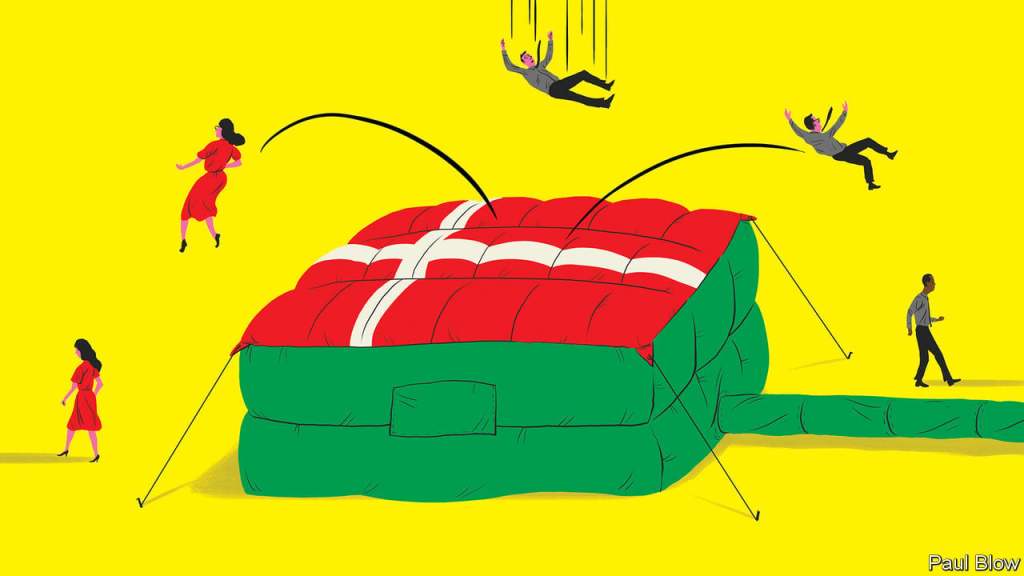
A central focus is the anomalous continuing political success of Denmark’s Social Democratic Party. Leonhardt writes,
Since the Social Democrats took power in 2019, they have compiled a record that resembles the wish list of a liberal American think tank. They changed pension rules to enable blue-collar workers to retire earlier than professionals. On housing, the party fought speculation by the private-equity industry by enacting the so-called Blackstone law, a reference to the giant New York-based firm that had bought beloved Copenhagen apartment buildings; the law restricts landlords from raising rents for five years after buying a property. To fight climate change, [Prime Minister] Frederiksen’s government created the world’s first carbon tax on livestockand passed a law that requires 15 percent of farmland to become natural habitat. On reproductive rights, Denmark last year expanded access to abortionthrough the first 18 weeks of pregnancy, up from 12 weeks, and allowed girls starting at age 15 to get an abortion without parental consent.
All the while, the country continues to provide its famous welfare state, which includes free education through college (including a monthly stipend of about $900 for living expenses), free medical care and substantial unemployment insurance, while nonetheless being home to globally competitive companies like Novo Nordisk, the maker of the anti-obesity drug Ozempic. In 2022, Frederiksen won a second term, defying the anti-incumbent mood that has ousted incumbent parties elsewhere since the Covid pandemic. As part of her success, she has marginalized the far right in her country.
But there is one issue on which Frederiksen and her party take a very different approach from most of the global left: immigration. Nearly a decade ago, after a surge in migration caused by wars in Libya and Syria, she and her allies changed the Social Democrats’ position to be much more restrictive. They called for lower levels of immigration, more aggressive efforts to integrate immigrants and the rapid deportation of people who enter illegally. While in power, the party has enacted these policies. Denmark continues to admit immigrants, and its population grows more diverse every year. But the changes are happening more slowly than elsewhere. …
Leftist politics depend on collective solutions in which voters feel part of a shared community or nation, [the prime minister] explained. Otherwise, they will not accept the high taxes that pay for a strong welfare state. “Being a traditional Social Democratic thinker means you cannot allow everyone who wants to join your society to come,” Frederiksen says. Otherwise, “it’s impossible to have a sustainable society, especially if you are a welfare society, as we are.” High levels of immigration can undermine this cohesion, she says, while imposing burdens on the working class that more affluent voters largely escape, such as strained benefit programs, crowded schools and increased competition for housing and blue-collar jobs. Working-class families know this from experience. Affluent leftists pretend otherwise and then lecture less privileged voters about their supposed intolerance.
“There is a price to pay when too many people enter your society,” Frederiksen told me. “Those who pay the highest price of this, it’s the working class or lower class in the society. It is not — let me be totally direct — it’s not the rich people. It is not those of us with good salaries, good jobs.” She kept coming back to the idea that the Social Democrats did not change their position for tactical reasons; they did so on principle. They believe that high immigration helps cause economic inequality and that progressives should care above all about improving life for the most vulnerable members of their own society. The party’s position on migration “is not an outlier,” she told me. “It is something we do because we actually believe in it.”
In this video, the two talking heads cover a whole lot of ground. I mostly agree with them. If you don’t, then God bless, and have a nice day.
Toward the end, they turn to trying to suss out what’s going on in Trump’s brain. I particularly commend that part of the video.
In case you don’t know:
Rick Wilson is a former Republican and former Republican political consultant. He currently writes political opinion pieces and is a political talking head on YouTube and elsewhere. He has written two books, including Everything Trump Touches Dies.
During the video Wilson refers, at one point, to his “misspent youth.” He may be thinking about the time he created the ad that defeated Max Cleland—a war hero paralyzed by his wounds—by implying that Cleland supported Al-Qaida.
Will Saletan has been writing on public affairs since 1996. He has also written two books. Sometimes he’s right, and sometimes he’s not. In 2003 he wrote a book arguing that conservatives had won the public debate about abortion rights. Well, if they had won it in 2003, they have lost it now; look at the headlines out of Missouri today. In 2023, he wrote The Corruption of Lindsey Graham: A case study in the rise of authoritarianism.






 Facing MAGA