Jeff Bezos Tells the Washington Post to Tell All You Idiots Out There That DOGE is Doing Some Great Stuff

Jeff Bezos’s Washington Post, Turmoil within DOGE spills into public view as Musk’s group confronts a PR crisis

The Post’s headline writer has ill served Bezos, and I assume that said headline writer will soon be canned. A much more accurate heading would be the article’s subheading, to wit, “Elon Musk’s DOGE is hunting for “wins” as it races to finish slashing the federal bureaucracy and move on to the more constructive work of building digital tools for the government.”

The gravamen of this is that Elon’s team is about to do great things by replacing outdated government software and replacing human beings with AI chatbots. 

Oh frabjous day!

Meanwhile, the Indispensable Ed Luce of the Financial Times of London speaks of “Elon Musk’s Self-Destruction”

Luce writes,

When Elon Musk said he loved Donald Trump “as much as a straight man can love another”, the emetic effect was widespread. Trump is one of the few people left in Washington DC who likes having Musk around. Yet having given Musk more power than any private figure in US history, the president is watching his benefactor turn into an albatross. The question is how Trump will get rid of Musk, not whether. 

The price of having him as co-helmsman is already steep. The New York Times chronicled how Trump clipped Musk’s wings in a heated cabinet meeting last week. Cabinet heads, rather than Musk’s so-called Department of Government Efficiency, would take care of their own hiring and firing, Trump said. His White House had until then been notably leak free — in contrast to his first term. But it appears senior staff are keen to see the back of the chainsaw-wielding oligarch. The showdown had been set up with the aim of hastening that day. 

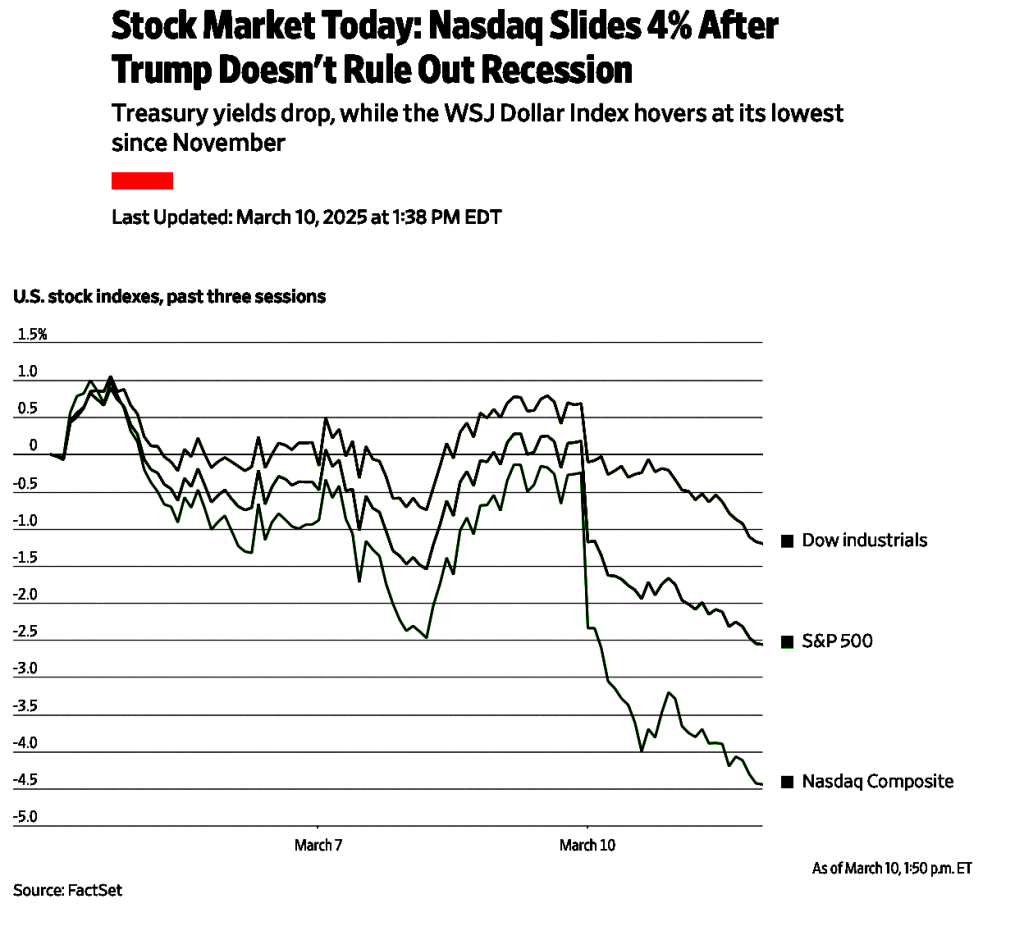
A measure of Musk’s worry about his waning star is that his visit to Mar-a-Lago last weekend was not originally scheduled, say insiders. Moreover, Musk has tried to funnel millions more into Trump’s political action committees and been turned down. Trump is not known to refuse money. But it would look like Musk was buying his prolonged stay. His standing is dropping as fast as Tesla’s stock price. Trump’s approval rating has remained steady. With signs of a coming “Trump recession”, Musk may still be a useful lightning rod.

But that is the extent of his upside. His sway is mostly negative. There is not a Republican legislator or Trump principal who is not terrified of Musk’s power. A $50mn cheque to fund a primary challenge could end a senator’s career — $10mn for a legislator. Musk’s X, which is Maga’s informal state broadcast arm, could also destroy a cabinet member’s career. Officials now routinely issue press releases first on X. The secretary of state, Marco Rubio, first announced plans to pare back USAID on X. 

There appears to be nothing Musk will not say to defame those in his way. This has been apparent since he accused a beleaguered caver of being a paedophile a few years ago. Musk is only acting more like himself. But his willingness to character assassinate is interfering with Rubio’s job. Musk recently threatened to trigger a collapse in Ukraine’s frontline by pulling his Starlink satellite service. After Poland’s foreign minister, Radosław Sikorski, objected, Musk posted: “Be quiet, small man . . . There is no substitute for Starlink.” Poland is one of the few European countries Trump has said he would aid in the event of an attack. An impotent Rubio felt obliged to back up Musk.   

But the cost of keeping him by Trump’s side is growing. In ignorance of how the federal government works, Musk is only causing damage. This also undercuts Russell Vought, head of the White House Office of Management and Budget, who has spent years drawing up plans to deconstruct the administrative state. He was co-author of Project 2025, the Heritage Foundation’s radical blueprint for a second Trump term. The traumatising of America’s civil service will outlast Musk. But Vought is likely to do it less incompetently. Nor does he share Musk’s seeming reluctance to go after the Pentagon, which is a major source of Musk’s federal contracts.

It is tempting to think Musk has a political death wish. The recent drop in the wannabe trillionaire’s net worth has also almost wiped out his post-election gains. But that would be naive. Doge’s access to taxpayer accounts, social security records and federal employee data would offer a gold mine for any AI titan. Musk’s temptation to hoover it up for his own ends will be great. But that means retaining Trump’s trust. If Musk has any self-knowledge, he will wear suits from now on and keep his offspring out of the Oval Office. After he took his four-year-old son, X, to the White House last month, insiders say Trump asked for the HMS Resolute desk to be disinfected. The boy felt just as at home as his father.

There is also Musk’s impact on Trump’s China policy. As clients in the US, Europe and elsewhere spurn Tesla and search for alternatives to SpaceX, Musk’s commercial reliance on China is growing. Musk’s dovish influence on China policy is plain. Trump now sounds almost as uninterested in Taiwan’s fate as he is in Ukraine’s. Most of the rest of his team are China hawks. If and when Trump turns against China, that will be another sign of Musk’s descent. 

“In the first Trump term, it took a disease to destroy the economy. This time, he’s the disease.”

As of around 11:00 AM World Time this morning:

The Business Roundtable has about 200 members—all chief executive officers of the largest corporations in America. Trump will be meeting with them later today. 

Some politicians want to distribute income upward—in other words, screwing the poor to make the rich richer.

Some politicians want to be Robin Hood—robbing the rich to help the poor.

Trump wants to screw the poor, screw the middle, and screw the rich, all at the same time.

MAGA is About to Have an Epiphany: That Jesus Wants J.D. Vance to be President—and That Right Soon

Today, Trump said that his tariffs could lead to inflation—and maybe a recession. 

He’s screwing his rich supporters, with trade wars, demolished supply chains, worthless investments due to demolished supply chains, dysfunctional government services, tanked stock portfolios, and really rotten consumer sentiment.

He’s screwing his poor idiot supporters with high inflation. Mamma’s gonna have problems getting her Social Security money. Grandma’s gonna lose her Medicaid, that pays for her nursing home. And veterans can kiss their health care goodbye.

Jesus is definitely not happy about all of this. 

It’s just about time for God to anoint J.D. Vance as our next President.

Probably to ascend to the kingship sometime around mid-April.

It’s the Distributive Bargaining, Stupid

One Side is Flipping a Coin, the Other is Playing Advanced Chess

Daily Kos, Negotiations Expert Explains Why Trump Fails To Get Deals Done

A Daily Kos community member writes,

One of the nation’s leading experts on the subject of negotiations is David Honig of Indiana University. He teaches both Fortune 500 company executives and heads of state on how to negotiate. Here’s his take on what he’s observed about Donald Trump’s style at the bargaining table…

“I’m going to get a little wonky and write about Donald Trump and negotiations. For those who don’t know, I’m an adjunct professor at Indiana University – Robert H. McKinney School of Law and I teach negotiations. Okay, here goes.

Trump, as most of us know, is the credited author of “The Art of the Deal,” a book that was actually ghost written by a man named Tony Schwartz, who was given access to Trump and wrote based upon his observations. If you’ve read The Art of the Deal, or if you’ve followed Trump lately, you’ll know, even if you didn’t know the label, that he sees all dealmaking as what we call “distributive bargaining.”

Distributive bargaining always has a winner and a loser. It happens when there is a fixed quantity of something and two sides are fighting over how it gets distributed. Think of it as a pie and you’re fighting over who gets how many pieces. In Trump’s world, the bargaining was for a building, or for construction work, or subcontractors. He perceives a successful bargain as one in which there is a winner and a loser, so if he pays less than the seller wants, he wins. The more he saves the more he wins.

The other type of bargaining is called integrative bargaining. In integrative bargaining the two sides don’t have a complete conflict of interest, and it is possible to reach mutually beneficial agreements. Think of it, not a single pie to be divided by two hungry people, but as a baker and a caterer negotiating over how many pies will be baked at what prices, and the nature of their ongoing relationship after this one gig is over.

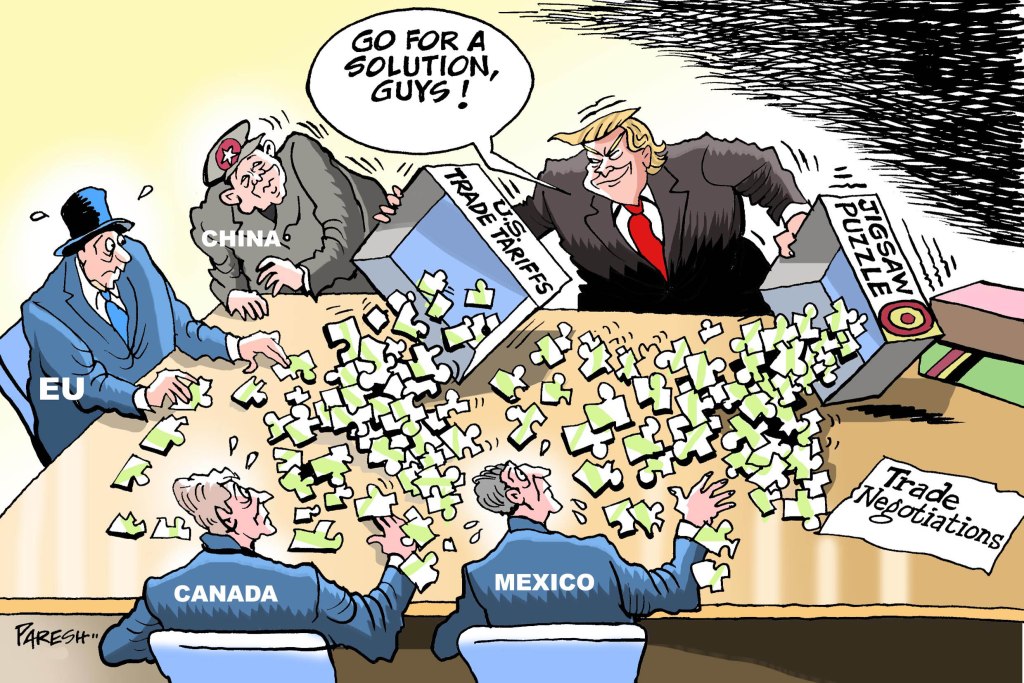
The problem with Trump is that he sees only distributive bargaining in an international world that requires integrative bargaining. He can raise tariffs, but so can other countries. He can’t demand they not respond. There is no defined end to the negotiation and there is no simple winner and loser. There are always more pies to be baked. Further, negotiations aren’t binary. China’s choices aren’t (a) buy soybeans from US farmers, or (b) don’t buy soybeans. They can also (c) buy soybeans from Russia, or Argentina, or Brazil, or Canada, etc. That completely strips the distributive bargainer of his power to win or lose, to control the negotiation.

One of the risks of distributive bargaining is bad will. In a one-time distributive bargain, e.g. negotiating with the cabinet maker in your casino about whether you’re going to pay his whole bill or demand a discount, you don’t have to worry about your ongoing credibility or the next deal. If you do that to the cabinet maker, you can bet he won’t agree to do the cabinets in your next casino, and you’re going to have to find another cabinet maker.

There isn’t another Canada.

So when you approach international negotiation, in a world as complex as ours, with integrated economies and multiple buyers and sellers, you simply must approach them through integrative bargaining. If you attempt distributive bargaining, success is  impossible. And we see that already.

Trump has raised tariffs on China. China responded, in addition to raising tariffs on US goods, by dropping all its soybean orders from the US and buying them from Russia. The effect is not only to cause tremendous harm to US farmers, but also to increase Russian revenue, making Russia less susceptible to sanctions and boycotts, increasing its economic and political power in the world, and reducing ours. Trump saw steel and aluminum and thought it would be an easy win, BECAUSE HE SAW ONLY STEEL AND ALUMINUM – HE SEES EVERY NEGOTIATION AS DISTRIBUTIVE. China saw it as integrative, and integrated Russia and its soybean purchase orders into a far more complex negotiation ecosystem.

Trump has the same weakness politically. For every winner there must be a loser. And that’s just not how politics works, not over the long run.

For people who study negotiations, this is incredibly basic stuff, negotiations 101, definitions you learn before you even start talking about styles and tactics. And here’s another huge problem for us.

Trump is utterly convinced that his experience in a closely held real estate company has prepared him to run a nation, and therefore he rejects the advice of people who spent entire careers studying the nuances of international negotiations and diplomacy. But the leaders on the other side of the table have not eschewed expertise, they have embraced it. And that means they look at Trump and, given his very limited tool chest and his blindly distributive understanding of negotiation, they know exactly what he is going to do and exactly how to respond to it.

From a professional negotiation point of view, Trump isn’t even bringing checkers to a chess match. He’s bringing a quarter that he insists of flipping for heads or tails, while everybody else is studying the chess board to decide whether its better to open with Najdorf or Grünfeld.”

— David Honig

They Sowed the Wind, They Have Inherited the Whirlwind

This is the Week When They’re Admitting that if You Elect an Actual Crazy Person, You Will Get Literally Crazy Government—and That the Crazy Person’s Supporters Will Get Exactly What They Deserve

Michelle Goldberg (N.Y. Times), The Right’s Trump Derangement Syndrome

Axios, Trump’s rug-pull presidency

Mike Allen of Axios writes this morning, 

Donald Trump is building a reputation for himself as the flip-flopper in chief — the president who, after announcing a bold new policy today, is more than likely to reverse it tomorrow.

Why it matters: In a chaotic and unpredictable world, the federal government normally acts as a stabilizing force. Under Trump, it has become the primary driver of the chaos.

The big picture: Across-the-board tariffs on Mexico and Canada — two of America’s three largest trading partners — have been on and then off and then on and then off. Colombia knowsthe feeling. 

For the record: “This is the art of the deal,” a White House spokesman tells Axios about the tariff reversals, adding that the General Services Administration and individual agencies, rather than Trump himself, are responsible for other executive-branch actions.

Flashback: In a matter of days, Trump denounced Ukrainian President Volodymyr Zelensky, then made up and invited him to Washington, then chastised him in the Oval Office, then expressed openness to rebuilding ties, then cut off arms and intelligence sharing.

Zoom in: Republicans in Congress have repeatedly found themselves boxed in by Trump’s flip-flops.

  • He spent weeks equivocating on whether Congress should pass his agenda in one bill or two — then blindsided the Senate by backing House Republicans’ one-bill approach.
  • He promised not to cut Medicaid, then backed a House GOP budget plan that could force exactly that in order to meet its proposed spending cuts.
  • He has vowed to achieve the unthinkable by balancing the budget — while endorsing trillions of dollars in tax cuts, plus new campaign promises like no tax on tips or overtime.

Follow the money: The stock market, for one, is tiring of such shenanigans. On Wednesday, stocks fell on news that tariffs were being imposed — and then on Thursday, when those tariffs were suspended, stocks fell again.

  • Foreign investors like French energy company Engie are on the record as saying that they need clarity and predictability in order to invest in the U.S. — something that’s clearly missing at the moment.
  • “I’m not even looking at the market,” Trump told reporters in the Oval Office Thursday, disavowing his longtime favorite metric for economic success.

Zoom out: In crypto, a rug-pull is any project that’s announced and then abandoned — often at great expense to anybody who believed the initial announcement. 

Between the lines: Elon Musk — who may or may not be the head of DOGE, depending on who you ask — is at least partially responsible for the administration’s “move fast and break things” ethos.

  • “We will make mistakes. We won’t be perfect. But when we make a mistake, we’ll fix it very quickly,” Musk said in a Cabinet meeting last week, pointing to the reversed cancellation of Ebola funding.
  • DOGE has made plenty of mistakes, but has not always been transparent about fixing them — quietly pulling down billions of dollars from its online “wall of receipts” on multiple occasions.

The bottom line: This is just exhausting.

Today’s Supreme Court Decision in Department of State v. Aids Vaccine Advocacy Coalition

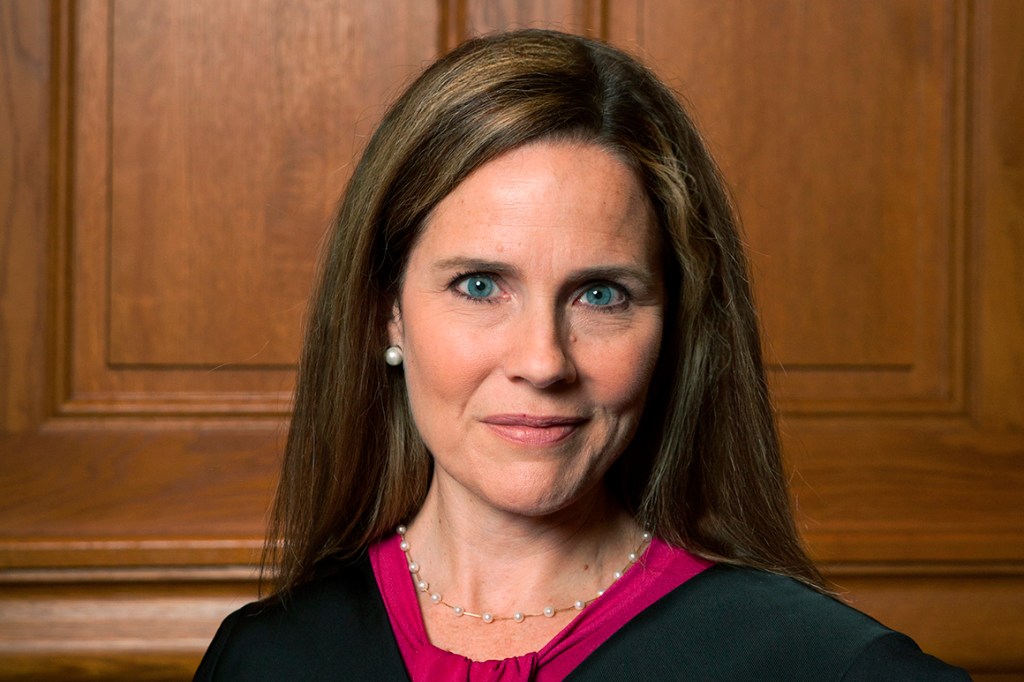
This image provided by Rachel Malehorn shows Judge Amy Coney Barrett in Milwaukee, on Aug. 24, 2018. (Rachel Malehorn, rachelmalehorn.smugmug.com, via AP)

Washington Post, Supreme Court says judge can force Trump administration to pay foreign aid

SCOTUSblog, Supreme Court denies Trump request to block $2 billion foreign-aid payment

If you want to dig in the weeds, please do so; the two sources above, along with many others, will help.

Big picture: the issue presented by the case is whether it is A-OK for Trump to spit on the Constitution by exercising kingly power to destroy a federal agency created and funded by Congress—particularly in a situation where the destruction of said agency will lead to unimaginable loss of life. 

In a dissenting opinion written by Justice Alito—who has been drinking a whole lot of Kool-Aid lately—and joined by Justices Thomas, Gorsuch, and Kavanaugh, the four justices seemed to take it as self-evident that Trump need not obey the Constitution and that it was a grievous act of “judicial hubris” for a lowly federal district judge to think that Trump has any obligation to the Constitution. 

But one of the three Trump-appointed justices, Amy Coney Barrett, has been tapering off the Kool-Aid lately. She joined with Justice Roberts and with the three liberals in a short, unsigned opinion, indicating that the lowly federal district judge in question could bloody well go right ahead and order Trump to pay up. (That is, it’s OK for the judge to order Trump to pay pending a final resolution of the case.)

If you read the opinion—and I hope you do—you will see that I have oversimplified. You will see that this onion has a lot of layers. But I do not think I have oversimplified in a misleading way. And my guess is that it’s going to be Constitution, 5, Dictatorship, 4, from here on.

I did say “guess.” There is a difference, you know, between a guess and a prediction.

And, by the way, as Trump becomes increasingly unpopular, I would’nt be shocked if we peel off Kavanaugh.