Chrystia Freeland—whom I mentioned in the immediately preceding post—has a long thumb sucker in the New York Times titled “Welcome Back, America! It’s Your Turn to Be Sorry.” It’s worth a read.
Meanwhile, the New York Times sucks its thumb at length over poor, poor, poor J.D. Vance (“Trump Grows Frustrated With Vance Over Iran War Critique”).
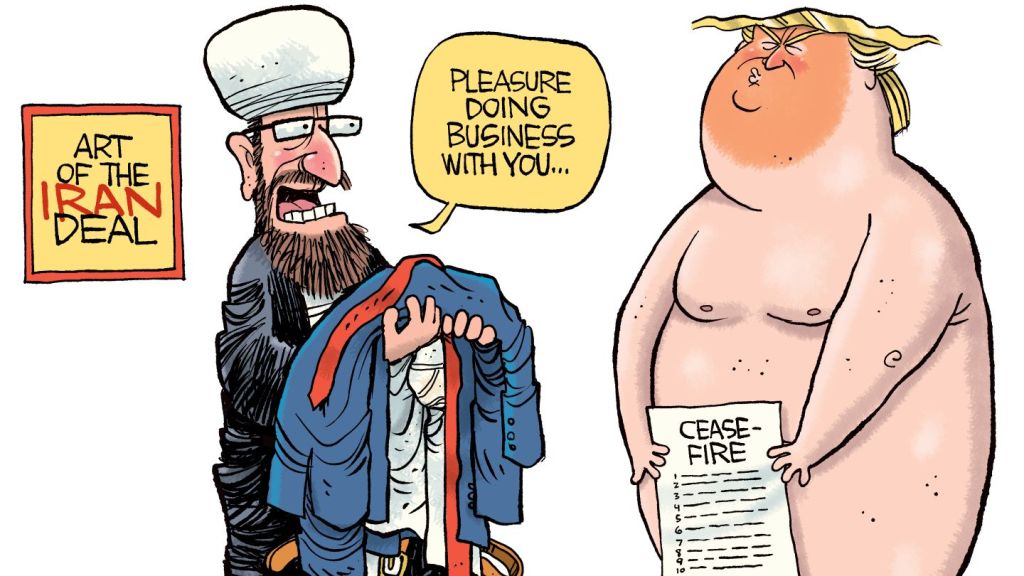
One never knows for sure what Mango Mussolini is actually thinking. But the most reasonable interpretation, IMHO, is that deep down in that pea sized reptilian brain, Trump knows that the Iran war is lot, that it cannot be ended except by surrender, but that his vanity would be severely hurt if he’s the one to do the surrendering, so he’s going to try to wait the thing out, let the next Democratic President do the surrendering, so that Mango Mussolini can then scream like a stuck pig.
J.D. Vance is a chameleon and a shape shifter. Hey J.D., here’s some advice from an ill wisher: it’s high time—indeed past high time—for you to shift your shape once again. If you want a political future, make a break with Dimwit Don, resign the vice presidency, and lead the parade to end the war. Ending the war is the one thing that most Americans agree on. It might just be your ticked into the Oval Office, where you can sit irresolutely at the Resolute Desk.
And meanwhile, Tom Friedman has returned from the Middle East and tells us all about his trip in a N.Y. Times artice, “Shock and Dread in the Gulf.” Friedman writes in part,
I’ve just spent several days talking to Arab, Iranian, Israeli, American and European analysts and diplomats attending the Sir Bani Yas regional conference in Abu Dhabi, overlooking the Persian Gulf. The mood was something I’d never encountered here before. Not shock and awe, but shock and dread.
The dread comes from the dawning awareness that this latest war with Iran, started by America and Israel, is going to end with Iran more dominant than ever over its neighbors. The Gulf Arabs never urged the United States to start this war, but once it did, they assumed it had a plan to finish it. They assumed the Americans understood that the only government they ever toppled primarily with air power was Japan’s — and that took two nuclear bombs. So, there is a gnawing feeling that the United States and Israel started something that they either don’t know how to finish or no longer want to pay the price to finish — and that Iran’s Arab neighbors will be paying instead, for an Iran that will be emboldened by being able to say it fought the “Great Satan” — America — and the “Little Satan” — Israel — to a draw.
The prevailing sentiment was most pointedly conveyed to me by an Eastern European diplomat at the conference, citing an aphorism from Cold War days: “The trouble with being an ally of the United States is that you never know when it will turn around and stab itself in the back.”
f I had a dollar for every person who asked me on this trip questions like “What is the Trump administration’s policy on Iran?” “Who’s in charge of their policy?” and “What’s going to happen to American policy once the Democrats control Congress?” I probably could have paid for my ticket home — business class. People are worried. They can connect the dots here, and they all seem to lead to a future living under an emboldened Iran’s shadow.
Here’s my reporter’s notebook of the conversations that struck me the most.
The Biggest Thing I Learned
President Trump clearly wants to tell the American people that the war is basically over, that the United States is getting all the oil tankers it wants out of the Strait of Hormuz and onto the high seas and that we can just sit back, pop popcorn and wait until our Navy’s economic blockade around Iran chokes the regime into saying uncle and submitting to our terms for a permanent cease-fire.
Alas, that is not how it looks from here. …
Tehran’s strategy seems to be to force Trump to choose which poison he wants to drink: accept a lousy, face-saving deal in which Tehran is given long-term security guarantees — and a lifting of sanctions — in return for reopening the Strait of Hormuz and some vague promise on denuclearization, or restart the war (the unpopularity of which partly cost Trump’s party the midterm elections), surely sending the price of oil soaring anew and digging his hole with the American people deeper. …