Susman Godfrey is possibly the best litigation law firm in the country. And they are being punished for successfully holding Fox News to account for its election lies.
If anybody can make Trump eat shit, these are the folks to do the job.
We shall see what we shall see. In the meantime, the firm had this to say:
In response to the executive order filed by the administration on April 9th, 2025, Susman Godfrey has issued the following statement:
“Anyone who knows Susman Godfrey knows we believe in the rule of law, and we take seriously our duty to uphold it. This principle guides us now. There is no question that we will fight this unconstitutional order.”
A point of personal privilege: I was among the late Steve Susman’s ten thousand closest friends. (Actually, it could have been more than ten thousand; I don’t rightly know.) And I am damn proud of it, too.
From wherever he is in the bardo, Steve is urging his living partners to hang in—and whispering litigation tricks into their shelflike ears.
Ed Luce of the Financial Times, acute student of America, and sometime guest on Morning Joe, writes today’s thought piece (particularly choice passages underlined):
We should trust in Donald Trump’s instincts, says Mike Johnson, Speaker of the House of Representatives. Alternatively, Johnson and his caucus should run screaming in the opposite direction. It is too late for Republicans to revert to being a normal party — belief in Trump is their organising principle. But they could play the loyalist by coaxing Trump off the ledge. In addition to their jobs, the future of the global economy, and every American’s retirement fund, depends on it.
Their task is complicated by the fact that Trump still thinks he is on to a winner. Try to stand in his shoes. From his 2011 Obama foreign birth conspiracy to his 2024 conviction as a felon, and so many points in between, Trump has almost annually been left for dead. But his phoenix keeps rising. Trump is a fantasist whose deepest-lodged fantasy — that he is an unstoppable champion — keeps coming true. Why would a little market turmoil stop him?
The starting point is that Trump is a hammer and the rest of the world, as well as half of America, is a nail. Sometimes the hammer can focus on select nails, or soften its blow, but he is always a hammer. That some of Trump’s closest backers, such as the New York hedge fund manager Bill Ackman, are surprised by his global tariff war is a mystery. Trump vowed in almost every single campaign speech to unleash the trade war we are now in.
He has been blaming foreigners for ripping off America since the mid-1980s. Note, his obsession was with Japan, not the Soviet Union. Trump has always been angriest with allies and friends. His deepest contempt is now reserved for Europe and Canada. Psychologists extrapolate from the estate settlement Trump tried to impose on his own siblings. If your instinct is to rip people off, including those closest to you, assume that is everyone’s method.
The mystery is why so many — from Ackman’s fellow billionaires to Florida-based Venezuelans — have bent over backwards to miss who Trump is. A trillion comments have been wasted accusing the wrong people of Trump derangement syndrome. The real TDS afflicts those who keep seeing a rational actor, or an economic chess game, where none exists. The whole market arguably suffers from this syndrome. Shortly after plummeting on Monday morning, a fake news release surfaced that said Trump would announce a pause on his tariffs this week. The markets more than erased their opening losses. All those gains, in turn, were wiped out when the White House issued a denial.
If an online meme can turn a bear market into a bull recovery in the space of a minute, and back again, Trump has the world in his palm. The merest rumour that he might be sane can trigger a buying frenzy. Roman emperors would envy the finger-crooking sway of one man. Yet at some point, possibly imminent, Trump could be forced to pause at least some of his “liberation day” duties. That will trigger a big relief rally. But his pause will be no surer than stray driftwood. The same might apply to his threats of a new 50 per cent tariff escalation on China.
Markets will cheer any hints of bilateral deals Trump plans to strike with more influential demandeurs — Japan, China and India should be closely watched. Investors should also pay heed to the fact that such deals will be struck between foreign governments and Trump personally, not his administration. The departments of Treasury, commerce and the US trade representatives are often out of the loop. Given the lack of boundary between Trump’s public role and private investments, the scope for non-trade-related bartering is great.
The idea that Trump’s impact will be limited to the goods-traded economy is also wishful thinking. Foreigners own a critical share of US Treasury debt. Continued high demand for an asset in whose issuer the world is losing trust is the difference between a Trump recession and a Trump depression. On this, Europe’s governments seem to have better instincts than the equity and fixed-income markets. Rather than escalate the trade war, the EU is mulling only a modest toolkit of retaliations. This is not because Brussels thinks Trump is likely to embrace comity. It is because it fears a tit-for-tat trade spiral will break the global financial system.
Either way, this teachable moment is needlessly belated. Trump’s sane-washers have forfeited their credibility. There is no school of foreign policy realism, or trade mercantilism, that could explain Trump’s actions. If you want to forecast the world, study his psychology. While Trump is in charge, stay short on America.
This follows up on my post yesterday. I have a few more points about this interesting development.
The Federalist Society Angle
Trump 1.0 saw the appointment of around 250 federal judges. Most were vetted and approved by the Federalist Society. One of the guiding lights of the Federalist Society was and is Leonard Leo, who is also one of the instigators of the litigation under discussion here—litigation premised on the claim that Trump acted lawlessly in imposing his Liberation Day tariffs, the centerpiece of his administration’s economic policy.
The Merits of the Case
Who’s right on the merits may bear some tangential relevance to who is likely actually to win the case.
The central issue is this: Trump relied on the International Emergency Economic Powers Act in decreeing his Liberation Day tariffs. But that act don’t say nothing about no tariffs. Trump was obviously trying to do an end run around a number of other statutes and regulations that do address the imposition of tariffs. So, says the plaintiff, along with Messrs. Koch and Leo, Trump acted lawlessly–outside the scope of his lawful powers.
That central issue raises, in turn, a host of other legal issues, and I am not an expert on any of them. The Forbes article quotes some people who are actually qualified to speak, who say that the case appears to have merit. And that is my untutored view as well.
How Long Will It Take to Decide the Case?
Plaintiff has not as of yet, and may not, ask for either a temporary restraining order or a preliminary injunction. Plaintiff and her counsel may well think that asking for this preliminary relief could slow things down.
Moreover, the case appears to be almost purely about issues of law, not fact; there would seem to be little need for witness depositions or document review. It could go quickly, if the district court judge and the Eleventh Circuit Court of Appeals choose to move it along.
And why wouldn’t the lower courts move it along? Like everybody else, they’re watching as their stock market investments go glug, glug, glug, down the old shitter.
An “Exit Ramp” for Trump?
As the pressure on Trump grows, it’s possible—not likely, in my view, but remotely possible—that he might start looking for a way out of his decision to crash the world economic order. Should he want to take an exit ramp, a decision by the Supreme Court ordering him to drop his tariffs could do the trick.
The Incentive/Disincentive to “Onshore” Manufacturing
Finally, if there is any business, anywhere, that is seriously considering building manufacturing capacity in the United States, based on Trump’s Liberation Day tariffs, the pendency of this litigation gives them yet another reason to hesitate. As many have observed, you’re only going to spend the money to build a U.S. plant if you think the tariffs are going to last a long time. The lawsuit is yet one more reason, among many others, to question whether that’s a good bet.
To summarize: Trump has two alternative strategies. One is to “reshore” American manufacturing. But that would require, at a minimum, that investors believe that the draconian tariffs are going to last a long time. The other is to negotiate country-by-country deals resulting in more favorable terms for American exporters.
Each strategy is highly problematic in its own right.
But, in addition, the two strategies are mutually inconsistent.
The Journal knows a lot of the senior people in China. And it knows even more of the people who know the senior people in China. Long article. Deeply reported.
Bottom line (for me): China expected negotiations, beginning with Trump’s inauguration. China wanted negotiations. China got stiff-armed by the Trump Administration. Xi had no real option but the retaliate. The standoff with China is going to last a long time.
Helpful article. Poor headline. Poor, because the actual topic of the article is why a lot of countries are not immediately retaliating, but are instead about reaching out to Trump to try to negotiate.
There’s no paywall at Politico, so read it for yourself. My own take, for what it’s worth: Yeah, I get the “prisoner’s dilemma” issue. But I also suspect that a lot of foreign leaders are thinking that the tariffs are going to be so hard on American consumers and businesses of all sizes, and hence on Republican politicians, that, over the medium term, the tariffs are going to go away regardless of who does or does not negotiate.
Plus which: most foreign leaders actually studied economics back in college. So they know that imposing tit-for-tat tariffs harms their own economies.
Dean Chemerinsky is a distinguished constitutional scholar and dean of the law school at U.C. Berkeley. Prof. Summers is many things, including former Secretary of the Treasury and former president of Harvard University. Each of them bemoans the failure of many rich law firms, and many prestigious universities, to stand up to Trump.
And good for them. Let us all bemoan the cowardice.
And let the record reflect that I, Ronald W. Davis, who attended Princeton, Harvard, and Columbia, hereby bemoan Harvard’s and Columbia’s failure to stand firm. And I hereby celebrate the position of Princeton’s president. I hope and expect he and the university will continue to stand firm, and, if they do, when Annual Giving rolls around, I will do the right thing. As, I believe, will my fellow alumni.
At the same time, I suggest that we all spend about 2% of our time bemoaning this or that and the remaining 98% of our time in hard-headed analysis and strategizing. And, here in the real world—not the one we wish we lived in—I suggest that for most people, most of the time, the most salient questions are
Is the authoritarian project going to take root, in which case I and my organization had best accommodate to it?
Or is the authoritarian project going down the shitter, in which case I and my organization can just keep our heads down and wait it out?
To help answer those questions, you might want to look to the town halls, the election results on Tuesday, and the condition of the financial markets this afternoon.
Jonathan Chait used to write for New York magazine and how he’s with The Atlantic. In my opinion, he’s often very good. I think his piece from yesterday afternoon is outstanding. Like the chicken who crossed to the middle of the street, he truly lays it on the line:
All Donald Trump had to do was start telling people the economy was good now. Take over in the middle of an economic expansion and then, without changing the underlying trend line, convince the country that you created prosperity. That’s what he did when he won his first term, and it is what Democrats expected and feared he would do this time.
But Trump couldn’t do the easy and obvious thing, apparently because he did not view his first term as a success. He considered it a failure, and blamed the failure on the coterie of aides, bureaucrats, and congressional allies who talked him out of his instincts, or ignored them. The second term has been Full Trump, as even his most delusional or abusive whims are translated immediately into policy without regard to democratic norms, the law, the Constitution, public opinion, or the hand-wringing of his party.
That is why Trump’s second term poses a far more dire threat to the republic than his first did. But it is also why his second term is at risk of catastrophic failure. Nothing illustrates this more clearly than Trump’s insistence on sabotaging the U.S. economy by imposing massive tariffs.
This afternoon, in an event the administration hyped as “Liberation Day,” Trump unveiled his long-teased plan to impose reciprocal trade restrictions on every country that puts up barriers to American exports. Although at least some economists would defend some kinds of tariff policies—such as those targeted at egregious trade-violating countries, or those designed to protect a handful of strategic industries—Trump has careened into an across-the-board version that will do little but raise prices and invite reprisal against American exports. As an indication of the mad-king dynamic at play, the new plan imposes a 20 percent tariff on the European Union, partly in retaliation against the bloc’s value-added tax system—even though the VAT applies equally to imports and domestic goods and is therefore not a trade barrier at all. U.S. stocks, which have fallen for weeks in anticipation of the tariffs, plunged even more sharply after Trump’s announcement.
Trump would not be the first president to encounter economic turbulence. But he might become the first one to kill off a healthy economy through an almost universally foreseeable unforced error. The best explanation for why Trump is intent on imposing tariffs is that he genuinely believes they are a source of free money supplied by residents of foreign countries, and nobody can tell him otherwise. (Tariffs are taxes on imports, which economists agree are paid mostly by domestic consumers in the form of higher prices.)
He has compounded the unavoidable damage to business confidence of any large tariff scheme by floating his intention for months while waffling over the details, paralyzing business investment. Even taken on its own terms, a successful version of Trump’s plan would require wrenching dislocations in the global economy. The United States would need to create new industries to replace the imports it is walling off, and this investment would require businesses to believe not only that Trump won’t reverse himself but also that the tariffs he imposes are likely to stay in place after January 20, 2029.
If businesses don’t believe that Trump will stick with his tariffs, the investment required to spur a domestic industrial revival won’t materialize. But if they do believe him, the markets will crash, because Trump’s tariff scheme will, by the estimation of the economists that investors listen to, produce substantially lower growth.
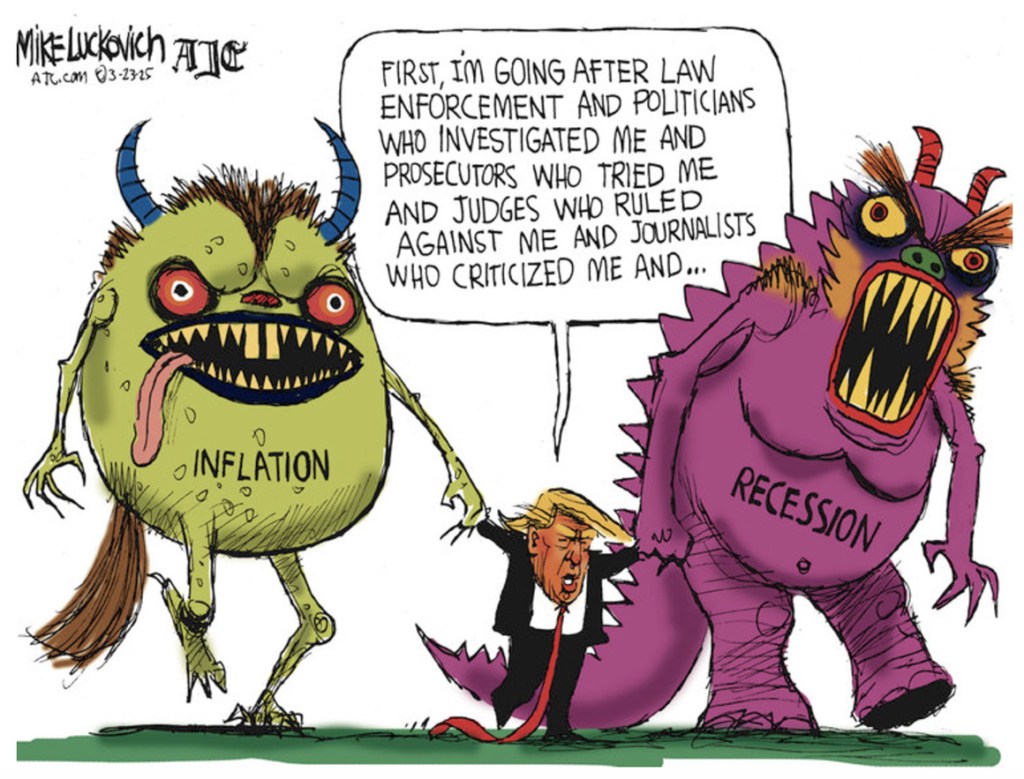
Probably the likeliest outcome is an in-between muddling through, with slower growth and higher inflation. Even Trump’s gestures toward sweeping tariffs have already made the economy wobble and lifted inflationary expectations. At this point, getting back to the steady growth and cooling inflation Trump inherited will require a great deal of luck.
Why didn’t anyone around Trump talk him out of this mistake? Because the second Trump administration has dedicated itself to filtering out the kinds of advisers who thwarted some of his most authoritarian first-term instincts, as well as his most economically dangerous ones. The current version of the national Republican Party, by contrast, is dedicated to the proposition recently articulated by one of Elon Musk’s baseball caps: Trump was right about everything.
In this atmosphere, questioning Trump’s instincts is seen as a form of disloyalty, and Trump has made painfully evident what awaits the disloyal. As The Washington Postreports, “Business leaders have been reluctant to publicly express concerns, say people familiar with discussions between the White House and leading companies, lest they lose their seats at the table or become a target for the president’s attacks.” Asked recently about the prospect of tariffs, House Speaker Mike Johnson revealingly said, “Look, you have to trust the president’s instincts on the economy”—a phrase containing the same kind of double meaning (have to) as Don Corleone’s offer he can’t refuse.
This dynamic allows Trump to do whatever he wants, no doubt to his delight. But the political consequences for his administration and his party could be ruinous. Public-opinion polling on Trump’s economic management, which has always been the floor that has held him up in the face of widespread public dislike for his character, has tumbled. This has happened without Americans feeling the full effects of his trade war. Once they start experiencing widespread higher prices and slower growth, the bottom could fall out.
A Fox News host recently lectured the audience that it should accept sacrifice for Trump’s tariffs just as the country would sacrifice to win a war. Hard-core Trump fanatics may subscribe to this reasoning, but the crucial bloc of persuadable voters who approved of Trump because they saw him as a business genius are unlikely to follow along. They don’t see a trade war as necessary. Two decades ago, public opinion was roughly balancedbetween seeing foreign trade as a threat and an opportunity. Today, more than four-fifths of Americans see foreign trade as an opportunity, against a mere 14 percent who see it, like Trump does, as a threat.
As the political scientists Steven Levitsky and Lucan Way point out, “Authoritarian leaders do the most damage when they enjoy broad public support.” Dictators such as Vladimir Putin and Hugo Chávez have shown that power grabs are easier to pull off when the public is behind your agenda. Trump’s support, however, is already teetering. The more unpopular he becomes, the less his allies and his targets believe he will keep his boot on the opposition’s neck forever, and the less likely they will be to comply with his demands.
The Republican Party’s descent into an authoritarian personality cult poses a mortal threat to American democracy. But it is also the thing that might save it.


 Facing MAGA