This morning, New York Times columnist Jamelle Bouie has four important points to make. I’ll summarize them and then let Mr. Bouie speak for himself.
1. In an alternative universe, in his second term, a politically skilled and disciplined Trump could probably have engineered a dictatorship in the United States.
2. But in this universe, Trump is “so solipsistic, so plainly consumed with narcissism, so deeply indifferent to the details of governance and so eager to satisfy his basest impulses that there was little chance he’d ever complete the authoritarian consolidation of his dreams.”
3. The second Trump term, we have “a presidency in terminal decline, if not outright collapse.”
4. If you don’t understand that “presidential commands are never self-executing,” then you don’t understand what the hell is going on.
Jamelle Bouie (N.Y. Times), Trump Is the Anti-Trump:
There is an alternate universe in which Donald Trump is the popular, successful president of his imagination.
In this world, Trump has a clear view of the political landscape. He knows he won a narrow victory, not a landslide. He knows that his key voters — the ones who put him over the top, as opposed to his core voters — elected him to lower the cost of living and turn the page back to where it was before the pandemic. And while he has the advantage of an unpopular predecessor — an easy repository for blame should things go wrong — he also starts the clock with a small and finite amount of political capital. The modern American public is wary, fickle and quick to anger. The right move is to invest that capital carefully, not gamble with the people’s trust.
This hypothetical President Trump would take the path of least political resistance. He would work with the Republican majority in Congress to send a new round of stimulus checks, rehashing the most important political success of his first term and fulfilling his promise to lower costs for most Americans. He would work with Congress to pass modest tariffs on critical goods and he would take a less draconian path on deportations, focusing, as he promised, on people in jails and prisons — “the worst of the worst.” And he would put hard political limits on his most fanatical aides and deputies, like Russell Vought and Stephen Miller. This Trump wouldn’t give Elon Musk his run of the executive branch and he would sideline his own desire for retribution against his political opponents, or at least channel his rage into something more productive. He would also decline to hand management of the federal government to an ignominious cadre of hacks, apparatchiks and television personalities.
In short, this Trump would rerun the approach of his first term. He would still be corrupt. He would still stretch the limits of common decency. He would still be bombastic, transgressive and contemptuous of political norms. But he would be restrained, somewhat, by the practical realities of governance. And this restraint would give our hypothetical Trump the leeway to pursue his more authoritarian goals; to curtail civil society and consolidate power over the entire federal government, courts and Congress included.
From the perspective of liberal society and constitutional government, this alternative world, in which a more cautious and methodical Trump successfully builds public and political support for the transformation of the United States into a full-throated authoritarian regime, would have been the worst-case scenario for a second Trump term.
We are lucky, then, that this alternate reality is unimaginable. There is no apparent evidence that Trump is capable of even the slightest bit of deferred gratification. If life is a series of marshmallow tests, then he has failed one after the other, kept afloat only by his immense wealth and privilege. The actual Trump is so solipsistic, so plainly consumed with narcissism, so deeply indifferent to the details of governance and so eager to satisfy his basest impulses that there was little chance he’d ever complete the authoritarian consolidation of his dreams.
All of this is simply to contrast what might have been with what plainly is: a presidency in terminal decline, if not outright collapse. Consider the big picture. Trump is nearly as unpopular now as he has ever been. His average approval ranges from a net negative of about 13 points to a net negative rating of nearly 20 points. He is underwater on every issue of consequence. The Supreme Court nullified his signature economic program and his immigration enforcement actions are so toxic with voters that they’ve forced him to fire his head of Homeland Security, Kristi Noem. He has wrecked the coalition that brought him into office with major reversals among Latinos, young men and Black Americans, and he is treading water with his core supporters, white voters without college degrees.
Trump insists, of course, that he is as popular as ever, but even Republican lawmakers see the writing on the wall. There has been a historic number of retirements from Congress, led mostly by Republicans.
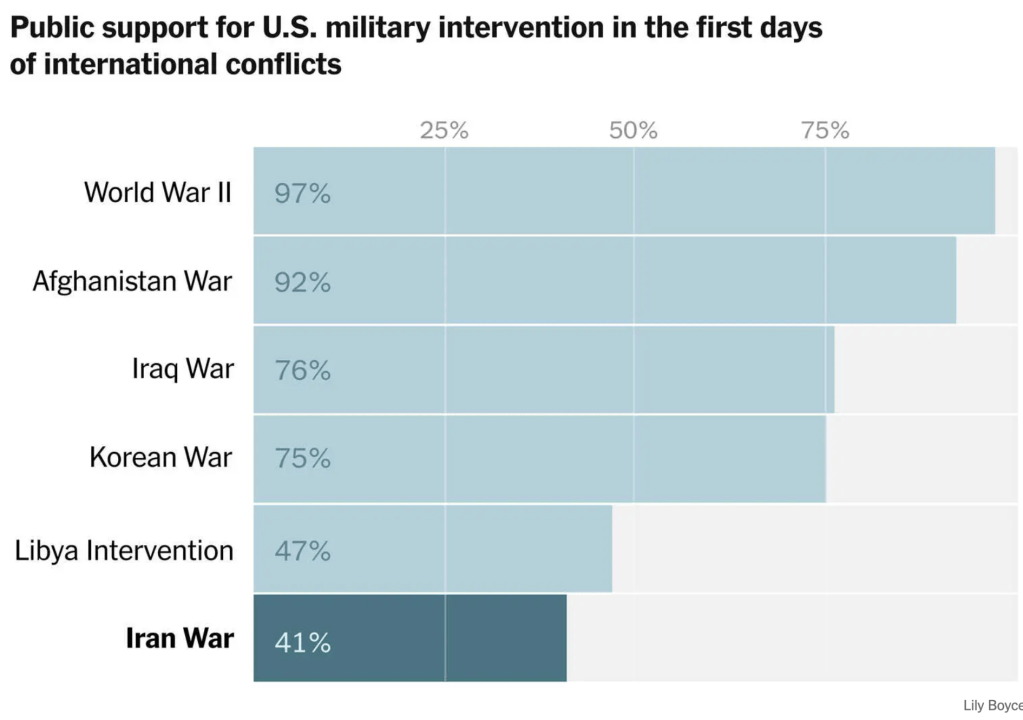
Last, but far from least, is the president’s foolhardy, reckless and immoral war in Iran, which was launched with neither public buy-in nor Congressional authorization. It didn’t take long after the bombing began before it destroyed an elementary school, killing more than 175 people, most of them children. Just two weeks in, the conflict has already grown beyond its initially limited scope, involving other belligerents and threatening the global economy. It is no surprise, then, that this is also the most unpopular war in modern American history, with few supporters beyond the president’s fellow partisans.
It is tempting to think that the president’s political collapse doesn’t really matter — that, as the Teflon Don, he suffers no particular consequences for his bad behavior. And it is true that the shamelessness, celebrity and cult of personality that defines Trump (and Trumpism) also works to buoy him in the face of political catastrophe. He might sink below water, but he’ll never go under. To end the story there, however, is to miss the larger relationship between presidential standing and presidential power.“Presidential commands are never self-executing,” the political scientist Jeffrey Tulis observes in his book “The Rhetorical Presidency,” paraphrasing another political scientist, Richard Neustadt. “Their efficacy depends upon artful wielding of informal power through bargaining — by showing other politicians that they will be helped, or at least not hurt, by doing what the president wants.”
The second Trump administration is defined by its total embrace of the “imperial presidency” and the “unitary executive.” But a key weakness of both concepts is that they treat presidential power as rigid, well-defined and highly formal — the “core duties” of Chief Justice John Roberts’s opinion in Trump v. United States.
The reality is more complicated. It may seem as if presidents have the power to command, to issue orders and see immediate results. But as Tulis reminds us, successful presidents do not order as much as they coax, cajole and persuade, for the straightforward reason that the formal authority of the presidency is limited compared with other actors in government. A skeptical lawmaker or recalcitrant bureaucrat can derail a presidential agenda and leave the chief executive at the mercy of an angry public. It’s for this reason that the most able men to hold the office of chief executive have rarely seen fit to act as tyrants, raining demands down onto the rest of the executive branch. They act instead as conveners, working to align different interests in pursuit of a single goal.
Presidential standing, in this paradigm, is the currency that makes presidential power work. A popular and well-liked president has more resources to deploy in pursuit of his agenda. He has the informal power he needs to bolster his more circumscribed formal authority. A distrusted, divisive and unpopular president, on the other hand, quickly finds that he is unable to work his will on political actors who are more worried about their own fates than the president’s interests and appetites.
And that is what we’ve seen with this president, a year after he gambled his political capital away in a disastrous attempt to reshape the nature of the American political system. His fast-eroding position has curtailed Trump’s ability to pressure lawmakers into backing his agenda: See the president’s empty demands for Congress to pass the SAVE America Act or the ongoing shutdown of the Department of Homeland Security. This rapid decline has also lowered the cost of institutional resistance to the administration’s attempts to curtail civil society and done the same for judicial opposition to the president’s most aggressive power grabs. I do not think it is an accident that the two most consequential rulings against Trump issued by this Supreme Court were decided as the president’s standing entered a tailspin.
You will notice that after months of teasing the possibility, Trump has mostly stopped talking about serving an unconstitutional third term. Perhaps he still intends to. Or perhaps he has enough self-awareness to know that he is not the triumphant leader of his imagination. That he is, instead, a lame duck whose White House is in disarray and whose actions have plunged the world into chaos. He thought he might remake the country in his own image. Instead, he’s likely to leave it like one of his casinos: broke, broken and in desperate need of new management.
If impeachment weren’t a dead letter, then we could remove him and end his misrule. As it is, we have nearly three more years to live through. It’s an open question whether we survive it intact.