Dr. Richardson is a prominent historian and professor at Boston College.
I think the whole video is worth watching, even if you are generally aware of what’s going on in this country. Some of the relevant points:
First Minute: HCR puts some of Trump’s outrageousness in historical context, in light of a Republican intellectual triumphalism—“We’re right and, guess what, you’re wrong!” We saw a lot of that beginning with Reagan’s election. I remember it well.
Third Minute: She doesn’t use the phrase, but others rightly call it “herrenvolk democracy”: any Democratic victory is inherently illegitimate.
Sixth Minute: A concerted effort to destroy rules-based order.
Eighth Minute: He thinks only people like himself should be in power.
Ninth Minute: He’s no compos mentis. It appears they’re giving him psychiatric drugs. It’s a behind-the-scenes effort to control him.
Eleventh Minute: No, J.D. Vance would not be worse.
Twelfth Minute: It’s extremely difficult to tell what’s happening in this Administration.
Fourteenth Minute: What appears to have just happened in Venezuela.
End of Seventeenth Minute: A work of genius by the Venezuelan regime and its allies.
As historians know, invasion of your country greatly helps to unify your people.
Nineteenth Minute: Trump’s oil fantasy.
Twenty-first Minute: Shrinkage from a global power to a regional power. Jettisoning the benefits of the rules-based international order.
Twenty-third Minute: Greenland.
Twenty-fourth Minute: A fundamental misunderstanding of the nature of American power.
Twenty-sixth Minute: Russia gets Ukraine, we get Venezuela. Sort of like the eve of World War I, but this time with nuclear weapons.
Twenty-seventh Minute: Oil is the technology of the past. The future lies in semi-conductors. We’re giving Xi permission to take over Taiwan—which makes 60% of the world’s semi-conductors. And Trump doesn’t understand this.
Twenty-eighth Minute: Destruction of the rules-based international order. A demented president, no longer operating in reality. Magical thinking is a hallmark of this moment.
Twenty-ninth Minute: Don’t follow grandpa down this road. Time to speak up.
President Donald Trump accused a group of Democratic lawmakers on Thursday of “seditious behavior” and called for their arrest for appearing in a video in which they reminded members of the U.S. military and intelligence community that they are obligated to refuse illegal orders.
“It’s called SEDITIOUS BEHAVIOR AT THE HIGHEST LEVEL,” Trump wrote on Truth Social. “Each one of these traitors to our Country should be ARRESTED AND PUT ON TRIAL. Their words cannot be allowed to stand.”
The video released Tuesday features a group of six Democrats who served in the military and intelligence community. Addressing active service members, they caution active-duty military members that “threats to our Constitution aren’t just coming from abroad, but from right here at home.”
“Our laws are clear,” Sen. Mark Kelly (Arizona), a Navy veteran, says in the video. “You can refuse illegal orders.”
“You must refuse illegal orders,” adds Rep. Chris Deluzio (Pennsylvania), who also served in the Navy.
The video does not specify particular orders that might be unlawful. But some of the lawmakers have relayed this week that they are hearing concerns from service members about the legality of strikes that have targeted people the Trump administration alleges are trafficking narcotics by sea.
The Pentagon did not respond Thursday morning to questions about the Pentagon’s post. Traditionally, the U.S. military adheres to the Uniform Code of Military Justice, which holds that service members must obey lawful orders, whether they agree with them or not. They are obligated to not follow “manifestly unlawful orders,” but such situations are rare and legally fraught. Members of the military take an oath to the Constitution, not the president.
The video, organized by Sen. Elissa Slotkin (Michigan) — who previously worked as a CIA analyst, also features Reps. Maggie Goodlander (New Hampshire), a former Navy reservist; Chrissy Houlahan (Pennsylvania), a former Air Force officer; and Jason Crow (Colorado), a former Army Ranger.
On his social media platform Thursday, Trump echoed other Republicans who have called for the Democrats to be removed from office, dishonorably discharged from the military and charged with treason — a crime punishable by death.
The stark punishment was not lost on Trump, who wrote in another post on Thursday: “SEDITIOUS BEHAVIOR, punishable by DEATH!”
He also reposted a post from a Truth Social user proclaiming: “HANG THEM GEORGE WASHINGTON WOULD !!”
The White House declined to comment on the record.
Democrats sharply criticized Trump’s threats.
“The administration should never try to force our servicemembers to carry out an illegal order,” Sen. Chris Coons (D-Delaware) said on social media. “Calling for the execution of senators and Congressmembers for reminding our troops of that is chilling behavior. Every one of my Republican colleagues needs to swiftly condemn this.”
Trump has repeatedly accused different groups and individuals of treason going back to his first presidential term, but has never followed through with prosecution, lobbing attacks on Black Lives Matter, the news media, former FBI director James B. Comey and former president Barack Obama with the claim.
Trump campaigned on prosecuting his political opponents and dispensing with the 50-year custom of insulating federal law enforcement from political influence. This year he has grown increasingly explicit in demanding specific investigations against people who have criticized him, leading directly to action by his appointees at the Justice Department.
In September, Trump pushed out a federal prosecutor in Virginia who declined to bring charges against New York Attorney General Letitia James (D) and replaced him with his own personal lawyer, Lindsey Halligan. Halligan then indicted James as well as Comey, whom Trump fired in 2017. On Wednesday, prosecutors acknowledged in court that a grand jury did not review the final indictment, a defect that Comey’s lawyers argued should cause the judge to dismiss the case.
The U.S. attorney in Miami is pursuing a broad probe against Obama administration officials, including former CIA director John Brennan and former director of National Intelligence James R. Clapper Jr. related to the investigation of Russian interference in the 2016 election. Trump officials have also initiated investigations at the president’s urging against Rep. Adam Schiff (D-California), who led the first impeachment inquiry against Trump in 2019, and Lisa Cook, a Federal Reserve governor he has sought to remove.
And on Friday, Trump directed the Justice Department to investigate prominent Democrats’ ties to Jeffrey Epstein, the wealthy sex offender who killed himself in jail in 2019. Bondi said she would proceed with that case, four months after saying the department’s review of the case found no information to pursue additional charges.
The Justice Department, Pentagon and the offices for Democratic lawmakers in the video did not immediately respond to requests for comment.
As far as I can tell, the headline is intended to be read in a straightforward way—“WHAT were Democrats thinking?”—not in a sarcastic tone of voice—“What were Democrats THINKING?”
In any event, as per usual, Ezra Klein has a dozen or so really interesting things to say—some of which might not have occurred to you and me—and it’s best to let him speak for himself.
But as a preamble, two brief comments from me. First, some of the eight senators who joined the Republicans are political heavyweights, and people not known for an inclination to wimp out. So, before your knee jerks and you hurl criticism at them for wimping out, please think twice.
Second, among the really interesting things one might say about this putrid mess, the most interesting, IMHO, is that Republicans are now set up to cast spectacularly unpopular votes to screw a large portion of the public on the health insurance costs.
Ezra Klein writes,
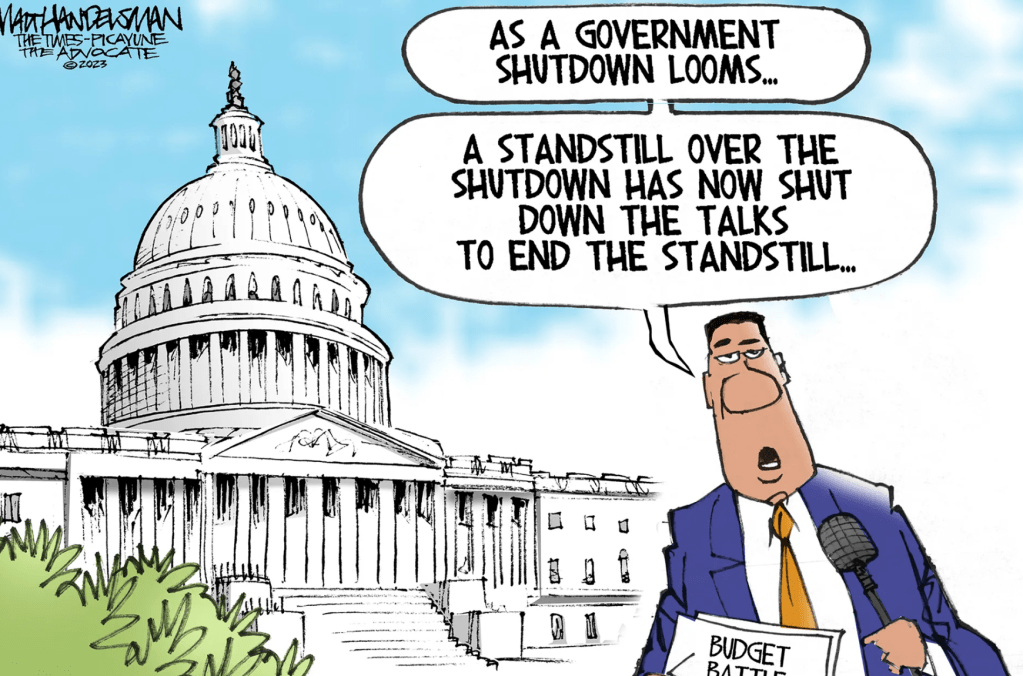
Back in September, when I was reporting an article on whether Democrats should shut down the government, I kept hearing the same warning from veterans of past shutdown fights: The president controls the bully pulpit. He controls, to some degree, which parts of the government stay open and which parts close. It is very, very hard for the opposition party to win a shutdown.
Which makes it all the more remarkable that Democrats were winning this one. Polls showed that most voters blamed Republicans, not Democrats, for the current shutdown — perhaps because President Trump was bulldozing the East Wing of the White House rather than negotiating to reopen the government. Trump’s approval rating has been falling — in CNN’s tracking poll, it dipped into the 30s for the first time since he took office again. And last week, Democrats wrecked Republicans in the elections and Trump blamed his party’s losses in part on the shutdown. Democrats were riding higher than they have been in months.
Then, over the weekend, a group of Senate Democrats broke ranks and negotiated a deal to end the shutdown in return for — if we’re being honest — very little.
The guts of the deal are this: Food assistance — both SNAP and WIC, I was told — will get a bit more funding, and there are a few other modest concessions on spending levels elsewhere in the government. Laid-off federal workers will be rehired and furloughed federal workers given back pay. Most of the government is funded only until the end of January. (So get ready: We could be doing this again in a few months.) Most gallingly, the deal does nothing to extend the expiring Affordable Care Act tax credits over which Democrats ostensibly shut down the government in the first place. All it offers is a promise from Republicans to hold a vote on the tax credits in the future. Of the dozen or so House and Senate Democrats I spoke to over the past 24 hours, every one expected that vote to fail.
To understand why the shutdown ended with such a whimper, you need to understand the strange role the A.C.A. subsidies played in it. Democrats said the shutdown was about the subsidies, but for most of them, it wasn’t. It was about Trump’s authoritarianism. It was about showing their base — and themselves — that they could fight back. It was about treating an abnormal political moment abnormally.
T he A.C.A. subsidies emerged as theshutdown demand because they could keep the caucus sufficiently united. They put Democrats on the right side of public opinion — even self-identified MAGA voters wanted the subsidies extended — and held the quivering Senate coalition together. You shut the government down with the Democratic caucus you have, not with the Democratic caucus you want.
The shutdown was built on a cracked foundation. There were Senate Democrats who didn’t want a shutdown at all. There were Senate Democrats who did want a shutdown but thought it strange to make their demand so narrow: Was winning on health care premiums really winning the right fight? Should Democrats really vote to fund a government turning toward authoritarianism so long as health insurance subsidies were preserved?
And what if winning on the health care fight was actually a political gift to Donald Trump? Absent a fix, the average health insurance premium for 20 million Americans will more than double. The premium shock will hit red states particularly hard. Tony Fabrizio, Trump’s longtime pollster, had released a survey of competitive House districts showing that letting the tax credits expire might be lethal to Republican efforts to hold the House. Why were Democrats fighting so hard to neutralize their best issue in 2026?
The political logic of the shutdown fight was inverted: If Democrats got the tax credits extended — if they “won” — they would be solving a huge electoral problem for Republicans. If Republicans successfully allowed the tax credits to expire — if they “won” — they would be handing Democrats a cudgel with which to beat them in the elections.
This is why Senator Chuck Schumer’s compromise, which offered to reopen the government if Republicans extended the tax credits for a year, struck many Democrats as misguided. Morally, it might be worth sacrificing an electoral edge to lower health insurance premiums. But a one-year extension solved the Republicans’ electoral problem without solving the policy problem. Why on earth would they do that?
In any case, Republicans were not interested in Schumer’s offer. Trump himself has shown no interest in a deal. Rather than negotiating over health care spending, Trump has been ratcheting up the pain the shutdown is causing. Hundreds of thousands of federal workers have been furloughed or fired. The administration has been withholding food assistance from Americans who desperately need it. Airports are tipping into chaos as air traffic controllers go without pay.
More than anything else, this is what led some Senate Democrats to cut a deal: Trump’s willingness to hurt people exceeds their willingness to see people get hurt. I want to give them their due on this: They are hearing from their constituents and seeing the mounting problems and they are trying to do what they see as the responsible, moral thing. They do not believe that holding out will lead to Trump restoring the subsidies. They fear that their Republican colleagues would, under mounting pressure, do as Trump had demanded and abolish the filibuster. (Whether that would be a good or a bad thing is a subject for another column.) This, in the end, is the calculation the defecting Senate Democrats are making: They don’t think a longer shutdown will cause Trump to cave. They just think it will cause more damage.
If I were in the Senate, I wouldn’t vote for this compromise. Shutdowns are an opportunity to make an argument, and the country was just starting to pay attention. If Trump wanted to cancel flights over Thanksgiving rather than keep health care costs down, I don’t see why Democrats should save him from making his priorities so exquisitely clear. And I worry that Democrats have just taught Trump that they will fold under pressure. That’s the kind of lesson he remembers.
But it’s worth keeping this is perspective: The shutdown was a skirmish, not the real battle. Both sides were fighting for position, and Democrats, if you look at the polls, are ending up in a better one than they were when they started. They elevated their best issue — health care — and set the stage for voters to connect higher premiums with Republican rule. It’s not a win, but given how badly shutdowns often go for the opposition party, it’s better than a loss.
John Marshall of Talking Points Memo makes a persuasive case for letting Trump bully the Republican senators into deep-sixing the filibuster. Marshall writes,
As you’ve probably already heard, Donald Trump went on Truth Social … and announced that the time had come for his senators to pass a clean “continuing resolution” to reopen the government with a simply majority vote by abolishing the filibuster. The only proper response to this is “bring it on.” It’s never good to cower, of course. “Give it your best shot” is always the proper posture. But if Trump is able to accomplish this (I’m skeptical — more on that in a moment), that’s great news.
This is such an important point that is worth itemizing the reasons why this is so.
First, the senate filibuster is a core reason for the decline of trust in government over the last quarter century. The evolution of its use helped severe the tethers connecting election results and governmental action. A party wins an election and its promised actions never happen. The filibuster is both the cause of and excuse for gridlock.
Second, the filibuster provides an overwhelming structural advantage for Republicans, a big reason to be skeptical it will happen. (More on that in a moment.) Republicans want tax cuts and judicial nominations, neither of which the filibuster affects. To the extent Republicans want non-budget/tax legislation, it’s generally stuff like a national abortion ban that Republican leaders are happy for an excuse not to touch. They’re no more likely to pass something like that post-filibuster. The Democrats’ agenda is always legislation focused — actual laws that institute reforms, create services, safety nets, anything. It’s in the nature of being the party of government. The senate filibuster is a permanent bar for any Democratic legislation Republicans oppose, regardless of which party is in the majority. Remember that Obamacare only passed in 2009-10 because two successive wave elections had briefly — for about six months — given Democrats the now unimaginable margin of 60 senate votes. Anyone who tells you the filibuster affects both parties equally is either lying or has been sleeping for the last 30 years.
Third, because the filibuster is a permanent bar on any Democratic legislation, any reforms to protect the republic against Trumpism are all ruled out in advance. As long as the filibuster exists, it means any future Democratic presidency or trifecta is simply a replay of the Biden presidency, a short breather before the further advance of Trumpist autocracy.
None of the above is new. It applied in 2021-22 when Senators Joe Manchin and Kyrsten Sinema refused any effort to limit or abolish the filibuster. These are the longterm, structural reasons why opposing the filibuster should be a litmus test for every Democratic senator. But there are also short-term and immediate reasons why, from the Democrats’ point of view, the timing is great.
Democrats refused to give their funding support for Trump’s autocracy and draconian cuts to health care. They’ve hung about as tough and as long as anyone imagined. That has inspired new confidence in their voters and prospective voters. It has also dramatically raised public awareness about the crippling cuts to health care Republicans chose to fund their mammoth tax cuts. It’s provided a monthlong spectacle of Republicans digging in, insisting on keeping the government shut down rather than just allowing people to keep their coverage. From a messaging and political standpoint it’s been a disaster for the GOP. In a revealing update this morning, the DC insider sheet Punchbowl pondered how it can be that voters don’t realize that the whole thing is Democrats’ fault and Democrats should take the blame. Their bafflement is a good reminder how much DC remains wired for the GOP.
At this point it seems clear that Trump not only doesn’t want to compromise but doesn’t even want to engage. It’s less a hardball negotiating stance than a lack of focus. He’s consumed by his ballroom and domestic military deployments and foreign trips and barely seems aware the government is shut down at all. We’re also now days away from the new Obamacare price hikes being locked in. I’m certainly not saying Democrats should throw in the towel. My point is that they have already gotten most of the political gains they can get from this.
Indeed, if you’re inclined to be cynical you could say that in narrowly electoral terms it’s almost the best of both worlds for them. There was a debate leading up to the shutdown about whether it made sense for Democrats to demand that Republicans repeal or soften their health care cuts. Those cuts will be causing pain across the country throughout 2026. Voters will be looking for someone to blame. Why should Democrats use their political capital to save Republicans from the electoral consequences of their own awful actions, the argument went. And in narrowly political terms it was a pretty good argument. If this ends now with Trump forcing the abolition of the filibuster, Dems won’t have had to choose. They’ll have fought, never given in and also be in a position to reap the political backlash against Trump’s taking health care coverage from millions and hiking the rates for millions more.
Democrats don’t need to pine or anguish over what the moral choice is here: political benefit vs getting people back their health care. The choice is abstract and purely notional. Trump and Senate Republicans are either going to do this or not. Democrats have no input on the decision. I’m only noting that in political terms, it leaves them having their cake and eating it too.
Which brings us back to my skepticism that this will even happen. Senate Republicans know better than anyone that the filibuster is their secret weapon. Trump doesn’t give a crap about any of this stuff. But these senators care a lot and they have a longer time horizon than the next three years. We say that Trump gets everything he wants from the GOP. But that’s not entirely true. When there is concerted GOP opposition to something, he doesn’t get his way, at least not in more than a superficial way. That’s especially so here because the entire thing just isn’t something Trump cares much about. Tariffs, soldiers in cities — those things excite him. This is just his tenth idea for how to force the Democrats’ hand, along with DOGE 2.0, which mostly didn’t happen, threats to cut SNAP funding, hammering Dems over hating the military and a bunch of other things they’ve tried and failed over the last month. If anything this latest gambit should be a reminder to the gullible — which includes most of official DC — that those constant claims that this was actually all going great for the White House maybe weren’t true after all.
The key points remain the same. Trump will likely have a much harder time getting Senate Republicans to abolish the filibuster than most people imagine. But if he does, it’s a good thing. No good future for the American republic is possible with the filibuster in place. And the short-term politics are pretty good too. So go ahead, clown, make every thinking Democrats’ day.
“They have a ‘Hate America’ rally that’s scheduled for October 18 on the National Mall,” the House speaker, Mike Johnson, said on Fox News on Friday. “It’s all the pro-Hamas wing and, you know, the antifa people. They’re all coming out.”
The Republican Minnesota congressman Tom Emmer said the party’s “terrorist wing” was holding the “Hate America” rally. “Democrats want to keep the government shut down to show all those people that are going to come here and express their hatred towards this country that they’re fighting President Trump,” said the House majority leader, Steve Scalise. The transportation secretary, Sean Duffy, embellished the story on Fox, referring to the demonstrations’ “paid protesters” and adding: “It begs the question who’s funding it.”
Since the spring, the shine has come off President Trump’s handling of immigration. And yet there has been no apparent surge in voters’ desire to put immigration policy back in the hands of Democrats.
Frankly, Democrats have not earned voters’ trust on immigration — and I say this as a Democrat.
The most recent Democratic administration presided over an enormous surge in migration, with the unauthorized immigrant population exploding to 14 million in 2023 from 10.5 million in 2021 and likely millions more by the time Joe Biden left office, according to the Pew Research Center.
For too long, Mr. Biden and his team asserted they couldn’t stop the surge without new legislation. That proved false: In 2024, having failed to get an immigration bill through Congress, Mr. Biden finally took executive actions to curb abuse of the asylum system and slow the flow of migrants across the southern border. When Mr. Trump took office, illegal border crossings slowed to a trickle. In other words, the problem had been fixable all along; Mr. Biden simply did not fix it until much too late.
As a result, the unauthorized immigrant population in the United States today is considerably different from what it was before Mr. Biden’s presidency. In 2021, over 80 percent of unauthorized immigrants had been living here for at least five years. Now there are millions more recent arrivals without similarly deep links to American communities. Admitting all these new migrants was never an agreed-upon public policy — no voters endorsed this, no law passed by Congress contemplated it and to the extent the migrants are seeking asylum, their legal claims are too often bogus.
But it happened, and Democrats need to explain to voters why they should not expect it to happen again if they regain power. They also need a story about what happens with the millions of people who came here recently, even though they weren’t supposed to.
The longstanding preferred Democratic framework has been comprehensive immigration reform. The idea is that you secure the border, set an intentional and thoughtful immigration policy about who to admit going forward, and give some sort of amnesty to most of the unauthorized immigrants who are already here. Twenty years of legislative efforts to enact this framework failed, even when there was substantial Republican support for it, which is no longer the case. And that was before the composition of the unauthorized immigrant population changed so drastically.
Center-left commentators like Matthew Yglesias and Jerusalem Demsas have been proposing policy ideas that aim to make Democrats’ plans for immigration more appealing to the public. These include refocusing immigration toward higher-skilled migrants, allowing more guest workers on nonimmigrant visas to address inflation-producing labor shortages in industries like hospitality, adding requirements related to assimilation and English-language learning, and even taxing immigrants at higher rates than native-born Americans.
The Center for American Progress has a smart set of proposals to prevent a recurrence of the abuses of the asylum system that prevailed during the Biden administration. The institution’s Neera Tanden and Debu Gandhi propose to prohibit almost all asylum claims from migrants who crossed the southern border illegally, while those who make claims atthe border would be held in custody instead of being allowed into the country on a parole basis. Their claims would be adjudicated within 30 days, with rapid removal for those whose claims are rejected. The proposal would also raise the standard of proof for asylum claims and maintain a list of democratic countries whose citizens are presumptively ineligible for asylum.
These sorts of reforms to prevent abuse are necessary to maintain the long-term political viability of the right to claim asylum — though Democrats should also be mindful that the total number of migrants matters, and further restriction could be necessary if too many migrants try to seek asylum under the new system.
The idea is to emphasize that immigration policy must be designed principally for the benefit of American citizens, who stand to gain from the economic and cultural contributions of immigrants so long as immigration is managed appropriately.
This is a good project — but it won’t work without a robust and credible commitment to enforcement, including interior enforcement. That’s because you can make whatever rules you want about who is supposed to immigrate and how, but if you continue to allow millions of people to come live in the United States in contravention of those rules, the immigration situation on the ground will not match what is written in policy.
The mental block that Democrats have here relates to an instinct about deportations: a feeling that it’s presumptively improper to remove an unauthorized immigrant who has settled in our country if that migrant hasn’t committed a crime unrelated to immigration. These people have been here a long time, the idea goes. They’re not causing trouble.
But if we build a system where people very often get to stay here simply because they made it in — the system that prevailed during most of Mr. Biden’s term — then we don’t really have an immigration policy, and voters won’t have any reason to believe us when we say our new policy will produce different results about who comes here.
Liberals also note, accurately, that there are negative economic consequences to a stepped-up program of interior enforcement that doesn’t focus narrowly on criminals. Unauthorized immigrants play an important role in our work force, especially in agriculture and construction. More deportations will make it more expensive to grow fruits and vegetables and reduce the number of housing units we can add. (On the other hand, it will also reduce demand for housing.) But these near-term economic costs need to be weighed against the way that stepped-up interior enforcement makes any future immigration policy more credible and more effective by sending migrants the message that they need a valid visa to stay in the United States.
The need to make a credible enforcement threat does not require Democrats to endorse specific enforcement practices of the Trump administration, like having ICE officers cover their faces during raids or pursue a goal of 3,000 detentions per day. Democrats are right to highlight and criticize the way that indiscriminate raids can sweep up U.S. citizens and to call for a more effectively targeted approach. But that more targeted approach still needs to contemplate that being in the country without authorization is reason enough to deport someone.
There is a political risk for Democrats in Mr. Trump’s softer poll numbers on immigration. Earlier in the year, when his immigration stances were clearly a political asset, Democrats looked for ways to moderate their image on immigration and show a willingness to get tough on enforcement; for example, many moderate Democrats in Congress voted for the Laken Riley Act (which directs the authorities to detain and deport immigrants who are charged or admit to — but are not yet convicted of — specific crimes, if they are in the country illegally).
But now that more Americans disapprove than approve of his approach to immigration, Democrats have often reverted toward centering the concerns of noncitizens — which is to say, nonvoters. The fact that voters increasingly see Mr. Trump’s approach to immigration as too harsh is not enough to turn the issue into an asset for Democrats. A late-July poll for The Wall Street Journalshows the problem for Democrats. It found respondents narrowly disapproving of the president’s handling of the issue — and yet it also showed that voters would not rather see immigration policy in the hands of Democrats. Only 28 percent said that they trust Democrats in Congress to handle immigration policy more than they trust Republicans, while 45 percent say they trust Republicans more than Democrats (the split was slightly wider on the question of illegal immigration).
If we force voters to choose between Mr. Trump’s overly harsh approach and our overly permissive one, we will continue to lose on the issue.
Most voters say immigration provides net benefits to the country, but they also want rules to be enforced. We need to echo both of those sentiments.
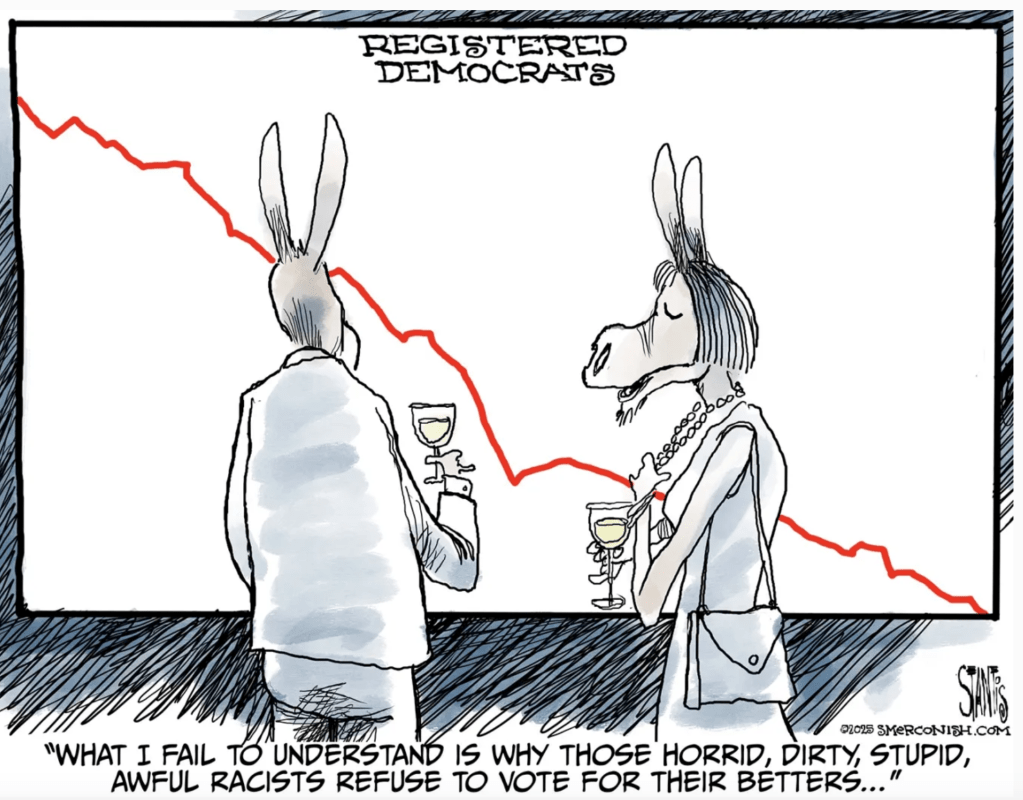
America has a conservative establishment. Its formal name is the Democratic party. Whether it be the federal government, universities, welfare or the regulatory state, Democrats fight to preserve the world as it is or was. “America is already great,” liberals cry, which is another way of saying that things were fine until Donald Trump came along. Their lodestar was Joe Biden, who personified nostalgia. Much of the party is now nostalgic for Biden. You have to be imprisoned in old ways of thinking to believe this is how US liberalism will rebound.
An invigorated US opposition would now be making hay. Trump’s team maintains a “promises kept” tally sheet. To be sure, he has in effect closed the border, demolished DEI quota culture, assaulted the deep state and launched trade wars against the rest of the world. But a big chunk of those who voted for Maga saw these moves as the means of lifting their economic prospects. The opposite is happening, which is why Trump’s numbers are in steady decline. Yet the fall in Democrats’ approval rating is even steeper. In relative terms, Trump’s political dominance has thus grown. Do not bet on a weakening economy changing that picture.
Trump’s genius is to keep pushing Democrats into reactive conservatism. That, plus the average age of the party’s leadership, makes Democrats look like permanently outraged grandparents. Trump’s assaults on pretty much every constitutional norm are indeed terrifying and outrageous. But they are remarkably inoculated against political backlash. To all intents and purposes, opposition to Trump has been reduced to a default outrage machine.
What is the solution? Democrats are a party of America’s professional elites plus various interest groups. And given that Trump won a majority of blue-collar voters, they are no longer the natural home of the working class. Any Democratic recovery would thus start by grappling with the latter’s worldview. The practical difficulty is that the party is shaped by elite professions, particularly law, government, media and academia. Such types often have a hard time concealing their distaste for those who voted for Trump. This is a poor starting point.
Democrats also face a deeper philosophical problem. Nobody knows how to reinvent 20th-century liberalism. In the US that was Franklin D Roosevelt’s 1930s New Deal, with updates over the next couple of generations. FDR built that world with “bold persistent experimentation”. His would-be heirs are stuck in a timid, persistent conservatism. They do not “welcome the hatred” of financial and business monopolists as Roosevelt did. They are the party of corporate America. No party in history could ever boast of so many expert fundraisers and humane philanthropists.
Lack of fresh ideas and cloistered demography are definitions of conservatism. If Trump did not exist, would Democrats want to reform the US administrative state? They should want to reinvent it but are now its militant defenders. A system that is so riddled with veto points that it takes years to execute simple projects and requires a PhD to navigate the tax system does not deserve to be defended. The same goes for a housing market that has priced younger voters out of the American dream and elite universities that are biased towards the children of alumni and donors. If Trump is attacking something, it must be defended to the hilt.
That Trump’s actions are destructive is no excuse. As political scientist Ruy Teixeira recently warned, Democrats are placing their chips on the “fool’s gold of midterm success”. Rather than seeking ways of reinventing a system in which America has lost faith, Democrats are betting on Trump’s defeat in next year’s congressional elections. The odds are that Republicans will lose the House of Representatives in 2026 and retain control of the Senate. Such midterm success would be a pyrrhic victory for Democrats. Biden based his 2024 re-election bid on his party’s relative success in the 2022 midterms. Look where that led.
A second piece of fool’s gold is to wait for Trumpism to die out with Trump. Even assuming that he does not launch a coup in 2028, Democrats would be unwise to think their problem will end with Trump. Familiarity with other democracies — Britain’s clueless Labour party, Germany’s moribund Social Democrats, France’s withered Socialists — shows that there is nothing unique to American populism.
The challenge for Democrats is to do what they should be doing were Trump not to exist. His superpower is to stop them from reaching that epiphany.
I’ll leave the fine details to the experts, but here is the gist. If Team Red—or, of course, Team Blue—finds itself with a lot of extremely safe congressional districts, the partisan redistricting may be accomplished by spreading out those partisan voters, so that the team has somewhat fewer safe seats and a larger number of seats that it’s going to win by, say, only five percent or so.
That works just fine if you can accurately predict which way the political win will be blowing, come next election. But what happens if the political wind starts blowing against you?
If, let’s say, the wind unexpectedly blows against you—let’s say by seven percent in favor of Team Blue—then your bunch of five percent wins turn into a bunch of two percent losses. And you have well and truly shot yourself in the foot.
You will recognize this situation as a corollary of the general rule that the straight edge ruler is not your best tool for short term and long term planning.
Down in Texas, Team Red—having partaken generously of Trump’s Kool-Aid—thinks that Orange Man’s popularity in the Lone Star State will continue from strength. In particular, they think the Latino community is overjoyed by the ICE arrests, and will reward Mango Mussolini in 2026 by increasing their support in congressional districts bordering on the Rio Grande.
Good luck with that.
Meanwhile, His Most High Excellency has declared today that he will order his “Justice Department” to sue California for retaliatory redistricting on the part of Team Blue.
The Very Stable Genius did not, however, articulate a coherent legal principle that would condemn Team Blue in California while, at the same time, blessing Team Red’s efforts in Texas.