
I fear this post will ruin my chances of being hired by the FBI.
Epsteingate

I was only able to download an audio file of the second podcastโby Sara Longwell and Will Sommer of the Bulwark. I recommend you give it a listen.The video may be behind a paywall, or you may be able to watch it here.
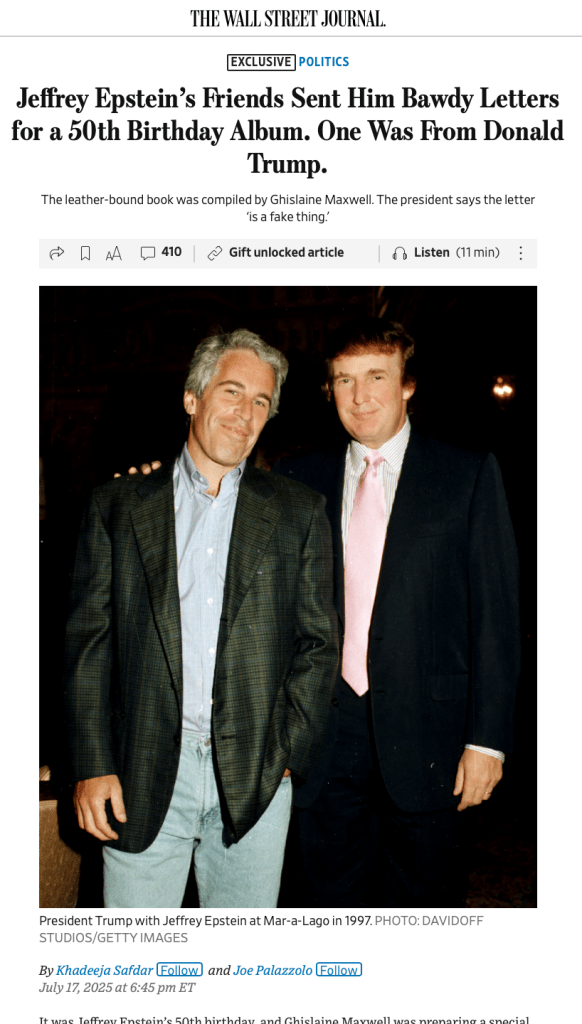
Why Did Trump Order the Coverup?
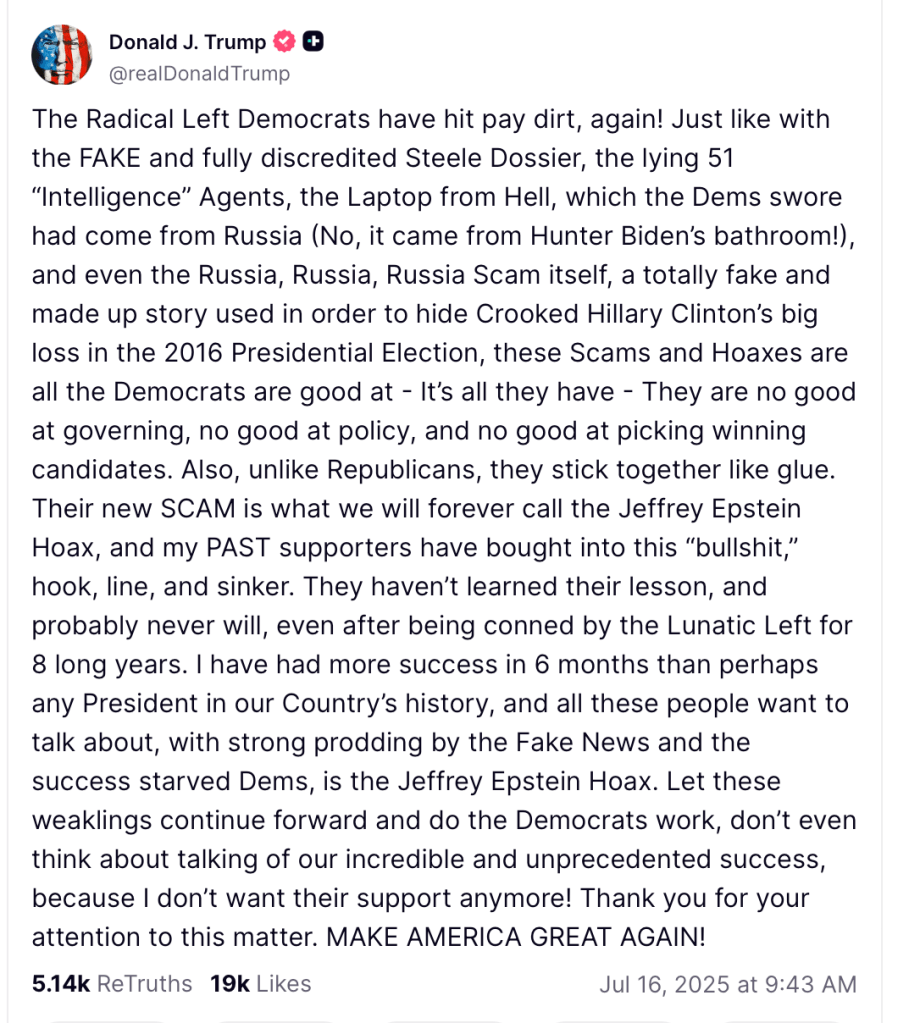
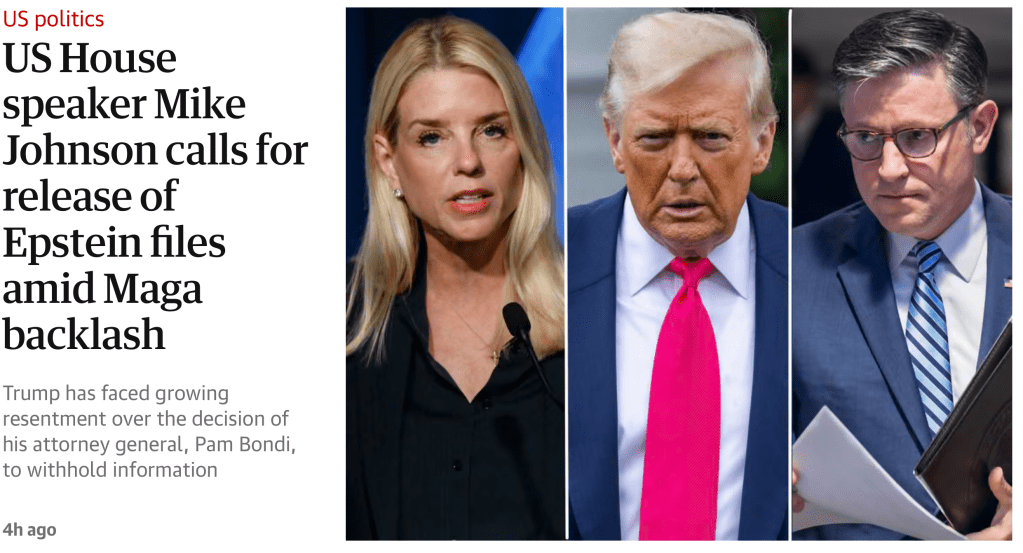
This weekend, lots of talking heads are postulating that MAGA minds are in deep distress, trying to figure out whether (1) Trump told Pam Bondi and the FBI to put the kibosh on Epsteingate because there is actually nothing to see, and Trump didnโt want to unwashed masses to realize they had been lied to, or (2) Trump told Pam Bondi and the FBI to put the kibosh on Epsteingate because Trump is as guilty as homemade sin, and he wanted to cover up his misdeeds.
Logically, thereโs a third possibility too: Trump told Pam Bondi and the FBI to put the kibosh on Epsteingate because Trump realized thereโs a load of blackmail material in the file, against a lot of people, and he wanted to preserve his ability to gain from those blackmail opportunities.
But, given all the facts and circumstances, I think the overwhelming probability is that Door Number Two is the right one: Trump put the kibosh on Epsteingate because Trump is guilty as sin.ย
A Big Fissure Within MAGA?
Apparently, despite all the talk of splits, fissures, and cognitive dissonance within MAGA resulting from Epsteingate, most of the MAGA folks have also lept to the conclusion that there is a Trump coverup. So, not much cognitive dissonance on the assumption that this is a coverup.
Good for them.
So, what comes next? Who knows?
The N.Y. Times Finally Catches Up on Trump v. CASA, โNationwideโ Injunctions, and Class Actions

Adam Liptak (N.Y. Times), Trumpโs Birthright Citizenship Ban Faces New Peril: Class Actions: In last monthโs decision limiting one judicial tool, universal injunctions, the court seemed to invite lower courts to use class actions as an alternative.
And, While Youโre Over at the Gray Lady, Check Out:
N.Y. Times Editorial Board, โI Am Not an Idiotโ: Dozens of Federal Judges Have Had It With Trump
The U.S. Justice Department normally employs about ten thousand lawyers. When you fire all the competent ones and replace them with hacks who were lucky to survive the first week of law school, this is what you get.
Chicken Little Clucks Again: The Supreme Court and the Federal Employeesโ Lawsuit

A couple of days ago, on July 8, the Supreme Court issued its ruling in Trump v. American Federation of Government Employees. There was a two-paragraph unsigned decision by eight of the nine justices, there was a short concurring opinion by Justice Sotomayor explaining why she went along with the conservatives on this one. (Justice Kagan, who also went along with the conservatives but didnโt say anything on her own, presumably agreed with Justice Sotomayor.) And there was a lengthy and strong dissent by Justice Jackson.
The case involved Trump Executive Order 14210, dated February 11. You can read it hereโand it might be a good idea to take a gander, because you will see that it orders the executive agencies to develop some plans, and to do so in accordance with applicable law.
Now Team Trump has some pretty screwy notions about what applicable law requires and doesnโt require. And the plans to be developedโessentially, schemes for a massive reduction in the federal workforceโwould call for very unwise and very probably illegal actions to be taken.
Still, they were just plans. And the question before the Court was whether Trump was likely to win in his claim that the Constitution doesnโt prevent him from making plansโplans that he claims will be in accord with applicable law.
As I said, eight justicesโtwo liberals, three wingnuts, and the three judges in what passes these days for the middleโall agreed that โThe District Court enjoined further implementation or approval of the plans based on its view about the illegality of the Executive Order โฆ, not on any assessment of the plans themselves. Those plans are not before this Court.โ
In the Wake of the Decision
A number of lawsuits involving specific federal agencies remain ongoing. In a couple of cases, Trumpโs plans have been blocked, and the validity of those injunctions was not before the Supreme Court this week. Much additional legal activity will surely follow.
Meanwhile, a plethora of catastrophizing headlines scream that the Supreme Court has given Trump the green light to fire federal workers.
Trueโbut misleadingly incomplete. What they have actually done is to give Trump the green light to try to institute a massive reduction in force, and to do it as fast as they can, before litigation catches up with them.ย That said, there is also a green light for courts to enjoin the hell out of RIFs in specific agencies, if the RIFs don’t comply with a whole lot of legal rules, including the requirement that Congress be consulted on massive changes to the federal workforce.
The labor lawyers are going to have a good year.
I Told You So

What Just Happened
Contrary to the views of headline writers who did not go to law school and who suffer from chronic confirmation bias, in the recent case of Trump v. CASA, the Supreme Court opened the door to nationwide injunctions against Trump in cases where plaintiff classes have been certified according to Rule 23 of the Federal Rules of Civil Procedure.
Today, the first such injunction was granted, by a federal district judge in New Hampshire, in a case spearheaded by the American Civil Liberties Union and its allies.
The judge โruled from the benchโโmeaning that the formal text of most of his ruling isnโt available, at least currently. (The order certifying the class, however, is found here. As I predicted, Trumpโs own executive order does a fine job of defining the class that is being certified.)
The ACLUโs press release reads in part,
CONCORD, N.H. โ A federal court in New Hampshire today blocked President Trumpโs executive order restricting birthright citizenship and certified a nationwide class that protects the citizenship rights of all children born on U.S. soil. The case is Barbara v. Donald J. Trump.
The ruling stems from a nationwide class-action lawsuit filed June 27, immediately after a Supreme Court ruling that potentially opened the door for partial enforcement of the executive order.
The American Civil Liberties Union, ACLU of New Hampshire, ACLU of Maine, ACLU of Massachusetts, Legal Defense Fund, Asian Law Caucus, and Democracy Defenders Fund brought the challenge on behalf of a proposed class of babies subject to the executive order. It seeks to protect all impacted families in the country in the wake of the Supreme Courtโs recent decision in Trump v. CASA, which directed courts to consider narrowing nationwide protection that had been provided in the first round of challenges to the executive order attacking birthright citizenship.
The groups were in court today successfully arguing for a preliminary injunction and nationwide class certification. The ruling was made from the bench.
In granting the request, the court provided for a 7-day delay so that the government โ which argued to the Supreme Court that a nationwide class was the appropriate way to seek nationwide protection in the birthright cases โ could nevertheless try to get the First Circuit Court of Appeals to stay the relief, if it decides to pursue that option. Even with a 7-day delay, the ruling will go into effect well before July 27, when partial implementation of the unconstitutional order might otherwise have begun.
โThis ruling is a huge victory and will help protect the citizenship of all children born in the United States, as the Constitution intended,โ said Cody Wofsy, deputy director of the ACLUโs Immigrantโs Rights Project, who argued the case.โWe are fighting to ensure President Trump doesnโt trample on the citizenship rights of one single child.โ
What Happens Next?
Team Trump could wait for more decisions along the same lines by district courts around the country, in order to forum shop for the best appellate court. More likely, I think, is that they will appeal to the federal appellate court in Boston, which will quickly rule in the ACLUโs favor, so that the Supreme Court will have to address the merits of birthright citizenship very soon.ย
And what will happen then?
Well, maybe Justices Thomas and/or Alito and/or Gorsuch will quibble with whether a class should have been certifiedโor raise some other arcane, pettifogging objection to jurisdiction. Or maybe one of them will receive a revelation from the Angel Moroni that all class actions are unconstitutional.
You never can tell. But I am confident that at least five of the justices will continue to adhere to language of the Fourteenth Amendment and to reject Trumpโs interpretation, just as the Supreme Court ruled back in 1898 in the Wong Kim Ark case.
And what will happen after that?
What will happen after that is that large pieces of shit will hit the fan.
Two Lengthy Thumb-Suckers on Whatโs Wrong With UsโOne Worth Reading; The Other, Not So Much

David Brooks (The Atlantic), Why Do So Many People Think Trump Is Good? The Work of the moral philosopher Alasdair MacIntyre helps illuminate the central questions of our time.
Nathan Taylor Pemberton (N.Y. Times), Trolling Democracy (Also available here.)
David Brooks tries so hard. Today, he gets an E for Effort, seeking to persuade us that our national crisis has something to do with deficient moral philosophy.
Well, I am confident that moral philosophy has something to do with it. But before you get to moral philosophy, just answer this question:
Assume that John Doe has poor moral philosophy. Or, for that matter assume John Doe is utterly wicked, without a moral bone in his body. Even on that assumption, why would John Doe elect a national leader who manifestly lacks the mental capacity to be a national leader. And a national leader who is going to inflict grievous harm on John Doeโs own economic interests?
The answer, it would seem, is that Mr. Doe lacks not only morality but also the ability to see reality accurately and to draw reasonable inferences about the likely consequences of his own actions.
The One Worth Reading
The other piece, by Nathan Pemberton, is a lengthy account of the rise of Nazi ideology among a certain segment of our populationโchiefly young men with poor economic prospectsโand the cultivation of that ideology by many people close to the President of the United States.
Before reading it, you may want to visit the package store.
Pollyanna Offers a Working Hypothesis About the Big Beautiful Bill

Pollyannaโs a busy young lady, so dear old dad doesnโt get all that many calls from her. Today, though, she called to offer an interesting working hypothesisโa hypothesis about the possible effect of the Big Beautiful Bill.
Not a prediction. A working hypothesis.
Here it is, but first some background.
As she pointed out, Trumpโs policies are disastrous for everyone, including the business and financial elite. Consider tariffs. Consider the gutting of clean energy, at a time when energy demand is exploding. Consider the effect of mass deportation on the work force. Consider inflation. Consider the effort to obliterate American scientific leadership. Consider the deficit.
Observe that most of the economic elite does not live in an information bubble. All the effects we just listed are fully reported in the Financial Times and the Economist. Even the Wall Street Journal recognizes most of them, most of the time.
Assume, for the sake of the discussion, that the average member of the elite does not give a tinkerโs damn about anything other than his or her own economic interests.ย But assume they do in fact care deeply about their own economic interests, and that, as a group, they have a generally accurate picture of what is going on.
Given all that, the working hypothesisโthe hypothesis that isnโt a prediction, just a hypothesisโgoes like this:
- generally speaking, the economic elite have been motivated, above all else, to secure permanent extension of the Trump tax cuts, and
- accordingly, the economic elites have greatly tempered their objections to Trumpโs disastrous policies, largely out of a concern not to upset the delicate political apple cart before passage of the Big Beautiful Bill, but
- now that the tax cuts are locked in statutory cement, the business and financial elite will feel significantly freer to try to stop Trumpโs sabotaging of the American economy.
Itโs a hypothesis.
โNationwideโ Injunctions, Birthright Citizenship, andย the Supreme Court Decision in Trump v. CASA

The case is here. For a variety of takes from the commentators, see, e.g.,
Amy Howe (SCOTUSblog), Supreme Court sides with Trump administration on nationwide injunctions in birthright citizenship case
Washington Post Editorial Board, Justices need to own the consequences of their injunction ruling: the court has significantly weakened district courtsโ ability to halt illegal presidential actions.
Jason Willick (Washington Post), Justice Kavanaugh explains what the injunctions ruling wonโt change
Philip Rotner (The Bulwark), Ignoring Substance, SCOTUS Permits Lawlessness
Nicholas Bagley (The Atlantic), The Supreme Court put Nationwide Injunctions to the Torch: That isnโt the disaster for birthright citizenship that some fear.
N.Y. Times, Guest Essay, โThereโs Just Too Much Lawlessnessโ: Three Legal Experts on an Embattled Supreme Court
See also yesterdayโs update from the ACLU.
I discussed the executive order on birthright citizenship in the preceding post.
What is a โNationwide Injunctionโ?
The term โnationwide injunctionโ is inapt and misleading, but lots of people want to use it anyway. So letโs define it for present purposes. For present purposes, a โnationwide injunctionโ is an injunction issued in a case brought by one or more persons (either two-legged persons or juridical persons such as corporations) that protects not only the individual plaintiff(s) but also everyone else in a similar legal position, even though there is no certified โclass actionโ in accordance with Rule 23 of the Federal Rules of Civil Procedure.
As so defined, a nationwide injunction is an end run around the normal requirements for class certification under Rule 23.[1]
To illustrate and explain the point: Plaintiffs in the CASA case include four new mothers and their babies, one pregnant woman and her unborn child, and three undocumented immigrant women who might become pregnant. If the plaintiffs wanted to secure a ruling protecting not only their children but alsoย all children whom Trump threatened to deprive of citizenship, then the normal/traditional route would be to ask the district court to โcertifyโ such a โclassโ of similarly situated mothers. That class certification process involves a number of inquiries about whether it would be advisable for the litigation to go forward on a class basis, not an individual basis. But Liza, Andrea, and the other expectant mothers asked for nationwide/universal relief, without going through the certification exercise.
Before Trump v. CASA, Was There a Legitimate Legal Controversy about Whether Courts Could Issue โNationwide Injunctionsโ?
Yes. Long story. But yes.
In fact, the Biden administration asked the Supreme Court to impose severe limitations on โnationwide injunctions.โ
Some Say it was Oddโand Inadvisableโfor the Court to Rule on the โNationwide Injunctionโ Question but Kick the Can Down the Road on the Substantive Issue of Birthright Citizenship. Do You Agree?
Yes, I do agree. And if anyone reading this post wants to delve deeper, many of the sources cited above will be useful.
But I think the much more interesting question is whether plaintiff can represent a class of similarly situated mothers, babies, and unborn children.
And whether, by so complying with Rule 23, they can find effective legal relief against Trumpโs illegal position on birthright citizenship.
Whatโs Going to Happen Next in the Birthright Citizenship Cases?
Iโll write about that in my next post, which will appear immediately above this one, because the posts on my blog appear in reverse chronological order.
[1] Related, but distinct, issues are raised by lawsuits with plaintiffs claiming to represent a category of other peopleโfor example, a suit brought by a state government on behalf of all its citizen or a suit brought by a trade association on behalf of all its members. Team Trump challenged the โstandingโ of states and associations to bring such cases, but the Court decided to kick this can down the road.
Trumpโs Executive Order on Birthright Citizenship

What Does the Executive Order Claim to Accomplish?
The executive order is prospective. It purports to deny citizenship to future babies born in the United States if (1) the babyโs mother is unlawfully present in the United States and (2) the babyโs father is not a U.S. citizen or lawful permanent resident.[1]
What is the Legal Basis for the Executive Order?
The 14th Amendment provides, โAll persons born or naturalized in the United States, and subject to the jurisdiction thereof, are citizens of the United States …โ
Thus, if you want to argue that babies born in the United States to undocumented parents are not citizens, then you have to hang your hat on the words โand subject to the jurisdiction thereof.โ And you have to make a very strained and slanty-eyed interpretation of that phrase.
That strained interpretation is the position Trump takes in the executive order.
A Frontal Challenge to an 1898 Supreme Court Case
Back in 1898, the Supreme Court consideredโand rejectedโthe legal position that Team Trump now espouses. So Trump has to argue (among other things) that the Supreme Court got it wrong in 1898, and that the law has stayed wrong for the past 127 years.
Four Ways to Read the Executive Order
(1) A Test Case before the Supreme Court. A charitable reading is that the executive order is intended as the predicate to a test case, in which the Supreme Court would revisit the issue it decided back in 1898.
Trump may argue that itโs OK to set up a test case. After all, we all have a constitutional right to be wrong, and we all, including His Most High Excellency, have a right to ask the Supreme Court to embrace our erroneous legal claims.[2]
(2) Defiance of the Supreme Court. An uncharitable reading of the executive order is that Mango Mussolini claims that HE ALONE, not the Supreme Court, may divine the definitive definition of the words in the Constitution.
(3) Evasion of Supreme Court Review, or, the Cuter Than Bambi Reading. A third interpretationโperhaps even more uncharitable, though very possibly accurateโis Team Trump is attempting to evade Supreme Court review of his novel constitutional argument by
- losing all the cases brought by people aggrieved by the order,ย
- avoiding all appeals of such losses, andย
- enforcing their erroneous legal interpretation against everybody else.ย
Some lawyersโnot that many, but someโare under the impression that they are cuter than Bambi. This is the sort of horseshit that they come up with.
(4) The FAFO Reading. Lastly, one may read the executive order as implying that Team Trump hasnโt thought through how to get their novel legal theory accepted. Under this interpretation, they just plan to Fuck Around and Find Out.
What about Retrospective Application of Trumpโs Position against Birthright Citizenship?
Someone other than me must surely have spotted this issueโbut, if so, I havenโt seen any evidence of it. Hereโs the issue.
Suppose thatโsome way, somehowโTeam Trump gets the courts to all enforcement of the executive order in respect of future babies born to undocumented immigrants. Bear with me on that. Just entertain the supposition.
Logically, that would imply everybody already born in the United States to undocumented parents also lacks U.S. citizenship.
Would Team Trump be prepared to take that position?
Thatโs at least five million people, and probably more.
[1] The order also addresses another distinct issue/problem, that of โbirth tourism.โ Thatโs an interesting issue, but pales in importance compared to the issue of babies born to undocumented immigrants.
[2] That right flows from the First Amendment right to petition for redress of grievance. And, BTW, Trump also has a constitutional right to ask Congress to pass a law endorsing his view of citizenship. But that wouldnโt work, because any such law would be unconstitutional unless and until the Supreme Court changes its mind about its 1898 interpretation of the Fourteenth Amendment.
Yesterdayโs ACLU Update on Recent Developments, Along With Prognostications and a Pep Talk
Broadcast live yesterday afternoon for ACLU contributors.
If you are not an ACLU contributor, you should be.