
From David Ignatius’ Lips to God’s Ears

David Ignatius (Washington Post), Democrats ignored border politics. Now the consequences are here: To fight Trump’s excesses on immigration, Democrats need to show they are credible on the issue:
Democrats have gotten the border issue so wrong, for so long, that it amounts to political malpractice. The latest chapter — in which violent protesters could be helping President Donald Trump create a military confrontation he’s almost begging for as a distraction from his other problems — may prove the most dangerous yet.
When I see activists carrying Mexican flags as they challenge ICE raids in Los Angeles this week, I think of two possibilities: These “protesters” are deliberately working to create visuals that will help Trump, or they are well-meaning but unwise dissenters who are inadvertently accomplishing the same goal.
Democrats’ mistake, over more than a decade, has been to behave as though border enforcement doesn’t matter. Pressured by immigrant rights activists, party leaders too often acted as if maintaining a well-controlled border was somehow morally wrong. Again and again, the short-term political interests of Democratic leaders in responding to a strong faction within the party won out over having a policy that could appeal to the country as a whole.
When red-state voters and elected officials complained that their states were being overwhelmed by uncontrolled immigration over the past decade, Democrats found those protests easy to ignore. They were happening somewhere else. But when red states’ governors pushed migrants toward blue-state cities over the past several years, protests from mayors and governors finally began to register. But still not enough to create coherent Democratic policies, alas.
It’s open season on former president Joe Biden these days, and he doesn’t deserve all the retrospective criticism he’s getting. But on immigration, he was anything but a profile in courage. Security advisers including Homeland Security Secretary Alejandro Mayorkaswanted tougher border policies starting in 2021. But political advisers such as Chief of Staff Ron Klain, who sought amity with immigration rights progressives in Congress and the party’s base, resisted strong measures. Though Biden was elected as a centrist, he leaned left — and waited until the last months of his presidency to take the strong enforcement measures recommended earlier.
Throughout the 2024 campaign, Trump played shamelessly on public anxieties about the border. Some of his arguments, such as claims that hungry migrants were eating pets, were grotesque. They were simply provocations. But Biden and Kamala Harris didn’t have good answers, other than indignation. They had straddled the issue through Biden’s term, talking about border security but failing to enact it, and the public knew it.
Democrats finally came up with a bipartisan border bill in 2024 that would have given the president more authority to expel migrants and deny asylum claims, and more money to secure the border. Republicans, led by Trump, were shameless opportunists in opposing the bill. They didn’t want Biden to have a win. In the end, Democrats didn’t have the votes — or, frankly, the credibility on the issue. Biden took executive action in June 2024, limiting entry into the United States. But it was too late. He could have taken that action in 2021.
Since Trump took office in January, he has been building toward this week’s confrontation in the streets. ICE raids have steadily increased in cities with large migrant populations, as have nationwide quotas for arrests and deportations. Trump declared a national emergency on Inauguration Day that gave him authority to send troops to the border to “assist” in controlling immigration. Homeland Security Secretary Kristi L. Noem seized every photo opportunity to convey a militarized approach to the coming clash. Over these months, the immigration issue has been a car crash skidding toward us in slow motion.
Since his first term, Trump has clearly wanted a military confrontation with the left over immigration or racial issues. Gen. Mark A. Milley, then chairman of the Joint Chiefs of Staff, helped talk Trump out of invoking the Insurrection Act in 2020 to contain the unrest that followed the death of George Floyd. But this time, Trump faces no opposition. He is surrounded by yes-men and -women.
The saddest part is that Democrats still have no clear policy. Some blue-state mayors and governors have pledged to provide “sanctuary” for migrants, but they don’t have good arguments to rebut Trump’s claim that they’re interfering with the enforcement of federal law. In some cases, sanctuary has meant refusing to hand over undocumented migrants convicted of violent crimes, former DHS officials tell me. That’s wrong. The courts have limited Trump’s most arbitrary policies and his defiance of due process, but not his authority to enforce immigration laws.
California Gov. Gavin Newsom (D) this week chose sensible ground to fight, filing a lawsuitchallenging Trump’s authority to override gubernatorial power by federalizing National Guard troops when there isn’t a “rebellion” or “invasion.” There is no evidence of such extreme danger — or that local law enforcement in Los Angeles can’t handle the problems.
But Newsom’s smart pushback doesn’t get Democrats out of addressing an issue they’ve been ducking for more than a decade: Do they have the courage to enforce the border themselves?
Over the long run, taking border issues seriously means more immigration courts and more border-control people and facilities — and a fair, legal way of deciding who stays and who goes. But right now, it means Democratic mayors and governors using state and local police to contain protests, so that troops aren’t necessary — and preventing extremists among the activists from fomenting the cataclysm in the streets that some of them seem to want as much as Trump.
Yes, of course, we need new bipartisan legislation to resolve the gut issue of how to protect the “dreamers” and other longtime residents who show every day that they want only to be good citizens. But on the way to that day of sweet reason, Democrats need to oppose violence, by anyone — and to help enforce immigration policies that begin with a recognition that it isn’t immoral to have a border.
From Tom Friedman’s Lips to God’s Ears

Thomas L. Friedman (N.Y. Times), The Israeli Government Is a Danger to Jews Everywhere:
Israelis, diaspora Jewry and friends of Israel everywhere need to understand that the way Israel is fighting the war in Gaza today is laying the groundwork for a fundamental recasting of how Israel and Jews will be seen the world over.
It won’t be good. Police cars and private security at synagogues and Jewish institutions will increasingly become the norm; Israel, instead of being seen by Jews as a safe haven from antisemitism, will be seen as a new engine generating it; sane Israelis will line up to immigrate to Australia and America rather than beckon their fellow Jews to come Israel’s way. That dystopian future is not here yet, but if you don’t see its outlines gathering, you are deluding yourself.
Fortunately, more and more retired and reserve duty Israeli Air Force pilots, as well as retired Army and security officers, are seeing this gathering storm and declaring they will not be silent or complicit in Israeli Prime Minister Benjamin Netanyahu’s ugly, nihilistic policy in Gaza. They have begun to urge Jews in America and elsewhere to speak up — SOS: Save Our Ship — before the widening moral stain of Israel’s military campaign in Gaza becomes irreversible.
First, the back story: Israel months ago destroyed Hamas as an existential military threat. Given that, the Netanyahu government should be telling the Trump administration and Arab mediators that it’s ready to withdraw from Gaza in a phased manner and be replaced by an international/Arab/Palestinian Authority peacekeeping force — provided that the Hamas leadership agrees to return all remaining living and dead hostages and leave the strip.
If instead, though, Israel goes ahead with Netanyahu’s vow to perpetuate this war indefinitely — to try to achieve “total victory” over every last Hamasnik, along with the far right’s fantasy of ridding Gaza of Palestinians and resettling it with Israelis — Jews worldwide better prepare themselves, their children and their grandchildren for a reality they’ve never known: to be Jewish in a world where the Jewish state is a pariah state — a source of shame, not of pride.
Because one day, foreign photographers and reporters will be allowed to go into Gaza unescorted by the Israeli Army. And when they do, and the full horror of the destruction there becomes clear to all, the backlash against Israel and Jews everywhere could be profound.
Do not confuse my warning to Israel for a shred of understanding for what Hamas did on Oct. 7, 2023. Hamas invited the Israeli response with its own mass killings of Israeli parents in front of their children, children in front of their parents, by kidnapping grandmothers and murdering kidnapped children. What society in the world would not see its heart grow cold by such brutality? Hamas deserves to be eliminated; Hamas is and always has been a cancer on the Palestinian people, let alone Israelis.
But as a Jew who believes in the right of the Jewish people to live in a secure state in their biblical homeland — alongside a secure Palestinian state — I am focused right now on my own tribe. And if my own tribe does not resist this Israeli government’s utter indifference to the number of civilians being killed in Gaza today — as well its attempt to tilt Israel into authoritarianism at home by moving to sack its independent attorney general — Jews everywhere will pay dearly.
Don’t just take that warning from me. Last week two respected former Israeli Air Force pilots, Brig. Gen. Asaf Agmon and Col. Uri Arad (who was a P.O.W. in Egypt during the October 1973 war), published an open letter in Hebrew in the Israeli newspaper Haaretz, addressed to their colleagues still serving in the Air Force. …
I have three reactions to these open letters:
First, Amen.
Second, this is what being pro-Israel really sounds like.
Third, it is time for a similar movement calling out Hamas’s vile excesses, led by those who support Palestinian statehood and a peaceful resolution in Gaza. No one should accept Hamas prolonging this war to keep itself in power. Nothing would do more to pressure Hamas to accept a cease-fire than to be denounced across the world, on college campuses and in high-profile demonstrations from those who have been giving this hate-driven organization a free pass. This is what being pro-Palestinian really sounds like.
A Bumper Sticker For Our Times

Mango Mussolini’s Moronic Manufactured Mayhem
Today, many talking heads are talking about the events in Los Angeles as a step on the road to authoritarianism—and an attempt to distract from Team Trump’s many failures.
All true.
And yet there remains an elephant in the room for Team Blue.
As a movement, we do not yet have a coherent and politically viable answer about
- How to deal with the undocumented people currently present here,
or about
- What the rules and procedures for political asylum ought to be,
or about
- Apart from people with legitimate asylum claims, how many—and who—should be permitted to enter the United States.
Not to have coherent and politically viable answers to these questions is political malpractice.
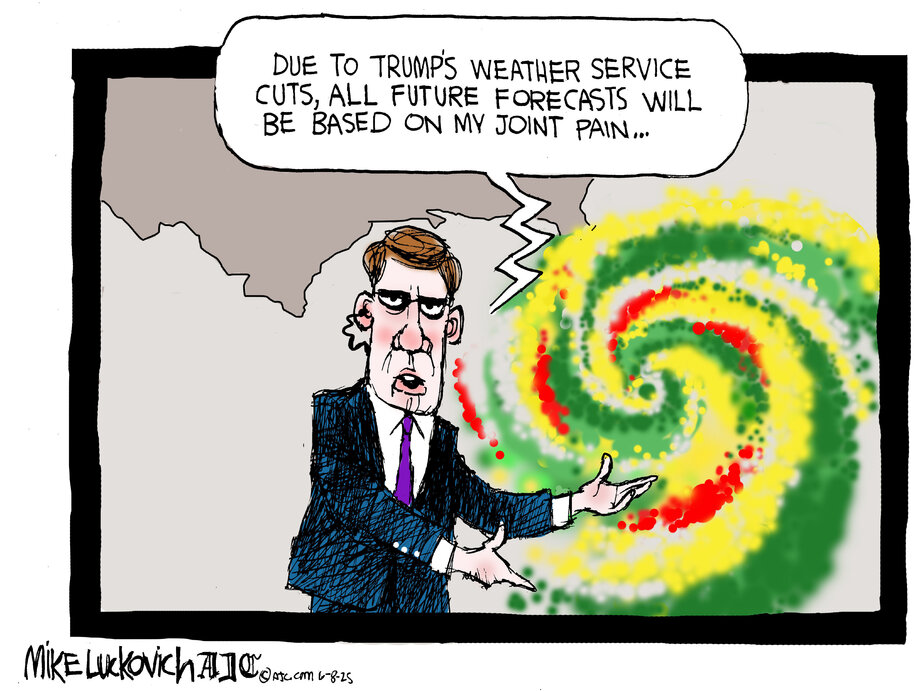
When Clouds Look Like Rocks and Towers, the Earth Will be Refreshed by Showers
Like Two Scorpions in a Bottle: Heather Cox Richardson and Rick Wilson Share Their views on Musk and Trump
And, from four months ago, the Marsh Family gives a musical take on Elon.
The Skinny on Elon: Peak Schadenfreude for Team Blue
Trump, China Policy, and Christopher Columbus’s Three Mistakes

N.Y. Times, DealBook Newsletter, Trump Bemoans How ‘HARD’ It Is to Strike a China Deal: Even the president appears to be doubting his strategy to win over Beijing, as relations fray between the trading partners.
Well, yeah. But the headline writer mistakenly assumes there’s a discernible goal toward which Trump has an actual strategy.
It is said that Christopher Columbus made three mistakes.
When he started out, he didn’t know where he was going.
When he got there, he didn’t know where he was.
When he came back, he didn’t know where he had been.
If you have no idea where you are going, it’s not meaningful to talk about your strategy for getting there. The ever insightful Ed Luce—who writes behind a pricey paywall—analyses the situation beautifully.
Financial Times, Edward Luce, The great Trump riddle on China: No one knows what the US president’s desired endgame with Beijing really is:
Smart money says that Donald Trump’s upside is that you know where he stands. That may be true on his love of grift and loathing of immigrants and trade deficits. When it comes to Trump and China, however, economists should drop their caveat about “all things being equal”.
Nothing to do with Trump’s China policy is predictable, let alone equal. Does he care about Taiwan? Let’s toss a coin. Does he want the US to decouple from China? Spin the roulette wheel. Trump’s supposed coming phone call with China’s President Xi Jinping is unlikely to lift our confusion. China is the ultimate Trump riddle.
You can hardly blame the Chinese for being wary of talking to him. In late April, Trump told Time that Xi had called him — “and I don’t think that’s a sign of weakness on his behalf”. No call had taken place.
Any reading by Trump of Xi’s psychology should thus be put down to an AI-style hallucination. China’s foreign ministry accused Trump of “misleading the public”, which by today’s standards was polite. But we should not mistake Xi’s avoidance of “wolf warrior” invective for submission to Trump in the tariffs war. China is not the UK. The Chinese are as confused about Trump’s endgame as everyone else.
If Xi does finally agree to a call with Trump — the first since he was inaugurated — the duelling Washington-Beijing readouts would make for interesting reading. It is almost impossible to imagine Xi agreeing to sit down for one of Trump’s reality TV Oval Office specials. That crapshoot has had big downside impacts on Ukraine’s Volodymyr Zelenskyy and South Africa’s Cyril Ramaphosa, and proved helpful to Canada’s Mark Carney and arguably to Britain’s Keir Starmer. Xi will never agree to run that gauntlet. Nor should he.
The China-US component of Trump’s on-again off-again trade war is in a category of its own. The rest are based on exaggerated or imaginary complaints. The EU is no likelier to concede that its value added tax is a trade barrier than Canada will admit to exporting fentanyl to the US. Both are fictions. By contrast, China’s dual-use technological ambitions pose a big geopolitical conundrum to America. How Trump addresses those — whether he scraps Joe Biden’s “small yard, high fence” restrictions on semiconductor trade with China — matters to everyone.
Yet we have little clue how much they concern Trump. The leverage goes both ways. The US could continue to restrict China’s access to AI technology and chips. But Trump has already relaxed some of this. Nvidia’s chief executive Jensen Huang is an influential advocate with Trump of further relaxation. On the other side, China has a stranglehold on the world’s rare earth supply that is critical to a wide range of US production. Trump claims China has reneged on last month’s deal to resume its exports of rare earths to the US. In that pause, Trump reduced his 145 per cent tariff on China to 30 per cent.
Will he ratchet tariffs up again if China does not lift its embargo? There is no way of knowing. Once upon a time Trump thought that the China-owned TikTok was a threat to US national security. Now he is keeping the social media app alive — with a possible view of a forced sale to a Trump business partner — against the wishes of Congress and the Supreme Court. As goes TikTok, so might go Trump’s China policy.
The same confusion reigns over Taiwan. Many voices in Trump’s administration urge a hardline defence of Taiwan. Pete Hegseth, the US defence secretary, said last week: “The threat China poses [to Taiwan] is real. And it could be imminent.” But few in the US or around the world take Hegseth seriously. Trump hired him to play Pentagon chief on TV. China is widely believed to be getting ready to launch an invasion of Taiwan by 2027. Hegseth could well have been speaking the truth. But you cannot assume he is credible. Trump has thus created a real national security risk by having a secretary of defence cry wolf.
Trump’s China uncertainty is also a tax on the global economy. France’s Emmanuel Macron spoke for many last week when he said: “We don’t want to be instructed on a daily basis what is allowed, what is not allowed, and how our life will change because of the decision of a single person.”
That was one way of putting it. Here is another from JPMorgan’s Jamie Dimon: “China is a potential adversary . . . But what I really worry about is us.” Dimon was tactful not to name the US president. On the conundrum posed by Trump’s erraticism, China and the rest of the world are as one.
Clients are Fleeing Cowardly Law Firms, and Other Significant Legal Developments
Trump Isn’t Appointing Judges Because He Can’t Find People to Appoint
The Wall Street Journal Does a Deep Dive Into All the Big Clients Saying Ixnay to the Cowardly Law Firms
Wall Street Journal, The Law Firms That Appeased Trump—and Angered Their Clients:
Support for the law firms that didn’t make deals has been growing inside the offices of corporate executives. At least 11 big companies are moving work away from law firms that settled with the administration or are giving—or intend to give—more business to firms that have been targeted but refused to strike deals, according to general counsels at those companies and other people familiar with those decisions.
Among them are technology giant Oracle, investment bank Morgan Stanley, an airline and a pharmaceutical company. Microsoft expressed reservations about working with a firm that struck a deal, and another such firm stopped representing McDonald’s in a case a few months before a scheduled trial.
In interviews, general counsels expressed concern about whether they could trust law firms that struck deals to fight for them in court and in negotiating big deals if they weren’t willing to stand up for themselves against Trump. The general counsel of a manufacturer of medical supplies said that if firms facing White House pressure “don’t have a hard line,” they don’t have any line at all. …
Not long after Latham struck a deal in April, the firm’s chair, Richard Trobman, met with Morgan Stanley’s chief legal officer, Eric Grossman, people familiar with the meeting said. Grossman heard him out about the firm’s reasoning for striking a deal and acknowledged that companies have to do what is best for themselves.
Soon after that meeting, Grossman and other Morgan Stanley lawyers communicated to law firms targeted by the White House that hadn’t signed deals that they were looking to give them new business, the people familiar with the meeting said. …
A top legal executive at another company said she called partners at Paul Weiss before it cut its deal to reassure the firm she would remain loyal, even though doing so risked millions in government contracts. She was shocked when the firm chair Brad Karp announced a deal, she said, and her company has plans to move work away from Paul Weiss.
The day after Paul Weiss struck its deal, female general counsels gathered for a conference in Washington. During a panel at the Women’s General Counsel Network event, a lawyer stood up and said her company had taken steps that morning to pull its business from Paul Weiss. The lawyer received thunderous applause.
About two weeks later, McDonald’s told a court that star Paul Weiss lawyer Loretta Lynch was withdrawing as its attorney in a high-profile lawsuit accusing the fast-food giant of discrimination against Black-owned media companies. Lynch, who had served as attorney general under former President Barack Obama, had been involved with the case for several years. It is unusual for companies to shake up representation close to trial. …
Emotions have run high inside some firms that struck deals, particularly among younger lawyers. At Skadden, Simpson, Latham and Kirkland, some associates have quit over the deals. One associate leaving Simpson wrote in his departure email, shared on LinkedIn, that he refused to “sleepwalk toward authoritarianism.” Partners, too, have left some of the firms that made deals.
At Sullivan & Cromwell, some lawyers have bristled at the role that co-chair Robert Giuffra played in facilitating a deal for Trump to drop an executive order against rival firm Paul Weiss. Giuffra, one of Trump’s personal lawyers, participated by phone in an Oval Office discussion with the Paul Weiss leader, who was there to work out a deal.
The New York Times Does a Deep Dive Into the Legal Issues Raised by Trump’s Purported Invocation of the International Economic Emergency Powers Act
N.Y. Times, A Fiery Brief Fueled by Conservatives Helped Put Trump’s Tariffs in Peril
This is a legally sophisticated yet understandable exposition of the legal issues. Despite the Times’ headline, the article shows how there is a large degree of bipartisan agreement among legal scholars that Trump’s tariffs are unconstitutional.
That bipartisan agreement should help the Supreme Court if and when it rules against Trump on the tariffs.
And, apart from the legal niceties, there is the fact that the tariffs are sending the economy to hell in a handbasket.

