How Team Trump is Responding, as of Sunday Night, to the Supreme Court’s Order on Immigration Due Process

I think sounds of silence signal that the legal part of Team Trump is having a terrible, horrible, no good, very bad weekend.

Meanwhile, an insightful op-ed in the N.Y. Times speaks of a recently invented right wing legal principle—the major questions doctrine, newly discovered as a conservative cure for perceived liberal excesses—that requires “clear congressional authorization” when the bureaucrats make decisions of great “economic and political significance.” Otherwise, bye-bye liberal policy adventuresomeness. 

Now, Orange Mussolini is the poster child for one who makes decisions of great economic and political significance without a ghost of a shadow of congressional authorization. 

Will the courts apply their new major questions doctrine in an intellectually consistent way? Stay tuned. We’ll find out in due course. See Aaron Tang, Will This Conservative Legal Doctrine Undo Trump’s First Months in Office?

Enquiring minds want to know. 

Alito’s Dissent to the Midnight Order

Read it here.

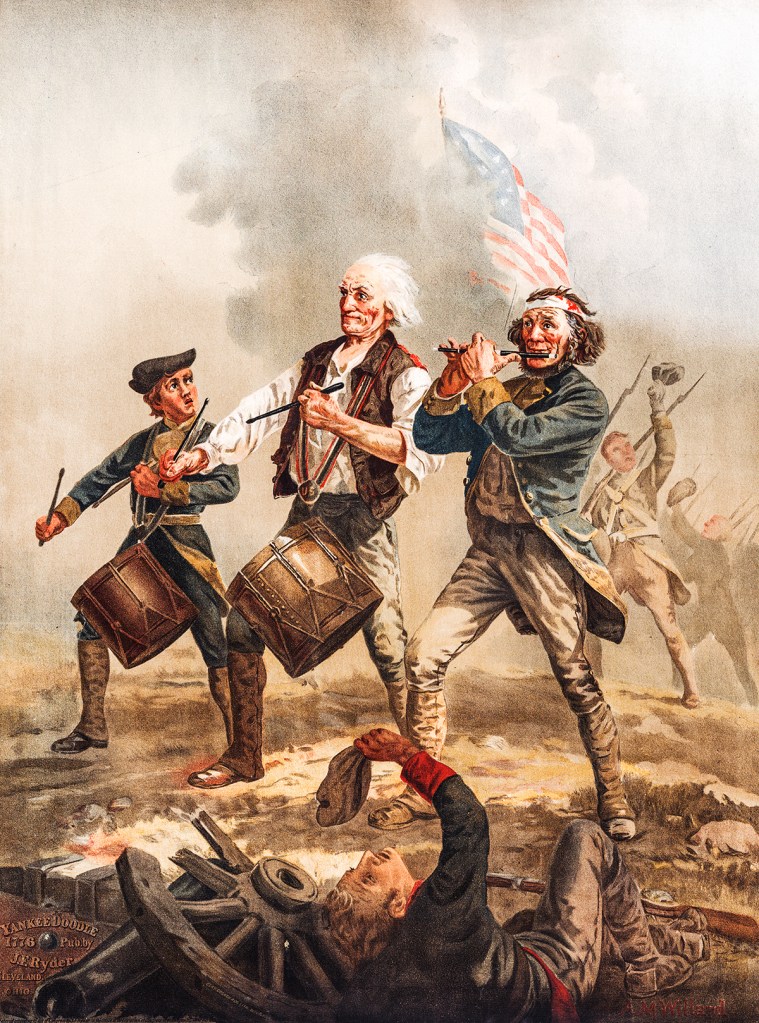
On April the 18th of 75—that would be 1775—Paul Revere took a midnight ride. Around midnight on April the 18th of 2025, seven justices of the Supreme Court issued an order. The order was addressed to His Most High Excellency, and it declared, in words or substance, “Yo! Numbnuts! Don’t deport no more undocumented aliens without due process! And, by the way, we’re telling you this at midnight on Good Friday, after unusual and truncated legal procedure, because we don’t trust your fat ass any further than we can throw your fat ass. And that ain’t very far. Have a nice day. Love and kisses, The Supreme Court.”

Justices Alito and Thomas dissented, and promised a written opinion. Two days later the written opinion has appeared over the transom. 

The First Question About the Dissent

Back on April 7, in Trump v. J.G.G., Justice Kavanagh wrote,

I agree with the Courts per curiam opinion. Importantly, as the Court stresses, the Court’s disagreement with the dissenters is not over whether the detainees receive judicial review of their transfers—all nine Members of the Court agree that judicial review of their transfers—all nine Members of the Court agree that judicial review is available. The only question is where that judicial review should occur. That venue question turns on … [yadda, yadda, yadda, yadda]. 

But was Justice Kavanagh telling the truth about the actual views of “all nine Members of the Court”? After all, Justices Alito and Thomas are—how to put this?—often idiosyncratic in their views. And their stated dissent to the Midnight Ruling left open the possibility that they might have dissented because they agreed with the Trump Administration on its dictatorial interpretation of the Alien Enemies Act.

The Answer to the First Question

Well, who knows what Alito and Thomas might do or say at some future time. But, as of this afternoon, we do know what they did not say. Their dissent offers no scintilla of support for Trump’s basic claim, or for any hint that Justice Kavanagh might have misdescribed their views of due process and judicial review. 

None. Zero. Not a smidgen. Not a soupçon. Bupkis. Rien. Nada. 

The Second Question About the Dissent

The second question is: What are we to glean from the fact that the Alito/Thomas dissent goes on, and on, and on, about how the Supreme Court’s Midnight Ruling is inconsistent with a whole variety of arcane rules of civil procedure?

The Answer to the Second Question

The answer is that seven justices do not Trump’s fat ass any further than they can throw Trump’s fat ass.

And they bloody well want him to know that they don’t trust his fat ass. 

And they want him to know that if he goes ahead and puts the next fifty Venzuelans on a plane for El Salvador, without notice and a hearing, then the long anticipated full blown constitutional crisis will be upon us. 

The Third Question About the Dissent

Well, then, why did Alito dissent?

The Answer to the Third Question

Alito writes, “ I refused to join the Court’s order because we had no good reason to think that, under the circumstances, issuing an order at midnight was necessary or appropriate.”

Translation? Not entirely clear, but one supposes that it wasn’t “appropriate” because it was in such tension with established procedural laws and precents—and it wasn’t “necessary” because, surely, Trump wasn’t going to play games and put those 50 guys on a plane before the Supreme Court could act.

Let me say that, if Justice Alito actually believes that Team Trump wasn’t trying to make a mockery of the Supreme Court, then I have a very nice bridge in Brooklyn that I am prepared to sell, at a very reasonable price.

The Dissent’s Addendum

The dissent ends thusly:

Both the Executive and the Judiciary have an obligation to follow the law. The Executive must proceed under the terms of our order in Trump v. J.G.G., 604 U.S. ___ (2025) (per curiam), and the Court should follow established procedures. 

And what, ladies and germs, is “our order in Trump v. J.G.G.”—the order that Justices Alito and Thomas so warmly embrace?

Why, it is, to quote the exact language of the Supreme Court decision, that detainees under the Alien Enemies Act “must receive notice … that they are subject to removal under the Act. The notice must be afforded within a reasonable time and in such a manner as will allow them to actually seek habeas relief in the proper venue before such removal occurs.”

Heather Cox Richardson at the Old North Church

A cry of defiance, and not of fear,
A voice in the darkness, a knock at the door,
And a word that shall echo forevermore!
For, borne on the night-wind of the Past,
Through all our history, to the last,
In the hour of darkness and peril and need,
The people will waken and listen to hear
The hurrying hoof-beats of that steed,
And the midnight message of Paul Revere.
 

Paul Revere’s Ride, by Henry Wadsworth Longfellow

Listen, my children, and you shall hear
Of the midnight ride of Paul Revere,
On the eighteenth of April, in Seventy-Five:
Hardly a man is now alive 
Who remembers that famous day and year.

He said to his friend, “If the British march
By land or sea from the town to-night,
Hang a lantern aloft in the belfry-arch
Of the North-Church-tower, as a signal-light,—
One if by land, and two if by sea;
And I on the opposite shore will be,
Ready to ride and spread the alarm
Through every Middlesex village and farm,
For the country-folk to be up and to arm.”

Then he said “Good night!” and with muffled oar
Silently rowed to the Charlestown shore,
Just as the moon rose over the bay,
Where swinging wide at her moorings lay
The Somerset, British man-of-war:
A phantom ship, with each mast and spar
Across the moon, like a prison-bar,
And a huge black hulk, that was magnified 
By its own reflection in the tide.

Meanwhile, his friend, through alley and street
Wanders and watches with eager ears, 
Till in the silence around him he hears 
The muster of men at the barrack door,
The sound of arms, and the tramp of feet, 
And the measured tread of the grenadiers 
Marching down to their boats on the shore.

Then he climbed to the tower of the church,
Up the wooden stairs, with stealthy tread,
To the belfry-chamber overhead,
And startled the pigeons from their perch
On the sombre rafters, that round him made
Masses and moving shapes of shade,—
By the trembling ladder, steep and tall,
To the highest window in the wall,
Where he paused to listen and look down
A moment on the roofs of the town,
And the moonlight flowing over all.

Beneath, in the churchyard, lay the dead, 
In their night-encampment on the hill, 
Wrapped in silence so deep and still 
That he could hear, like a sentinel’s tread, 
The watchful night-wind, as it went 
Creeping along from tent to tent, 
And seeming to whisper, “All is well!”
A moment only he feels the spell 
Of the place and the hour, and the secret dread 
Of the lonely belfry and the dead; 
For suddenly all his thoughts are bent 
On a shadowy something far away, 
Where the river widens to meet the bay,—
A line of black, that bends and floats 
On the rising tide, like a bridge of boats.

Meanwhile, impatient to mount and ride, 
Booted and spurred, with a heavy stride, 
On the opposite shore walked Paul Revere.
Now he patted his horse’s side, 
Now gazed on the landscape far and near, 
Then impetuous stamped the earth, 
And turned and tightened his saddle-girth;
But mostly he watched with eager search 
The belfry-tower of the old North Church, 
As it rose above the graves on the hill, 
Lonely and spectral and sombre and still.
And lo! as he looks, on the belfry’s height, 
A glimmer, and then a gleam of light!
He springs to the saddle, the bridle he turns, 
But lingers and gazes, till full on his sight 
A second lamp in the belfry burns!

A hurry of hoofs in a village-street,
A shape in the moonlight, a bulk in the dark, 
And beneath from the pebbles, in passing, a spark 
Struck out by a steed that flies fearless and fleet: 
That was all! And yet, through the gloom and the light, 
The fate of a nation was riding that night; 
And the spark struck out by that steed, in his flight, 
Kindled the land into flame with its heat.

He has left the village and mounted the steep,
And beneath him, tranquil and broad and deep,
Is the Mystic, meeting the ocean tides;
And under the alders, that skirt its edge,
Now soft on the sand, now loud on the ledge,
Is heard the tramp of his steed as he rides.

It was twelve by the village clock
When he crossed the bridge into Medford town.
He heard the crowing of the cock, 
And the barking of the farmer’s dog, 
And felt the damp of the river-fog,
That rises when the sun goes down.

It was one by the village clock,
When he galloped into Lexington. 
He saw the gilded weathercock 
Swim in the moonlight as he passed, 
And the meeting-house windows, blank and bare, 
Gaze at him with a spectral glare, 
As if they already stood aghast 
At the bloody work they would look upon.

It was two by the village clock,
When he came to the bridge in Concord town. 
He heard the bleating of the flock, 
And the twitter of birds among the trees, 
And felt the breath of the morning breeze
Blowing over the meadows brown.
And one was safe and asleep in his bed
Who at the bridge would be first to fall,
Who that day would be lying dead,
Pierced by a British musket-ball.

You know the rest. In the books you have read,
How the British Regulars fired and fled,—
How the farmers gave them ball for ball,
From behind each fence and farmyard-wall,
Chasing the red-coats down the lane,
Then crossing the fields to emerge again
Under the trees at the turn of the road,
And only pausing to fire and load.

So through the night rode Paul Revere;
And so through the night went his cry of alarm
To every Middlesex village and farm,—
A cry of defiance, and not of fear,
A voice in the darkness, a knock at the door,
And a word that shall echo forevermore!
For, borne on the night-wind of the Past,
Through all our history, to the last,
In the hour of darkness and peril and need,
The people will waken and listen to hear
The hurrying hoof-beats of that steed,
And the midnight message of Paul Revere.

The Condord Hymn, by Ralph Waldo Emerson

By the rude bridge that arched the flood,

   Their flag to April’s breeze unfurled,

Here once the embattled farmers stood

   And fired the shot heard round the world.

The foe long since in silence slept;

   Alike the conqueror silent sleeps;

And Time the ruined bridge has swept

   Down the dark stream which seaward creeps.

On this green bank, by this soft stream,

   We set today a votive stone;

That memory may their deed redeem,

   When, like our sires, our sons are gone.

Spirit, that made those heroes dare

   To die, and leave their children free,

Bid Time and Nature gently spare

   The shaft we raise to them and thee.

David Brooks’ Uprising

More here:

David Brooks (N.Y. Times), What’s Happening Is Not Normal. America Needs an Uprising That Is Not Normal.

My friends and I from Happy Acres will be at the barricades in just a few minutes.

Meanwhile …

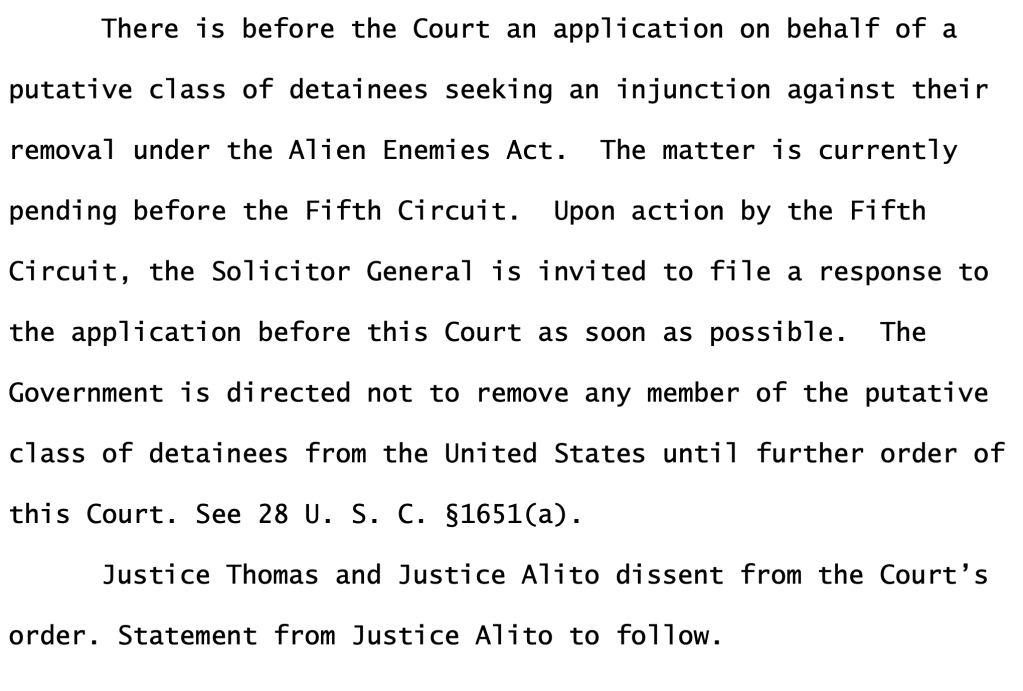
As I write, it’s about twelve hours after the Supreme Court issued its 1 AM order—the one that said, “The Government is directed not to remove any member of the putative class of detainees from the United States until further order of this Court.”

As of this hour, not a peep have we heard from His Most High Excellency, nor from our legally blonde Attorney General, nor, for that matter, from the American Civil Liberties Union.

And Isn’t This Just Too Special for Words?

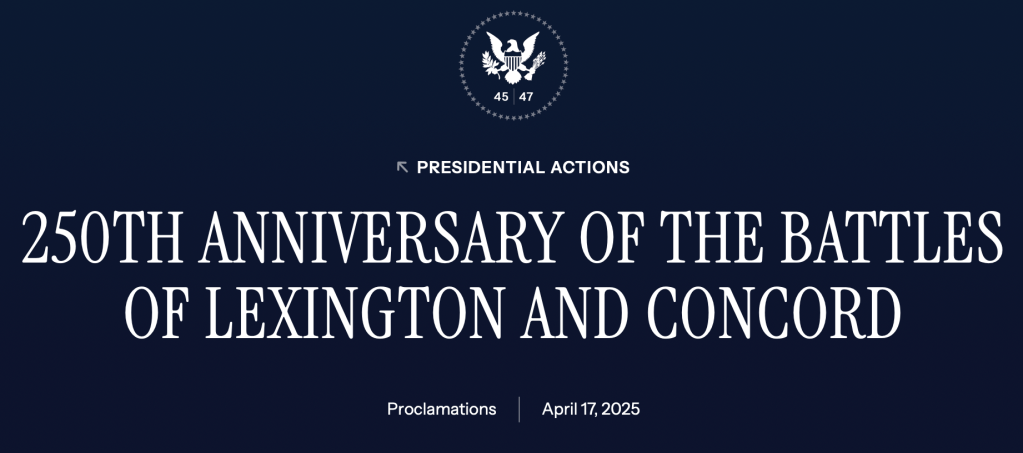
His Most High Excellency has solemnly proclaimed today as a day of commemoration of the Battles of Lexington and Concord.

Order by the Fourth Circuit Court of Appeals in Abrego García v. Noem

O R D E R

WILKINSON, Circuit Judge, with whom KING and THACKER, Circuit Judges, join:

Upon review of the government’s motion, the court denies the motion for an emergency stay pending appeal and for a writ of mandamus. The relief the government is requesting is both extraordinary and premature. While we fully respect the Executive’s robust assertion of its Article II powers, we shall not micromanage the efforts of a fine district judge attempting to implement the Supreme Court’s recentdecision.

It is difficult in some cases to get to the very heart of the matter. But in this case, it is not hard at all.The government is asserting a right to stash away residents of this country in foreign prisons without the semblance of due process that is the foundation of our constitutional order. Further, it claims in essence that because it has rid itself of custody that there is nothing that can be done.

This should be shocking not only to judges, but to the intuitive sense of liberty that Americans far removed from courthouses still hold dear.

The government asserts that Abrego Garcia is a terrorist and a member of MS-13. Perhaps, butperhaps not. Regardless, he is still entitled to due process. If the government is confident of its position, itshould be assured that position will prevail in proceedings to terminate the withholding of removalorder.See8 C.F.R. § 208.24(f) (requiring that the government prove “by a preponderance of evidence” that the alien is no longer entitled to a withholding of removal). Moreover, the government has conceded thatAbrego Garcia was wrongly or “mistakenly” deported. Why then should it not make what was wrong,right?

The Supreme Court’s decision remains, as always, our guidepost. That decision rightly requires the lower federal courts to give “due regard for the deference owed to the Executive Branch in the conduct offoreign affairs.”Noem v. Abrego Garcia, No. 24A949, slip op. at 2 (U.S. Apr. 10, 2025);see also UnitedStates v. Curtiss-Wright Exp. Corp., 299

U.S. 304, 319 (1936). That would allow sensitive diplomatic negotiations to be removed from public view.It would recognize as well that the “facilitation” of Abrego Garcia’s

return leaves the Executive Branch with options in the execution to which the courts in accordance with the Supreme Court’s decision should extend a genuine deference. That decision struck a balance that does not permit lower courts to leave Article II by the wayside.

The Supreme Court’s decision does not, however, allow the government to do essentiallynothing. It requires the government “to ‘facilitate’ Abrego Garcia’s release from custody in El Salvador and to ensure that his case is handled as it would have been had he not been improperly sent to El Salvador.” Abrego Garcia, supra, slip op. at 2. “Facilitate” is an active verb. It requires that steps be taken as theSupreme Court has made perfectly clear. See Abrego Garcia,supra, slip op. at 2 (“[T]he Government shouldbe prepared to share what it can concerning the steps it has taken and the prospect of further steps.”). Theplain and active meaning of the word cannot be diluted by its constriction, as the government would have it,to a narrow term of art. We are not bound in this context by a definition crafted by an administrative agencyand contained in a mere policy directive. Cf. Loper Bright Enters. v. Raimondo, 603 U.S. 369, 400 (2024);Christensen v. Harris Cnty., 529 U.S. 576, 587 (2000). Thus, the government’s argument that all itmust do is “remove  any domestic barriers to [Abrego Garcia’s] return,” Mot. for Stay at 2, is not well taken in light of the Supreme Court’s command that the government facilitate Abrego Garcia’s release from custody in El Salvador.

“Facilitation” does not permit the admittedly erroneous deportation of an individual to the one country’s prisons that the withholding order forbids and, further, to do so in disregard of a court order thatthe government not so subtly spurns. “Facilitation” does not

sanction the abrogation of habeas corpus through the transfer of custody to foreign detention centers inthe manner attempted here. Allowing all this would “facilitate” foreign detention more than it would domestic return. It would reduce the rule of law to lawlessness and tarnish the very values for which Americans of diverse views and persuasions have always stood.

The government is obviously frustrated and displeased with the rulings of the court. Let one thing beclear. Court rulings are not above criticism. Criticism keeps us on our toes and helps us do a better job. See Cooper v. Aaron, 358 U.S. 1, 24 (1958) (Frankfurter, J., concurring) (“Criticism need not be stilled. Active obstruction or defiance is barred.”). Court rulings can overstep, and they can further intrude upon the prerogatives of other branches. Courts thus speak with the knowledge of their imperfections but also with a sense that they instill a fidelity to law that would be sorely missed in their absence.

“Energy in the [E]xecutive” is much to be respected. FEDERALIST NO. 70, at 423 (1789) (Alexander Hamilton) (Clinton Rossiter ed., 1961). It can rescue government from its lassitude and recalibrate imbalances too long left unexamined. The knowledge that executive energy is a perishable qualityunderstandably breeds impatience with the courts. Courts, in turn, are frequently attuned to caution and are often uneasy with the Executive Branch’s breakneck pace.

And the differences do not end there. The Executive is inherently focused upon ends; the Judiciary much more so upon means. Ends are bestowed on the Executive by electoral outcomes. Means are entrusted to all of government, but most especially to the Judiciary by the Constitution itself.

The Executive possesses enormous powers to prosecute and to deport, but with powers come restraints. If today the Executive claims the right to deport without due process and in disregard of courtorders, what assurance will there be tomorrow that it will not deport American citizens and then disclaim responsibility to bring them home?∗ And what assurance shall there be that the Executive will not train its broad discretionary powers upon its political enemies? The threat, even if not the actuality, would always bepresent, and the Executive’s obligation to “take Care that the Laws be faithfully executed” would lose itsmeaning. U.S. CONST. art. II, § 3;see also id.art. II, § 1, cl. 8.

Today, both the United States and the El Salvadoran governments disclaim any authority and/or responsibility to return Abrego Garcia. See President Trump Participates in a Bilateral Meeting with thePresident of El Salvador, WHITE HOUSE (Apr. 14, 2025). We are told that neither government has the powerto act. The result will be to leave matters generally and Abrego Garcia specifically in an interminable limbowithout recourse to law of any sort.

The basic differences between the branches mandate a serious effort at mutual respect. The respect that courts must accord the Executive must be reciprocated by the Executive’s respect for the courts. Too often today this has not been the case, as calls for impeachment of judges for decisions the Executivedisfavors and exhortations to disregard court orders sadly illustrate.

∗ See, e.g., Michelle Stoddart,‘Homegrowns are Next’: Trump Doubles Down on Sending American ‘Criminals’ to Foreign Prisons, ABC NEWS (Apr. 14, 2025, 6:04 PM); David Rutz, Trump Open to SendingViolent American Criminals to El Salvador Prisons, FOX NEWS (Apr. 15, 2025, 11:01 AM EDT).

It is in this atmosphere that we are reminded of President Eisenhower’s sage  example. Puttinghis “personal opinions” aside, President Eisenhower honored his “inescapable” duty to enforce theSupreme Court’s decision in Brown v. Board of Education IIto desegregate schools “with all deliberatespeed.” Address by the President of the United States, Delivered from his Office at the White House 1-2(Sept. 24, 1957); 349 U.S. 294, 301 (1955). This great man expressed his unflagging belief that “[t]he verybasis of our individual rights and freedoms is the certainty that the President and the Executive Branchof Government will support and [e]nsure the carrying out of the decisions of the Federal Courts.”Id.at 3.Indeed, in our late Executive’s own words, “[u]nless the President did so, anarchy would result.” Id.

Now the branches come too close to grinding irrevocably against one another in a conflict that promises to diminish both. This is a losing proposition all around. The Judiciary will lose much from theconstant intimations of its illegitimacy, to which by dent of custom and detachment we can only sparinglyreply. The Executive will lose much from a public perception of its lawlessness and all of its attendant contagions. The Executive may succeed for a time in weakening the courts, but over time history will scriptthe tragic gap between what was and all that might have been, and law in time will sign its epitaph.

It is, as we have noted, all too possible to see in this case an incipient crisis, but it may present an opportunity as well. We yet cling to the hope that it is not naïve to believe our good brethren in the ExecutiveBranch perceive the rule of law as vital to the American ethos. This case presents their unique chance tovindicate that value and to summon the

best that is within us while there is still time.

In sum, and for the reasons foregoing, we deny the motion for the stay pending appeal and the writof mandamus in this case. It is so ordered.
If a Critical Mass of Americans Wake Up, Then the Supreme Court’s Stand Will be Indispensable to Justice

David French (N.Y. Times), The Supreme Court Can’t Save America, but Here’s What It Can Do

Mr. French writes,

Millions of Americans are desperate for a quick and effective response to Trump’s attacks on the Constitution. But the election foreclosed that possibility. The courts — even if they have the courage — lack the power to save America.

In this moment, think of the courts as a rear guard, capable of delaying constitutional collapse until the American people finally understand that the life and health of the Constitution is up to them. If they keep electing men like Trump or sycophants like those in his Congress of cowards, then we’ll lose our Republic.

But if a critical mass of Americans do wake up, then the court’s stand will be indispensable to justice and — critically — accountability. Every public official associated with Trump’s defiance of the courts (including his vice president, JD Vance) should be impeached, convicted and barred forever from holding public office.

I know that’s a fantastical vision in the present moment. In a closely divided country, impeachment and removal aren’t viable options, but supermajorities among Americans have existed before. The civil rights movement, empowered in part by the Supreme Court, attained a supermajority that changed America, and a movement to preserve the Constitution can be a supermajority again.

We can’t ask the Supreme Court to do more than it’s able to do, but it must do all that it can. The choices it will face may well be as stark as the choice between segregation and equality, or between internment and freedom.

The court’s past failures have destroyed lives and put our Republic in mortal danger. Its past courage has inspired revolutionary change. Unless Trump backs down, it will face the same choice the court faced in 1954 — yield in the face of enormous resistance or stand even when the politicians fail.

Let Us Now Praise King & Spalding

Not to Mention Quinn Emanuel 

Quinn Emanuel Urquhart & Sullivan is a top ranked business litigation law firm. King & Spalding is a top corporate and litigation firm; one good source ranks them as #24. Here is the letter that two of their partners signed on behalf of Harvard and sent to Team Trump:

April 14, 2025

VIA ELECTRONIC MAIL

Josh Gruenbaum

Commissioner of the Federal Acquisition Service General ServicesAdministration

Sean R. Keveney Acting General Counsel

U.S. Department of Health & Human Services

Thomas E. Wheeler Acting GeneralCounsel

U.S. Department of Education

Dear Messrs. Gruenbaum, Keveney, and Wheeler:

We represent Harvard University. We are writing in response to your letter dated April 11,  2025, addressed toDr. Alan Garber, Harvard’s President, and Penny Pritzker, Senior Fellow of the    Harvard Corporation.

Harvard is committed to fighting antisemitism and other forms of bigotry in its community. Antisemitism and discrimination of any kind not only are abhorrent and antithetical to Harvard’s values but also threaten its academicmission.

To that end, Harvard has made, and will continue to make, lasting and robust structural, policy, and programmatic changes to ensure that the university is a welcoming and supportive learning environment for allstudents and continues to abide in all respects with federal law across its academic programs and operations, whilefostering open inquiry in a pluralistic community free from intimidation and open to challenging orthodoxies,whatever their source.

Over the past 15 months, Harvard has undertaken substantial policy and programmatic measures. It hasmade changes to its campus use policies; adopted new accountability procedures; imposed meaningful discipline for those who violate university policies; enhanced programs designed to address bias and promote ideological diversity and civil discourse; hired staff to support these programs and support students; changed partnerships; dedicatedresources to combat hate and bias; and enhanced safety and security measures. As a result, Harvard is in a verydifferent place today from where it was a year ago. These efforts, and additional measures the university will be taking against antisemitism, not only are the right thing to do but also are critical to strengthening Harvard’scommunity as a place in which everyone can thrive.

It is unfortunate, then, that your letter disregards Harvard’s efforts and instead presents demands that, incontravention of the First Amendment, invade university freedoms long recognized by the Supreme Court. The government’s terms also circumvent Harvard’s statutory rights by requiring unsupported and disruptive remedies foralleged harms that the government has not proven through mandatory processes established by Congress and required by law. No less objectionable is the condition, first made explicit in the letter of March 31, 2025, that Harvard accede to these terms or risk the loss of billions of dollars in federal funding critical to vital research and innovation that has saved and improved lives and allowed Harvard to play a central role in making our country’sscientific, medical, and other research communities the standard-bearers for  the world. These demands extend notonly to Harvard but to separately incorporated and independently operated medical and research hospitals engaging in life-saving work on behalf of their patients. The university will not surrender its independence or relinquish its constitutional rights. Neither Harvard nor any other private university can allow itself to be taken over by the federal government. Accordingly, Harvard will not accept the government’s terms as an agreement in principle.

Harvard remains open to dialogue about what the university has done, and is planning to do, to improve the experience of every member of its community. But Harvard is not prepared to  agree to demands that go beyond thelawful authority of this or any administration.

William A. Burck                                                         Robert K. Hur

Quinn Emanuel Urquhart & Sullivan, LLP                King & Spalding LLP

1300 I Street NW                                                        1700 Pennsylvania Avenue NW

Suite 900                                                                     Suite 900

Washington, DC 20005                                              Washington, DC 20006