
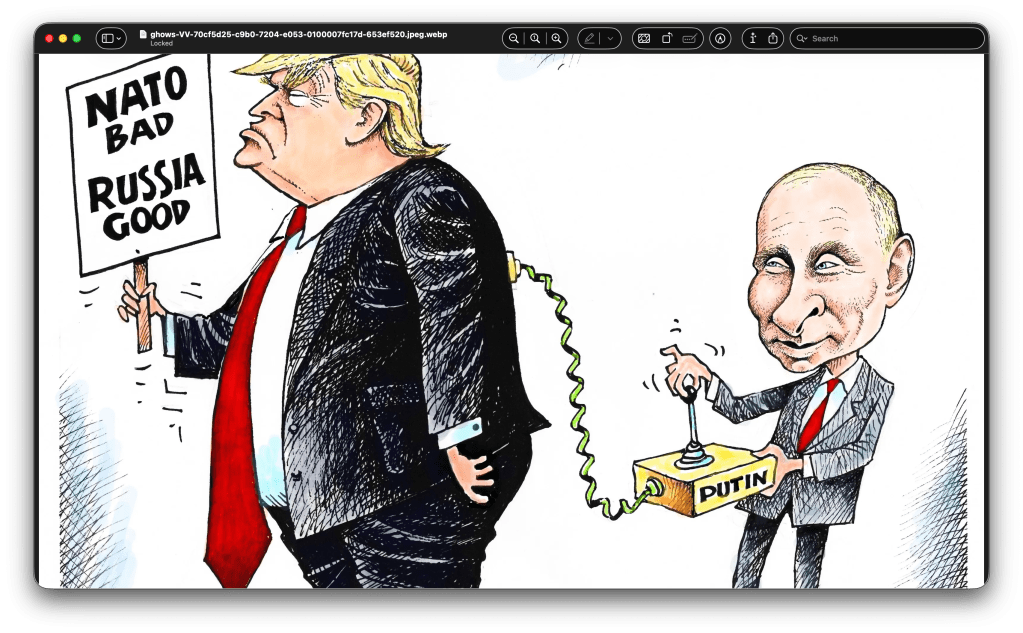
I wrote this post in order to reproduce an op-ed from the Wall Street Journal that argues—based, apparently, on European sources—that Putin may attack on of his Eastern European neighbors as a way to undermine NATO.
I think it’s an interesting question. I go further. There is, in my view, abundant evidence that Trump is a Putin tool. Consider, among many other things, the stories that the idiotic acting Director of National Intelligence is busy gutting the intelligence community.
Be all that as it may, Mr. Baker of the WSJ, writes,
Putin May See an Opportunity to Destroy NATO: Even a small incursion could doom the alliance if it lacks the political will to respond with force.
He is mired in a struggle against a country with a population and a military a fractionthe size of his own. Since the decision to launch that war has worked out so well, are we seriously being asked to believe that he would attack an alliance with an economy and military many times the size of his own?
A month ago I would have scoffed at the idea. But conversations with multiple senior European political, military and intelligence figures in the past few weeks suggest to me the possibility is real and rising.
For some Americans, including perhaps the president, the idea that Russia may take a shot at some feckless Europeans who have been notably unhelpful with America’s military preoccupations in recent months might induce a yawn of indifference or even a smirk of schadenfreude. But the risks of any Russian provocation in Europe for America’s global security are profound. Ukraine, a non-NATO member, is one thing. If we failed to respond to Russian aggression against a member of the alliance, NATO would become a dead letter.
Which is why Mr. Putin might attack. As one intelligence analyst put it to me last week: His inspiration may be Marshal Ferdinand Foch, the general who commanded French forces at the Battle of the Marne in 1914. He famously reported: “My center is yielding. My right is retreating. Situation excellent. I am attacking.”
A sudden show of unexpected force just as he appears to be reeling from his ill-advised Ukraine war could be to Mr. Putin’s advantage. Although Mr. Trump’s verbal shock treatment has jolted European NATO members into finally doing more in their own defense, they are still nowhere near ready for a defensive war. Government officials say it will be at least five years before their militaries are close to being capable of replacing U.S. capabilities in Europe.
Mr. Trump has 2½ years left in office. There is no guarantee his successor will have as skeptical an approach to NATO. If Mr. Putin chose the right targets, European leaders suspect Mr. Trump’s administration wouldn’t come to a NATO country’s aid, fatally undermining the credibility of the alliance’s collective-defense commitment—and with it, NATO’s existence—a dream outcome for Mr. Putin.
His political needs might also be suited by an attack on NATO. A former British defense official said to me last week, “After four years of failure and rising popular discontent at home, he desperately needs a military victory.” What better way to lift morale than to plant the Russian flag in some NATO field?
All this suggests we are now in a narrow window of opportunity for Russia to make a move. If Mr. Trump goes ahead with plans to cut European deployments, that window gets wider.
Sure enough, intelligence reports point to rising risks of Russian action. Last week a Polish news report said U.S. officials had warned Warsaw that Russia may attack the country. In an interview last month, a senior military figure from a NATO nation identified multiple risks, including a Russian seizure of islands in the Baltic and an incursion to “assist” the Russian minority in Estonia. None of these would amount to a full-scale invasion, but each would be enough of a provocation that if NATO failed to respond, its credibility would be in tatters.
Is Europe really worth defending with U.S. blood and treasure? Is NATO still an essential strategic interest? I’ve long sympathized with the argument that a large U.S. commitment to the European theater is an anachronism in our security posture, a throwback to 20th-century geopolitics. China is obviously the biggest threat to U.S. security and leadership; managing that relationship requires a shift of strategic resources and attention toward the Pacific. The Europeans can and should take care of their own freedom and security.
But whether we want it or not, we are in a cold-to-simmering war with an axis of resistance that runs from Beijing through Tehran to Moscow. The U.S. is still dealing with the fallout of an inconclusive war with Iran that has left us militarily depleted. As we scramble to manage potential opportunistic moves by China’s Xi Jinping in the Asia-Pacific, Mr. Putin could deal a timely and fatal blow to an already weakened trans-Atlantic alliance. That would be another hammer to the head of Western security and hegemony, and a dramatic enhancement of the power of Russia’s alliance with China and our other adversaries.
Perhaps all the talk of an imminent Russian attack is merely disinformation from European officials, trying to keep President Trump from further weakening NATO. But if you were the American president, would you want to take that risk?

